


Commercial LED Lighting Solutions
- 15+ years experience delivering 50-75% energy savings nationwide
- 5-year warranty with USA-based technical support and service
- Free lighting plans ensure optimal foot-candles in commericial installation


-
 Professional Layout Designed for Your Commercial Space's Traffic Patterns & Tasks
-
Precise Lumen Output Calculations & Control Zoning for Code Compliance
-
Maximize ROI Through Optimized Energy Savings & Reduced Operating Costs


This category features commercial LED lighting fixtures suited for offices, warehouses, and outdoor areas. Products include panel lights for drop ceilings, linear fixtures for open office layouts, UFO and linear high bays for warehouse aisles and racking systems, as well as pole-mounted and wall-mounted lights for parking lots, building exteriors, and service bays. These fixtures are commonly installed above workstations, over open warehouse floors, along corridors, and around exterior perimeters.
Commercial & Industrial Lighting Solutions are offered here for environments such as office suites, distribution centers, retail shops, workshops, and sports courts. The selection covers both indoor and outdoor layouts, supporting lighting infrastructure in spaces ranging from administrative offices to large-scale storage and exterior site areas.
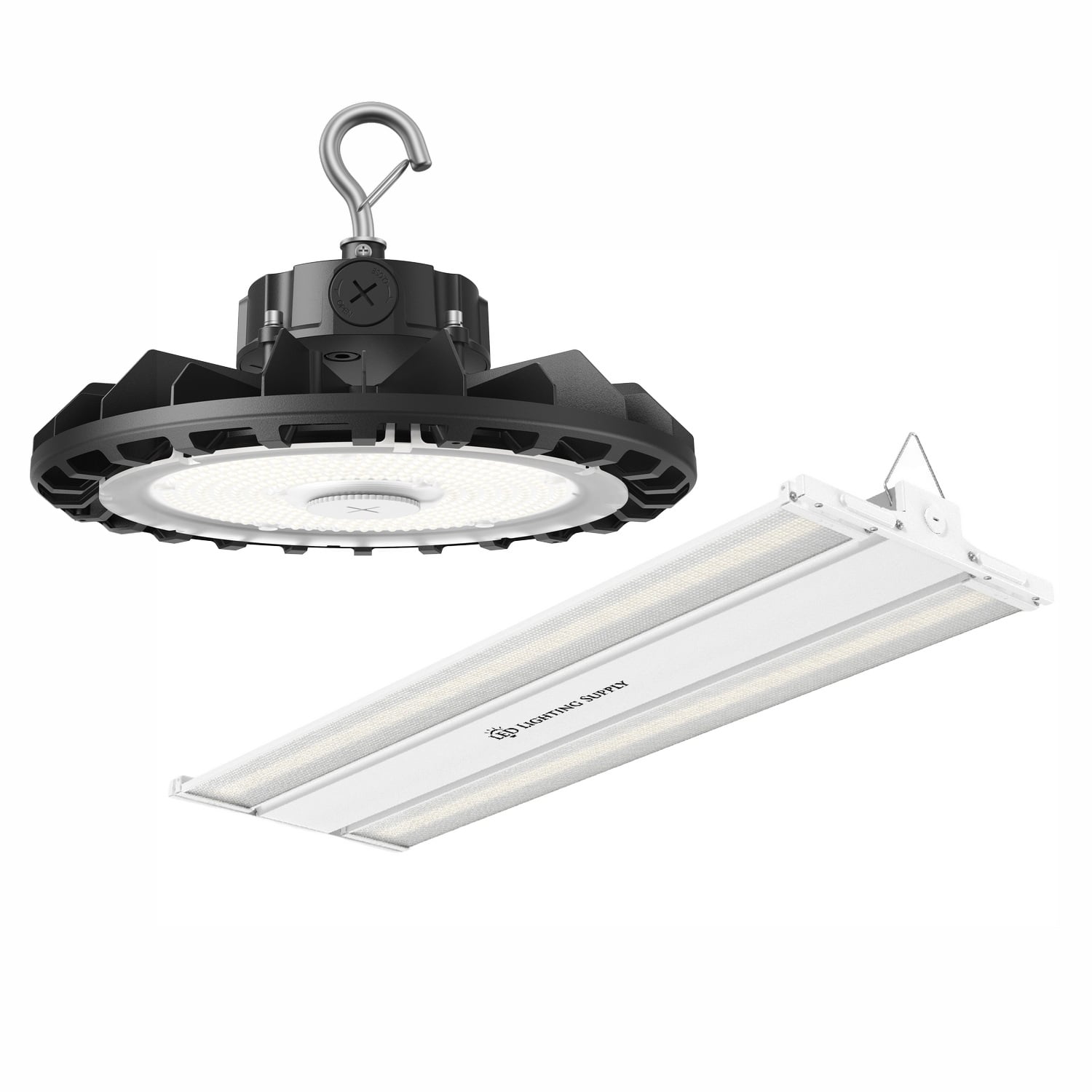
LED High Bay Lights


Low Bay LED Lights

Commercial LED Shop Lights

LED Flat Panel Lights and Troffer Lights

Commercial Ceiling Lighting

LED Flush Mount Ceiling Lights

LED Stairwell Lights

LED Exit Signs and Emergency Lighting

LED Airport Lighting

LED Auditorium Lighting

LED Brewery Lighting

LED Car Dealership Lighting

LED Car Wash Lighting

LED Commercial Kitchen Lighting

Convenience Store Lighting

LED Convention Center Lighting

LED Data Center Lighting

LED Distillery Lighting
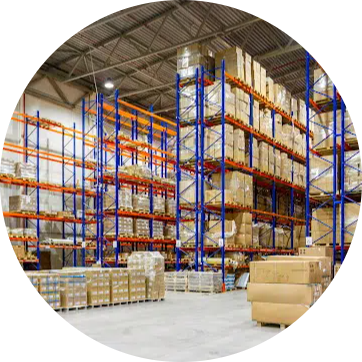
LED Distribution Center Lighting
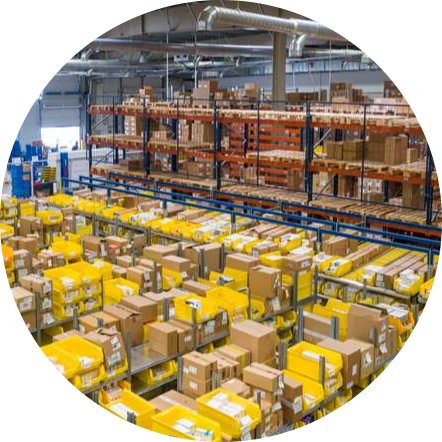
LED Fulfillment Center Lighting

LED Gas Station Lighting

LED Horse Barn and Stable Lighting

LED Hospital Lighting

LED Lights for Laboratories and Research Facilities

LED Office Lighting

LED Parking Garage Lighting

LED Parking Lot Lights

LED Commercial Perimeter Security Lighting

Pharmaceutical Lighting and Cleanroom Lighting

LED Pole Barn Lighting

LED Quonset Hut Lighting

LED School Lighting

LED Lights for Shipping Containers

LED Shopping Mall Lighting

LED Storage Facility Lighting

LED Lights for Grocery Stores and Supermarkets

LED Walk-In Cooler Lighting

LED Warehouse Lighting
LED High Bay Lights
Low Bay LED Lights
Commercial LED Shop Lights
LED Flat Panel Lights and Troffer Lights
Commercial Ceiling Lighting
LED Flush Mount Ceiling Lights
LED Stairwell Lights
LED Exit Signs and Emergency Lighting
LED Airport Lighting
LED Auditorium Lighting
LED Brewery Lighting
LED Car Dealership Lighting
LED Car Wash Lighting
LED Commercial Kitchen Lighting
Convenience Store Lighting
LED Convention Center Lighting
LED Data Center Lighting
LED Distillery Lighting
LED Distribution Center Lighting
LED Fulfillment Center Lighting
LED Gas Station Lighting
LED Horse Barn and Stable Lighting
LED Hospital Lighting
LED Lights for Laboratories and Research Facilities
LED Office Lighting
LED Parking Garage Lighting
LED Parking Lot Lights
LED Commercial Perimeter Security Lighting
Pharmaceutical Lighting and Cleanroom Lighting
LED Pole Barn Lighting
LED Quonset Hut Lighting
LED School Lighting
LED Lights for Shipping Containers
LED Shopping Mall Lighting
LED Storage Facility Lighting
LED Lights for Grocery Stores and Supermarkets
LED Walk-In Cooler Lighting
LED Warehouse Lighting
Commercial LED Lighting for Business, Facility, and Property Applications
Commercial LED lighting is used to illuminate offices, warehouses, schools, workshops, retail spaces, parking areas, gyms, service bays, pole barns, security areas, and other business environments. The right fixture depends on how the space is used, where the fixture is mounted, how much light is needed, what electrical system is available, and whether the project is indoors, outdoors, or both.
Commercial fixtures are different from most residential lighting because they are designed for higher output, longer operating hours, larger spaces, and more demanding installation conditions. Depending on model, commercial LED fixtures may include selectable wattage, selectable color temperature, dimming, motion sensors, photocells, emergency backup options, wet-location ratings, impact ratings, and higher-voltage driver options.
A good commercial lighting selection starts with the application. An office usually needs a different fixture than a warehouse, parking lot, gym, storefront, loading area, or security perimeter. Choosing by wattage alone can lead to poor results. Fixture type, lumen output, mounting height, beam spread, controls, voltage, environment, and certifications all matter.
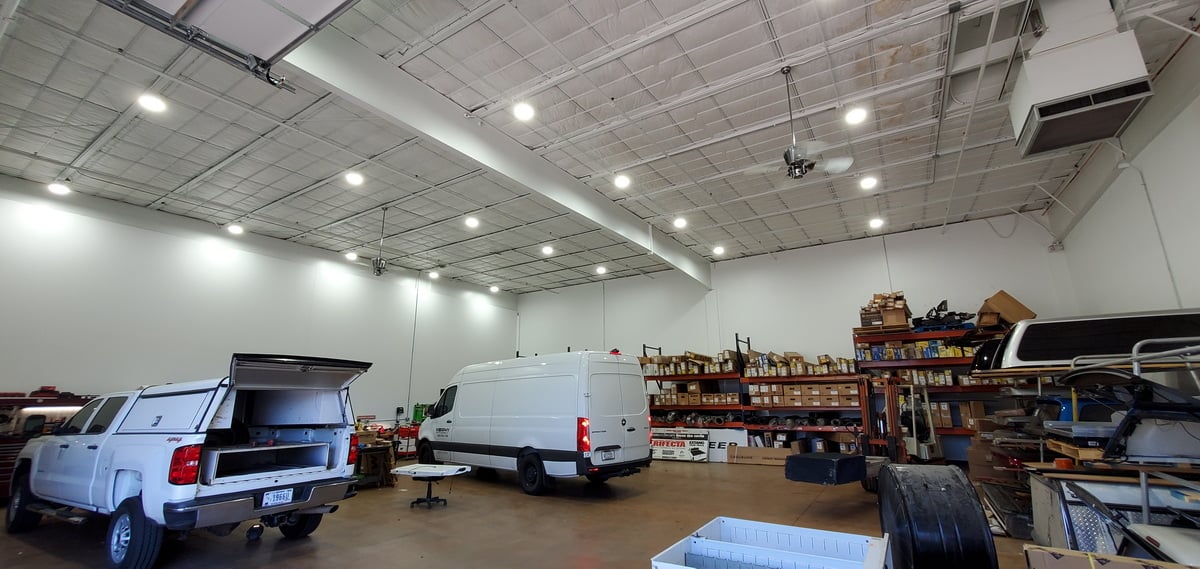
Case Study: Installation of new LED Lighting for a Yamaha Dealership
|
After: 120 Watt High Output UFO High Bay | 18000 Lumens | 4000K |
 |
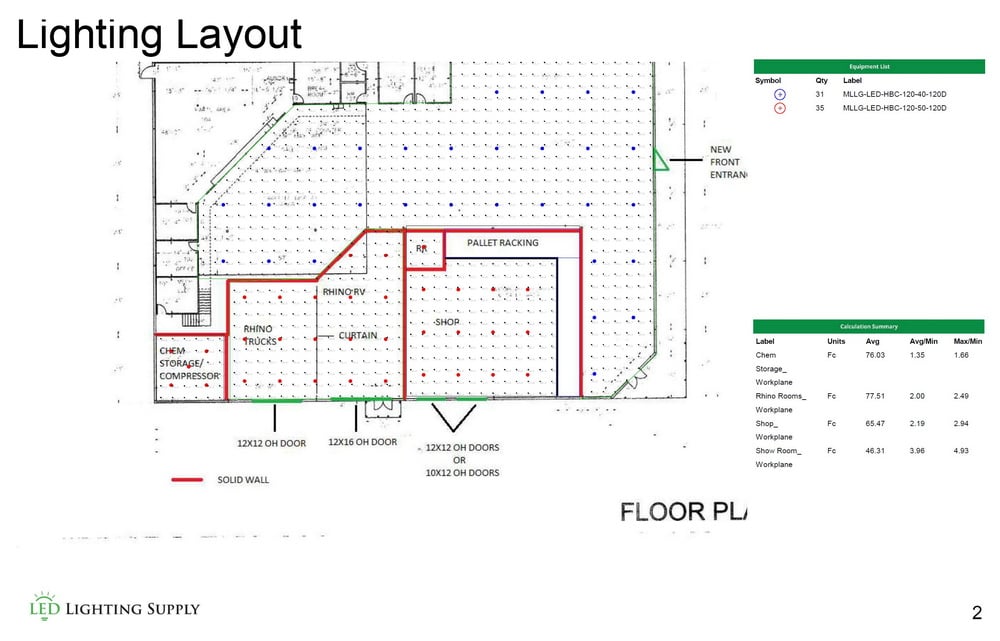
Lighting Plan We Created for the Customer
|
Lighting Plan |
Heat Map |
 |
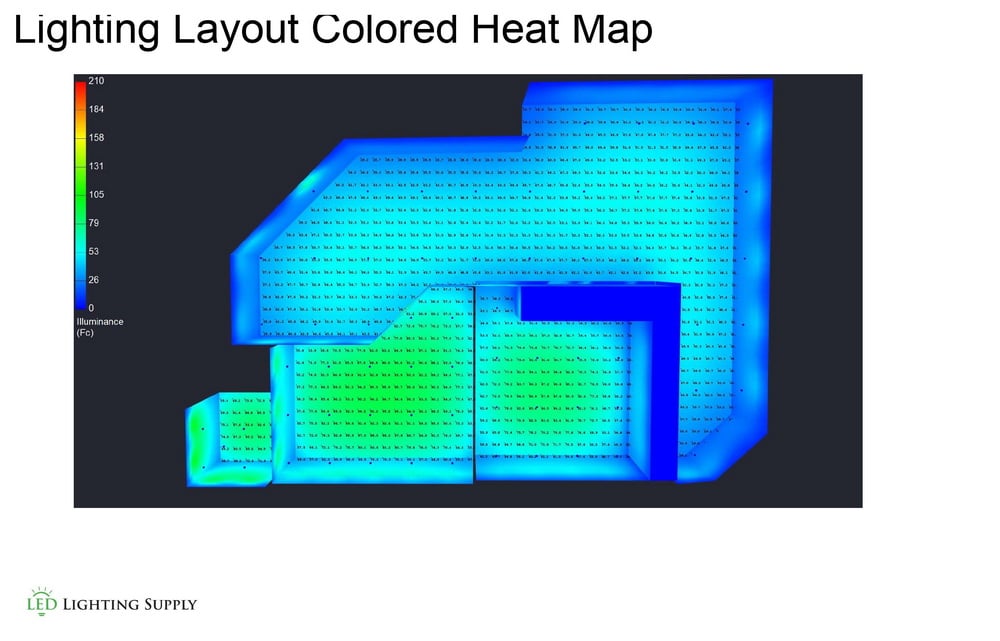 |
Yamaha Dealership Lighting Installation Plan Metrics
- Mounting height: 21 ft
- Fixture Used: MLLG-LED-HBC-200-4-120: 100 / 120 / 150 / 200 Watt Adjustable LED UFO High Bay | 15000 to 30000 Lumens
- FC achieved: 65.47 FC average
- Uniformity (Avg/Min): 2.00
Selection and Installation Note: Product specifications, wattage, lumen output, selectable settings, color temperature, voltage, mounting hardware, controls, dimming, certifications, environmental ratings, and warranty coverage vary by model. Confirm the selected product specification before ordering. For commercial buildings, electrical upgrades, emergency lighting, exterior lighting, code-sensitive applications, or safety-critical spaces, verify requirements with your local inspector or a licensed electrical professional.
Start with the Type of Commercial Space
Commercial lighting is easier to choose when the space is grouped by use. Indoor work areas, high-ceiling spaces, outdoor site lighting, customer-facing areas, and specialty-rated environments all have different fixture needs.
| Commercial Area | Common Fixture Choices |
|---|---|
| Offices, classrooms, and healthcare spaces | LED panels, troffers, linear fixtures, and selectable-CCT fixtures for clean, even general lighting in drop ceilings and finished interiors. |
| Warehouses and distribution centers | UFO high bays, linear high bays, and high-output fixtures for taller ceilings, open floor areas, aisles, and storage zones. |
| Workshops, service bays, and utility spaces | Shop lights, high bays, task lighting, and brighter CCT options for detailed work, repairs, tools, and equipment areas. |
| Retail, showroom, and customer-facing areas | Panels, downlights, track lighting, linear fixtures, and display lighting depending on layout, ceiling type, glare control, and appearance goals. |
| Gyms and recreation spaces | High bays, linear fixtures, guarded fixtures, or impact-resistant options depending on activity, ceiling height, and ball-strike exposure. |
| Parking lots and exterior pole lighting | LED parking lot lights, area lights, cobra head fixtures, and flood lights for drive aisles, parking rows, exterior circulation, and site visibility. |
| Building exteriors, entrances, and loading areas | Wall packs, canopy lights, flood lights, and security lights for doors, loading docks, walkways, façades, and perimeter walls. |
| Security and perimeter lighting | Wall packs, flood lights, area lights, motion-sensor fixtures, and camera-supportive lighting for access points, yards, gates, and fence lines. |
| Pole barns and outbuildings | Linear high bays, UFO high bays, shop lights, or suspended fixtures depending on ceiling structure, mounting height, dust, and work activity. |
| Damp, wet, or utility areas | Vapor tight fixtures, wet-location fixtures, and properly rated linear fixtures for parking garages, covered walkways, coolers, utility rooms, and damp areas. |
| Specialty commercial environments | NSF-rated, hazardous-location, high-temperature, corrosion-resistant, emergency, or harsh-environment fixtures where the application requires model-specific ratings. |
Indoor Commercial LED Lighting
Indoor commercial lighting should match the activity performed in the space. Offices, schools, workshops, warehouses, gyms, and retail areas all require different fixture styles and brightness levels. The best fixture is usually determined by ceiling height, room size, mounting method, visual comfort, work type, and controls.
- High bay lights are used in warehouses, gyms, manufacturing spaces, shops, pole barns, and other high-ceiling areas.
- Panel lights are commonly used in offices, schools, healthcare spaces, conference rooms, corridors, and drop ceilings.
- Shop lights are used in workshops, service areas, garages, utility spaces, and work bays.
- Linear fixtures can be useful where long rows, aisles, or continuous light distribution are preferred.
- Vapor tight fixtures may be used in damp, wet, covered, dusty, or utility areas when the selected model is rated for the environment.
For indoor spaces, confirm mounting height, fixture spacing, voltage, dimming, color temperature, glare, and whether the fixture will be exposed to dust, moisture, vibration, or impact. Standard indoor fixtures should not be used in wet, washdown, hazardous-location, high-temperature, or harsh-environment areas unless the selected model is rated for that use.

Outdoor Commercial LED Lighting
Outdoor commercial lighting supports visibility, access, security, parking, building perimeter lighting, and pedestrian movement. Outdoor fixtures should be selected by application, mounting height, beam distribution, voltage, controls, environmental rating, and the surrounding property.
- Parking lot lights are used for parking areas, drive aisles, and larger exterior lots.
- Wall packs are used on building exteriors, entrances, loading areas, and perimeter walls.
- Flood lights are used where directional light is needed for signs, yards, equipment areas, or security coverage.
- Perimeter security lights are used for building perimeters, access points, camera-supportive areas, and motion-activated lighting.
- Canopy lights may be used under covered entries, gas station canopies, drive-throughs, loading covers, or covered exterior work areas.
- Cobra head and roadway-style fixtures may be used for private roads, drive aisles, site roads, or areas where a street-light style fixture is preferred.
Outdoor projects should confirm wet-location suitability, IP rating, surge protection, controls, fixture aiming, glare, and neighboring properties. Photocells and motion sensors may be useful depending on operating schedule, safety needs, and whether the area requires dusk-to-dawn lighting or occupancy-based control.

How to Choose Commercial LED Lighting
The best commercial lighting choice depends on the space, not just the replacement wattage. Many projects replace fluorescent, metal halide, high-pressure sodium, or older LED fixtures, but a one-for-one replacement is not always the best approach if the existing lighting was too dim, too harsh, poorly spaced, or expensive to maintain.
| Selection Factor | What to Confirm |
|---|---|
| Application | Confirm whether the fixture is for office work, storage, production, retail, parking, security, recreation, or task lighting. |
| Fixture type | Select the fixture family that fits the space, such as panels, high bays, shop lights, wall packs, flood lights, parking lot lights, vapor tight fixtures, or specialty-rated fixtures. |
| Mounting height | Ceiling height or pole height affects lumen output, beam angle, fixture spacing, glare, and coverage. |
| Lumen output | Compare actual lumen output and fixture distribution instead of relying only on wattage equivalency. |
| Color temperature | 3000K, 4000K, and 5000K options may be available depending on model. Choose based on comfort, visibility, and space use. |
| Controls | Review dimming, occupancy sensors, motion sensors, photocells, timers, emergency backup, and building control compatibility. |
| Voltage | Confirm whether the site requires 120V, 208V, 240V, 277V, 347V, 480V, or another electrical configuration. |
| Environment | Check whether the fixture needs to be rated for wet locations, dust, impact, washdown, high temperature, corrosive environments, or hazardous locations. |
| Certifications | Confirm UL, ETL, DLC, DLC Premium, NSF, emergency, or other required ratings on the selected product specification. |
Color Temperature and Adjustable Fixtures
Color temperature affects the appearance and comfort of a commercial space. Many commercial projects use 4000K for neutral white light in offices, schools, and general work areas. 5000K is often selected for warehouses, shops, parking areas, and task-focused spaces where a brighter, crisper appearance is preferred. 3000K may be used where a warmer appearance is desired.
Some fixtures include selectable color temperature or selectable wattage. These options can be useful when a facility wants flexibility after installation, but they should still be selected carefully. Adjustable fixtures are not a substitute for confirming mounting height, lumen output, beam distribution, voltage, controls, and environmental suitability.

Controls for Commercial LED Lighting
Controls can improve energy performance and make lighting easier to manage. The right controls depend on how the space is used and whether lights need to run continuously, by schedule, by daylight, or by occupancy.
- Occupancy sensors are useful in storage rooms, offices, restrooms, workshops, warehouses, and intermittently used areas.
- Motion sensors are common for security lighting, exterior fixtures, parking areas, and lower-traffic spaces.
- Photocells are commonly used for dusk-to-dawn exterior lighting.
- Dimming may be useful in offices, classrooms, gyms, retail spaces, and areas with changing lighting needs.
- Emergency backup may be needed in code-sensitive spaces depending on the application and local requirements.
Confirm control compatibility before ordering. Not every fixture supports every sensor, dimming method, emergency option, or building control system.
Commercial LED Lighting Project Examples
Commercial lighting projects vary by building type, ceiling height, fixture style, controls, and operating schedule. The examples below show how different fixture types can support different applications.
Case Study: Conversion of (72) T5 6 tube fixtures to LED Lighting Supply 200 Watt LED UFO Fixtures (one-for-one replacement) in Williston, ND
|
Before: T5 54W HO Fluorescent Fixtures |
After: 200 W LED UFO Fixtures |
 |
 |
Lighting Plan We Created for the Customer
|
Lighting Plan |
Heat Map |
 |
 |
LED High Bays Warehouse Installation Lighting Plan Metrics
- Mounting height: 20 ft
- Fixture Used: MLLG-LED-HBC-200-5-120: 100 / 120 / 150 / 200 Watt Adjustable LED UFO High Bay | 15000 to 30000 Lumens | 5000K | 100-277V | White Housing
- FC achieved: 60.33 FC average
- Uniformity (Avg/Min): 1.42
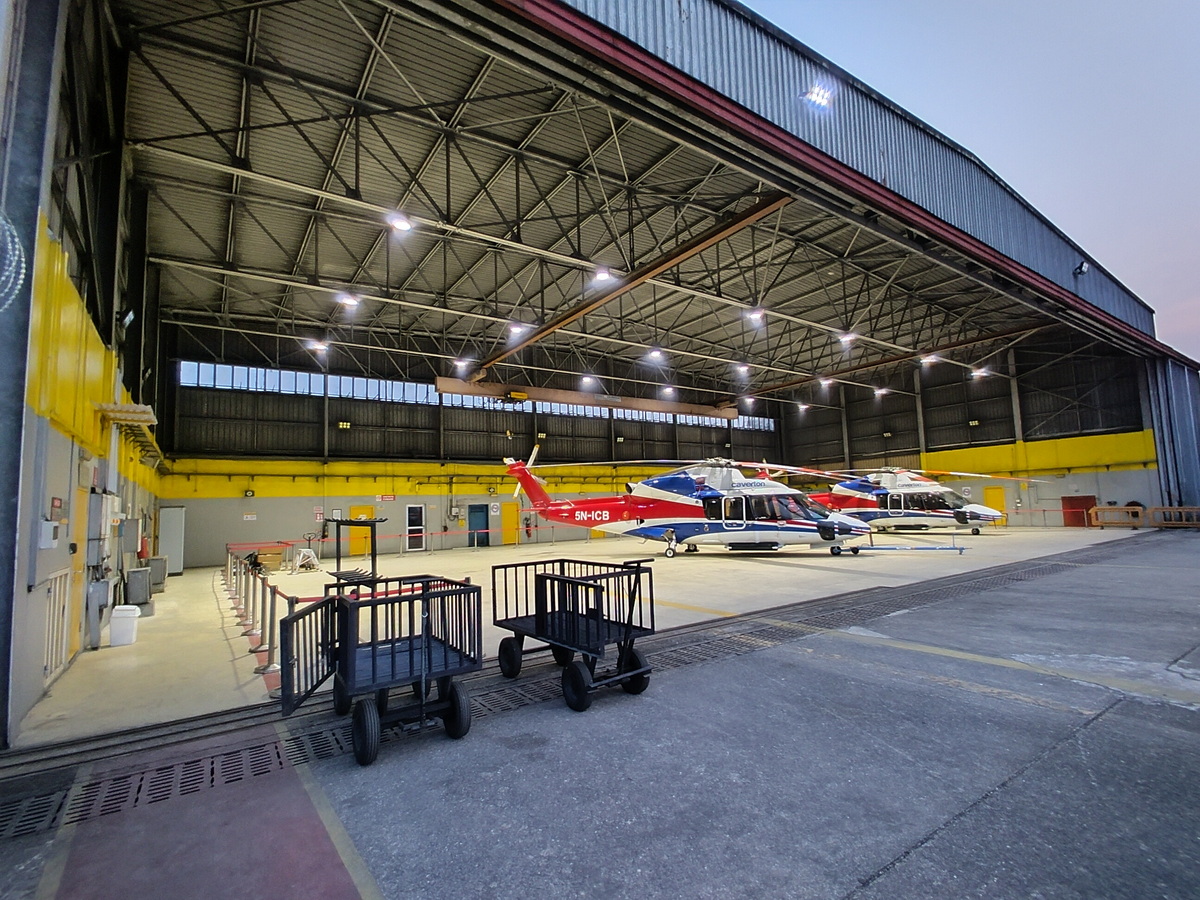
Case Study: Replacement of 1500 Watt Metal Halide Lighting with 480 Watt LED UFO High Bays in Lagos, Nigeria
| After: 480 Watt LED UFO High Bay Light | 76800 Lumens |
 |
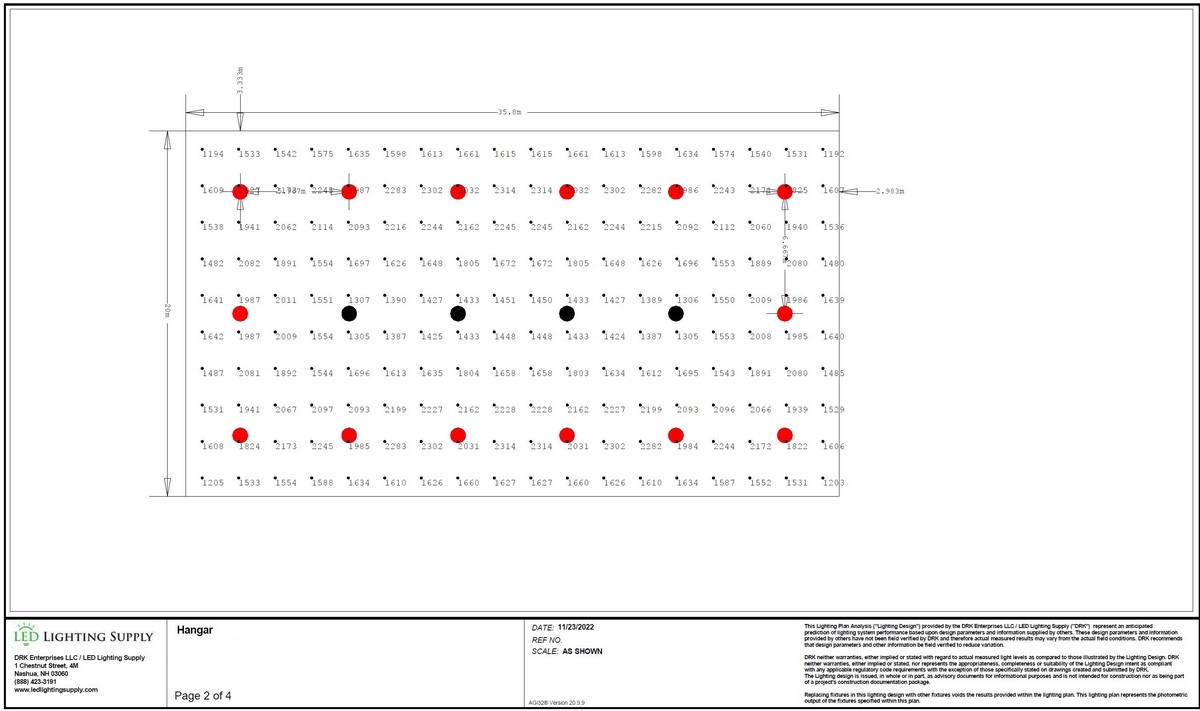
Lighting Plan We Created for the Customer
|
Lighting Plan |
Heat Map |
 |
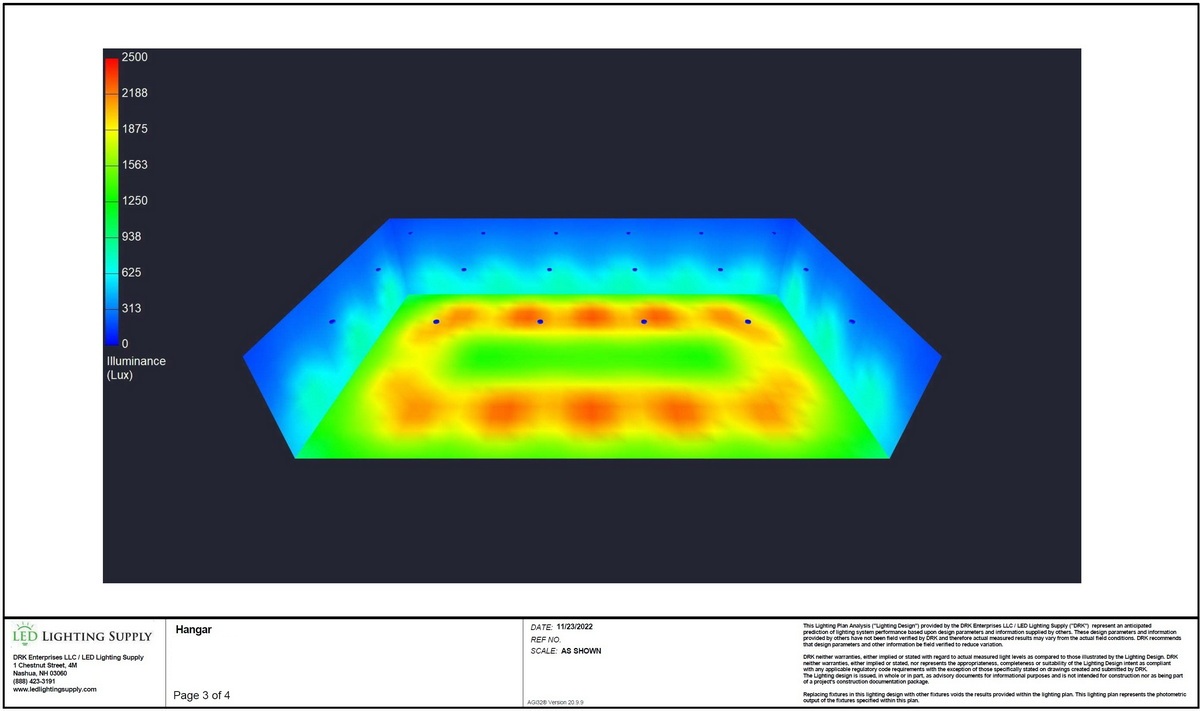 |
Aircraft Hangar Lighting Installation Plan Metrics
- Mounting height: 35 ft ft
- Fixtures Used: MLLG-LED-HB5-480-5-60: 480 Watt LED UFO High Bay | 76800 Lumens | 5000K | 100-277V
- FC achieved: 167 FC average
- Uniformity (Avg/Min): 1.51
LED Conversions Warehouse High Bay Lighting Upgrade Case Study
The Backstory:
LED Lighting Supply was approached by LED Conversions, the contractor for this warehouse project, to support with a warehouse lighting upgrade. The existing lights in the facility included antiquated 400-watt metal-halide fixtures, which prevented achieving proper warehouse lighting levels, negatively impacted working conditions, and increased operational costs.
The Customer's Challenge:
Operating with outdated metal halide fixtures in place created several challenges for the warehouse:
- High energy consumption, leading to increased utility costs
- Uneven light distribution, resulting in poor visibility across aisles and work areas
- Frequent maintenance and lamp replacements, increasing downtime and labor costs
- Inconsistent light quality, contributing to eye strain and reduced worker productivity
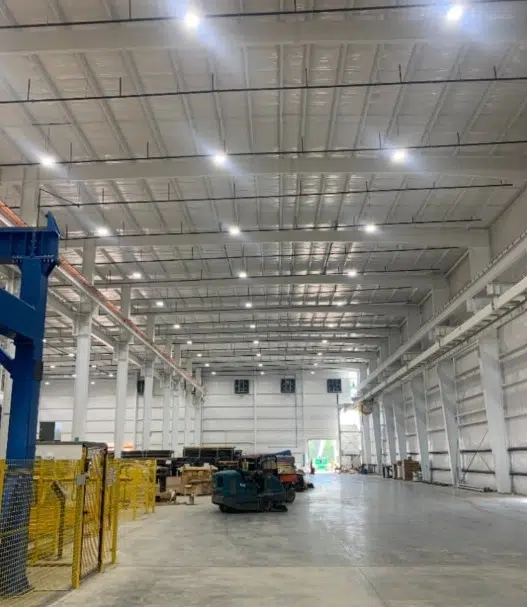
Lighting Plan We Created for the Customer
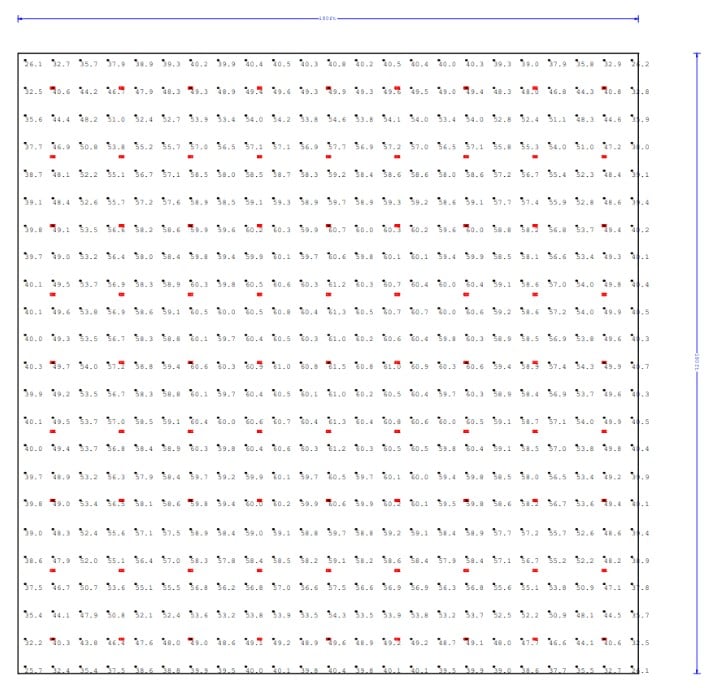
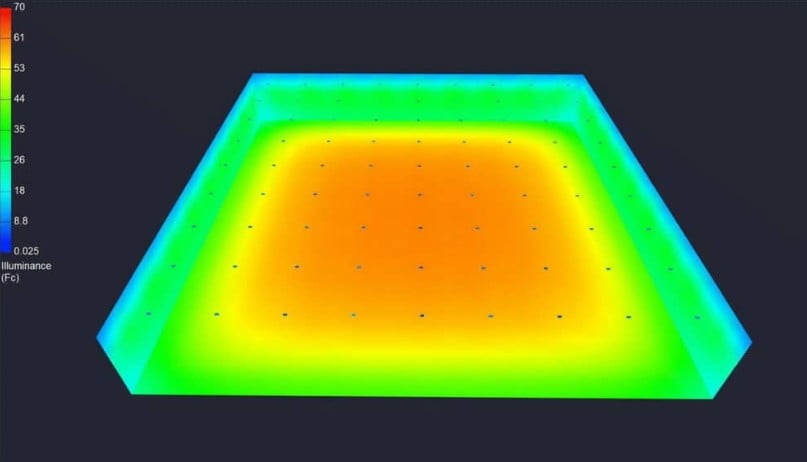
Lighting Plan Metrics:
- Foot Candles Achieved: 55 FC
- Product(s) Used: MLLG-LED-HBC-200-5-120
Tatsumi Intermodal U.S.A. Inc.’s Linear High Bay Warehouse Lighting Case Study
The Backstory
Tatsumi Intermodal U.S.A. Inc. faced challenges with consistent and effective lighting throughout its warehouse areas. They were operating with a legacy fluorescent lighting system that consumed excess energy while producing minimal brightness. Tatsumi approached LED Lighting Supply to provide a custom-tailored lighting solution that aligns with OSHA (Occupational Safety and Health Administration) requirements.
The Customer's Challenge
The facility consists of three separate warehouse spaces with 300 fluorescent fixtures. Each section required a lighting solution that would increase overall brightness levels to meet OSHA illumination standards while preserving the existing wiring system. The fluorescent lights were only producing about 20 foot candles (fc) across each warehouse floor section. Proper lighting levels for a warehouse environment typically fall between 40 and 60 fc, depending on the space dimensions.
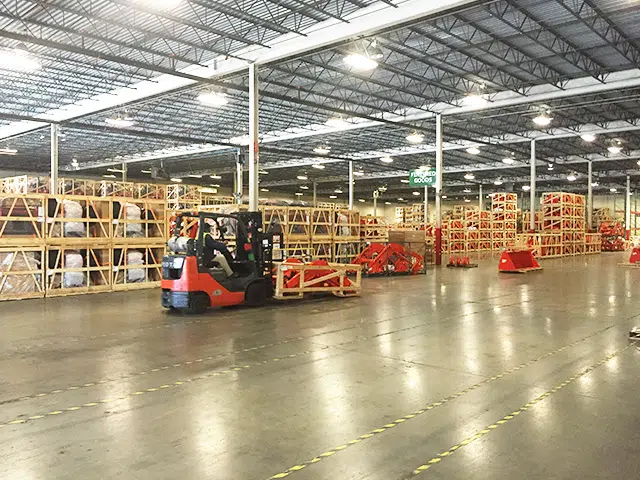
Lighting plan metrics:
- Product(s) Used: MLLG-X-LED-HBLIN6-(240/270/310)-CC-[V]


Commercial Lighting Certifications, Rebates, and Warranty Support
LED commercial lighting fixtures from LED Lighting Supply carry a safety listing such as UL, ETL, or CSA, depending on product. Many models are DLC or DLC Premium listed for utility rebate support where available. Rebate requirements vary by utility, region, and product listing, so confirm eligibility on the selected product specification before ordering.
Most commercial LED lighting fixtures include a 5-year warranty unless otherwise specified, with USA-based warranty support. Before purchase, review the selected product specification to confirm certifications, DLC status, voltage, controls compatibility, mounting method, environmental ratings, and whether the fixture is right for the project.
Common Commercial LED Lighting Mistakes
- Choosing by wattage alone: Wattage does not tell you fixture output, beam distribution, coverage, or visual comfort.
- Using the wrong fixture family: A high bay, panel, wall pack, flood light, parking lot light, vapor tight, or specialty-rated fixture is designed for a different application.
- Ignoring mounting height: Ceiling height and pole height affect lumen requirements, glare, spacing, and fixture selection.
- Mixing color temperatures: Inconsistent CCT can make a facility look uneven or uncomfortable.
- Forgetting controls: Sensors, photocells, dimming, and emergency options should be reviewed before ordering.
- Skipping voltage verification: Confirm site voltage and driver compatibility before selecting fixtures.
- Using indoor fixtures outdoors: Outdoor, wet, washdown, or harsh locations require properly rated fixtures.
- Assuming all certifications apply: UL, ETL, DLC, DLC Premium, NSF, IP, IK, and emergency ratings vary by model.
- Ignoring specialty environments: Food processing, hazardous locations, high-temperature areas, and corrosive spaces require application-specific fixtures.
Contact us about your commercial LED lighting project, and our Product Specialists can help review fixture type, mounting height, lumen output, voltage, controls, color temperature, certifications, environmental requirements, and product specifications.
Commercial LED Lighting Solutions Frequently Asked Questions
What Is LED Commercial Lighting?
LED commercial lighting offers energy-efficient solutions for business environments, potentially reducing lighting costs by 50% to 75% while enhancing light quality and minimizing maintenance. Many fixtures feature wattage and lumen adjustability, allowing performance fine-tuning post-installation. These fixtures adapt to various voltages, including 120V, 208V, 240V, 277V, or 347V, without manual configuration.
What Is Commercial Grade LED Lighting?
Commercial-grade LED lighting provides robust illumination suitable for business needs, offering more power than residential lighting but not as rugged as industrial options. These fixtures automatically adjust to your building's electrical system, accommodating standard or higher commercial voltages seamlessly.
What Are the Common Applications for Commercial Lighting?
Commercial lighting is versatile, with applications in offices, schools, warehouses, workshops, gyms, and outdoor areas. Each setting has specific requirements, such as 4000K color temperature for offices and 5000K for warehouses. Proper lighting enhances safety and productivity, with recommendations available from the Illuminating Engineering Society and OSHA.
What Are the Average Foot Candles for LED Fixtures Used in Commercial Applications?
Foot-candle levels vary by activity: 10-20 for storage, 30-50 for office work, and 50-100 for detailed tasks. Tailored lighting plans ensure optimal results, considering space, current lighting, and goals. Photometric analyses can help determine the right fixture and beam angles for your needs.
How Many Lumens Do I Need to Light up a Commercial Indoor Space?
Lumen needs depend on usage: 30 lumens per square foot for light use, 50 for medium use, and 70 for high-use activities. Many fixtures offer wattage and lumen adjustability, allowing you to fine-tune lighting post-installation for optimal energy savings and comfort.
Color Temperature Options and Recommendations
Choosing the right color temperature affects comfort and productivity. 5000K is ideal for detailed work, while 4000K suits office environments. Many fixtures offer selectable options, allowing you to test different temperatures before deciding.
Certifications and Safety Standards
Our commercial LED fixtures meet rigorous safety and performance standards, including UL Listed and ETL Listed certifications. Many also have DLC and DLC Premium certifications, ensuring high efficiency and rebate eligibility. These certifications confirm you are investing in reliable lighting solutions.
5-Year Warranty and Warranty Support
All our commercial LED lighting fixtures come with a 5-year warranty, supported by our USA-based team. We are committed to assisting with any warranty claims or technical issues throughout the lifespan of your lighting investment.