Industrial Wall Fans
- Wall-mounted design keeps floor space clear for operations
- Fixed and oscillating options available depending on model
- Application support for airflow, mounting, and fan selection



Our Industrial Wall Fans include fixed and oscillating wall-mounted models with fixed-speed, multi-speed, or variable-speed operation. Available configurations vary by fan diameter, airflow, motor and drive type, electrical connection, controls, and mounting brackets.
These fans are commonly used in warehouses, distribution facilities, manufacturing plants, assembly stations, production lines, workshops, garages, maintenance bays, loading areas, gyms, and service spaces where floor space must remain clear.
-
 Starting At $6,000.00

-
Starting At $6,333.33
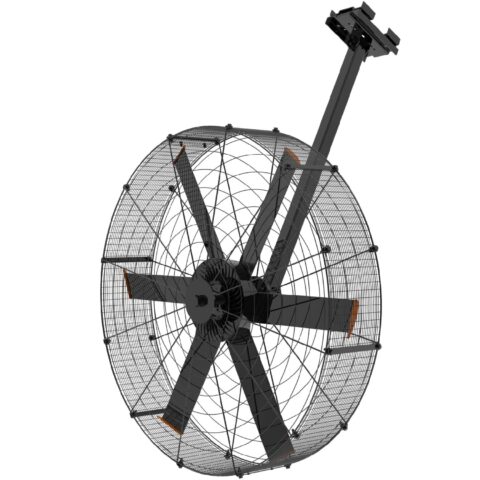


Industrial wall fans provide fixed, directional air movement in warehouses, manufacturing facilities, workshops, garages, loading areas, maintenance spaces, gyms, and other locations where floor space is limited or portable fans would interfere with operations. Mounted above the work area, they can direct airflow toward occupied zones, equipment areas, production lines, or sections of a building that receive limited circulation.
The correct wall-mounted fan depends on the required airflow, discharge distance, mounting height, fan diameter, operating speed, wall or structural support, electrical service, controls, environmental exposure, sound requirements, and the location of employees, machinery, storage, vehicles, and ventilation equipment.
Selection Note: Industrial wall fans move and mix indoor air. They do not independently lower the actual room temperature, provide outdoor-air ventilation, remove airborne contaminants, control humidity, or replace HVAC, exhaust, filtration, process cooling, dehumidification, or workplace heat-risk controls.
How to Select an Industrial Wall Fan
| Selection Factor | What to Confirm |
|---|---|
| Airflow objective | Determine whether the fan will provide general circulation, directed airflow toward a workstation, air movement along a production line, or supplemental circulation in a loading, storage, or service area. |
| Fan diameter and airflow | Compare model-specific fan diameter, airflow, speed range, discharge pattern, and published performance data rather than selecting by room square footage alone. |
| Air throw and coverage | Estimate how far useful airflow must travel and identify racks, machinery, partitions, walls, vehicles, stored materials, and other objects that may block or redirect it. |
| Mounting height and angle | Confirm the approved mounting range, available tilt or oscillation, and whether airflow can reach the intended occupied area without creating an excessive draft. |
| Occupied work zones | Identify employees who remain at assembly stations, packing tables, inspection areas, service counters, maintenance bays, or other fixed positions for extended periods. |
| Wall and structural support | Verify that the wall, column, beam, bracket location, and attachment method can support the selected fan and operating loads. |
| Fixed or oscillating operation | Determine whether airflow should remain directed toward one work zone or sweep across a larger area. Oscillation availability and range vary by model. |
| Speed control | Review fixed-speed, multi-speed, or variable-speed options based on the required airflow, sound, occupancy, and operating schedule. |
| Sound requirements | Use published model-specific sound information for workstations, offices, gyms, inspection areas, communication-sensitive zones, and other occupied spaces. |
| Electrical service | Confirm voltage, phase, current draw, plug or hardwired connection, circuit capacity, disconnect requirements, controller compatibility, and wiring method. |
| Dust and process conditions | Determine whether airflow could spread dust, smoke, fumes, vapors, aerosols, sparks, loose packaging, or process contaminants into occupied areas. |
| Environmental exposure | Identify moisture, washdown, corrosion, chemicals, outdoor exposure, high or low ambient temperatures, and hazardous-location requirements. |
| Clearances and access | Account for doors, lifts, racks, stored materials, vehicles, overhead equipment, pedestrian traffic, fan guards, and maintenance access. |
| Maintenance | Plan how blades, guards, motors, brackets, fasteners, controls, wiring, and oscillating components will be inspected and cleaned. |
| Product documentation | Verify airflow, electrical specifications, controls, approved mounting method, environmental rating, duty rating, maintenance schedule, safety listing, and warranty. |
Industrial Wall Fans Compared With Other Fan Types
| Fan Type | Typical Use |
|---|---|
| Industrial Wall Fans | Fixed directional airflow toward workstations, production lines, loading areas, service bays, gyms, workshops, and locations where floor space must remain clear. |
| Drum Fans | Portable, high-volume airflow for changing work zones, maintenance projects, loading activity, temporary events, and locations where the fan must be repositioned. |
| Pedestal Fans | Elevated portable airflow toward smaller workstations or occupied areas where wall mounting is not practical. |
| Commercial Ceiling Fans | General circulation across rooms and smaller industrial support spaces with suitable ceiling height and mounting structure. |
| HVLS Fans | Broad, low-speed air movement across large open buildings with high ceilings and adequate overhead clearances. |
| Exhaust and Ventilation Equipment | Outdoor-air exchange, contaminant removal, source capture, filtration, and pressure control when properly designed for the building or process. |
Wall-mounted fans are often selected when a permanent fan is preferred but ceiling mounting is unavailable or floor-mounted equipment would interfere with traffic. Some facilities use wall fans for specific work zones while ceiling or HVLS fans provide broader circulation.
Warehouses and Distribution Facilities
Industrial wall fans may be positioned along warehouse perimeters, packing areas, shipping stations, loading zones, maintenance spaces, and other locations where directional airflow is needed. Mounting the fan above floor level helps preserve aisle space and reduces the need to move portable equipment as warehouse activity changes.
Fan placement should account for rack rows, pallet storage, forklifts, raised loads, conveyors, dock doors, pedestrian routes, signs, lighting, sprinklers, and future storage changes. Airflow should not disturb labels, stretch wrap, cartons, paper, lightweight packaging, powders, or small components.
Loading doors and dock operations create changing airflow conditions. Wall fans may support local circulation but do not prevent outdoor-air infiltration or replace dock heaters, air curtains, ventilation, cooling, or building-pressure controls.
Manufacturing, Assembly, and Production Areas
Wall-mounted fans can direct airflow toward assembly stations, inspection areas, production lines, machine operators, and other occupied zones. A fixed mount may be useful where floor fans would interfere with material handling, equipment access, or production traffic.
Fan placement should be reviewed around machinery, cutting, grinding, welding, painting, chemical use, process heat, and local exhaust systems. Do not direct airflow in a way that spreads sparks, metal particles, dust, smoke, fumes, vapors, or aerosols.
Strong airflow may interfere with welding shielding gas, paint application, laboratory work, fume capture, dust collection, clean processes, or temperature-sensitive production. The fan should support rather than disrupt the required process controls.
An industrial wall fan should not be relied upon to keep machinery, controls, motors, batteries, or electrical equipment within their approved operating temperatures. Equipment-cooling requirements should follow the equipment manufacturer’s documentation.
Garages, Workshops, and Service Areas
Wall fans can provide directed air movement in automotive shops, repair garages, maintenance bays, tire shops, fabrication areas, and workshops. Their elevated position can keep floor space available for vehicles, lifts, tools, and service equipment.
Mounting and airflow direction should remain clear of vehicle lifts, overhead doors, exhaust hoses, shelving, cords, stored fluids, tools, and active traffic routes.
Standard industrial wall fans should not be assumed suitable around fuel vapors, solvent use, spray finishing, battery charging, flammable liquids, or other potentially hazardous atmospheres. Review the area classification and required equipment approvals before installing an electrical fan.
Vehicle exhaust must be handled through suitable source-capture and ventilation systems. A circulation fan may redistribute exhaust gases rather than remove them from the building.
Gyms, Commercial Facilities, and Public Areas
Industrial wall fans may be used in gyms, training facilities, event spaces, service areas, agricultural buildings, and other facilities where directional airflow and open floor space are important. Oscillating models may serve a wider occupied area, while fixed-position fans may be aimed toward a particular zone.
In public or supervised spaces, confirm fan guarding, mounting height, control access, bracket security, cord or wiring protection, and separation from children, spectators, athletes, equipment, decorations, and temporary seating.
Review published sound information where communication, instruction, music, alarms, or customer experience are important. Do not assume every industrial fan is suitable for sound-sensitive spaces.
Fixed and Oscillating Wall Fans
Fixed-position wall fans direct airflow toward one defined area. They may be appropriate for a workstation, service bay, packing station, or section of a production line where the target does not change frequently.
Oscillating wall fans move the discharge pattern across a wider area. They may be useful for shared work zones, fitness areas, loading spaces, or rooms where occupants move throughout the day.
Oscillation angle, speed, control method, mounting requirements, and the ability to disable oscillation vary by model. Confirm that the sweeping airflow will not affect nearby processes, lightweight materials, doors, alarms, detectors, or ventilation equipment.
Airflow Direction, Mounting Height, and Obstructions
Wall-fan performance depends on the mounting location, fan angle, operating speed, discharge distance, and the objects between the fan and the target area.
A fan mounted too high or directed too steeply may move air above the occupied zone. A fan mounted too low may create excessive drafts, interfere with operations, or become vulnerable to contact from equipment and stored materials.
Racks, walls, partitions, machinery, vehicles, shelving, and stacked inventory can reduce air throw or redirect the airflow. Evaluate the actual facility layout rather than relying only on open-air performance data.
When multiple wall fans are used, their airflow patterns should complement one another. Poorly coordinated placement may create turbulence, recirculation, or competing air streams.
HVAC, Ventilation, and Seasonal Operation
Wall fans may supplement existing HVAC systems by increasing air movement in occupied zones or areas that receive limited circulation. They do not provide actual heating, cooling, filtration, humidity control, or outdoor-air ventilation.
Fan placement should be coordinated with HVAC supplies, returns, thermostats, unit heaters, exhaust systems, make-up air, smoke control, local exhaust, and temperature sensors.
During warm conditions, air movement across occupants may improve perceived comfort when conditions are appropriate. Actual results depend on air speed, temperature, humidity, clothing, activity, mounting height, and whether airflow reaches the occupant.
A fan does not lower the actual air temperature by itself. It should be used as one part of a broader approach to ventilation, cooling, hydration, work practices, rest schedules, monitoring, and heat-risk management.
Potential energy savings depend on the building, HVAC system, climate, thermostat strategy, controls, operating hours, occupancy, and utility rates. Savings and payback should not be based on a universal percentage or fixed timeline.
Dust, Fumes, Vapors, and Hazardous Locations
Wall-fan airflow can redistribute airborne materials. Before selecting or operating a fan, determine whether the area contains combustible dust, flammable gases, vapors, smoke, welding fumes, paint mist, chemical aerosols, fibers, biological contaminants, or other substances that should be captured or contained.
Standard industrial wall fans should not be assumed suitable for classified hazardous locations. Equipment used in these areas must carry the appropriate approval for the specific class, division or zone, group, temperature code, and environmental conditions.
Fan placement should support rather than interfere with local exhaust, dust collection, spray booths, fume extraction, isolation areas, and process ventilation. An industrial hygienist, ventilation professional, fire-protection professional, or other qualified specialist may be needed for contaminant-producing or hazardous processes.
Environmental Ratings and Harsh Conditions
Dust, moisture, corrosion, chemicals, temperature, and outdoor exposure can affect fan selection. An electrical safety listing does not automatically mean a fan is approved for wet locations, washdown, corrosive environments, hazardous locations, or extreme ambient temperatures.
Review the selected fan’s enclosure, ingress rating, materials, finish, motor construction, controls, wiring, and approved operating environment. An IP rating addresses protection against solids and water ingress; it does not by itself establish chemical resistance, corrosion resistance, sanitation suitability, or hazardous-location approval.
Agricultural buildings, food-processing areas, cold storage, battery rooms, chemical storage, and other specialized environments may require additional corrosion, sanitation, temperature, or hazardous-location approvals.
Motors, Controls, and Electrical Requirements
Industrial wall-fan construction varies by model. Products may use direct-drive, belt-drive, AC, permanent-magnet, or other motor and drive configurations. Motor type, voltage, phase, current draw, speed range, oscillation, sound, controls, maintenance, and environmental suitability should be reviewed using the selected product’s documentation.
| Product Feature | What to Review |
|---|---|
| Motor and drive | Confirm motor type, drive configuration, voltage, phase, current draw, duty rating, service requirements, and approved environment. |
| Speed settings | Determine whether fixed, multi-speed, or variable-speed operation is needed for the required airflow, sound, occupancy, and task. |
| Oscillation | Verify oscillation range, controls, adjustment, and whether the fan can operate in a fixed position when needed. |
| Controls | Review pull-chain, wall control, remote control, thermostat, scheduling, occupancy input, or building-management options offered with the selected model. |
| Electrical connection | Confirm whether the fan is cord-and-plug connected or hardwired, along with circuit, disconnect, grounding, and controller requirements. |
| Sound | Use published sound data at relevant speeds and consider communication, concentration, alarms, and nearby occupied areas. |
Mounting, Guarding, and Maintenance
Industrial wall fans should be mounted using manufacturer-approved brackets and attachment hardware secured to suitable structure. Do not assume drywall, light-gauge finishes, masonry veneer, or an unverified wall surface can support the fan and operating loads.
Before installation, confirm the fan weight, bracket, fasteners, wall or structural material, operating loads, mounting height, clearances, airflow direction, electrical connection, and access for adjustment and service.
Verify that intake and discharge guards remain securely installed and that blades cannot be reached from work platforms, ladders, shelving, equipment, storage, or public areas.
Dust, fibers, grease, and debris can collect on blades, guards, motors, brackets, and controls. Cleaning frequency should reflect the operating environment and manufacturer’s instructions.
Disconnect power and follow the manufacturer’s servicing instructions before cleaning or inspection. Do not operate a fan with missing guards, damaged blades, loose brackets, worn wiring, defective controls, unusual vibration, or abnormal sound.
Inspection and maintenance intervals should follow the selected manufacturer’s instructions and actual operating conditions rather than a universal schedule.
Industrial Wall Fan Selection and Placement Support
LED Lighting Supply can help compare industrial wall-fan options using the application, room dimensions, mounting height, required airflow distance, occupied work zones, obstructions, wall or structural support, electrical service, environmental conditions, sound requirements, controls, and operating schedule.
You can use our Fan Electricity Consumption Calculator to estimate operating cost using the selected model’s power input, expected operating hours, and local electricity rate. Calculator results do not account for demand charges, HVAC interaction, operational changes, or other facility energy use.
Preliminary placement guidance should be verified using the selected fan’s performance data and actual field conditions. Final placement may need adjustment after observing airflow around racks, machinery, doors, equipment, workstations, and ventilation systems.
Certifications, Environmental Ratings, and Warranty
Safety listings, voltage options, controls, environmental ratings, duty ratings, maintenance requirements, and warranties vary by wall-fan model. Depending on the selected product, electrical safety documentation may include a UL, ETL, MET, CSA, or other recognized listing.
Electrical safety listings, outdoor approval, damp- or wet-location ratings, ingress ratings, corrosion resistance, hazardous-location approvals, ambient-temperature limits, and warranty coverage address different product characteristics and should be reviewed separately.
Before ordering, confirm the selected fan’s airflow, speed settings, mounting bracket, oscillation, electrical specifications, controls, sound data, dimensions, weight, guards, approved operating environment, maintenance requirements, and warranty terms.
Need Help Selecting an Industrial Wall Fan?
Contact LED Lighting Supply and provide the application, room or work-zone dimensions, required airflow distance, photographs, proposed mounting location, occupied areas, obstructions, electrical service, environmental conditions, sound requirements, controls, and operating schedule when available.
Our Product Specialists can help compare available fan diameters, airflow levels, fixed and oscillating models, speed controls, motors, brackets, guards, electrical configurations, and environmental ratings. Final structural support, electrical installation, workplace placement, ventilation and exhaust needs, hazardous-location suitability, process safety, industrial hygiene, and code compliance should be confirmed by the appropriate structural, electrical, mechanical, industrial hygiene, fire-protection, safety, or code professionals when required.
Industrial Wall Fans FAQs
How Do I Choose The Right Industrial Wall Fan?
Choose an industrial wall fan by matching the required airflow objective, fan diameter, airflow, speed range, discharge pattern, mounting height, and discharge distance to the actual work area. Also confirm obstructions, structural support, electrical service, controls, sound requirements, environmental exposure, and published model-specific performance data.
When Is A Wall-Mounted Fan A Better Fit Than A Portable Fan?
A wall-mounted fan may be a suitable choice when permanent directional airflow is needed and floor-mounted equipment would interfere with traffic, material handling, vehicles, tools, or operations. Drum fans are intended for portable, high-volume airflow in changing work zones and locations where the fan must be repositioned.
Should I Choose A Fixed Or Oscillating Industrial Wall Fan?
Choose a fixed-position fan when airflow should remain directed toward one defined area, such as a workstation, service bay, packing station, or section of a production line. Oscillating models may serve wider shared work zones, fitness areas, loading spaces, or rooms where occupants move throughout the day, but oscillation availability, range, controls, and mounting requirements vary by model.
What Can Affect Whether Airflow Reaches The Intended Work Area?
Airflow reaching the target area depends on mounting location, fan angle, operating speed, discharge distance, and objects between the fan and the target. Racks, walls, partitions, machinery, vehicles, shelving, and stacked inventory can reduce air throw or redirect airflow.
Can Industrial Wall Fans Replace Ventilation Or Cooling Equipment?
Industrial wall fans move and mix indoor air but do not independently lower actual room temperature, provide outdoor-air ventilation, remove airborne contaminants, control humidity, or replace HVAC, exhaust, filtration, process cooling, dehumidification, or workplace heat-risk controls. They may supplement existing HVAC systems by increasing air movement in occupied zones or areas with limited circulation.
What Should Be Confirmed Before Mounting An Industrial Wall Fan?
Before mounting an industrial wall fan, confirm the fan weight, approved bracket and attachment hardware, wall or structural material, operating loads, mounting height, clearances, airflow direction, electrical connection, and service access. The wall, column, beam, bracket location, and attachment method must support the selected fan and operating loads.
How Should Industrial Wall Fans Be Evaluated For Dust, Fumes, Or Hazardous Areas?
Evaluate whether wall-fan airflow could redistribute combustible dust, flammable gases, vapors, smoke, welding fumes, paint mist, chemical aerosols, fibers, or other airborne materials that should be captured or contained. Standard industrial wall fans should not be assumed suitable for classified hazardous locations, and equipment used there must carry the appropriate approval for the specific conditions.
What Product Details Should I Confirm Before Ordering?
Before ordering, confirm the selected fan's airflow, speed settings, mounting bracket, oscillation, electrical specifications, controls, sound data, dimensions, weight, guards, approved operating environment, maintenance requirements, and warranty terms. Safety listings, voltage options, environmental ratings, duty ratings, controls, and warranties vary by wall-fan model.