Commercial Ceiling Lighting
- Options for offices, schools, healthcare, retail, and commercial spaces
- Field-selectable wattage and color temperature available on select models
- Photometric plans available to help evaluate fixture placement and coverage


Get Your Custom Lighting Plan With Product Recommendations
- Layout designed around fixture spacing, mounting height, and target foot-candle levels for uniform ceiling illumination
- Fixture selection matched to ceiling grid size, lumen output, color temperature, and dimming or controls compatibility
- LED fixtures can reduce energy use and relamping compared with older fluorescent systems


Our LED Commercial Ceiling Lighting includes flat panels, troffers, recessed downlights, and linear fixtures for interior commercial spaces. Available options include 1 x 4, 2 x 2, and 2 x 4 panel and troffer configurations, wattage-adjustable models, 3000K to 5000K color-adjustable models, 120-277V input, dimming, motion sensors, daylight controls, and emergency battery backup options.
These ceiling fixtures are commonly used in offices, classrooms, healthcare facilities, lobbies, conference rooms, hallways, warehouses, fitness centers, retail stores, and garages.







What are LED Commercial Ceiling Lights?
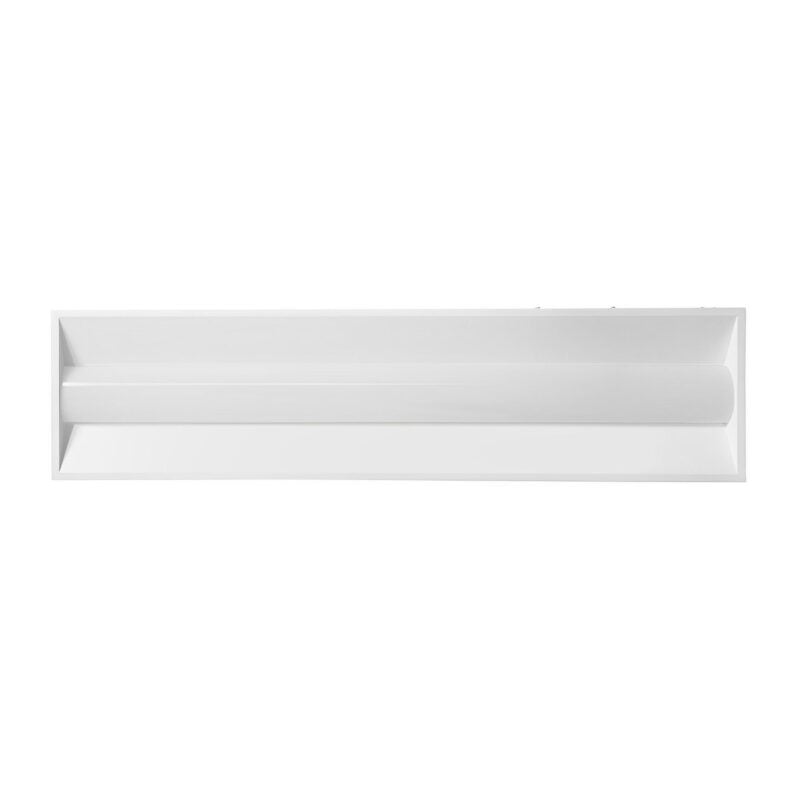
Commercial ceiling lights provide general, ambient, or task lighting in offices, schools, healthcare facilities, retail spaces, hallways, commercial buildings, and other indoor environments. With more than 15 years of commercial lighting experience, LED Lighting Supply works with facility managers, contractors, and building owners to help match fixture type, light output, controls, mounting, and electrical requirements to the application.
LED ceiling lights include flat panel lights and troffers, recessed downlights, and linear fixtures. They are commonly used in offices, classrooms, hallways, healthcare spaces, retail facilities, and other areas where uniform overhead illumination is needed. Available color temperatures commonly include 3000K, 3500K, 4000K, and 5000K depending on the fixture.

Best Applications for Commercial LED Ceiling Lights
Commercial ceiling fixtures are available for a wide range of indoor applications. The right fixture depends on required light levels, mounting height, ceiling type, visual tasks, glare control, color quality, controls, environmental conditions, and applicable building or life-safety requirements.
- Commercial offices - 3000K to 4000K fixtures are commonly used, with optics and glare control selected to provide comfortable illumination for desks, computer work, and shared spaces.
- Educational institutions and classrooms - Dimming, occupancy controls, suitable color temperature, and low-flicker performance can help support different classroom activities and lighting needs.
- Hospitality spaces - Lobbies, meeting rooms, conference spaces, and common areas may use warmer color temperatures, dimming, and selectable-CCT fixtures to provide different lighting conditions throughout the day.
- Healthcare facilities and offices - Fixture selection should consider required illuminance, color quality, glare control, cleanability, controls, and any healthcare-specific electrical or life-safety requirements for the space.
- Hallways and corridors - Long-life LED fixtures combined with occupancy or scheduling controls can reduce energy use and maintenance compared with older fluorescent systems.
- Conference rooms - Dimmable fixtures and appropriate glare control can support presentations, video conferencing, and different meeting conditions.
- Fitness centers - Select fixtures based on mounting height, required light levels, glare, impact exposure, humidity, temperature, and other environmental conditions.
- Retail stores - Higher-CRI options can improve merchandise color appearance, while fixture optics, spacing, and mounting height help control brightness and uniformity.

What LED Lighting Supply Commercial Ceiling Light Is Best for You?
Choose commercial ceiling lights by first matching the fixture size, ceiling grid or opening, and mounting method to the building. Then determine the light output, optics, and spacing needed for the required foot-candle levels at the work plane. Finally, confirm color temperature, CRI, dimming, controls, voltage, environmental ratings, and any emergency-lighting requirements.
- 1 x 4 LED Commercial Ceiling Panels - Narrow panels that can work well in corridors, perimeter areas, offices, and spaces where a 2x4 fixture is not a good fit.
- 2 x 2 LED Commercial Ceiling Panels - Square fixtures commonly used in offices, classrooms, medical offices, and modular ceiling layouts.
- 2 x 4 LED Commercial Ceiling Panels - A common replacement or new-construction format for standard commercial ceiling grids. Required output and spacing should be selected from mounting height and target light levels rather than fixture size alone.
- LED Commercial Ceiling Troffers - Available in common grid sizes with different optical designs that can help provide comfortable, uniform illumination and reduce excessive brightness or glare.
- Wattage Adjustable LED Ceiling Lights - Field-selectable fixtures allow installers to choose from multiple wattage and lumen settings within the range provided for the specific model.
- Color Adjustable LED Ceiling Lights - Field-selectable fixtures can provide multiple color-temperature choices, commonly within approximately 3000K to 5000K depending on the model.
- LED Ceiling Lights with Emergency Battery Backup - Selected fixtures can include emergency battery equipment designed to provide reduced illumination during loss of normal power. Many listed emergency-lighting systems are designed for at least 90 minutes of emergency operation, but the fixture, emergency driver, installation, controls, placement, and resulting egress illumination must meet the applicable life-safety and building-code requirements. An integrated battery does not by itself establish code compliance or eliminate the need for other emergency fixtures.

Technical Specifications and Installation Requirements
Commercial ceiling fixtures are available with different voltage ranges. Many models operate on 120-277V universal input, while others may have different voltage requirements. Confirm the input voltage and driver specification of the exact fixture before ordering or installation.
For suspended-grid installations, verify the actual ceiling-grid module and fixture dimensions. Common commercial LED panels and troffers include 1x4, 2x2, and 2x4 formats, but ceiling systems and openings can vary. For surface-mounted, recessed, or suspended applications, verify the required mounting kit, clearance, structural support, and access above the ceiling.
Mounting height, fixture output, beam distribution, spacing, room reflectance, partitions, furniture, and the required work-plane illumination all affect fixture quantity. Higher ceilings may require greater lumen output, different optics, or different spacing, but a photometric plan is the best way to confirm the layout for larger or performance-sensitive projects.
Color temperature and CRI should be selected for the application rather than treated as universal settings. 3500K to 4000K is common in many offices and commercial spaces, while warmer 3000K lighting may be preferred in hospitality or customer-facing areas. Higher CRI may be appropriate where accurate color appearance is important, including retail, healthcare, inspection, and design environments.
When Are LED Commercial Ceiling Lights a Good Fit?
Commercial LED ceiling fixtures are often a practical choice when a project needs broad, even overhead illumination in a finished indoor space. They are especially well suited to suspended-grid ceilings, offices, classrooms, corridors, medical offices, meeting rooms, and retail areas where low-profile fixtures and a clean ceiling appearance are important.
- Replacing fluorescent panels or troffers - LED panels and troffers in common 1x4, 2x2, and 2x4 formats can simplify replacement planning when they match the existing ceiling grid, voltage, wiring conditions, and mounting requirements.
- Improving visual comfort - Fixtures with an appropriate lens and optical distribution can provide more uniform illumination and help manage excessive brightness in spaces with desks, screens, and frequent visual tasks.
- Reducing maintenance access - Many commercial LED fixtures are rated for 50,000 hours or more based on specified lumen-maintenance criteria. Actual service life depends on the product, driver, operating temperature, operating schedule, controls, and installation conditions.
- Supporting control strategies - Compatible dimming, occupancy sensing, daylight response, scheduling, and building controls can be considered where operating patterns support their use. Verify compatibility among the fixture, driver, sensor, and control system.
- Coordinating appearance across multiple rooms - Common fixture sizes, color temperatures, and lumen packages can help facilities maintain a more consistent lighting appearance across offices, hallways, classrooms, and shared spaces.
- Planning a new ceiling layout - Ceiling fixtures can be laid out around room geometry, furniture, partitions, and visual tasks. Final quantity and spacing should be based on fixture-specific photometric data rather than a universal spacing rule.
Ceiling panels and troffers are not the best choice for every application. Tall open areas may require high-bay fixtures or other distributions, while spaces requiring accent lighting, directional task lighting, decorative lighting, or specialized environmental protection may need different fixture types.

Energy Savings and ROI Calculations
Energy savings depend on the difference between existing system wattage and replacement LED wattage, along with operating hours. For example, a 40W LED fixture replacing an existing lighting system that actually draws 70W reduces connected lighting load by 30W while operating.
At 12 hours of operation per day, a 30W reduction equals approximately 131 kWh of annual energy savings per fixture. At an electricity rate of $0.12 per kWh, that represents about $16 per fixture per year in direct lighting-energy savings. Actual savings depend on the existing system wattage, replacement fixture, hours of operation, controls, utility rates, HVAC interaction, and other facility conditions.
Maintenance savings can also be significant when LED fixtures replace fluorescent lamps and ballasts, particularly in locations where access requires lifts or interrupts operations. Calculate ROI using the actual equipment cost, installation cost, operating schedule, utility rate, available rebates, maintenance expenses, and expected fixture performance for the project.
Emergency Lighting Considerations
Emergency lighting is a life-safety system and should be designed separately from normal-lighting performance. Emergency battery equipment commonly provides at least 90 minutes of operation when listed and installed for that purpose, but duration alone does not establish compliance.
The emergency lighting system must provide the required illumination along applicable means-of-egress areas and meet the applicable building, fire, electrical, and life-safety requirements. Emergency drivers and battery packs must also be compatible with the specific luminaire and installed according to their listing and manufacturer instructions.
Depending on the building and layout, integrated emergency battery fixtures may form part of the required emergency-lighting system, but additional emergency luminaires, exit signs, generators, inverters, or other equipment may still be necessary. For schools, healthcare facilities, public buildings, and other life-safety-sensitive applications, have the emergency-lighting design reviewed by the appropriate qualified professional and authority having jurisdiction.
Certifications, Rebates, and Warranty Support
Commercial LED ceiling fixtures may carry safety listings such as UL, ETL, or CSA, depending on the product. Many models may also appear on the DesignLights Consortium Qualified Products List for applicable categories and utility-rebate programs. Certification and rebate eligibility are model-specific, so verify the exact fixture before ordering.
For emergency-equipped fixtures, verify the listing and compatibility of the complete emergency-lighting configuration, including the luminaire and emergency driver or battery equipment. A standard luminaire safety listing alone does not establish that the fixture satisfies emergency-lighting requirements.
Warranty length and terms vary by product. Before purchase, review the selected product specification to confirm safety listing, DLC status where applicable, voltage, dimming, controls compatibility, mounting method, environmental rating, emergency options, and warranty terms.
Expert Support From Start to Finish
LED Lighting Supply can help review ceiling type, existing fixture dimensions, mounting method, voltage, controls, color temperature, required light levels, and other project requirements before fixtures are selected.
We also provide photometric lighting plans that can estimate fixture placement, mounting height, foot-candle levels, and uniformity for the proposed lighting design. Photometric plans can help compare fixture and layout options, but they do not replace electrical, building, fire, accessibility, healthcare, or life-safety code review and should not be represented as verification of code compliance.
For code-sensitive applications such as schools, healthcare facilities, public buildings, emergency-egress systems, or other regulated spaces, final fixture selection and installation requirements should be confirmed with the appropriate qualified professional and authority having jurisdiction.
Commercial Ceiling Lighting FAQs
How Do I Choose Commercial Ceiling Lights For My Space?
Choose commercial ceiling lights by matching the fixture size, ceiling grid or opening, and mounting method to the building, then selecting light output, optics, and spacing for the required foot-candle levels at the work plane. Confirm color temperature, CRI, dimming, controls, voltage, environmental ratings, and any emergency-lighting requirements before selection.
How Should I Determine Fixture Quantity And Spacing?
Fixture quantity and spacing should be based on mounting height, fixture output, beam distribution, room reflectance, partitions, furniture, and required work-plane illumination. A photometric plan is the best way to confirm layouts for larger or performance-sensitive projects.
Can LED Panels And Troffers Replace Existing Fluorescent Fixtures?
LED panels and troffers in common 1x4, 2x2, and 2x4 formats can simplify replacement planning when they match the existing ceiling grid, voltage, wiring conditions, and mounting requirements. Fixture size alone should not determine the required output or spacing.
What Should I Verify Before Ordering Commercial Ceiling Fixtures?
Verify the exact fixture input voltage and driver specification, along with the ceiling-grid module or opening dimensions and mounting requirements. For surface-mounted, recessed, or suspended fixtures, also verify the required mounting kit, clearance, structural support, and access above the ceiling.
How Should I Select Color Temperature And CRI?
Select color temperature and CRI for the application rather than treating them as universal settings. 3500K to 4000K is common in many offices and commercial spaces, warmer 3000K lighting may be preferred in hospitality or customer-facing areas, and higher CRI may be appropriate where accurate color appearance is important.
When Are Commercial LED Ceiling Lights Not The Best Choice?
Commercial LED ceiling panels and troffers are not the best choice for every application. Tall open areas may require high-bay fixtures or other distributions, while spaces needing accent lighting, directional task lighting, decorative lighting, or specialized environmental protection may need different fixture types.
Can Commercial Ceiling Lights Be Used With Dimming And Building Controls?
Compatible dimming, occupancy sensing, daylight response, scheduling, and building controls can be considered where operating patterns support their use. Verify compatibility among the fixture, driver, sensor, and control system.
Can An Integrated Emergency Battery Establish Emergency-Lighting Compliance?
No, an integrated battery does not by itself establish code compliance or eliminate the need for other emergency fixtures. The complete emergency-lighting system must provide required illumination along applicable means-of-egress areas and meet applicable building, fire, electrical, and life-safety requirements.