LED Flat Panel Lights and Troffer Lights
- Fits standard 1x4, 2x2, and 2x4 ceiling grids
- Selectable wattage and color temperature options available
- Product specialists help with panel selection and spacing


Get Your Custom Lighting Plan With Product Recommendations
- Fixture placement and spacing planned around ceiling grid layout to help achieve target foot-candles and uniformity
- Panel size, lumen output, color temperature, and optics matched to room type and visual comfort goals
- LED panels can reduce energy use and relamping compared with fluorescent troffers in compatible applications


Our LED Flat Panel Lights and Troffer Lights include 1×4, 2×2, and 2×4 panel fixtures and troffer-style models for commercial ceiling applications. Available products include backlit and edge-lit designs, with selectable wattage, color temperature, dimming, motion sensor, emergency battery backup, and mounting accessory options depending on the model.
These fixtures are commonly used in offices, conference rooms, schools, classrooms, healthcare offices, retail stores, corridors, hospitality interiors, and other indoor commercial spaces with dropped or suspended ceiling systems.






What Are LED Panel Lighting Fixtures?
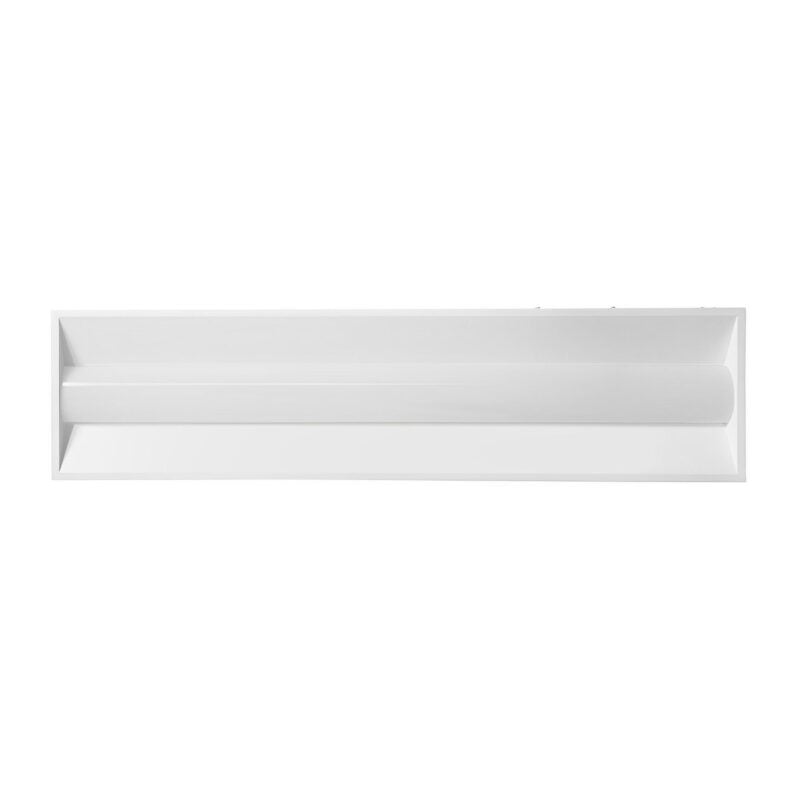
LED panel lighting fixtures are slim, low-profile commercial ceiling lights used in dropped ceiling grids, suspended ceiling systems, and indoor commercial spaces that need clean, even illumination. They are commonly used to replace fluorescent troffers and older fluorescent panel fixtures in offices, schools, healthcare spaces, retail stores, corridors, conference rooms, hospitality interiors, and other professional environments.
Common LED panel sizes include 1x4, 2x2, and 2x4. These sizes fit many standard ceiling grid layouts and can support both retrofit projects and new construction. LED panels are often chosen when the project needs a flat, modern ceiling appearance with broad general illumination.
Choose LED panel lighting by first matching the fixture size to the ceiling grid and deciding between a flat, modern panel appearance or a traditional recessed troffer-style appearance. Then confirm the room's light level target, lumen output, color temperature, glare requirements, dimming requirements, mounting method, emergency backup needs, and project goals. Many LED panel models may include selectable wattage, selectable color temperature, dimming, motion sensor options, emergency battery backup, or alternate mounting accessories, depending on the model.

Selection and Installation Note: Product specifications, lumen output, wattage, color temperature, CRI, glare performance, dimming type, motion sensor options, emergency backup, mounting accessories, certifications, and warranty coverage vary by model. Confirm the selected product specification before ordering. Lay-in panels installed in suspended ceiling systems must be supported and secured to the ceiling grid in accordance with the luminaire listing, manufacturer instructions, applicable electrical code, ceiling-system requirements, and local building or seismic requirements. Additional independent support to the building structure may be required by local code, seismic requirements, the ceiling assembly, or project specifications, but it is not a universal requirement for every grid-supported luminaire. For code-sensitive, electrical, emergency egress, commercial, healthcare, education, or safety-critical applications, installation should be performed by a qualified professional electrician.
Airtho Upgrades Cleanroom Facilities to LED Lighting Case Study
The Backstory:
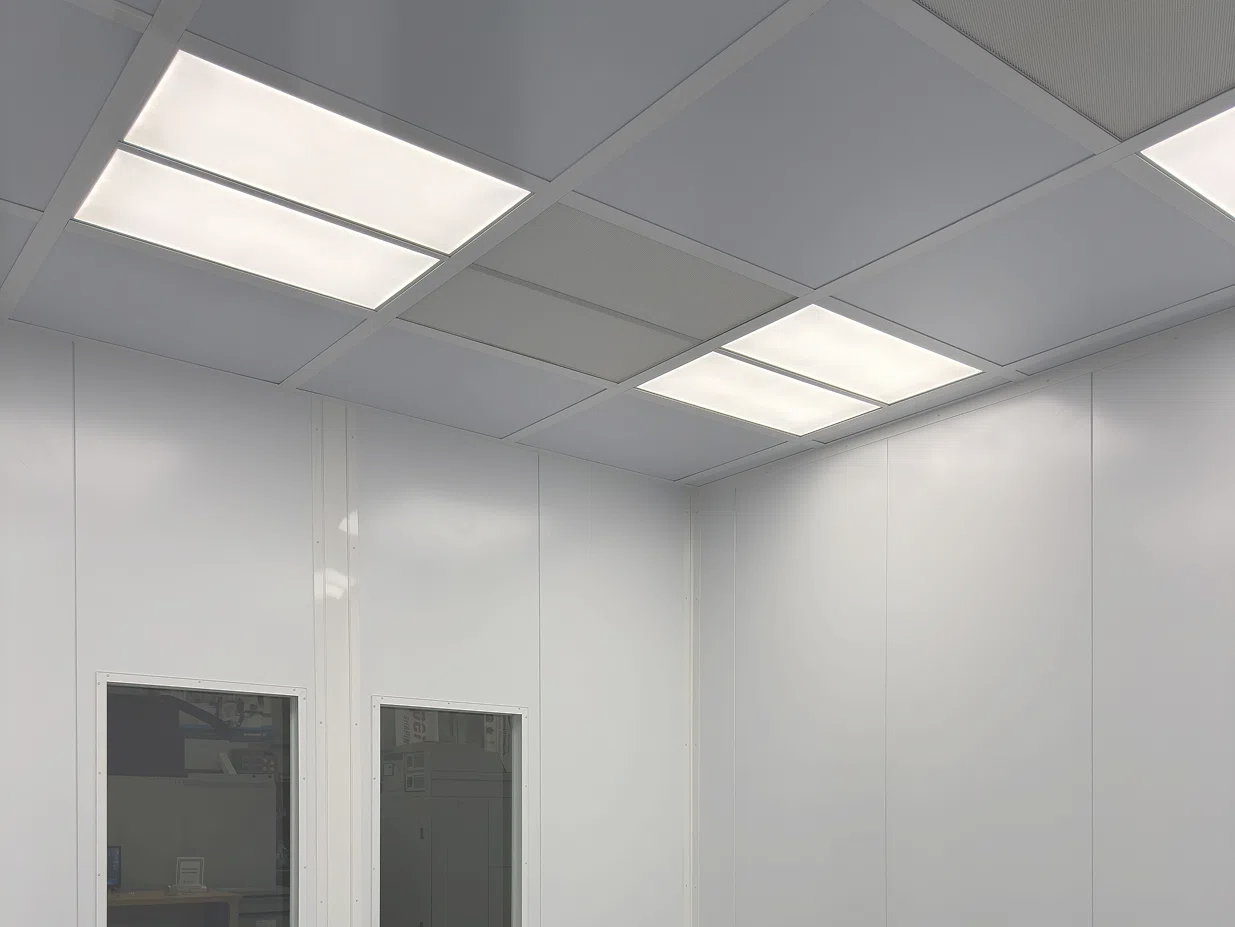
Airtho designs modular, pre-engineered structures for controlled environments. Building these types of facilities requires the proper lighting solution the first time. Airtho needed a supplier who could move fast and understand cleanroom-specific requirements.
Airtho’s President, Brandon Bogart, reached out to LED Lighting Supply in 2020 with a time-sensitive need for 10 LED panel lights. The lighting would be installed in a cleanroom drop ceiling system for a job that ships out the following week. Our Product Specialist, Jeff Cesenaro, was quick to respond and provided his consultative expertise, walking Brandon through kelvin temperature and lumen output options.
He recommended 2x4 edge-lit panel lights with an emergency battery backup option, all in time to meet the deadline. Jeff showed their team that we can plan, quote, revise, and deliver controlled environment lighting solutions across multiple projects promptly. That first exchange led to LED Lighting Supply becoming the preferred lighting supplier for Airtho.
The Challenge of Airtho’s Controlled Environment Lighting:
Cleanroom and controlled environment projects require specialized lighting fixtures and expert guidance. Airtho's work called for lighting layout direction, target illumination planning, and communication they could count on at every stage.
Airtho needed a partner that offers:
- Expert advice tailored to the strict cleanliness and performance demands of controlled environments
- Consistent light output and quality across every fixture, critical for maintaining uniform conditions in controlled spaces
- Custom-tailored layout plans matched to each facility's individual dimensions and classification requirements, rather than a generic approach
LED Lighting Supply gave Airtho the support they needed to meet these requirements.
Lighting Plan Created for Techni-Glass in Hawkins County, Tennessee
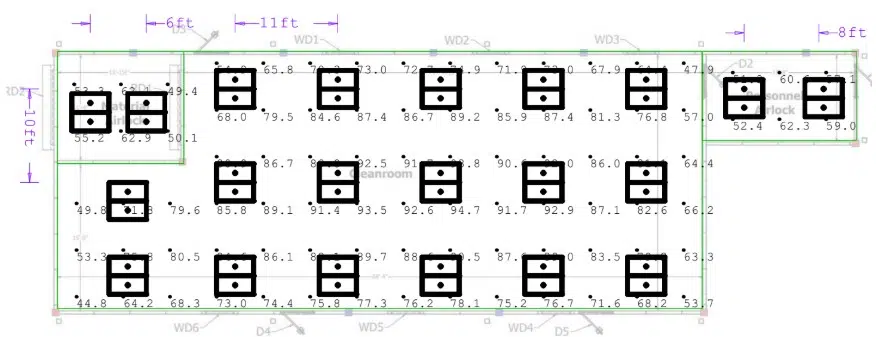
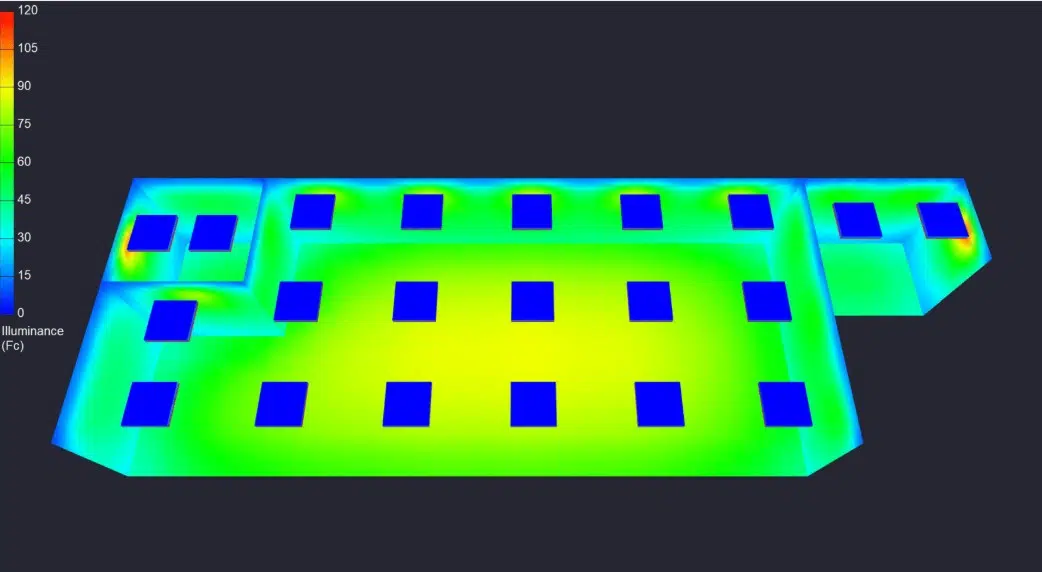
Lighting Plan Metrics:
- Mounting Height: 13 feet
- Fixture Used: 42 MLLG-AL-LED-PANBLH-2X4-4
- FC Achieved: 78 foot-candles
- Uniformity (Avg/Min): 2.11
- Product(s) Used: MLLG-AL-LED-PANBLH-2X4-40-40
When LED Panel Lights Are the Right Fit
LED panel lights work best in indoor commercial spaces where a clean ceiling appearance, even light distribution, and efficient general illumination are needed. They are not the right choice for every environment, especially wet, harsh, high-bay, outdoor, or hazardous applications.
| Use LED Panel Lights When | Do Not Use Standard LED Panels When |
|---|---|
| Replacing fluorescent troffers or fluorescent panel fixtures in compatible dropped ceiling systems. | The space requires high-bay lighting. Warehouses, gyms, factories, and high-ceiling industrial spaces usually need high bay fixtures. |
| A clean, flat ceiling appearance is desired in offices, schools, healthcare offices, retail stores, conference rooms, and commercial interiors. | The location is wet, humid, washdown, outdoor, or harsh. Use properly rated vapor-tight fixtures for applicable damp, wet, washdown, or harsh environments. |
| The ceiling uses a suspended grid that matches 1x4, 2x2, or 2x4 panel sizes. | The area is hazardous or classified. Hazardous locations require fixtures listed and marked for the documented area classification, such as applicable explosion-proof or hazardous-location fixtures. |
| The project needs dimming, motion sensors, or emergency backup options available on compatible panel models. | The space has direct impact, vibration, high heat, or industrial contamination beyond the fixture rating. |
LED Panel Light Sizes We Offer
LED panel size should match the ceiling grid and room layout. The most common panel sizes are 1x4, 2x2, and 2x4.
| Panel Size | Best Used For |
|---|---|
| 1x4 LED Flat Panels | Corridors, hallways, narrow rooms, and ceiling grid layouts where a longer, narrower panel is preferred. |
| 2x2 LED Flat Panels | Private offices, smaller rooms, schools, healthcare spaces, conference rooms, and 2x2 ceiling grid openings. |
| 2x4 LED Flat Panels | Open offices, classrooms, retail spaces, meeting rooms, and general commercial interiors where broader panel coverage is preferred. |
| LED Troffers | Traditional recessed commercial ceiling applications and fluorescent troffer replacement projects where a troffer-style appearance is preferred. |
Best Applications for LED Panel Lighting
LED panel lights are commonly used in indoor commercial spaces where a clean ceiling appearance and broad, even lighting are preferred.
| Application | Why LED Panels Work Well |
|---|---|
| Corporate Offices | LED panels provide clean, uniform lighting for open offices, private offices, workstations, and administrative areas. |
| Conference Rooms | Panels provide even general illumination for meetings, presentations, and video calls. Dimmable models can help adjust light levels when compatible controls are used. |
| Schools and Classrooms | LED panels provide consistent lighting for classrooms, libraries, computer labs, offices, and common areas. Glare performance should also be reviewed for visually demanding learning spaces. |
| Healthcare Offices | Panels provide a clean ceiling appearance and dependable general lighting for waiting rooms, administrative areas, exam rooms, and corridors. Glare, color quality, and applicable healthcare requirements should be confirmed for the exact space. |
| Retail Stores | CRI 80+ panel options provide clean general illumination for sales floors, checkout areas, fitting rooms, and back-of-house spaces. |
| Corridors and Hallways | 1x4 and 2x2 panels can work well in corridors and narrow ceiling grid layouts where even wayfinding light is needed. |
| Hospitality Interiors | LED panels can provide clean, low-profile lighting for back-of-house spaces, meeting rooms, corridors, offices, and service areas. |
| New Construction | Standard panel sizes and commonly available multi-voltage drivers can simplify product selection for many commercial ceiling grid layouts, subject to the selected model's voltage range and project requirements. |
Recommended Foot-Candles for LED Panel Lighting
Use the tool below for general starting foot-candle ranges by application. Foot-candle guidance helps estimate light levels for offices, classrooms, conference rooms, retail spaces, corridors, healthcare offices, and similar commercial interiors. Final fixture count and spacing should be reviewed based on ceiling height, room size, panel size, lumen output, controls, daylight, surface reflectance, glare performance, and visual comfort.
Step 1: Find your foot candle levels
Step 2: Estimate your fixture count and space
LED Panel Lighting Layout Estimator
Use this estimator to calculate approximate fixture count, spacing, and average foot-candles for offices, schools, healthcare spaces, and commercial interiors using LED panel fixtures. Enter your room dimensions, mounting height, target foot-candles, light loss factor, and room/layout condition to generate a preliminary lighting layout. When IES photometry is available, workplane height and room reflectance controls are shown.
Project Inputs
Estimated Results
Estimated average foot-candles are preliminary and should be verified with a lighting plan for project-critical applications.
Room / Layout Condition: This field is used only when usable IES photometry is not available. In fallback mode, it acts as a simplified room utilization factor for reflectance, fixture distribution, racking, obstructions, and how much fixture light reaches the work area. Open / light-colored spaces use 0.90, typical warehouses or shops use 0.75, racked or obstructed spaces use 0.60, and dark or complex spaces use 0.45. When IES photometry is active, this field is hidden and the estimator uses the selected workplane height, LLF, and simplified reflectance adjustment instead.
Photometry / Simulation Note: When usable IES photometry is available for the selected fixture, this estimator uses the fixture’s IES candela data, selected workplane height, light loss factor, and simplified reflectance adjustment to estimate fixture count, average foot-candles, and visual light distribution. The reflectance adjustment is a conservative approximation and is not a full zonal-cavity, radiosity, or professional photometric room calculation. When IES photometry is not available, the estimator uses a simulated beam model based on lumens, mounting height, room/layout condition, light loss factor, and beam angle.
Preliminary Estimate Only: This estimator is intended for simple square or rectangular spaces and should be used as a planning aid, not a final photometric lighting plan. Actual light levels may vary based on fixture optics, selected IES file, mounting conditions, workplane height, ceiling height, surface reflectance, obstructions, controls, voltage, installation conditions, and site-specific requirements. Project-critical applications should be verified with a formal lighting plan.
This estimate is a starting point. Warehouses, industrial facilities, hazardous locations, sports areas, schools, healthcare spaces, public areas, and code-sensitive projects may require a reviewed lighting layout before purchase or installation.
Choosing LED Panel Lights by Size, Ceiling Type, Lumens, Color Temperature, and Controls
LED panel lights should not be selected only by fixture size or wattage. A 1x4, 2x2, or 2x4 panel may all work well in the right application, but the correct option depends on ceiling grid size, room layout, light level target, lumen output, glare requirements, color temperature, dimming requirements, emergency backup needs, and installation method.
| Planning Factor | What to Confirm |
|---|---|
| Ceiling grid size | Confirm whether the project needs 1x4, 2x2, or 2x4 LED panels based on the actual ceiling grid opening. |
| Mounting method and ceiling support | Most panels are designed for recessed installation in a compatible suspended ceiling grid. When the ceiling grid supports the luminaire, the fixture must be securely fastened to the suspended-ceiling grid framing member using mechanical means or listed clips permitted by the fixture listing, manufacturer instructions, and applicable electrical code. This does not necessarily mean the luminaire must be fastened directly to the building’s structural framing. Additional independent support to the building structure may be required by local amendments, seismic requirements, the ceiling-system design, fire-rated assembly requirements, project specifications, or manufacturer instructions. Surface, cable, or separately suspended mounting requires compatible mounting accessories. |
| Room type | Offices, classrooms, corridors, healthcare offices, retail floors, conference rooms, and storage rooms may need different light levels and visual-comfort targets. |
| Lumen output | Compare lumen output, fixture spacing, ceiling height, room size, and target foot-candles instead of matching fluorescent wattage. |
| Wattage selection | Selectable wattage can help fine-tune output after installation, depending on the model. |
| Color temperature | Many panels offer selectable 3500K, 4000K, and 5000K options. Some models are fixed 4000K. Choose CCT based on room use and visual comfort. |
| CRI | Listed flat panel products may show CRI 80+ for general commercial lighting. Color-critical spaces may require higher CRI or specialized fixtures. |
| Glare and UGR | For offices, classrooms, healthcare spaces, computer work areas, and other visually demanding interiors, review glare performance in addition to lumens and foot-candles. Unified Glare Rating (UGR) is used to evaluate discomfort glare in a room. Lower UGR values generally indicate less discomfort glare, but actual glare depends on the luminaire, room dimensions, surface reflectance, mounting arrangement, and viewing position. Where a project specifies a UGR limit, confirm the fixture's published glare data and the lighting layout rather than assuming all flat panels provide the same visual comfort. |
| Dimming compatibility | Confirm whether the panel supports 0-10V, 1-10V, or another dimming method and whether existing controls are compatible. |
| Motion sensors | Motion sensor options may be useful in corridors, storage rooms, break rooms, offices, and other intermittently occupied spaces. |
| Emergency backup | Confirm whether emergency battery backup panels are required for corridors, egress paths, or other code-sensitive spaces. Emergency-lighting requirements should be verified for the applicable occupancy, location, and local code. |
| Voltage | Panel products may support 100-277V or other voltage ranges depending on the model. Confirm site voltage and the exact fixture input range before ordering. |
| Environment | Standard indoor panels are not substitutes for damp, wet, washdown, outdoor, hazardous-location, or harsh-environment fixtures. |
| Certifications and rebates | Confirm the required safety listing, DLC qualification where applicable, RoHS status if required by the project, and utility rebate eligibility for the exact model. |
Backlit vs Edge-Lit LED Panels
LED panels are commonly described as backlit or edge-lit, depending on how the LEDs are positioned inside the fixture. Many current commercial panel options are backlit designs because they can provide strong efficiency, good uniformity, and reliable general illumination. Edge-lit designs may be used where a very thin profile is the main priority, depending on available models.
| Feature | Backlit LED Panels | Edge-Lit LED Panels |
|---|---|---|
| LED Placement | LEDs are positioned behind the diffuser. | LEDs are positioned along the panel edges. |
| Light Distribution | Designed to spread light directly through the diffuser. | Uses a light guide to distribute light from the edges. |
| Fixture Profile | Low profile, but may be deeper than some edge-lit designs. | Often very slim, depending on design. |
| Best Use | General commercial panel lighting where efficiency and uniformity matter. | Applications where a very thin profile is the main priority, if available. |

LED Panel Light Certifications, Rebates, and Warranty Support
Selected LED panel lights from LED Lighting Supply carry a safety listing such as UL, ETL, or CSA, depending on the product. Some models are listed on the DLC Qualified Products List as Standard or Premium products, which may support eligibility for participating utility incentive programs. DLC qualification is a performance and efficiency program, not an electrical safety certification. Rebate eligibility varies by utility, region, program, and exact product listing, so confirm eligibility for the selected product before ordering.
Many LED panel lights include a 5-year warranty, unless otherwise specified, with USA-based warranty support. Before ordering, confirm the selected panel's safety listing, DLC status where applicable, warranty coverage, voltage, dimming compatibility, glare performance, emergency backup options, mounting method, ceiling-support requirements, and whether the fixture fits the room and ceiling layout.
Common LED Panel Lighting Mistakes
After the lighting design and product selection are complete, many panel-lighting issues come from missed coordination details. Addressing the following items before delivery and installation can help avoid delays, field modifications, and control-system problems.
- Ordering by nominal size without checking the actual opening: Confirm the existing grid opening, tee dimensions, ceiling obstructions, and the selected fixture's published dimensions. Nominal 1x4, 2x2, and 2x4 sizes are not a substitute for verifying fit.
- Missing required accessories: Surface-mount frames, suspension kits, flange kits, remote mounting hardware, seismic clips, and emergency components are often separate or model-specific items. Include all required accessories in the order.
- Not confirming driver and junction-box access: Coordinate above-ceiling access, branch-circuit routing, and service access for drivers, emergency components, and controls before the ceiling is closed.
- Assuming a dimmable fixture will work with any control: Confirm the driver type, control voltage or protocol, wiring arrangement, and control compatibility. Commission compatible controls after installation.
- Leaving selectable settings uncoordinated: For selectable-CCT or selectable-wattage models, document the intended field setting and apply it consistently before occupancy. Mixed settings can create visibly uneven light output or color appearance.
- Failing to inspect fixtures before installation: Check shipment quantities, lens condition, housing damage, accessories, and product labels before installation. Resolve concealed shipping damage promptly according to the carrier and supplier process.
- Overlooking ceiling-system coordination: Coordinate fixture installation with ceiling contractors, fire protection, HVAC, access panels, and other above-ceiling trades so panels are not blocked, poorly supported, or difficult to service.
- Skipping emergency-lighting testing and documentation: Where emergency backup is installed, verify the equipment is installed and tested in accordance with the manufacturer instructions and applicable code requirements. Maintain required testing and maintenance records where applicable.
- Ordering replacements without matching the original specification: Before replacing existing panels, confirm dimensions, voltage, control method, CCT, lumen package, mounting method, and any emergency or sensor features rather than matching only the fixture's general appearance.
Contact us about your LED panel lighting project and our Product Specialists can help review ceiling grid size, panel size, lumen output, fixture spacing, color temperature, glare considerations, controls, emergency backup, mounting requirements, and product specifications.
This Content on LED panel lighting guidance, glare and UGR considerations, suspended ceiling mounting and support, commercial lighting layout, electrical requirements, certifications, and fixture selection content Was Professionally Reviewed By:

Jamie Popp, Professional Electrical Engineer (PE)
Multi-State Licensed Professional Engineer
Master of Science in Engineering
Master of Science in Project Management
Jamie has spent over 15 years working directly with industrial energy systems and facility operations. In his engineering design work, he focuses on comprehensive lighting designs, complex power distribution engineering, technical hazardous area classifications, and design-level construction support.
He applies these specialized design skills across demanding environments, including petrochemical, nuclear, mining, pulp and paper, and manufacturing facilities.
This content was reviewed for technical accuracy, engineering relevance, real-world application, and clarity for the stated lighting topic.
LED Flat Panel Lights and Troffer Lights FAQs
How Do I Choose Between LED Flat Panels And LED Troffers?
Choose LED flat panels for a clean, flat ceiling appearance in compatible 1x4, 2x2, or 2x4 ceiling grids, and choose LED troffers when a traditional recessed troffer-style appearance is preferred for a fluorescent troffer replacement project.
How Should I Select The Right LED Panel Size?
Select the LED panel size by confirming the actual ceiling grid opening and room layout. 1x4 panels are suited to corridors, hallways, and narrow rooms; 2x2 panels can work in private offices, smaller rooms, schools, healthcare spaces, and conference rooms; and 2x4 panels are used in open offices, classrooms, retail spaces, meeting rooms, and general commercial interiors where broader panel coverage is preferred.
What Should I Compare Instead Of Matching Fluorescent Wattage?
Compare lumen output, fixture spacing, ceiling height, room size, and target foot-candles instead of matching fluorescent wattage. Final fixture count and spacing should also be reviewed based on panel size, controls, daylight, surface reflectance, and visual comfort.
When Are Standard LED Panel Lights Not The Right Choice?
Standard LED panels are not the right choice for wet, humid, washdown, outdoor, hazardous, high-bay, or harsh environments. They also are not substitutes for fixtures needed in spaces with direct impact, vibration, high heat, or industrial contamination beyond the fixture rating.
What Should I Confirm Before Choosing Dimmable LED Panels?
Confirm the panel's supported dimming method and whether existing controls are compatible before ordering. Depending on the model, panels may support 0-10V, 1-10V, or another dimming method.
Are Motion Sensors And Emergency Battery Backup Available?
Motion sensor options and emergency battery backup may be available depending on the LED panel model. Confirm the selected product specification when motion sensors, emergency backup, or other project-specific features are required.
How Do Backlit And Edge-Lit LED Panels Differ?
Backlit LED panels position LEDs behind the diffuser, while edge-lit LED panels position LEDs along the panel edges and use a light guide to distribute light. Backlit panels are used for general commercial panel lighting where efficiency and uniformity matter, while edge-lit designs may be used where a very thin profile is the main priority, depending on available models.
What Product Details Should Be Verified Before Ordering LED Panel Lights?
Verify the selected panel's ceiling-grid fit, mounting method, lumen output, color temperature, dimming compatibility, voltage, emergency backup options, certifications, DLC status, and room layout before ordering. Product specifications, warranty coverage, and available accessories vary by model.