


LED Explosion Proof Lighting for Hazardous Locations & Industrial Applications
- UL844 certified explosion proof LED fixtures prevent ignitions in hazardous environments
- 50-70% energy savings compared to traditional metal halide lighting systems
- 50,000+ hour LED lifespan eliminates frequent hazardous area maintenance


-
 Professional Hazardous Location Layout Ensuring Code Compliance & Safety Zone Coverage
-
Precise Fixture Count & Classification Requirements for Your Specific Hazardous Environment
-
Maximize Safety Compliance While Reducing Energy Costs & Explosion-Proof Maintenance Expenses


LED explosion proof lights are specialized fixtures built with robust housings and sealed enclosures for installation in hazardous locations where flammable gases, vapors, or combustible dusts may be present. These lights are commonly found in environments such as chemical processing plants, oil refineries, paint spray booths, grain handling facilities, wastewater treatment plants, and battery storage sites. Typical form factors include linear fixtures mounted along production lines, round or jelly jar styles installed above work areas, and compact units positioned in confined spaces or on equipment.
This category features Commercial & Industrial Lighting Solutions suited for classified areas that require certified hazardous location lighting. Fixtures are installed over open floors, along catwalks, inside storage tanks, and within process enclosures—wherever regulated safety standards call for explosion proof construction. Real-world applications include manufacturing zones with solvent use, grain elevators with airborne dust, and utility sites with methane or hydrogen exposure.
Color Adjustable / Wattage Adjustable LED Explosion Proof Lights


LED Lights for Class 1 Division 1 Hazardous Locations

LED Lights for Class 1 Division 2 Hazardous Locations

LED Lights for Class 2 Division 1 Hazardous Locations

LED Lights for Class 2 Division 2 Hazardous Locations

Round Explosion Proof Lights

Square Explosion Proof Lighting

Explosion Proof LED Panel Lights

LED Explosion Proof Flood Lights

Explosion Proof LED Linear Lights

Explosion Proof LED Jelly Jar Lights

Explosion Proof LED Emergency Exit Lights
Showing 61–72 of 109 results
 SKU:MLLG-E-LED-EXPLP12-40-50-C1D2 | Web ID:1934Built to Order 6 Weeks
- Watts: 40
- Lumens: 5600
- Lumens/Watt: 140
- Replaces: 150 Watt Metal Halide
- Color Temp: 5000K
- CRI: 70+
- IP Rating: IP66
- IK Rating: IK09
- Voltage: 100V-277V
- Operating Temp: -22°F to 122°F
- Rated Life: 50,000 (L70) hours
- Dimmable: 1-10V
- Beam Angle (Std): 120°
- Optics: Polycarbonate Lens
- Fixture Color: Gray
- Mount: Chain-Cable | Recessed | Surface
- Dimensions (in): 25.2 X 12 X 3.7
- Weight (lbs): 19.8
- Warranty: 5 years
Starting At$856.40


 SKU:MLLG-E-LED-EXPLP14-40-50-C1D2 | Web ID:1938Built to Order 6 Weeks
- Watts: 40
- Lumens: 5600
- Lumens/Watt: 140
- Replaces: 150 Watt Metal Halide
- Color Temp: 5000K
- CRI: 70+
- IP Rating: IP66
- IK Rating: IK09
- Voltage: 100V-277V
- Operating Temp: -22°F to 122°F
- Rated Life: 50,000 (L70) hours
- Dimmable: 1-10V
- Beam Angle (Std): 120°
- Optics: Polycarbonate Lens
- Fixture Color: Gray
- Mount: Chain-Cable | Recessed | Surface
- Dimensions (in): 49.2 X 12 X 3.7
- Weight (lbs): 44
- Warranty: 5 years
Starting At$996.00- SKU:MLLG-E-LED-EXPLP14-60-50-C1D2 | Web ID:1939Built to Order 6 Weeks
- Watts: 60
- Lumens: 8400
- Lumens/Watt: 140
- Replaces: 250 Watt Metal Halide
- Color Temp: 5000K
- CRI: 70+
- IP Rating: IP66
- IK Rating: IK09
- Voltage: 100V-277V
- Operating Temp: -22°F to 122°F
- Rated Life: 50,000 (L70) hours
- Dimmable: 1-10V
- Beam Angle (Std): 120°
- Optics: Polycarbonate Lens
- Mount: Chain-Cable | Recessed | Surface
- Dimensions (in): 49.2 in L X 12 in W X 3.7 in H
- Weight (lbs): 44
- Warranty: 5 years
Starting At$1,025.80  SKU:MLLG-E-LED-EXPLP22-40-50-C1D2 | Web ID:1935Built to Order 6 Weeks
- Watts: 40
- Lumens: 5600
- Lumens/Watt: 140
- Replaces: 150 | 250 Watt Metal Halide
- Color Temp: 5000K
- CRI: 70+
- IP Rating: IP66
- IK Rating: IK09
- Voltage: 100V-277V
- Operating Temp: -22°F to 122°F
- Rated Life: 50,000 (L70) hours
- Dimmable: 1-10V
- Beam Angle (Std): 120°
- Optics: Polycarbonate Lens
- Mount: Chain-Cable | Recessed | Surface
- Dimensions (in): 25.2 X 23.8 X 3.7 in
- Weight (lbs): 46.3
- Warranty: 5 years
Starting At$996.00- SKU:MLLG-E-LED-EXPLP22-60-50-C1D2 | Web ID:1936Built to Order 6 Weeks
- Watts: 60
- Lumens: 8400
- Lumens/Watt: 140
- Replaces: 250 Watt Metal Halide
- Color Temp: 5000K
- CRI: 70+
- IP Rating: IP66
- IK Rating: IK09
- Voltage: 100V-277V
- Operating Temp: -22°F to 122°F
- Rated Life: 50,000 (L70) hours
- Dimmable: 1-10V
- Beam Angle (Std): 120°
- Optics: Polycarbonate Lens
- Mount: Chain-Cable | Recessed | Surface
- Dimensions (in): 25.2 in L X 23.8 in W X 3.7 in H
- Weight (lbs): 46.3
- Warranty: 5 years
Starting At$1,025.80 - SKU:MLLG-E-LED-EXPLP22-80-50-C1D2 | Web ID:1937Built to Order 6 Weeks
- Watts: 80
- Lumens: 11200
- Lumens/Watt: 140
- Replaces: 250 Watt Metal Halide
- Color Temp: 5000K
- CRI: 70+
- IP Rating: IP66
- IK Rating: IK09
- Voltage: 100V-277V
- Operating Temp: -22°F to 122°F
- Rated Life: 50,000 (L70) hours
- Dimmable: 1-10V
- Beam Angle (Std): 120°
- Optics: Polycarbonate Lens
- Mount: Chain-Cable | Recessed | Surface
- Dimensions (in): 25.2 in L X 23.8 in W X 3.7 in H
- Weight (lbs): 46.3
- Warranty: 5 years
Starting At$1,055.60  SKU:MLLG-E-LED-EXPLP24-60-50-C1D2 | Web ID:1930Built to Order 6 Weeks
- Watts: 60
- Lumens: 8400
- Lumens/Watt: 140
- Replaces: 250 Watt Metal Halide
- Color Temp: 5000K
- CRI: 70+
- IP Rating: IP66
- IK Rating: IK09
- Voltage: 100V-277V
- Operating Temp: -22°F to 122°F
- Rated Life: 50,000 (L70) hours
- Dimmable: 1-10V
- Beam Angle (Std): 120°
- Optics: Polycarbonate Lens
- Mount: Chain-Cable | Recessed | Surface
- Dimensions (in): 49 X 23 X 3.7
- Weight (lbs): 88
- Warranty: 5 years
Starting At$1,345.00 SKU:MLLG-E-LED-EXPLP24-80-50-C1D2 | Web ID:1931Built to Order 6 Weeks
- Watts: 80
- Lumens: 11200
- Lumens/Watt: 140
- Replaces: 250 Watt Metal Halide
- Color Temp: 5000K
- CRI: 70+
- IP Rating: IP66
- IK Rating: IK09
- Voltage: 100V-277V
- Operating Temp: -22°F to 122°F
- Rated Life: 50,000 (L70) hours
- Dimmable: 1-10V
- Beam Angle (Std): 120°
- Optics: Polycarbonate Lens
- Mount: Chain-Cable | Recessed | Surface
- Dimensions (in): 49 X 23 X 3.7
- Weight (lbs): 88
- Warranty: 5 years
Starting At$1,345.00- SKU:MLLG-E-LED-EXPLP24-100-50-C1D2 | Web ID:1932Built to Order 6 Weeks
- Watts: 100
- Lumens: 14000
- Lumens/Watt: 140
- Replaces: 250 Watt Metal Halide
- Color Temp: 5000K
- CRI: 70+
- IP Rating: IP66
- IK Rating: IK09
- Voltage: 100V-277V
- Operating Temp: -22°F to 122°F
- Rated Life: 50,000 (L70) hours
- Dimmable: 1-10V
- Beam Angle (Std): 120°
- Optics: Polycarbonate Lens
- Mount: Chain-Cable | Recessed | Surface
- Dimensions (in): 49 in L X 23 in W X 3.7 in H
- Weight (lbs): 88
- Warranty: 5 years
Starting At$1,345.00 - SKU:MLLG-E-LED-EXPLP24-120-50-C1D2 | Web ID:1933Built to Order 6 Weeks
- Watts: 120
- Lumens: 16800
- Lumens/Watt: 140
- Replaces: 400 Watt Metal Halide
- Color Temp: 5000K
- CRI: 70+
- IP Rating: IP66
- IK Rating: IK09
- Voltage: 100V-277V
- Operating Temp: -22°F to 122°F
- Rated Life: 50,000 (L70) hours
- Dimmable: 1-10V
- Beam Angle (Std): 120°
- Optics: Polycarbonate Lens
- Mount: Chain-Cable | Recessed | Surface
- Dimensions (in): 49 X 23 X 3.7
- Weight (lbs): 88
- Warranty: 5 years
Starting At$1,404.60 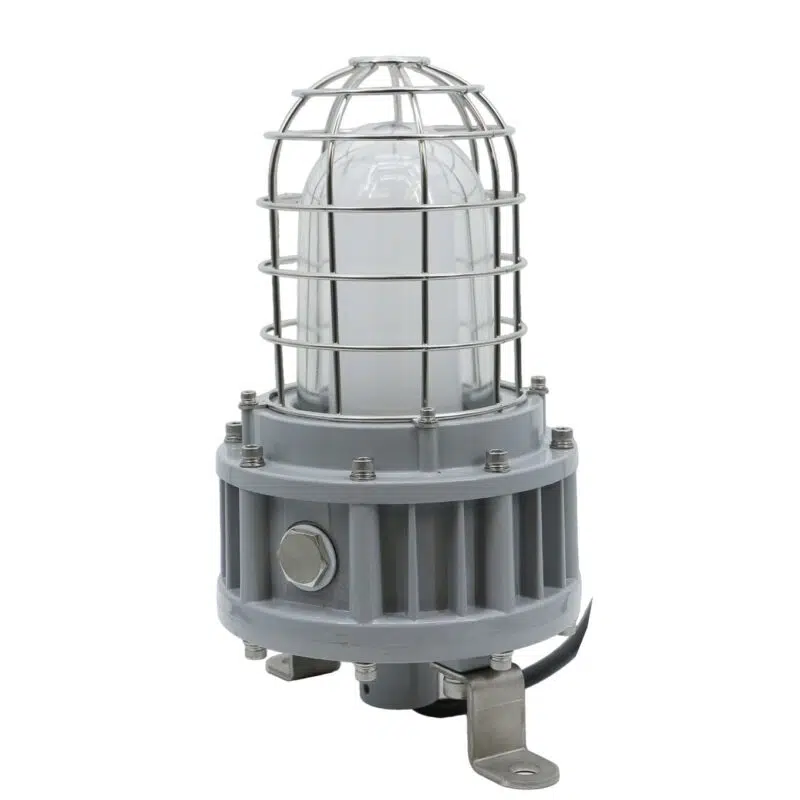 SKU:MLLG-E-LED-EXPLG-20-50-C1D1 | Web ID:2081Availability: 259 In Stock Ships 3-5 Days
- Watts: 20
- Lumens: 2800
- Lumens/Watt: 140
- Replaces: 100 Watt Metal Halide
- Color Temp: 5000K
- CRI: 70+
- IP Rating: IP66
- IK Rating: IK10
- Voltage: 100V-277V
- Operating Temp: -22°F to 122°F
- Rated Life: 50,000 (L70) hours
- Dimmable: No
- Beam Angle (Std): 360°
- Optics: Spherical Tempered Glass Dome
- Mount: Surface | 3/4 in NPT Pendant
- Dimensions (in): 12.5 X 8.8
- Weight (lbs): 14
- Warranty: 5 years
Starting At$500.00

- SKU:MLLG-E-LED-EXPLG-30-50-C1D1 | Web ID:1286Availability: 298 In Stock Ships 3-5 Days
- Watts: 30
- Lumens: 3900
- Lumens/Watt: 130
- Replaces: 100 Watt Metal Halide
- Color Temp: 5000K
- CRI: 70+
- IP Rating: IP66
- IK Rating: IK10
- Voltage: 100V-277V
- Operating Temp: -22°F to 122°F
- Rated Life: 50,000 (L70) hours
- Dimmable: 1-10V
- Beam Angle (Std): 360°
- Optics: Spherical Tempered Glass Dome
- Mount: 3/4 in NPT Pendant
- Dimensions (in): 12.5 X 8.8
- Weight (lbs): 14
- Warranty: 5 years
Starting At$520.00
What Are Explosion Proof Lights and Why Your Facility Needs Them
Explosion proof and hazardous location light fixtures are engineered for areas where flammable gases, vapors, liquids, combustible dusts, or ignitable fibers may create a fire or explosion risk. For facilities seeking reliable hazardous location LED lighting, these fixtures are essential for safety, compliance, and long-term performance in demanding industrial environments. The type of protection required depends on the hazardous location classification.
Class I locations involve flammable gases or vapors. In these environments, explosion proof fixtures are designed to contain an internal ignition if gas enters the enclosure and is ignited, then prevent that ignition from propagating to the surrounding atmosphere. The enclosure and flame paths help control and cool escaping gases so the external hazardous atmosphere is not ignited.
Class II locations involve combustible dusts, while Class III locations involve ignitable fibers or flyings. In these environments, the concern is different from Class I gas protection. Class II and Class III hazardous location fixtures are designed to reduce ignition risks by limiting dust, fiber, or flying entry and accumulation, controlling surface temperatures, and preventing arcs, sparks, or hot surfaces from igniting combustible material when properly rated, installed, and maintained.
The critical difference is simple: standard lights can become ignition sources in hazardous areas. Properly rated explosion proof and hazardous location LED lights are engineered to operate safely in classified environments where ordinary electrical equipment may create unacceptable risk. When selecting explosion proof LED light fixtures, it is important to match the fixture to the specific Class, Division, Group, temperature rating, voltage, mounting method, and environmental conditions of your facility.
The Role of the T Rating / Temperature Class
In addition to matching the correct Class, Division, and Group, hazardous location lights must also be selected with the proper T Rating, also called the Temperature Class. The T Rating identifies the maximum external surface temperature the fixture is rated to reach under the conditions covered by its listing. This matters because a fixture must not become hot enough to ignite the gas, vapor, dust, fiber, or flying material present in the surrounding area.
For Class I gas and vapor locations, the fixture's T Rating must be lower than the auto-ignition temperature of the specific gas or vapor present. For Class II combustible dust and Class III fiber or flying locations, temperature control is also critical because dust or fibers can ignite from hot surfaces, especially if material accumulates on or near the fixture.
Common T Ratings include T1, T2, T3, T4, T5, and T6, with lower maximum surface temperatures as the number increases. For example, a T4 fixture has a lower maximum surface temperature than a T3 fixture. The correct T Rating depends on the hazardous material in the facility, the ambient temperature, the fixture listing, and the installation conditions.
Higher T-code numbers indicate lower maximum surface temperatures. The selected fixture must have a T-code suitable for the auto-ignition temperature of the gas, vapor, dust, fiber, or flying material present in the classified area.
When selecting explosion proof or hazardous location LED lighting, always verify that the fixture is rated for the required Class, Division, Group, and T Rating. A fixture may be approved for the correct Class and Division but still be unsuitable if its surface temperature rating is too high for the hazardous material present.
The Occupational Safety and Health Administration (OSHA) provides guidance on electrical safety in hazardous locations, emphasizing that proper classification and equipment selection are critical to preventing workplace fires, explosions, and injuries. OSHA's hazardous location standards address electrical installations in areas where flammable gases, vapors, liquids, combustible dusts, or ignitable fibers may be present.
Explosion Proof Lighting Selector
Use the selector below as a starting point to narrow explosion proof and hazardous location lighting options by application and fixture type. Final fixture selection should be confirmed against the required Class, Division, Group where applicable, T Rating, certification, voltage, mounting method, environmental conditions, and installation requirements.
Explosion Proof / Hazardous Location Lighting Selector
Use When / Don't Use When
Use LED Explosion Proof Lights When
- Hazardous materials are present - flammable gases, vapors, liquids, or combustible dust create ignition risks
- NEC classification applies - facility has been assessed as Class I, II, or III hazardous location
- OSHA compliance required - workplace safety regulations mandate explosion rated equipment
- Energy efficiency matters - need 50-75% energy reduction compared to HID with long fixture life depending on model and application
- Extreme conditions exist - high temperatures, moisture, vibration, corrosive atmospheres, or chemical exposure
Don't Use an LED Explosion Proof Light When
- Non-hazardous environments - residential, office, or standard commercial areas with no ignition risks
- Unclassified industrial areas - manufacturing spaces with no flammable materials or combustible dust
- Budget doesn't support proper installation - qualified electricians and explosion rated components required
- Classification uncertain - haven't completed a professional hazardous area assessment to determine actual requirements
What We Verify Before You Order Explosion Proof LED Light Fixtures
We confirm
- Hazardous location classification: Class I, II, or III; Division 1 or 2; applicable Group; and T Rating
- Environmental conditions (temperature, moisture, vibration, chemicals)
- Mounting requirements and fixture spacing needs
- Electrical specifications and conduit system compatibility
If we provide a lighting plan, you will get
- Fixture layout with proper spacing calculations for uniform illumination
- Lumen output specifications and color temperature recommendations
- Installation guidelines
Note: Guidance is general planning information. Final selection should be validated with a photometric plan and confirmed by a licensed professional when required for code- or safety-critical areas.
I added this section, which should help some of the secondary keywords rank. How does this improve us versus Commercial LED Lights
Explosion Proof Fixture Types
| Fixture Type | Common Applications |
|---|---|
| Explosion Proof Round High Bay Lights | Round high bay fixtures are commonly used where a compact, high-output fixture is preferred for open industrial areas. |
| Explosion Proof Square High Bay Lights | Square high bay fixtures are commonly used where a broader rectangular fixture footprint or different mounting/configuration style is preferred. |
| Explosion Proof Linear Lights | Used for lower ceilings, equipment rooms, walkways, paint booths, inspection areas, and production lines where long, even light distribution is needed. |
| Explosion Proof Flood Lights | Used for wide-area illumination, tank farms, loading areas, outdoor process areas, fuel handling zones, and industrial yards requiring directional hazardous location lighting. |
| Explosion Proof Jelly Jar Lights | Used for compact lighting in stairwells, corridors, small rooms, equipment access points, and maintenance areas where a smaller hazardous location fixture is required. |
| Explosion Proof Emergency and Exit Lights | Used where emergency egress lighting is required in classified areas. Fixture selection should confirm hazardous location rating, battery backup requirements, and local code requirements. |
| Explosion Proof Panel Lights | Used in paint spray booths, finishing areas, inspection spaces, and classified rooms where a low-profile hazardous location fixture or panel-style light distribution is required. Fixture selection should confirm the required Class, Division, Group, T Rating, mounting method, and installation environment. |
| Explosion Proof Junction Boxes | Used to protect electrical connections, splices, and terminations in hazardous classified areas. Junction boxes must be selected based on the required Class, Division, Group, environmental rating, conduit or cable system, and applicable installation requirements. View all our explosion proof accessories. |
Explosion Proof Lighting Comparisons
Explosion proof lighting is often confused with other industrial lighting categories. While some fixtures may look similar from the outside, they are designed for different environments, safety requirements, and electrical classifications. Understanding these differences can help prevent costly mistakes and ensure the correct fixture is selected for the application.
Explosion Proof vs Hazardous Location Lighting
Many people use the terms explosion proof lighting and hazardous location lighting interchangeably, but they are not exactly the same thing.
Hazardous location lighting is the broader category of lighting designed for classified areas where flammable gases, vapors, combustible dusts, or ignitable fibers may be present. Explosion proof lighting is one type of hazardous location lighting commonly used in Class I environments where an internal ignition must be contained and prevented from igniting the surrounding atmosphere.
Depending on the classification, hazardous location lighting may include explosion proof, dust-ignitionproof, increased safety, intrinsically safe, or other protection methods. The correct fixture depends on the Class, Division, Group, T Rating, and applicable certification requirements of the installation.
| Term | Description |
|---|---|
| Hazardous Location Lighting | General category of lighting designed for classified hazardous areas. |
| Explosion Proof Lighting | A specific type of hazardous location lighting designed to contain an internal ignition and prevent ignition of the surrounding atmosphere. |
Explosion Proof vs Intrinsically Safe Lighting
Explosion proof and intrinsically safe equipment are both designed for hazardous locations, but they use different protection methods.
Explosion proof fixtures are designed to contain an internal ignition event within the fixture enclosure and prevent that ignition from reaching the surrounding hazardous atmosphere.
Intrinsically safe equipment works differently. It limits electrical and thermal energy to levels that are incapable of causing ignition under specified operating conditions. Intrinsically safe designs are commonly used for sensors, controls, handheld devices, communications equipment, and portable lighting.
For facility illumination, explosion proof fixtures are generally the more common solution. Intrinsically safe products are typically used where very low-energy operation is required.
| Protection Method | How It Reduces Ignition Risk |
|---|---|
| Explosion Proof | Contains an internal ignition and prevents ignition from reaching the surrounding atmosphere. |
| Intrinsically Safe | Limits electrical and thermal energy so ignition cannot occur under specified conditions. |
Explosion Proof vs Vapor Tight Fixtures
This is one of the most common sources of confusion when selecting industrial lighting.
Vapor tight fixtures are designed to resist moisture, dust, dirt, and contaminants. They are commonly used in parking garages, food processing facilities, washdown environments, utility spaces, and industrial areas where environmental protection is required.
However, a vapor tight fixture is not automatically approved for hazardous locations. While many vapor tight fixtures have high IP ratings, they may not carry the Class, Division, Group, or T Rating required for a classified hazardous area.
If flammable gases, vapors, combustible dusts, or ignitable fibers may be present, the fixture must be specifically rated and listed for the hazardous location classification.
| Fixture Type | Typical Application |
|---|---|
| Explosion Proof Fixture | Classified hazardous locations requiring Class, Division, Group, and T Rating compliance. |
| Vapor Tight Fixture | Wet, dusty, dirty, or corrosive environments that are not classified hazardous locations. |
Explosion Proof vs Standard Industrial LED Lighting
Standard industrial LED fixtures are commonly used in warehouses, manufacturing plants, gymnasiums, distribution centers, and commercial facilities where hazardous materials are not present.
Explosion proof fixtures are designed specifically for classified hazardous locations and typically require specialized construction, certifications, and installation methods.
If an area has not been classified as a hazardous location and does not contain flammable gases, vapors, combustible dusts, or ignitable fibers, a standard industrial LED fixture may provide the required illumination at a lower cost. However, if the area is classified, properly rated hazardous location lighting should be used.
How to Determine If Your Location Requires Explosion Proof Lighting
Final classification should be confirmed by a qualified engineer, safety professional, licensed electrician, or the local code authority responsible for approving the installation.
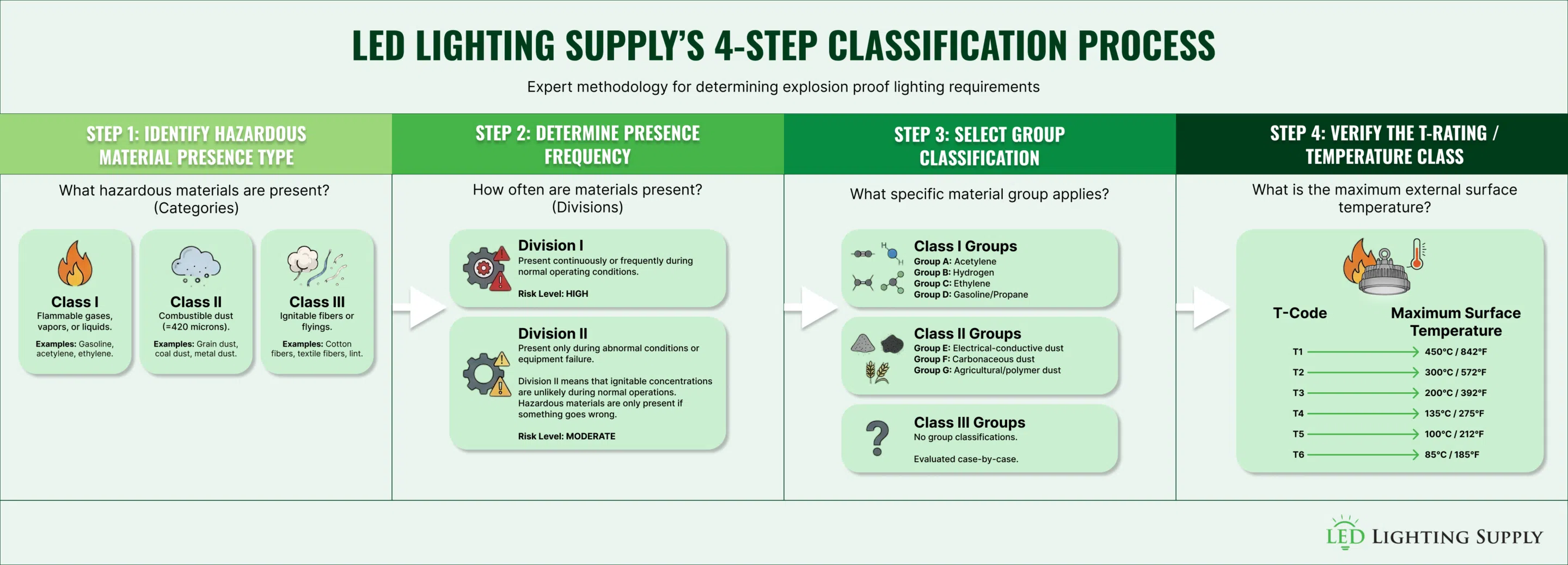
LED Lighting Supply's 4-Step Hazardous Location Classification Process
Use the following process as a planning guide for understanding explosion proof lighting requirements. The correct fixture must match the required Class, Division, Group, and T Rating for the hazardous material and installation environment.
Step 1: Identify the Hazard Type - Class I, Class II, or Class III
The Class identifies the general type of hazardous material that may be present in the area.
| Class | Hazard Type and Common Examples |
|---|---|
| Class I | Flammable gases, vapors, or liquids. Common examples include gasoline vapors, methane, hydrogen, acetylene, propane, ethylene, alcohol vapors, and solvent vapors. Class I areas are common in refineries, fuel storage areas, chemical plants, paint spray booths, wastewater facilities, and some battery or hydrogen applications. |
| Class II | Combustible dusts. Common examples include grain dust, flour dust, coal dust, carbon black, metal dust, plastic dust, chemical dust, and other dusts that can ignite or explode when suspended in air or accumulated in sufficient quantities. Class II areas are common in grain handling, food processing, coal handling, metal processing, and dust-producing manufacturing environments. |
| Class III | Ignitable fibers or flyings. Common examples include cotton fibers, textile fibers, lint, sawdust-like flyings, and other larger combustible particles that may not remain suspended in air like dust but can still create a fire hazard. Class III areas are common in textile mills, woodworking operations, and facilities handling combustible fibers or flyings. |
Step 2: Determine How Often the Hazard Is Present - Division 1 or Division 2
The Division identifies the likelihood that the hazardous material will be present in ignitable concentrations or quantities.
| Division | What It Means |
|---|---|
| Division 1 | Hazard is present during normal operating conditions. Division 1 areas may have flammable gas, vapor, combustible dust, or ignitable fibers present continuously, frequently, or during normal production, processing, handling, or maintenance activities. This is generally the higher-risk division. |
| Division 2 | Hazard is not normally present, but may appear under abnormal conditions. Division 2 areas may become hazardous because of accidental release, equipment failure, container rupture, ventilation failure, poor housekeeping, or other abnormal operating conditions. This is generally lower risk than Division 1, but still requires properly rated equipment. |
Step 3: Select the Correct Material Group - Groups A Through G
The Group identifies the specific hazardous material involved. Groups are not shared across all Classes. Class I locations use Groups A, B, C, and D for gases and vapors. Class II locations use Groups E, F, and G for combustible dusts. Class III locations involve ignitable fibers or flyings and typically do not use Groups A through G.
| Class | Group | Typical Hazardous Material |
|---|---|---|
| Class I | Group A | Acetylene. Group A is one of the most severe Class I gas groups and requires equipment specifically rated for acetylene environments. |
| Class I | Group B | Hydrogen and similar gases. Examples include hydrogen and certain gases or vapors with high explosion pressure or low ignition energy. |
| Class I | Group C | Ethylene and similar gases. Examples include ethylene and carbon monoxide. |
| Class I | Group D | Common flammable gases and vapors. Examples include propane, gasoline, naphtha, benzene, butane, ethyl alcohol, acetone, and methane. |
| Class II | Group E | Combustible metal dusts. Examples include aluminum and magnesium dust. These dusts can be conductive and may require equipment specifically rated for Group E conditions. |
| Class II | Group F | Carbonaceous dusts. Examples include coal dust, carbon black, and coke dust. |
| Class II | Group G | Other combustible dusts. Examples include grain, flour, starch, plastic, wood, and some chemical dusts. |
| Class III | No Groups | Ignitable fibers or flyings. Class III locations are evaluated based on fibers or flyings rather than Groups A through G. |
Step 4: Verify the T Rating / Temperature Class
After identifying the Class, Division, and Group, the fixture must also have the correct T Rating, also called the Temperature Class. The T Rating identifies the maximum external surface temperature the fixture is rated to reach under the conditions covered by its listing.
This is critical because the fixture must not become hot enough to ignite the hazardous material present in the surrounding area. For Class I gas and vapor locations, the T Rating must be lower than the auto-ignition temperature of the gas or vapor. For Class II and Class III locations, temperature control is also important because combustible dusts, fibers, or flyings can ignite from hot surfaces, especially if material accumulates on or near the fixture.
| T-Code | Maximum Surface Temperature |
|---|---|
| T1 | 450°C / 842°F |
| T2 | 300°C / 572°F |
| T3 | 200°C / 392°F |
| T4 | 135°C / 275°F |
| T5 | 100°C / 212°F |
| T6 | 85°C / 185°F |
Higher T-code numbers indicate lower maximum surface temperatures. For example, a T4 fixture has a lower maximum surface temperature than a T3 fixture. The selected fixture must have a T Rating suitable for the gas, vapor, dust, fiber, or flying material present in the classified area.
Putting It Together: Example Hazardous Location Ratings
A complete hazardous location lighting requirement may look like one of these examples:
| Example Rating | What It Means |
|---|---|
| Class I, Division 1, Group D, T4 | Designed for areas where common flammable gases or vapors such as gasoline, propane, methane, or alcohol vapors may be present during normal operations, with a maximum surface temperature suitable for the hazardous material. |
| Class I, Division 2, Group B, T4 | Designed for areas where hydrogen or similar gases may be present only under abnormal conditions, such as leaks, failures, or ventilation issues. |
| Class II, Division 1, Group G, T5 | Designed for areas where combustible agricultural or organic dusts such as grain, flour, or starch may be present during normal operations, with a controlled surface temperature. |
| Class II, Division 2, Group F, T4 | Designed for areas where carbonaceous dusts such as coal dust or carbon black are not normally present in hazardous quantities but may accumulate under abnormal conditions. |
| Class III, Division 1 | Designed for areas where ignitable fibers or flyings are handled, manufactured, or used during normal operations. Class III locations typically do not use Groups A through G. |
Important Safety Reminder
This guide is intended to help facility managers, engineers, electricians, and buyers understand hazardous location lighting terminology. It is not a substitute for a formal hazardous location assessment. Before purchasing or installing explosion proof lighting, confirm the required Class, Division, Group, T Rating, ambient temperature rating, voltage, mounting, and environmental protection with a qualified professional and the applicable electrical code requirements.
Explosion Proof Lighting: Applications, Industries & Common Classifications
The following guide provides common examples of where explosion proof and hazardous location lighting may be required. Actual classifications depend on the materials present, ventilation, process conditions, equipment layout, and how often hazardous gases, vapors, dusts, fibers, or flyings may be present. Always confirm the required Class, Division, Group, and T Rating with the facility safety team, engineer, local code authority, and applicable electrical codes.
Chemical Processing, Manufacturing & Storage
| Chemical processing plants | Chemical processing facilities may require Class I, Division 1 or Division 2 lighting where flammable gases, vapors, solvents, or reactive compounds are present. Depending on the material, Groups B, C, or D may apply. Certified hazardous location lighting helps reduce ignition risks in production, blending, transfer, and handling areas. |
| Chemical storage warehouses and tank farms | Stored chemicals may release hazardous vapors during filling, dispensing, inspections, or maintenance. These areas may require Class I hazardous location lighting selected for the specific vapor group and exposure level. |
| Paint spray booths and finishing areas | Paint fumes and solvent vapors commonly require Class I, Division 1 or Division 2 explosion proof paint booth lighting. Group D is common for many solvent vapor environments, but the final classification depends on the chemicals and process conditions. |
| Pharmaceutical manufacturing facilities | Solvent-based processes and volatile compounds used in pharmaceutical production may require Class I, Division 2 hazardous location lighting. Properly rated fixtures help maintain ignition-safe conditions in controlled production, mixing, and packaging areas. |
Oil, Gas & Petrochemical Facilities
| Petroleum refineries and petrochemical plants | Refineries and petrochemical plants commonly include Class I, Division 1 and Division 2 areas where gasoline vapors, hydrocarbon gases, or petroleum products may be present. Explosion proof refinery lighting solutions are used to reduce ignition risks in processing, transfer, and maintenance areas. |
| Offshore oil and gas platforms | Offshore platforms combine flammable gas exposure with corrosive marine conditions. Properly rated explosion proof harsh environment lighting may be required for process decks, compressor areas, drilling zones, and enclosed spaces. |
| Natural gas processing and compressor stations | Pressurized gas systems, valves, seals, and piping can create Class I hazardous locations where leaks may produce ignitable atmospheres. Explosion proof lighting helps protect personnel and equipment in compressor buildings, processing areas, and gas handling zones. |
| Gasoline dispensing areas | Gasoline dispensing and fuel transfer areas often include Class I, Division 1 or Division 2 zones where gasoline vapors may be present. Group D is common for gasoline vapor environments, but classification boundaries depend on the installation and applicable code requirements. |
Food, Beverage & Agricultural Processing
| Grain elevators and grain handling facilities | Combustible grain dust accumulation may require Class II, Division 1 or Division 2 hazardous location lighting. Group G is commonly associated with agricultural dusts such as grain particles, flour, starch, and similar organic dusts. |
| Food processing plants | Facilities handling sugar, flour, starch, spices, or other combustible food ingredients may require dust-ignitionproof or hazardous location LED lighting. Proper fixture selection helps reduce ignition risks while improving efficiency and visibility in production environments. |
| Flour mills | Flour dust and grain particles may create Class II, Division 1 or Division 2 hazardous locations. Group G is commonly associated with these combustible agricultural dust environments. |
| Distilleries and alcohol production facilities | Ethanol vapors generated during fermentation, distillation, transfer, and storage may require Class I, Division 1 or Division 2 explosion proof lighting. Group D is common for many alcohol vapor environments. |
Industrial Manufacturing & Heavy Industry
| Manufacturing plants with hazardous locations | Manufacturing environments may require hazardous location lighting where flammable gases, vapors, combustible dusts, or fibers are present during production, finishing, mixing, grinding, coating, or material handling operations. |
| Metal finishing and coating facilities | Processes involving solvents, degreasers, coatings, or combustible metal dusts may require Class I or Class II hazardous location lighting, depending on the material and process. Conductive metal dusts may fall under Group E when Class II conditions apply. |
| Paper mills and wood processing plants | Fine wood dust, paper dust, and chemical treatments may create hazardous areas inside paper mills and wood processing facilities. Wood dust and sawdust are commonly associated with Class II dust hazards, often Group G, depending on the material and site conditions. |
| Textile manufacturing | Cotton fibers, lint, and synthetic fibers may create Class III hazardous locations where ignitable fibers or flyings are present. Class III locations do not use gas or dust groups in the same way Class I and Class II locations do. |
Water, Wastewater & Utilities
| Wastewater treatment plants | Methane and hydrogen sulfide gases produced during treatment processes may require Class I, Division 2 lighting in digesters, pump stations, enclosed process areas, and other classified zones inside wastewater treatment plants. |
| Water treatment and pumping stations | Confined utility spaces, chemical feed areas, and enclosed pumping stations may require certified hazardous location lighting where ignitable gases or vapors can accumulate. LED upgrades can improve safety, visibility, and energy efficiency when properly rated for the space. |
Energy Storage & Emerging Technologies
| Battery energy storage systems (BESS) | Some lithium-ion battery storage facilities may require hazardous location lighting where off-gassing, thermal runaway risks, or ventilation conditions create potentially ignitable atmospheres. |
| Hydrogen production and storage facilities | Hydrogen has very low ignition energy and may require carefully selected explosion proof lighting for high-risk gas environments such as hydrogen storage facilities. Hydrogen is commonly associated with Class I gas hazards, and Group B may apply depending on the classification. |
Power Generation Facilities
| Natural gas power plants | Explosion proof power plant lighting may be required in turbine halls, fuel handling areas, gas compression systems, and enclosed spaces where leaks can create Class I hazardous atmospheres. |
| Nuclear power plants | While not all areas are classified, hazardous location lighting may be required in backup power systems, hydrogen-cooled generators, battery rooms, or fuel storage zones where combustible gases may be present. |
| Coal and biomass power plants | Dust from coal, biomass, and other organic materials can create Class II combustible dust environments. Properly rated lighting may be required in conveyor systems, silos, transfer points, and processing areas. |
| Hydrogen-cooled generators | Hydrogen used for generator cooling can introduce a high explosion risk. Properly rated lighting may be required in generator enclosures and associated service areas where hydrogen may be present. |
Mining Operations
| Underground coal mining | Properly rated mining lights are essential in underground coal mines where methane gas and coal dust create highly explosive atmospheres. These environments may involve Class I gas hazards and Class II combustible dust hazards, depending on the area and applicable mining regulations. |
| Hard rock mining | Hazardous location mining lights may be required in areas where drilling, blasting, fuel storage, or equipment operation can generate combustible dust, fumes, or gas exposure. |
| Ore processing and refining | Explosion proof and dust-rated lights may be used in crushing, grinding, and refining zones where fine particulates can become combustible under certain conditions. |
| Conveyor and material handling systems | Dust accumulation around conveyors, transfer points, silos, and material handling systems may require mining lights with proper hazardous location ratings to reduce ignition risks. |
Aircraft Hangars & Transportation Fuel Areas
| Aircraft hangars | Aircraft hangars may include Class I, Division 2 areas where aviation fuel vapors are present during fueling, maintenance, or storage operations. Group D is common for many aviation fuel vapor environments, depending on site-specific classification. |
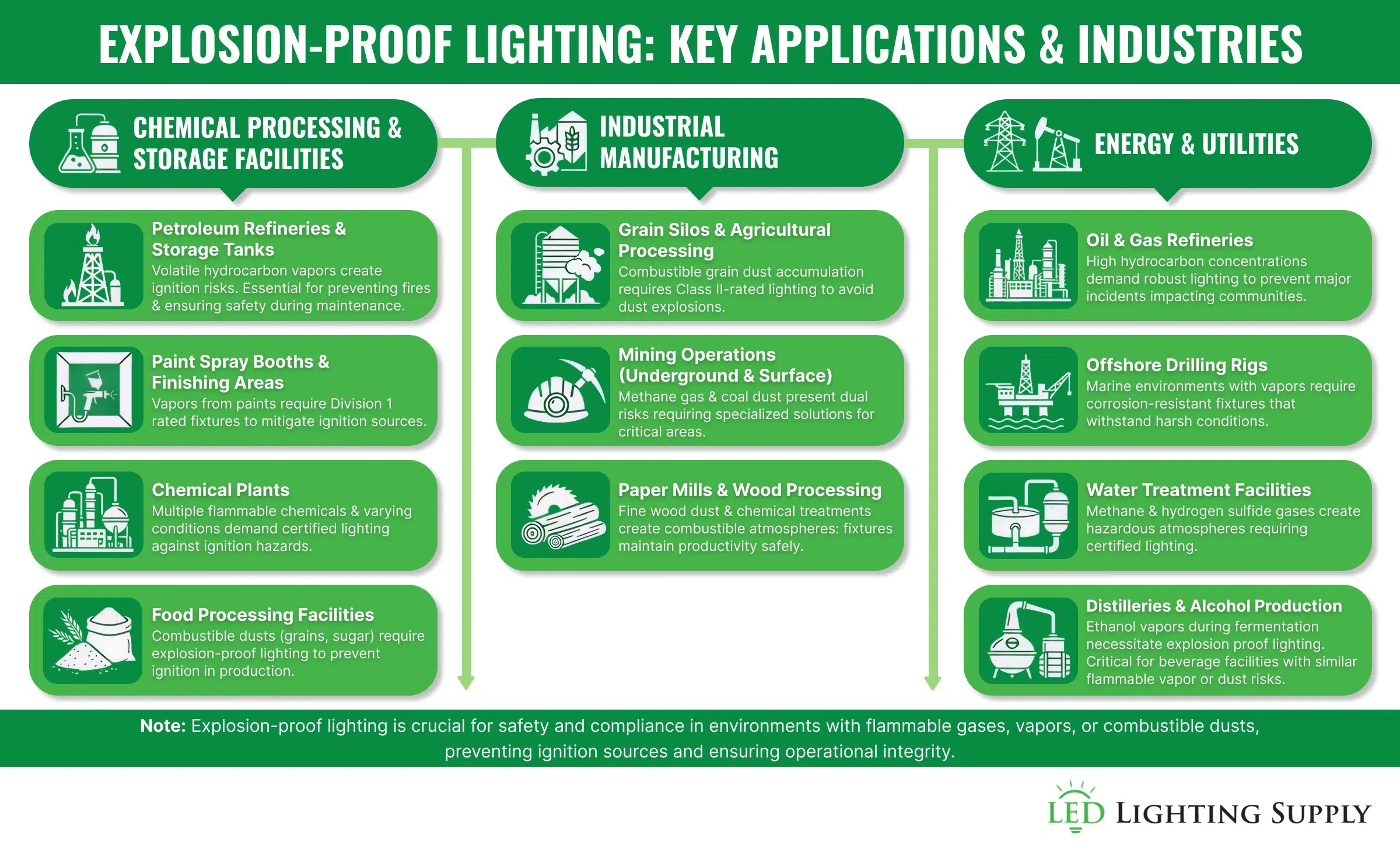
Explosion proof and hazardous location LED lights are used in refineries, laboratories, fabrication shops, food and beverage facilities, wastewater treatment plants, mining operations, and other environments where gases, vapors, dusts, fibers, or flyings may create ignition risks. The correct fixture depends on the facility classification, environmental conditions, mounting method, voltage, and required light levels.

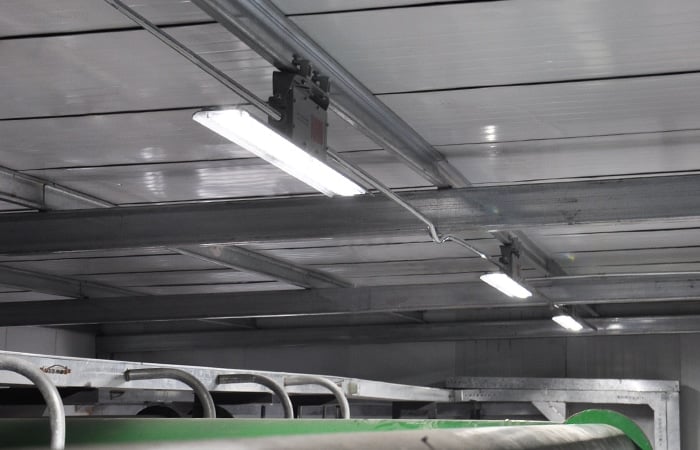
Our customer replaced explosion proof fluorescent fixtures with our 100 Watt 4 Foot Explosion Proof Linear LED Light | 16000 Lumens linear fixtures and saw a significant improvement in light quality after converting to LED.
Case Study: Conversion of existing lighting to LED Lighting Supply Class 1 Division 2 Fixtures in Holbrook, AZ
|
After: 200 Watt Square Explosion Proof LED Light | 28000 Lumens |
After: 200 Watt Square Explosion Proof LED Light | 28000 Lumens |
 |
 |
Lighting Plan We Created for the Customer
|
Lighting Plan |
Heat Map |
 |
 |
Explosion Proof Lighting Installation Plan Metrics
- Mounting height: 20 ft
- Fixture Used: MLLG-E-LED-EXPLA-200-50-[V]-C1D2: 200 Watt Square Explosion Proof LED Light | 28000 Lumens | Class 1 Div 2 | Class 2 Div 2 | 5000K | 100V-277V or 277V-480V
- FC achieved: 62.80 FC average
- Uniformity (Avg/Min): 1.85
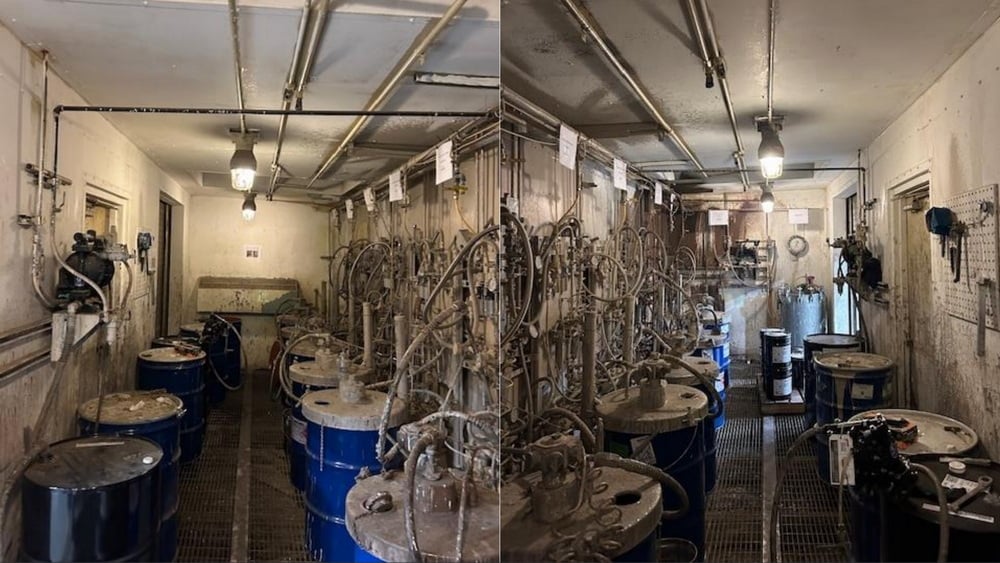
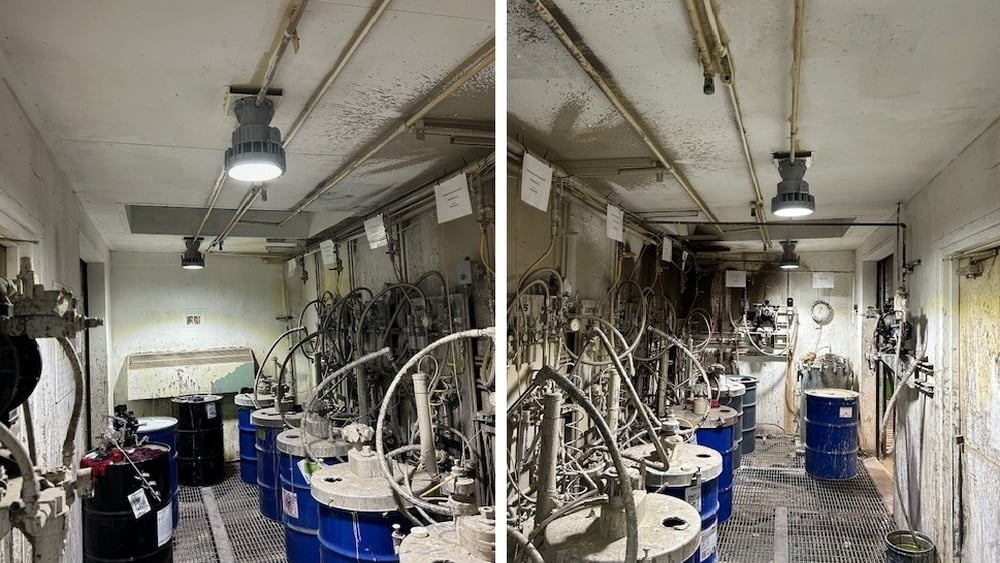
Case Study: Conversion of existing paint booth metal halide explosion proof lighting to LED Lighting Supply Class 1 Division 1 Fixtures in Chicago, IL
|
Before: 100 Watt Round Explosion Proof Metal Halide Light |
After: 50 Watt Round Explosion Proof LED Light | 7000 Lumens |
 |
 |
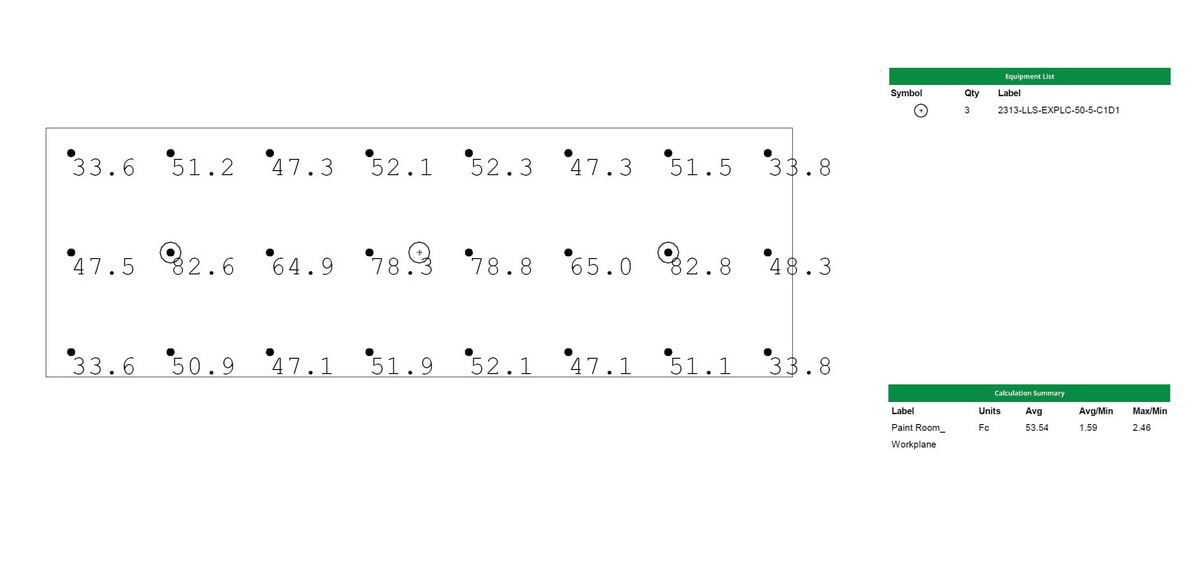
Lighting Plan We Created for the Customer
|
Lighting Plan |
Heat Map |
 |
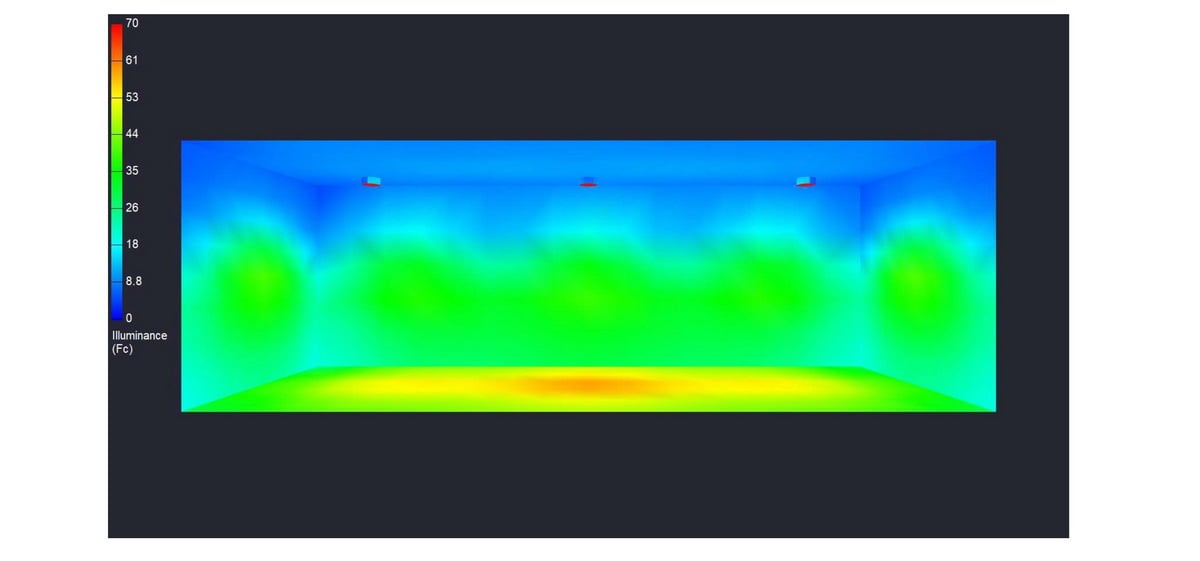 |
Explosion Proof Lighting Installation Plan Metrics
- Mounting height: 10 ft
- Fixture Used: LLS-EXPLC-50-5-C1D1: 50 Watt Round Explosion Proof LED Light | 7000 Lumens | Class 1 Div 1 | 5000K | 100-277V
- FC achieved: 53.54 FC average
- Uniformity (Avg/Min): 1.59

Explosion Proof Certifications & Compliance
Explosion proof and hazardous location lighting must be selected based on the specific classification of the area where the fixture will be installed. The required certification depends on the applicable code system, the hazardous material present, the likelihood of exposure, the material group, the fixture's T Rating, and the installation environment.
LED Lighting Supply offers selected explosion proof and hazardous location lighting fixtures with certifications and ratings for classified industrial environments. Always verify the fixture's listing, Class, Division, Group, T Rating, ambient temperature rating, voltage, mounting method, and environmental ratings before ordering or installing.
- UL 844 listed models available: UL 844 applies to luminaires for hazardous classified locations, including many North American Class/Division applications such as Class I, Class II, and Class III locations when the fixture is marked for the specific classification.
- Class/Division ratings: North American hazardous locations commonly use Class I, II, or III; Division 1 or 2; and applicable Groups A-G depending on the gas, vapor, dust, fiber, or flying material present.
- ATEX and IECEx options available: For international or zone-based projects, selected fixtures may be available with ATEX or IECEx certifications. These systems use zone-based classifications and should be matched to the project's regional code and hazardous area requirements.
- T Rating / Temperature Class: A fixture may have the correct Class and Division but still be unsuitable if its maximum surface temperature is too high for the hazardous material in the area.
Not sure which certification or classification applies to your facility See our Hazardous Location Lighting Buyer's Guide for a full breakdown of NEC vs ATEX standards, zones, divisions, groups, and substance types.
Important: Certification requirements should be confirmed by a qualified engineer, safety professional, licensed electrician, or local electrical code authority before fixtures are purchased or installed in a hazardous classified location.
LED Lighting Supply's Explosion Proof Lighting Advantages
Explosion proof and hazardous location lighting is not selected only for brightness. The fixture must match the required Class, Division, Group, T Rating, voltage, mounting method, and environmental conditions of the installation. Once those safety requirements are confirmed, LED technology can provide major operational advantages over traditional HID, fluorescent, and halogen fixtures.
Energy Efficiency, Visibility & Reduced Maintenance
LED explosion proof fixtures can significantly reduce energy use compared to older HID or fluorescent hazardous location lighting. Depending on the fixture model, wattage being replaced, operating hours, and application, facilities may reduce lighting energy consumption by 50-75% while improving light quality and visibility in work areas.
LED fixtures also eliminate many of the maintenance issues associated with lamps and ballasts. In hazardous areas, reducing maintenance is especially important because every service event may require special procedures, qualified personnel, shutdown planning, lifts, permits, or hot-work controls depending on the facility. Where specified by the model, long-life LED fixtures can help reduce relamping frequency, downtime, and personnel exposure in classified areas.
Explosion proof LED lighting can support demanding industrial environments by offering model-specific options for:
- Class I, Class II, and Class III hazardous location ratings
- Division 1 and Division 2 applications
- Applicable Groups and T Ratings
- High-output illumination for production, inspection, and maintenance areas
- Instant-on performance with no HID warm-up time
- Moisture, dust, corrosion, vibration, and impact resistance where rated
- Lower operating heat compared with many HID fixtures, supporting better thermal performance when properly specified
What are the Cost Savings and ROI When You Convert from Metal Halide to LED?
Compare estimated energy costs, 5-year savings, simple payback, and ROI for replacing metal halide fixtures with LED.
60W LED Explosion Proof Light vs 250W Metal Halide Replacement (with ballast)
Assumptions: Based on 24 hours/day, 365 days/year at $0.16/kWh,
20 fixture(s), and a 15% ballast factor applied to the metal halide wattage
(250W lamp + 15% ballast = ~ 288W input).
•
Energy cost and ROI calculations are based on energy savings only and assume an LED fixture cost of
$415.00 per fixture.
• Maintenance savings from reduced bulb and ballast replacements are not included
in these calculations.
In this example with 20 fixture(s), total LED fixture investment is approximately $8,300.00, and estimated annual energy-only savings are $6,377.28. Simple payback based on energy savings alone is under 16 months. Maintenance savings from eliminating metal halide bulb and ballast replacements provide additional value throughout the fixture's 50,000-hour lifespan, but are not included in this ROI calculation.
Safer Maintenance Planning in Classified Areas
In hazardous locations, maintenance is not just a cost issue. Replacing failed lamps, ballasts, or damaged fixtures can require additional safety controls and qualified labor. By upgrading to properly rated LED explosion proof fixtures, facilities can reduce the number of lighting maintenance events while improving visibility for operators, inspectors, and maintenance teams.
LED fixtures also provide instant-on illumination, which is useful in facilities where lighting is needed immediately after a power interruption, shift change, inspection, or maintenance event. Unlike many traditional HID fixtures, LEDs do not require a long warm-up or restrike period.

Our 40 Watt Explosion Proof Jelly Jar LED Light | 5200 Lumens was installed to replace old halogen jelly jar lights.
Certification, Ratings & Application Fit
LED Lighting Supply offers selected explosion proof and hazardous location fixtures with listed certifications and ratings for classified industrial environments. Because hazardous location requirements vary by site, each fixture should be verified against the required Class, Division, Group, T Rating, ambient temperature rating, voltage, mounting method, and environmental exposure before purchase or installation.
- Listed hazardous location models available: Select fixtures are available with UL, ETL, ATEX, IECEx, or other applicable certifications depending on the product and project requirements.
- Application-specific selection: Fixture style, lumen output, beam angle, mounting, and voltage should be selected based on the classified area and lighting task.
- Environmental durability: Verify IP ratings, corrosion resistance, impact resistance, and ambient temperature limits for the installation environment.
- Professional confirmation: Final fixture selection should be confirmed by a qualified engineer, safety professional, licensed electrician, or local electrical code authority.


Explosion Proof Lighting Installation Planning
Explosion proof lighting should only be installed by qualified electricians experienced with hazardous classified locations. These installations are not the same as standard commercial or industrial lighting projects. The fixture, wiring method, conduit or cable system, junction boxes, seals, fittings, switches, and other electrical components must be approved for the specific hazardous location classification and installed according to the applicable electrical code, product listing, manufacturer instructions, and local code requirements.
Before installation, confirm the required Class, Division, Group, T Rating, ambient temperature rating, voltage, mounting method, wiring method, sealing requirements, and environmental protection. The classification and installation method should be reviewed by qualified personnel familiar with the facility, process conditions, and applicable NEC requirements.
| Installation planning considerations | Confirm the hazardous location classification before selecting fixtures Verify that all electrical components are rated for the classified area Review manufacturer installation instructions and product listings Confirm wiring method, sealing, grounding, bonding, and environmental requirements with a qualified professional Document the fixture ratings and installation requirements for future inspection and maintenance |
| Common problems to avoid | Using standard electrical components in a classified area Mixing rated and non-rated fixtures, boxes, fittings, switches, conduit, or cable systems Installing fixtures before the hazardous area classification is confirmed Assuming a fixture is acceptable because it is labeled “explosion proof” without verifying Class, Division, Group, and T Rating Ignoring manufacturer instructions, local code requirements, or inspection requirements |
Important: This information is for planning purposes only and is not an installation guide. Final installation requirements must be determined by a qualified electrician, engineer, facility safety professional, or local electrical code authority.
LED Explosion Proof Lighting for Hazardous Locations & Industrial Applications Frequently Asked Questions
What Are Explosion Proof Lights
Explosion proof lights are specialized fixtures designed to prevent internal ignitions from causing explosions in hazardous environments. They are essential in areas where flammable gases, vapors, or combustible dusts are present, ensuring safety and compliance with safety standards.
Why Does My Facility Need Explosion Proof Lighting
If your facility operates in environments with flammable materials, explosion proof lighting is crucial for safety and regulatory compliance. These fixtures are engineered to contain potential ignitions, reducing the risk of explosions and ensuring safe operations.
How Do I Determine If My Location Requires Explosion Proof Lighting
Evaluate your facility using the NEC hazardous location classification system. Areas with flammable gases, vapors, or dusts typically require explosion proof lighting. Consult a professional to assess your specific needs and ensure compliance with safety standards.
What Are the Key Considerations When Selecting Explosion Proof Lighting
Consider the hazardous classification of your location, environmental conditions, and specific application needs. Ensure fixtures are certified for your environment and provide adequate illumination for safety and efficiency.
Can I Use Division 2 Fixtures in Division 1 Areas
No, Division 2 fixtures should not be used in Division 1 areas. Division 1 fixtures are designed for continuous exposure to hazardous conditions, while Division 2 fixtures are for areas where hazards are present only under abnormal conditions.
What Certifications Should Explosion Proof Lights Have
Explosion proof lights should have UL844 certification for North American applications. For international use, ATEX and IECEx certifications may be required. Verify that all fixtures meet the necessary safety standards for your specific environment.
How Do Explosion Proof Lights Enhance Safety
Explosion proof lights are designed to prevent ignitions from escaping the fixture, reducing the risk of explosions in hazardous environments. They are tested and certified to meet stringent safety standards, ensuring reliable performance in demanding conditions.
What Are the Installation Requirements for Explosion Proof Lights
Installation must be performed by qualified electricians familiar with hazardous-location work. Use explosion rated conduit systems and ensure all components are properly rated for the environment. Follow NEC guidelines for safe and compliant installations.
What Are the Benefits of LED Explosion Proof Lights
LED explosion proof lights offer energy efficiency, durability, and long fixture life. They reduce energy consumption by up to 75% compared to traditional lighting and are designed to withstand extreme conditions, minimizing maintenance and operational costs.
What Industries Commonly Use Explosion Proof Lighting
Industries such as chemical processing, oil and gas, food and beverage, and mining commonly require explosion proof lighting due to the presence of flammable materials. These fixtures ensure safety and compliance in high-risk environments.