


LED Parking Lot Lights
- Options for retrofits, new installations, and solar-powered sites
- Control-ready models available with photocells and motion sensors
- Free photometric plans help evaluate coverage and fixture placement



Get Your Custom Lighting Plan With Product Recommendations
- Custom Layout Designed Around Pole Height, Spacing, Optics & Site Coverage Requirements
- Precise Fixture Count, Lumen Output & Distribution Type for Uniform Foot-Candle Levels
- Reduce Energy Costs, Eliminate HID Maintenance & Minimize Light Trespass Issues


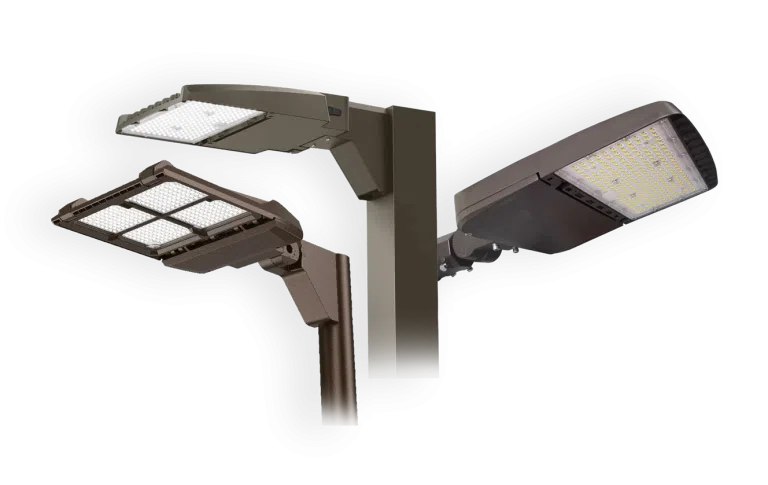
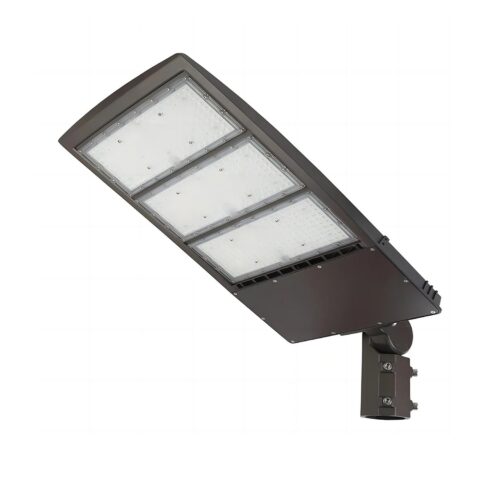
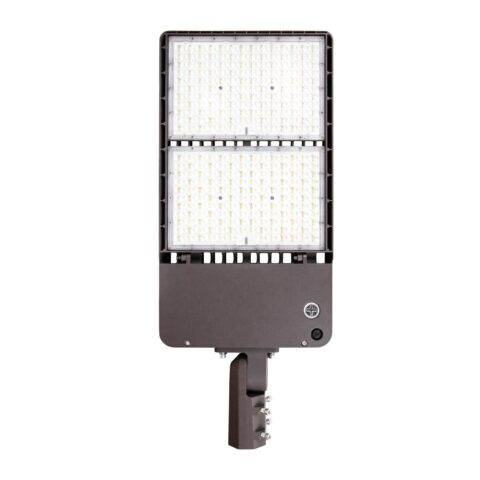
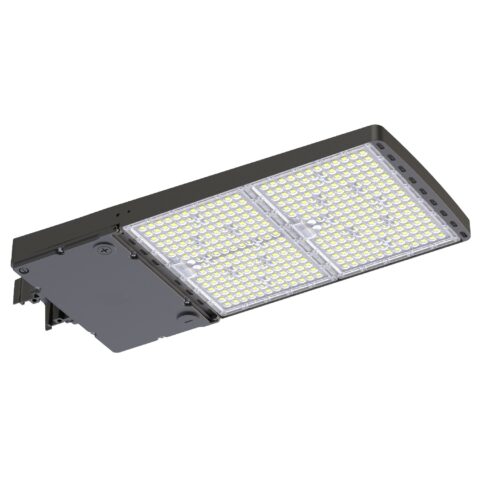
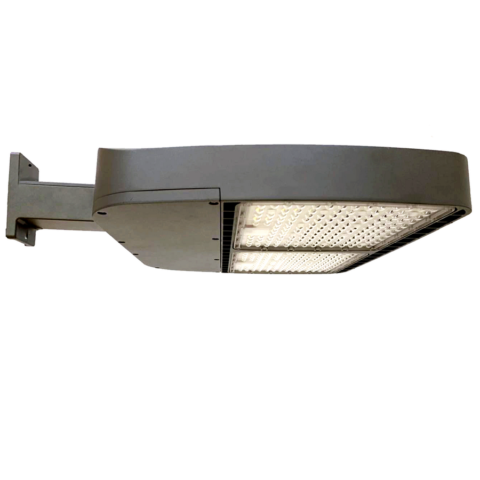
Our Commercial LED Parking Lot Lights include pole-mounted LED shoebox lights and area lights for outdoor site lighting. Available models vary by 100-277V and 277-480V configurations, Type III and Type V optics, mounting options, photocells, motion sensors, dimming, selectable wattage, and selectable color temperature.
These fixtures are commonly used in retail lots, schools, churches, dealerships, apartment complexes, municipal lots, industrial yards, commercial properties, drive lanes, entrances, loading zones, and perimeter areas.





Choosing LED Parking Lot Lights
Start by confirming the site layout, pole height, pole spacing, mounting method, target light levels, voltage, and whether the project is a retrofit or new installation. Then select the optic distribution and fixture output that provide safe, uniform visibility across parking spaces, drive lanes, entrances, pedestrian areas, loading zones, and perimeter areas without creating excessive glare, light trespass, or wasted energy.
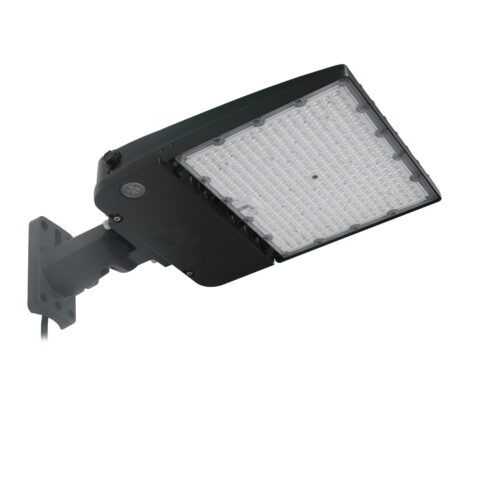
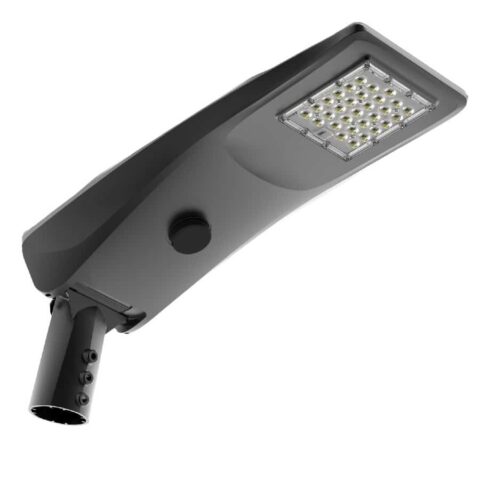
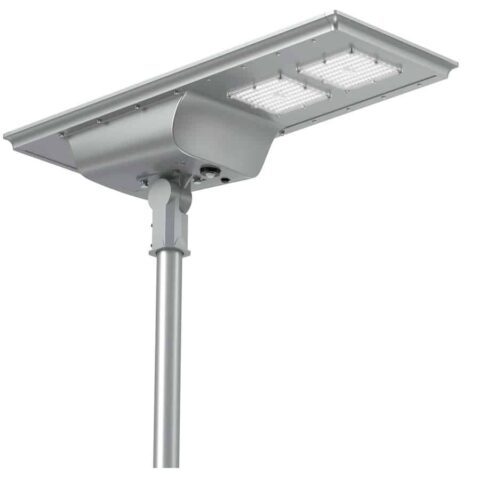
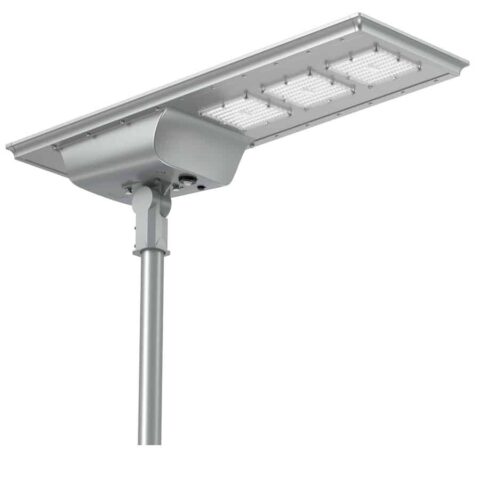
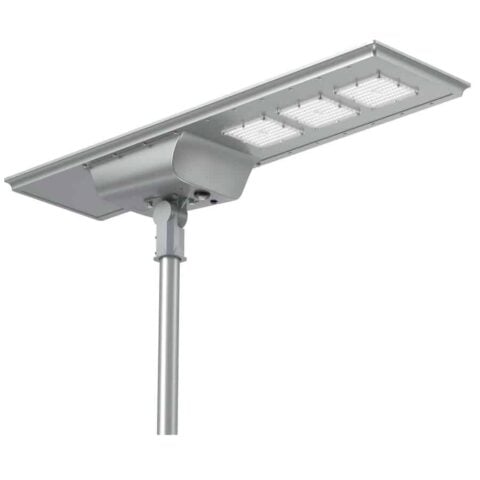
Most parking lot lighting projects use pole-mounted LED shoebox lights or LED area lights. Consider post top lights for decorative areas, solar parking lot lights where wiring or grid power is difficult, retrofit kits where an existing fixture housing can be retained, and wall-mounted area lights or bollards where poles are not practical. Parking lot lighting is commonly used for retail lots, schools, churches, dealerships, apartment complexes, municipal lots, industrial yards, and commercial properties where vehicle and pedestrian visibility are important.
LED parking lot lights can reduce energy use compared to older metal halide, high-pressure sodium, and HID lighting systems when properly specified. Actual savings depend on the existing fixture wattage, operating hours, control strategy, fixture count, and utility rate. Many models are control-ready and can be equipped with photocells for dusk-to-dawn operation or motion sensors for dimming during low-activity periods.
With over 15 years of commercial and industrial lighting experience, LED Lighting Supply's Product Specialists can help confirm fixture count, pole spacing, mounting height, optic distribution, expected light levels, and energy savings before you order. For larger parking lots or safety-critical sites, a photometric lighting plan is the best way to avoid dark spots, overlighting, glare, and light trespass.
Selection and Installation Note: Product specifications, ratings, controls, certifications, and warranty coverage vary by model. Confirm the selected product specification before ordering. For code-sensitive, electrical, exterior, pole-mounted, emergency, wind-load, light-trespass, or safety-critical applications, verify requirements with your local inspector or a licensed electrical professional.
Recommended Foot-Candles for Parking Lot Lighting
Use the tool below to find general starting foot-candle ranges for parking lots, drive lanes, pedestrian areas, loading areas, and other outdoor site lighting applications. Average foot-candles tell you how much light is present overall, while uniformity tells you how evenly the light is distributed. Final fixture count, pole spacing, optics, mounting height, glare control, and uniformity should be verified with a photometric plan.
Step 1: Find your foot candle levels
Step 2: Estimate your fixture count and space
Shoebox Lighting Layout Estimator
Use this estimator to calculate approximate fixture count, pole placement, spacing, and average foot-candles for parking lots, exterior areas, and outdoor sport court applications using LED shoebox fixtures. Enter the area size, mounting height, target foot-candles, light loss factor, and outdoor light use factor to generate a preliminary layout.
Project Inputs
Estimated Results
Estimated average foot-candles are preliminary. The visual heat map is normalized to the estimated average and is intended to show approximate coverage behavior, not a verified lighting plan.
Parking Lot / Exterior Area Mode: Fixtures are placed on poles along the longest edges of the area. Edge fixtures are modeled as level / down-facing shoebox fixtures with the optic directed inward. For wider parking areas, a center row can be added.
Sport Court Mode: Poles are placed on the long edges of the court. Fixtures are modeled as level / down-facing and directed toward court coverage zones instead of being tilted toward one center point.
Photometry / Simulation Note: When usable IES photometry is available for the selected fixture, this estimator uses the fixture’s IES candela data to improve the visual ground-level light distribution. When IES photometry is not available, the estimator uses a simulated Type 3 or Type 5 optic model based on lumens, mounting height, outdoor light use factor, light loss factor, and fixture direction.
Outdoor Light Use Factor: Suggested starting points: open rectangular paved area 0.60–0.70, typical parking lot 0.45–0.60, areas with setbacks or edge losses 0.35–0.50, complex outdoor sites 0.25–0.40.
Preliminary Estimate Only: This estimator is intended for simple rectangular outdoor areas. Actual light levels may vary based on fixture optics, pole setbacks, mounting height, fixture orientation, distribution type, surface reflectance, obstructions, voltage, installation conditions, spill light requirements, and site-specific requirements.
This estimate is a starting point. Parking lots, roadways, sport courts, public areas, campuses, vehicle areas, and code-sensitive exterior projects should be reviewed with a lighting plan before purchase or installation.
Kroger’s Grocery Store Parking Lot Upgrades to LED Area Lighting Case Study
The Backstory:
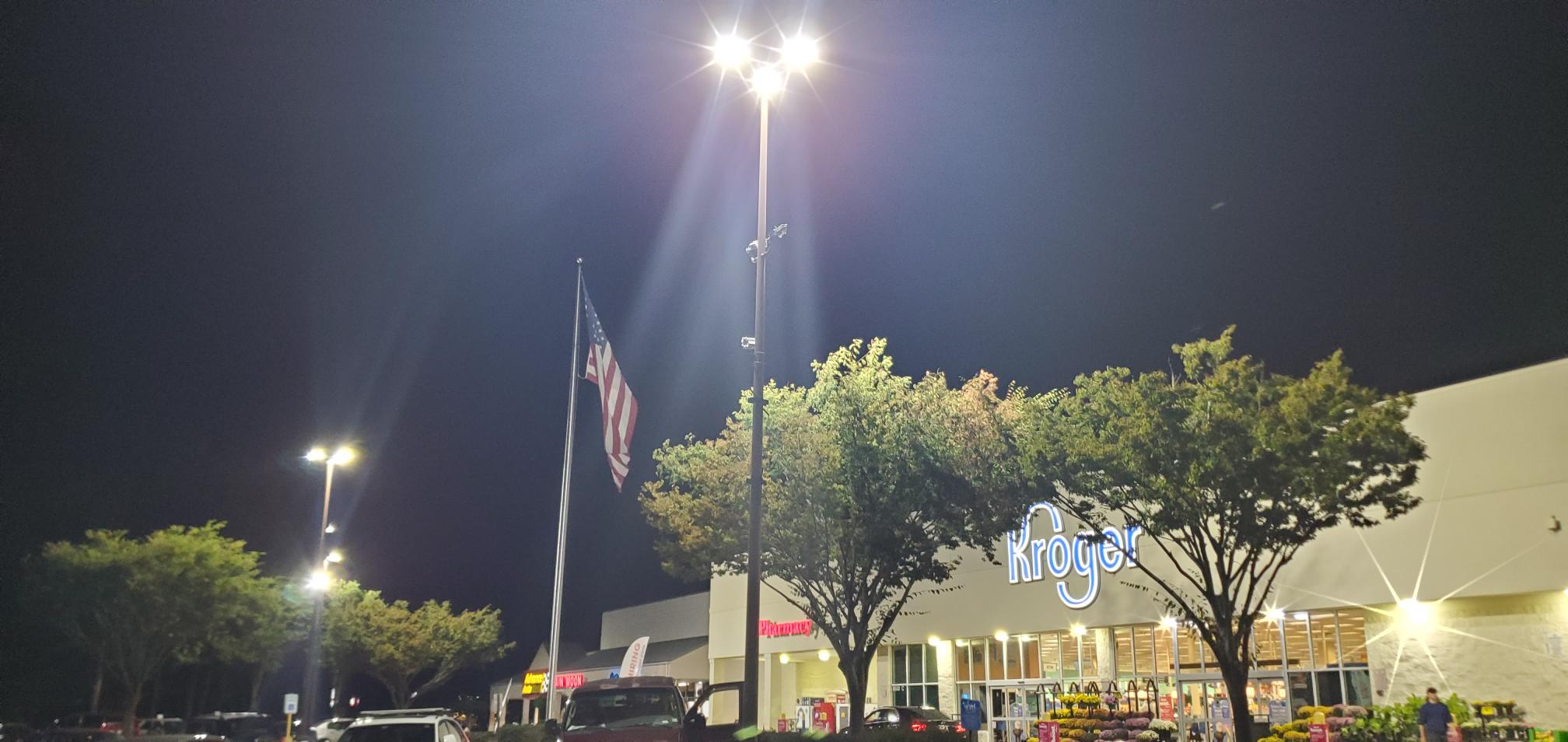
A Kroger grocery store in Maryville, Tennessee, struggled to consistently illuminate its parking lot due to the aging 1,000-watt metal-halide lights it used. The general contractor leading the job, Pat Walsh, President at Walsh Electric, reached out to LED Lighting Supply to assist in selecting the ideal light fixture replacement solution.
Pat previously worked with our Product Specialist, Jeff Cesenaro, on numerous lighting projects. Given their pre-existing relationship, there was no question which company could help get the job done.
The Challenge of Kroger’s Aging Metal Halide Lights:
A parking lot is one of the most safety-sensitive spaces a retailer manages. Consistent parking lot lighting is essential for a high-traffic location like Kroger, where customer safety and visibility directly impact the shopping experience. The metal halide fixtures on site couldn't deliver the consistency needed and were becoming an ongoing cost. Additionally, the building exterior needed perimeter lighting that extends light coverage to the parking area for safety.
Any solution had to be consistent with the existing pole infrastructure to avoid the cost and disruption aspects of new construction. The contractor was seeking a consultative partner to supply the lights and help streamline the replacement project, and they found that with LED Lighting Supply.
Lighting plan metrics:
When LED Parking Lot Lights Are the Right Fit
LED parking lot lights are usually the best starting point when a commercial site needs to replace older HID fixtures, improve visibility, reduce maintenance, add controls, or create a more efficient outdoor lighting system. They are not a one-size-fits-all product. Existing pole condition, mounting height, fixture weight, wind exposure, voltage, optic type, and local lighting requirements should be reviewed before ordering.
| Use LED Parking Lot Lights When | Consider Another Solution When |
|---|---|
| You are replacing metal halide, high-pressure sodium, or other HID parking lot fixtures and want instant-on performance, reduced maintenance, and improved efficiency. | The existing pole, arm, tenon, or foundation is damaged and cannot safely support the selected fixture, bracket, or wind load. |
| The site needs wide-area outdoor coverage for parking spaces, drive lanes, truck courts, entrances, pedestrian routes, or exterior circulation areas. | The area requires narrow task lighting or building-mounted security lighting where a flood light, wall pack, canopy light, or dock light may be a better fit. |
| The project requires controlled light distribution to reduce glare, uplight, dark spots, or light trespass. | The project has strict dark-sky, municipal, neighbor-impact, or light-trespass requirements that have not been checked against the selected optic and layout. |
| The site needs controls, such as photocells, motion sensors, dimming, or scheduled operation. | The electrical system, voltage, circuit capacity, surge protection, or control method has not been confirmed for the selected fixture. |
| You need commercial-grade outdoor fixtures with appropriate safety listings, environmental ratings, surge protection, and warranty support for the application. | Hazardous-location requirements apply and the selected fixture is not specifically rated for the required classified-location conditions. |
LED Lighting for Truck Parking Lots
Truck parking lots require more than basic pavement illumination because parked trailers, wide turning movements, and long vehicle rows can create deep shadows and uneven visibility. Pole-mounted LED parking lot lights should be selected around the actual parking layout, circulation lanes, entrances, pedestrian routes, security cameras, and property boundaries rather than wattage alone.
Controlled optics can direct light between truck rows and along travel paths while reducing glare for drivers looking through windshields and mirrors.
Fixture placement should also account for pole protection, trailer height, camera sightlines, spill light, and dark areas that develop when spaces are occupied. For large or heavily used truck lots, a photometric plan is recommended to verify pole height, fixture output, spacing, minimum light levels, uniformity, and glare before equipment is ordered.
Choosing Parking Lot Lights by Pole Height, Optics, Layout, Mounting, and Light Levels
A successful parking lot lighting project starts with the site layout, not just fixture wattage. The same LED parking lot light can perform very differently depending on pole height, pole spacing, optic type, fixture tilt, mounting location, surrounding buildings, landscaping, traffic patterns, nearby property lines, and the fixture or mounting type selected.
For retrofit projects, review the existing poles, fixtures, voltage, mounting hardware, and light levels. For new construction, the layout should be designed around target illumination levels, uniformity, pole placement, glare control, and local requirements. In both cases, a photometric plan can confirm fixture count, mounting height, optic selection, expected foot-candles, and light spill before the project is installed.
| Selection Factor | Why It Matters |
|---|---|
| LED shoebox / area lights | Used for most commercial parking lots, industrial yards, drive lanes, campuses, dealerships, and exterior open areas where pole-mounted lighting is required. |
| Post top lights | Used for decorative parking areas, pedestrian zones, campuses, parks, apartment complexes, and commercial properties where appearance matters as much as light output. |
| Solar parking lot lights | Used where trenching, wiring, or grid power is difficult or expensive. Solar lighting should be matched to local sun exposure, runtime requirements, pole height, and battery capacity. |
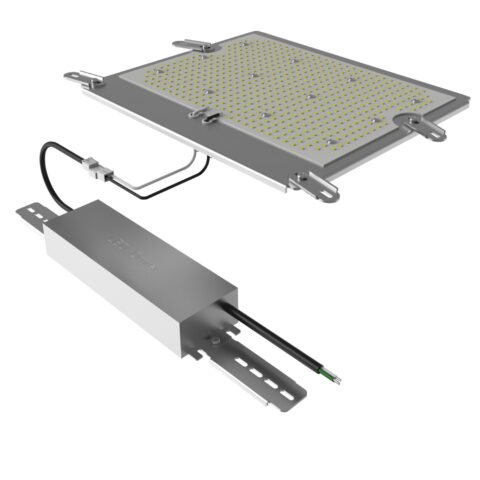
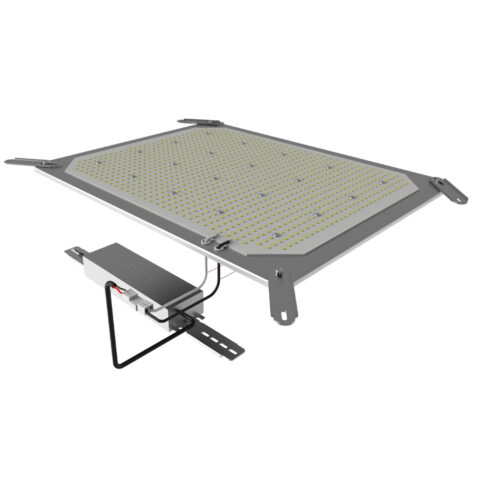
| Parking lot retrofit kits | Used to upgrade existing HID parking lot fixtures while retaining the existing fixture housing where appropriate. Retrofit suitability depends on housing condition, thermal performance, voltage, and installation requirements. |
| Parking lot light poles | Used for new parking lot lighting projects or pole replacement. Pole height, wind rating, foundation, bolt pattern, fixture EPA, mounting geometry, and site wind criteria should be verified before installation. |
| Wall-mounted area lights | Used for building-mounted perimeter lighting, entrances, loading docks, drive lanes near structures, and smaller parking areas where poles are not practical. |
| Bollard and walkway lights | Used for pedestrian routes, walkways, building entrances, parks, campuses, and areas where lower-level pathway lighting is needed alongside parking lot fixtures. |
| Lot size and shape | Large rectangular lots, narrow drive lanes, irregular layouts, and corner lots may require different fixture placements, optics, and pole locations. |
| Pole height | Higher poles can cover more area but require the correct lumen package and optic. Lower poles may need lower output, tighter spacing, or glare control. |
| Pole spacing | Wide spacing can create dark zones if fixture output or optic is not matched correctly. Tight spacing can overlight the site if wattage is too high. |
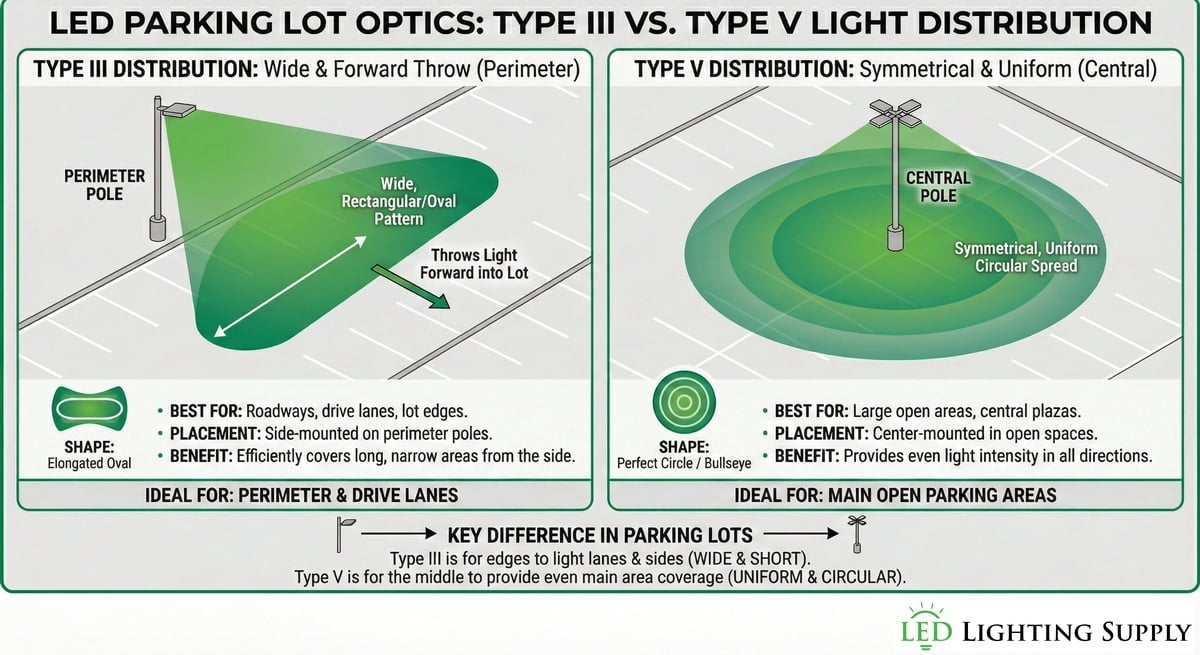
| Perimeter vs center poles | Perimeter poles often need forward-throw optics, while center poles may use symmetrical optics to spread light in multiple directions. |
| Optics / beam distribution | Type III distributions are commonly used where an asymmetric forward throw is needed, such as perimeter or building-side locations. Type V distributions are commonly used for more symmetrical coverage around interior pole locations. Final optic selection should be based on the site layout and fixture photometry. |
| Target foot-candles | Light levels should match the use of the lot, traffic level, security needs, pedestrian activity, and applicable project requirements. |
| Uniformity | Uniformity helps reduce dark spots and overly bright patches. A lot can have enough average light but still feel unsafe if coverage is uneven. |
| Glare and light trespass | Improper aiming, excessive output, or the wrong optic can create glare for drivers and pedestrians or spill light onto neighboring properties. |
| Voltage compatibility | Standard 100-277V and high-voltage 277-480V parking lot light options are available on selected models. Verify existing circuit voltage before ordering. |
| Mounting method | Slip fitter, arm mount, yoke/trunnion mount, direct arm mount, wall mount, and retrofit brackets are available. Existing hardware and fixture compatibility should be verified before purchase. |
| Controls | Photocells, motion sensors, dimming, and scheduled operation may be available depending on fixture model, mounting height, detection pattern, and site activity. |
| Surge protection | Outdoor pole-mounted fixtures can be exposed to electrical disturbances, so fixture-level and site-level surge protection should be reviewed before ordering. |
| Adjustable output | Selectable wattage and selectable color temperature may be useful when the site needs field adjustment after installation. Available options vary by model. |
| Pole and foundation condition | Confirm pole condition, foundation condition, fixture weight, EPA, tenon size, mounting geometry, and applicable wind-load requirements before replacing existing fixtures. A qualified professional should determine structural suitability where required. |
Tip: Do not match HID wattage directly to LED wattage. LED replacement should be based on lumen output, optic distribution, mounting height, pole spacing, and target foot-candle levels.
Replacing Metal Halide Parking Lot Lights with LED
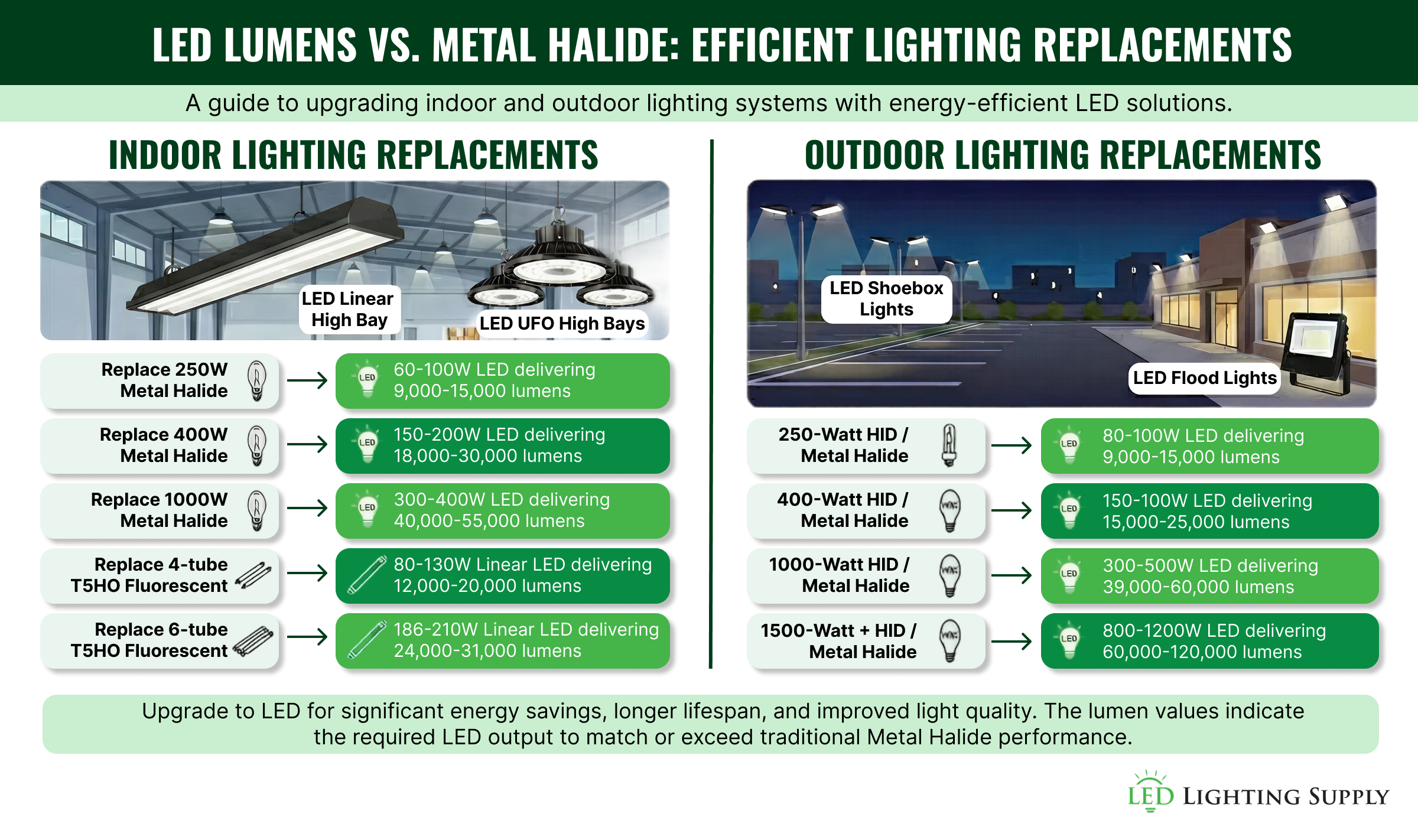
Many parking lot lighting projects involve replacing older metal halide, high-pressure sodium, or other HID fixtures with LED shoebox or area lights. LED parking lot lights can replace HID fixtures with lower wattage, instant-on performance, improved control compatibility, and reduced long-term maintenance. The right replacement depends on more than the old fixture wattage. Pole height, pole spacing, lumen output, optic distribution, color temperature, fixture tilt, and target foot-candle levels all affect the result.
The ranges below are general starting points. Final replacement should be based on delivered lumens, optic distribution, pole height, spacing, target foot-candle levels, voltage, mounting method, and photometric results.
| Existing HID Fixture | General LED Parking Lot Starting Point |
|---|---|
| 250W metal halide or HPS | Often replaced with approximately 10,000 to 15,000 LED lumens, depending on pole height, spacing, optic type, and target light levels. |
| 400W metal halide or HPS | Often replaced with approximately 15,000 to 30,000 LED lumens, depending on pole height, spacing, optic type, and target light levels. |
| 1000W metal halide or HPS | Often replaced with approximately 40,000 to 60,000+ LED lumens, depending on mounting height, site layout, fixture spacing, and project requirements. |
- Reduced maintenance: LED fixtures avoid the lamp and ballast replacements associated with many HID systems.
- Instant on and instant off: LED fixtures reach full output immediately, unlike many HID systems that require warm-up time.
- Control compatibility: Many LED parking lot fixtures support photocells, motion sensors, dimming, and scheduled operation.
- Directional light control: LED optics can help direct light toward parking areas, drive lanes, and pedestrian zones instead of wasting light where it is not needed.
- Light pollution control: Proper optics, back shields, fixture placement, and aiming can help reduce glare, uplight, and light trespass.
- Adjustable output: Selectable wattage and selectable color temperature options may be available depending on model and site needs.

We were asked to recommend a parking lot fixture to replace 400 Watt high-pressure sodium fixtures. The customer said our lights made the area brighter and safer.
Parking Lot Lighting Certifications and Warranty Support
Selected LED parking lot lights from LED Lighting Supply carry a safety listing from a Nationally Recognized Testing Laboratory, such as UL or ETL, depending on the product. Many models may be DLC or DLC Premium listed for utility rebate programs where available. DLC qualification is an efficiency and performance program, not an electrical safety certification. Rebate requirements vary by utility, region, and product listing, so confirm eligibility on the selected product specification before ordering.
Warranty coverage varies by product, with many LED parking lot lights offering a 5-year warranty unless otherwise specified. Before purchase, confirm certifications, DLC status, voltage, controls compatibility, mounting method, wet-location or environmental rating, surge protection, warranty terms, and whether the fixture is right for the parking lot layout, pole height, mounting setup, and surrounding site conditions. An IP rating addresses protection against solids and water ingress; it does not by itself establish corrosion resistance, chemical resistance, or hazardous-location suitability.

Our customer used our LED parking lot lights to upgrade from high-pressure sodium fixtures.
Before You Order: Parking Lot Lighting Project Checklist
After selecting a fixture style and preliminary layout, use this checklist to make sure the order can be installed as planned. These are practical purchasing and coordination decisions that can prevent change orders, delays, or incompatible equipment on site.
- Document the existing mounting connection: Photograph and measure the pole tenon, arm, bolt pattern, or fixture bracket. Confirm that the selected fixture and mount are compatible; slip fitter, arm, yoke, wall, and trunnion mounts are not universally interchangeable.
- Confirm circuit voltage and controls wiring: Verify the available branch-circuit voltage, photocell receptacle or sensor requirements, dimming leads, and any lighting-control system compatibility before ordering.
- Choose an optic for each pole location: A perimeter pole may need a different distribution than an interior pole. Use the fixture-specific IES photometric file and site layout rather than assigning one optic to every location.
- Review the final photometric layout: Check average and minimum illuminance, uniformity, glare, property-line spill light, and light coverage around entrances, pedestrian paths, accessible routes, loading areas, and cameras where applicable.
- Verify structural and wind-loading information: Compare fixture weight, effective projected area (EPA), brackets, and mounting geometry with available pole and manufacturer loading data. Pole, foundation, and structural capacity should be evaluated by the appropriate qualified professional when required.
- Specify environmental protection for the actual exposure: Select a wet-location-rated fixture and review enclosure rating, housing material, finish, seals, hardware, and manufacturer documentation when salt, chemicals, coastal air, washdown, or corrosive conditions are present.
- Confirm product listings and rebate documentation: Match the exact catalog number, voltage, optic, controls, and options to the required safety listing, DLC listing, or utility rebate requirements. Options can affect qualification.
- Plan installation access and commissioning: Coordinate lift access, pole access, circuit shutdowns, aiming or orientation, photocell direction, control programming, and post-installation nighttime verification.
Request a free parking lot lighting plan, and our Product Specialists can help match fixture output, pole spacing, optics, mounting hardware, voltage, controls, and light levels to your site..
LED Parking Lot Lights FAQs
How Should I Choose LED Parking Lot Lights For My Site?
Choose LED parking lot lights based on site layout, pole height and spacing, mounting method, target light levels, voltage, optic distribution, controls, and whether the project is a retrofit or new installation. Fixture selection should also account for wind exposure, surrounding conditions, glare, light trespass, and existing hardware where applicable.
How Can I Determine The Right Fixture Count And Pole Spacing?
Fixture count and pole spacing should be verified with a photometric plan using the site layout, mounting height, fixture output, optics, target foot-candles, uniformity, and glare control. For larger parking lots or safety-critical sites, a photometric lighting plan is the best way to avoid dark spots, overlighting, glare, and light trespass.
Should I Match HID Wattage Directly To LED Wattage?
No. LED replacement should be based on lumen output, optic distribution, mounting height, pole spacing, and target foot-candle levels rather than matching HID wattage directly to LED wattage.
Which Optic Distribution Should I Use For Parking Lot Lights?
Type III optics are commonly used for perimeter and building-mounted fixtures, while Type V optics are commonly used for interior pole locations. Final optic selection should be based on the site layout.
What Should I Verify Before Retrofitting Existing Parking Lot Fixtures?
For a retrofit, review the existing poles, fixtures, voltage, mounting hardware, and light levels before ordering. Also confirm pole and foundation condition, fixture weight, EPA, tenon size, wind-load requirements, and compatibility of the selected mounting method.
What Voltage Options Are Available For LED Parking Lot Lights?
Standard 100-277V and high-voltage 277-480V options are available. Verify the existing circuit voltage before ordering.
Can LED Parking Lot Lights Use Photocells Or Motion Sensors?
Many LED parking lot light models are control-ready and can be equipped with photocells for dusk-to-dawn operation or motion sensors for dimming during low-activity periods. Photocells, motion sensors, dimming, and scheduled operation may be available depending on fixture model, mounting height, detection pattern, and site activity.
What Should Be Considered For Truck Parking Lot Lighting?
Truck parking lot lighting should be selected around the actual parking layout, circulation lanes, entrances, pedestrian routes, security cameras, and property boundaries rather than wattage alone. Fixture placement should also account for pole protection, trailer height, camera sightlines, spill light, and dark areas that develop when spaces are occupied.
