


TAA-Compliant LED Parking Lot Lights
- Documented TAA-compliant options for government and contractor projects
- Multiple optical distributions available for varied site layouts
- Product specialists help match fixtures to project requirements



Get Your Custom Lighting Plan With Product Recommendations
- Layout planned around pole height, spacing, and optical distribution to help achieve target foot-candles and uniformity
- Fixture selection matched to lumen output, beam type, voltage, controls, and environmental ratings for the site
- LED fixtures can reduce energy use and extend maintenance intervals compared with legacy area lighting


Our TAA-Compliant LED Parking Lot Lights for Government Projects include pole-mounted shoebox area lights with controlled optical distributions for outdoor lighting installations. Available models include Type II, Type III, Type IV, and Type V optics, multiple voltage configurations, and photocell, motion-sensor, dimming, scheduling, and building-management control options.
These fixtures are used in federal office parking lots, military support facilities, government campuses, courthouses, public agency buildings, fleet and maintenance yards, federal warehouses, public works properties, schools, and institutional campuses.
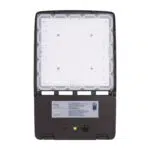



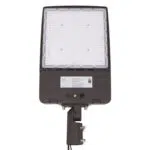
TAA-Compliant LED Parking Lot Lights
TAA-compliant LED parking lot lights are designed for government, military, institutional, and contractor-led outdoor lighting projects that require products meeting applicable Trade Agreements Act procurement rules. These pole-mounted area lights use shoebox-style housings and controlled optical distributions to illuminate parking areas, roadways, vehicle yards, campuses, and other large outdoor spaces. Fixture selection should account for pole height, pole spacing, mounting position, target foot-candles, lumen output, optical distribution, voltage, controls, environmental exposure, and project procurement requirements.
Procurement Note: TAA compliance does not automatically qualify a fixture for every federal, state, municipal, military, or publicly funded project. Confirm the applicable solicitation clauses, acquisition threshold, funding requirements, and product documentation before ordering.
What Does TAA Compliant Mean?
The Trade Agreements Act applies to covered federal acquisitions and permits qualifying products from the United States and designated countries to receive eligible treatment. A product generally qualifies when it is manufactured in the United States or a designated country, or substantially transformed there into a new and different commercial product. A manufacturer, distributor, or seller being based in the United States does not independently establish TAA compliance. Confirm current documentation for the exact parking lot light model and configuration being purchased.
Where TAA Parking Lot Lights Work Well
| Facility or Project | Lighting Considerations |
|---|---|
| Federal office parking lots | Area lighting should support vehicle circulation, pedestrian routes, entrances, parking spaces, and security-camera visibility. |
| Military bases and support facilities | TAA parking lot lights may be used around administrative buildings, housing-support areas, storage facilities, parking areas, and non-classified support properties when permitted by the specification. Review broader military base LED lighting solutions when coordinating multiple facility areas. |
| Government campuses | Fixture placement should account for parking areas, internal roadways, pedestrian crossings, building approaches, glare, and spill light. |
| Courthouses and public agency buildings | Lighting may be required for public parking, employee parking, entrances, walkways, security zones, and after-hours access. |
| Government fleet and maintenance yards | Higher light levels or controlled distributions may be needed around parked vehicles, equipment areas, service bays, fuel areas, and circulation routes. Indoor and service-area requirements may also call for dedicated fleet maintenance facility lighting. |
| Federal warehouses and distribution facilities | Outdoor lighting may cover employee parking, loading approaches, trailer areas, access roads, security perimeters, and vehicle staging areas. |
| Public works properties | Applications can include municipal garages, equipment yards, maintenance facilities, storage properties, and employee parking where TAA products are required or permitted. |
| Government contractor projects | TAA-compliant area lights may be required when federal procurement clauses are passed through to the contractor or subcontractor. |
| Institutional and educational facilities | Schools, training centers, and institutional campuses may use TAA fixtures when applicable federal procurement or funding requirements are included in the project. |
Choosing a TAA-Compliant Parking Lot Light
- Confirm TAA documentation: Verify compliance for the exact fixture, driver, wattage, voltage, and configuration being ordered.
- Review the project specification: Determine whether the project requires TAA, Buy American, Buy America, BABA, or another domestic-preference standard.
- Match output to the site: Select lumen output based on pole height, pole spacing, target foot-candles, site dimensions, and photometric performance.
- Choose the correct distribution: Type II, Type III, Type IV, Type V, or other optics should be matched to pole location and the shape of the area being illuminated.
- Confirm voltage: Verify whether the site uses standard commercial voltage or a 277-480V electrical system. Review documented 480-volt LED parking lot lights when required.
- Review mounting: Confirm compatibility with the parking lot light pole, tenon, arm, slip fitter, direct mount, or other mounting hardware.
- Evaluate controls: Review parking lot lights with photocells, motion-sensor parking lot lights, dimming, scheduling, and building-management compatibility.
- Check environmental ratings: Confirm IP rating, wet-location suitability, operating temperature, wind exposure, corrosion resistance, and surge protection.
- Verify certifications separately: UL, ETL, DLC, DLC Premium, and utility-rebate eligibility do not independently establish TAA compliance.
Photometric Planning for Government Parking Areas
A photometric plan is recommended for government parking lots, campuses, fleet yards, roadways, and other large outdoor projects. The plan can help verify pole locations, fixture quantity, lumen output, optical distribution, average and minimum foot-candles, uniformity, glare, and light spill before installation. Existing poles should also be reviewed for height, spacing, condition, mounting configuration, wind loading, and available voltage. Replacing fixtures by wattage alone may produce poor uniformity or leave dark areas between poles.
When TAA Compliance May Not Be Enough
A TAA-compliant parking lot light is not automatically approved for every government or publicly funded project. State and local purchases, federally funded infrastructure, Department of Defense acquisitions, construction contracts, and projects subject to Buy American, Buy America, or Build America, Buy America requirements may use different rules. Parking lot lights incorporated into a government construction project may be evaluated as construction materials rather than as a separate supply purchase. The contracting officer, purchasing authority, general contractor, or project specifier should confirm the applicable requirements before fixtures are ordered.
Need Help Choosing TAA-Compliant Parking Lot Lights?
Contact us about TAA-compliant LED parking lot lights, and our Product Specialists can help identify documented TAA options and review pole height, site dimensions, lumen output, optical distribution, voltage, controls, mounting, environmental ratings, certifications, and photometric planning requirements.
TAA-Compliant LED Parking Lot Lights FAQs
How Can I Verify TAA Compliance For A Parking Lot Light?
Verify current TAA documentation for the exact parking lot light model and configuration being purchased, including the fixture, driver, wattage, and voltage. A manufacturer, distributor, or seller being based in the United States does not independently establish TAA compliance.
What Factors Should Determine Parking Lot Light Output?
Select lumen output based on pole height, pole spacing, target foot-candles, site dimensions, and photometric performance. Replacing fixtures by wattage alone may produce poor uniformity or leave dark areas between poles.
How Should I Choose An Optical Distribution?
Type II, Type III, Type IV, Type V, or other optics should be matched to the pole location and the shape of the area being illuminated. Fixture selection should also account for target foot-candles, lumen output, and pole spacing.
Why Is A Photometric Plan Recommended For Large Outdoor Projects?
A photometric plan can help verify pole locations, fixture quantity, lumen output, optical distribution, average and minimum foot-candles, uniformity, glare, and light spill before installation. It is recommended for government parking lots, campuses, fleet yards, roadways, and other large outdoor projects.
What Existing Pole Conditions Should Be Reviewed?
Existing poles should be reviewed for height, spacing, condition, mounting configuration, wind loading, and available voltage. Mounting compatibility should also be confirmed with the parking lot light pole, tenon, arm, slip fitter, direct mount, or other mounting hardware.
Is TAA Compliance Enough For Every Government Or Publicly Funded Project?
No, a TAA-compliant parking lot light is not automatically approved for every government or publicly funded project. Projects may be subject to different rules, including Buy American, Buy America, or Build America, Buy America requirements, so applicable solicitation clauses, funding requirements, and product documentation should be confirmed before ordering.
