LED Tennis Court Lights
- Fixtures available for indoor ceiling or outdoor pole mounting
- Photometric plans help evaluate court coverage and glare control
- DLC-listed options available for utility rebate eligibility


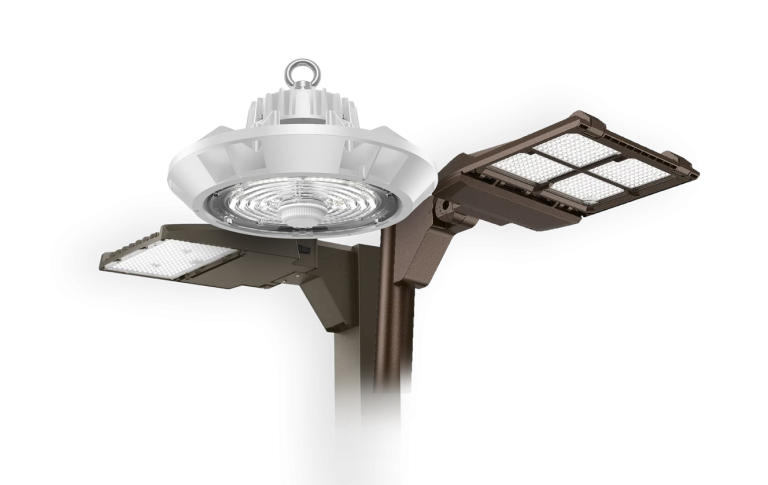

Our LED Tennis Court Lighting includes indoor high bays, linear fixtures, court fixtures, indirect lighting systems, pole-mounted area lights, sports field lights, and adjustable flood lights. Available models vary by wattage, lumen output, beam angle, optics, 4000K or 5000K color temperature, 100-277V or 277-480V configurations, dimming, timers, photocells, motion sensors, and court-bank controls.
These fixtures are used for private outdoor courts, school courts, tennis clubs, indoor tennis facilities, recreation facilities, multi-court complexes, training courts, and competition courts.
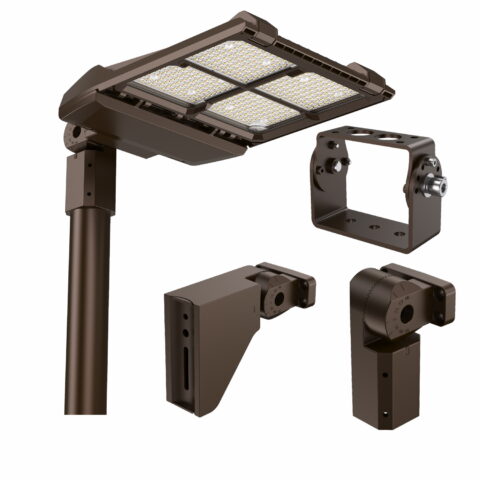


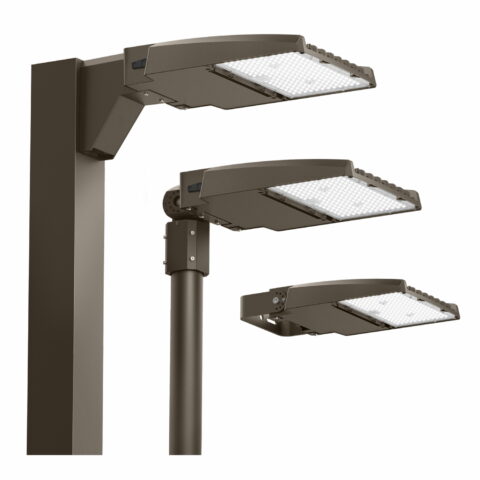


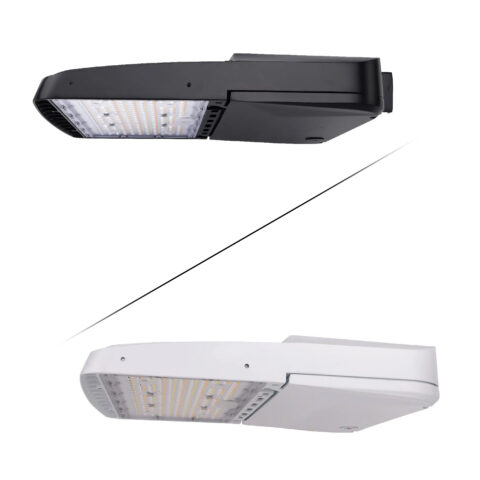
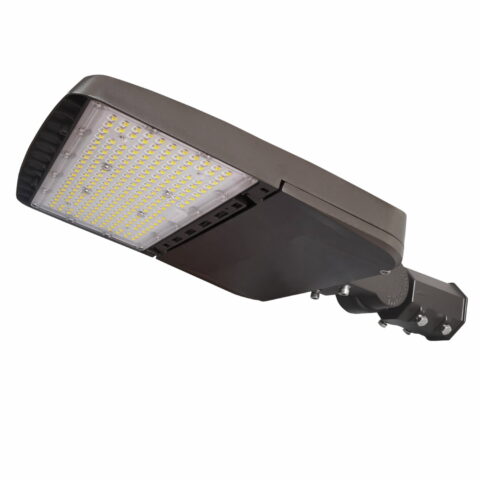
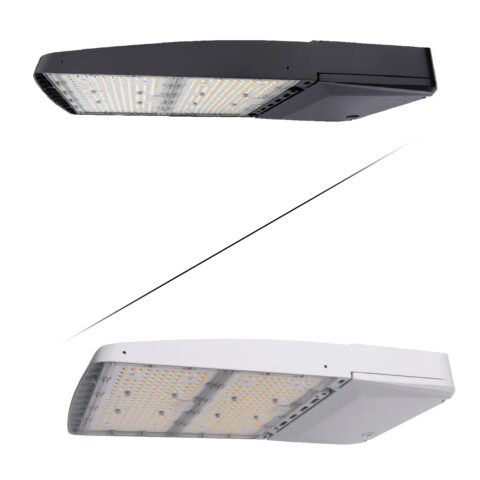
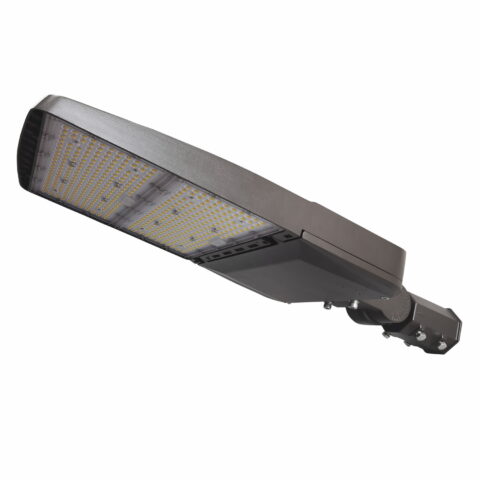

Tennis Court Lighting Starts with Ball Tracking, Glare Control, and Court Coverage
Start by identifying whether the court is indoor or outdoor, the level of play, and the target light level. Then plan the fixture layout around court coverage, baseline-to-net visibility, ball tracking, mounting conditions, pole placement or ceiling height, glare control, light uniformity, controls, and electrical infrastructure. A private outdoor court, school court, tennis club, indoor facility, multi-court complex, and competition court may all need different fixture layouts.
Tennis creates different lighting challenges than pickleball. Players look across a longer court, track higher overhead shots, serve from the baseline, move through doubles alleys, and react to fast ball movement over a larger playing surface. Poorly placed fixtures can create glare during serves and overheads, dark zones near the baseline, uneven light near the net, or uncomfortable bright spots along the sidelines.
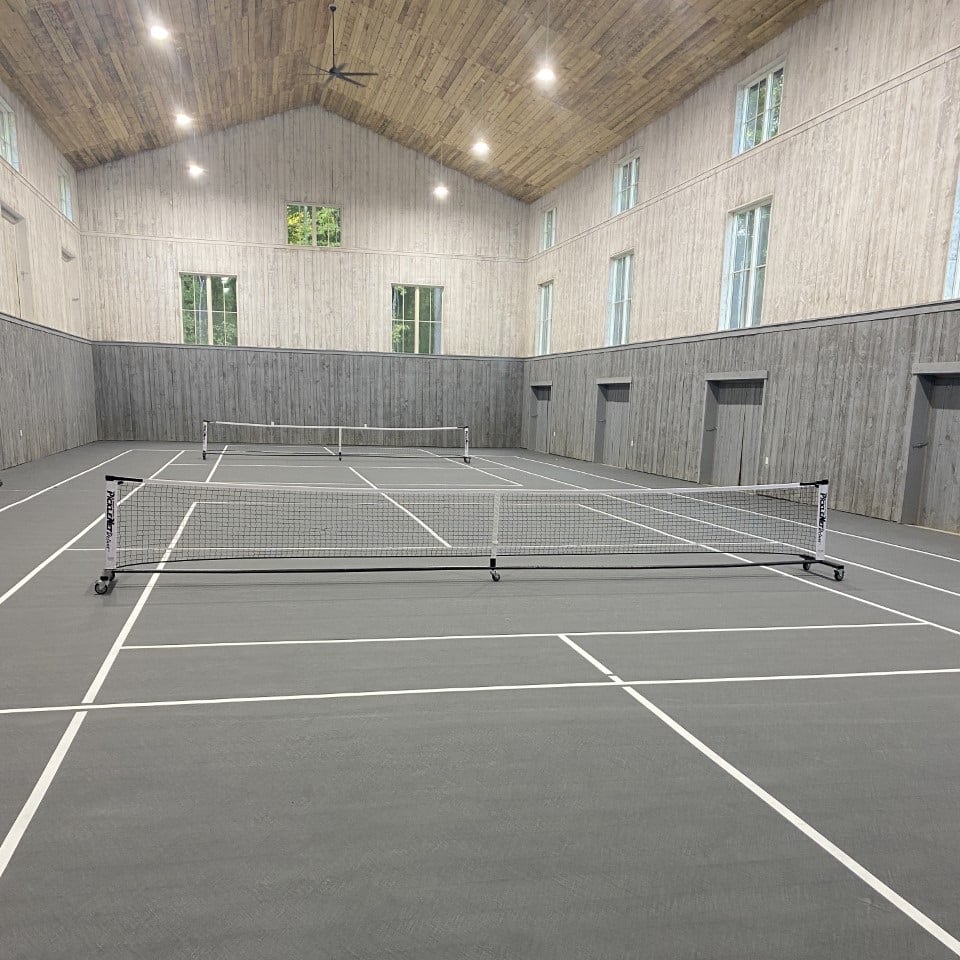
Most indoor tennis courts use ceiling-mounted LED high bays, linear fixtures, court fixtures, or indirect lighting systems depending on ceiling height, structure, court use, and glare goals. Outdoor tennis courts usually use pole-mounted LED area lights, sports field lights, or adjustable flood lights depending on pole height, pole setback, court count, spill-light limits, and required light levels.
Selection and Installation Note: Product specifications, fixture wattage, lumen output, beam angle, optic type, mounting hardware, voltage, controls, dimming, motion sensors, surge protection, impact rating, certifications, and warranty coverage vary by model. Confirm the selected product specification before ordering. For indoor tennis courts, outdoor courts, pole-mounted lighting, multi-court complexes, recreation facilities, electrical upgrades, structural mounting review, emergency lighting, code-sensitive applications, or safety-critical projects, verify requirements with your local inspector, structural professional, or licensed electrical professional.
Where Tennis Court Lighting Usually Goes Wrong
Tennis lighting problems usually show up during play, not on a fixture spec sheet. A layout can look bright from the sidelines but still create problems for players serving, tracking lobs, moving at the baseline, or playing doubles. Before selecting fixtures, review the court from the player’s point of view.
| Problem Area | Why It Matters |
|---|---|
| Baseline visibility | Players need consistent light when serving, returning, and tracking deep shots near the back of the court. |
| Overhead shot glare | Poor fixture placement can put bright sources in a player’s line of sight during serves, lobs, and overheads. |
| Net and service box coverage | Uneven light near the net or service boxes can make short shots, volleys, and ball spin harder to read. |
| Doubles alleys | Lighting should cover the full playing area, including sidelines and doubles alleys, not only the center court. |
| Multi-court glare | Fixtures aimed for one court can create glare or spill into adjacent courts if the layout is not planned carefully. |
| Outdoor spill light | Courts near homes, roads, parks, or neighboring facilities may need tighter optics, shielding, or aiming control. |
Recommended Foot-Candles for Tennis Court Lighting
Tennis court lighting levels vary by court use, level of play, and whether the court is indoors or outdoors. Recreational courts may need lower light levels than club, school, competition, or tournament courts. Indoor and outdoor courts may also need different layouts even when the target foot-candle range is similar because ceiling height, pole placement, background contrast, and glare control are different.
Use the foot-candle guide below as a starting point for indoor and outdoor tennis court lighting levels. Final fixture selection and fixture quantity should be confirmed with a photometric plan that accounts for court dimensions, ceiling height, pole height, pole setback, fixture placement, beam angles, aiming, uniformity, glare, spill light, controls, and electrical infrastructure.
Step 1: Find Your Target Foot-Candle Levels
Shoebox Lighting Layout Estimator
Use this estimator to calculate approximate fixture count, pole placement, spacing, and average foot-candles for parking lots, exterior areas, and outdoor sport court applications using LED shoebox fixtures. Enter the area size, mounting height, target foot-candles, light loss factor, and outdoor light use factor to generate a preliminary layout.
Project Inputs
Estimated Results
Estimated average foot-candles are preliminary. The visual heat map is normalized to the estimated average and is intended to show approximate coverage behavior, not a verified lighting plan.
Parking Lot / Exterior Area Mode: Fixtures are placed on poles along the longest edges of the area. Edge fixtures are modeled as level / down-facing shoebox fixtures with the optic directed inward. For wider parking areas, a center row can be added.
Sport Court Mode: Poles are placed on the long edges of the court. Fixtures are modeled as level / down-facing and directed toward court coverage zones instead of being tilted toward one center point.
Photometry / Simulation Note: When usable IES photometry is available for the selected fixture, this estimator uses the fixture’s IES candela data to improve the visual ground-level light distribution. When IES photometry is not available, the estimator uses a simulated Type 3 or Type 5 optic model based on lumens, mounting height, outdoor light use factor, light loss factor, and fixture direction.
Outdoor Light Use Factor: Suggested starting points: open rectangular paved area 0.60–0.70, typical parking lot 0.45–0.60, areas with setbacks or edge losses 0.35–0.50, complex outdoor sites 0.25–0.40.
Preliminary Estimate Only: This estimator is intended for simple rectangular outdoor areas. Actual light levels may vary based on fixture optics, pole setbacks, mounting height, fixture orientation, distribution type, surface reflectance, obstructions, voltage, installation conditions, spill light requirements, and site-specific requirements.
This estimate is a starting point. Parking lots, roadways, sport courts, public areas, campuses, vehicle areas, and code-sensitive exterior projects should be reviewed with a lighting plan before purchase or installation.
Step 2: Confirm Fixture Count and Layout with a Tennis Court Lighting Plan
An online estimator can help establish an initial target light level, but it should not determine final tennis-court fixture quantities. Indoor and outdoor tennis courts use different fixture types, mounting methods, optics, aiming strategies, and layouts. Fixture count should be based on photometric calculations using the actual fixture IES files and project geometry.
Request a tennis court lighting plan to evaluate fixture quantity, mounting locations, ceiling or pole height, optics, aiming, target foot-candle levels, uniformity, glare, and spill light for the actual court.
Indoor Tennis Court Lighting: Direct, Indirect, or Linear Layouts
Indoor tennis lighting depends heavily on ceiling height, court layout, building structure, ceiling reflectance, and glare sensitivity. Some facilities use direct ceiling-mounted fixtures. Others use indirect or uplight systems to reduce direct glare by reflecting light from a suitable ceiling surface.
| Indoor Option | Best Used For |
|---|---|
| LED High Bays | Indoor courts with adequate ceiling height where properly selected direct illumination can provide the required court coverage while controlling glare. |
| Linear LED Fixtures | Indoor tennis facilities where fixture rows and optical distribution can support even court coverage while keeping bright sources away from critical player sightlines. |
| Indirect Lighting | Facilities prioritizing reduced direct glare where the ceiling geometry, height, surface, and reflectance are suitable for an indirect system. |
| Adjustable Wattage or CCT Fixtures | Facilities that want flexibility for recreation, training, club play, or owner preference, depending on fixture model. |
For indoor tennis courts, avoid selecting fixtures or estimating fixture quantity only by wattage or lumens. Ceiling height, photometric distribution, fixture spacing, player sightlines, ceiling reflectance, and glare control can substantially change the number and placement of fixtures required.
Outdoor Tennis Court Lighting: Pole Height, Setback, and Aiming
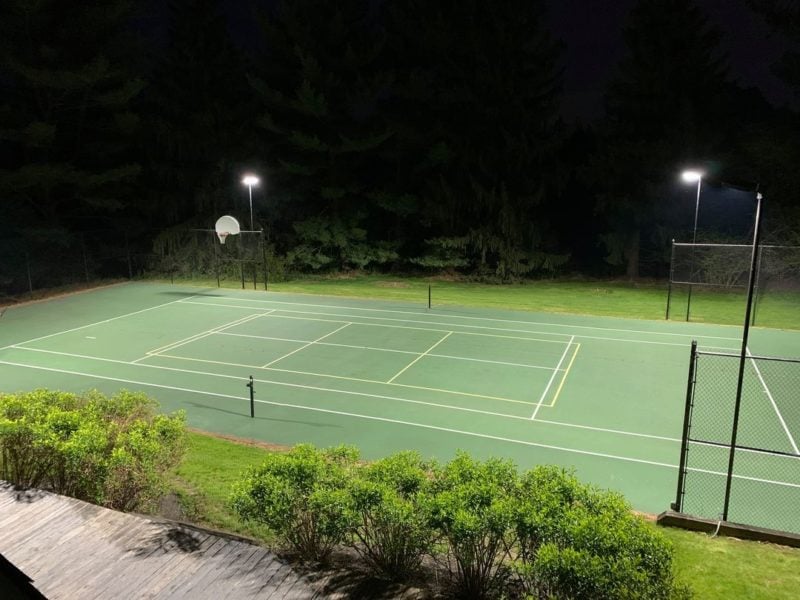
Outdoor tennis courts usually use pole-mounted fixtures placed around the court perimeter. The best layout depends on the number of courts, pole locations, pole height, pole setback, optic package, neighbor proximity, target light level, uniformity, and spill-light requirements.
Poles placed too close to the court can create glare during serves and overhead shots and may create physical-clearance concerns. Poles placed farther away may require different optics, output, mounting heights, or aiming. For multi-court layouts, pole sharing can reduce equipment count, but fixture aiming must be reviewed so lighting for one court does not create excessive glare or spill on another. Project-specific tennis court light poles should be selected according to fixture loading, mounting height, foundation requirements, and site conditions.
| Outdoor Design Factor | What to Confirm |
|---|---|
| Pole height | Mounting height affects distribution, glare, aiming, fixture output, and the optics required to reach the playing surface. |
| Pole setback | Pole locations should account for player safety, site geometry, sightlines, fixture aiming, and glare during serves, lobs, and overheads. |
| Optic package | Outdoor tennis courts often require controlled distributions selected for rectangular court geometry, pole position, throw distance, and spill-light limitations. |
| Fixture aiming | Aiming should support coverage across baselines, service boxes, net areas, doubles alleys, and sidelines while controlling glare and off-site spill. |
| Site surroundings | Nearby homes, roads, parking areas, walkways, or other courts may require shielding, controlled optics, different pole locations, or adjusted aiming. |
What a Tennis Court Lighting Plan Should Confirm
A tennis lighting plan should verify more than average illuminance. It should show whether the court is evenly lit from baseline to net, whether the doubles alleys are covered, whether glare is controlled during serves and overhead shots, and whether pole placement or ceiling mounting is appropriate.
| Planning Detail | Why It Matters for Tennis |
|---|---|
| Court class and use | Recreational, club, school, training, and competition courts may require different light levels, uniformity, glare control, and operating strategies. |
| Indoor or outdoor layout | Indoor ceiling-mounted layouts and outdoor pole-mounted layouts use different fixture types and create different glare, aiming, structural, and maintenance concerns. |
| Fixture count | Fixture quantity should be calculated from the actual fixture photometrics, court geometry, mounting conditions, target light levels, and uniformity rather than estimated from wattage alone. |
| Baseline-to-net coverage | The design should support consistent visibility across baselines, service boxes, net areas, sidelines, and doubles alleys. |
| Player sightlines | Fixture placement should reduce direct glare during serves, returns, lobs, overheads, and fast directional changes. |
| Uniformity | Uneven light can make the ball harder to track and can create uncomfortable bright-dark transitions across the court. |
| Mounting height | Ceiling height or pole height affects beam spread, glare, fixture count, aiming, and maintenance access. |
| Controls | Facilities may need court-bank switching, timers, dimming, photocells, motion sensors, or separate indoor control zones. |
| Electrical service | Confirm voltage, circuit capacity, conductor sizing, switching, controls, and surge protection before selecting fixtures. |
Request a tennis court lighting plan to confirm fixture count, court coverage, mounting layout, target foot-candle levels, uniformity, glare control, spill light, voltage, and product specifications before ordering.
Choosing LED Tennis Court Lights
Tennis court lighting should not be selected by wattage alone. A 200W fixture and a 400W fixture can perform very differently depending on lumen output, photometric distribution, mounting height, beam angle, fixture placement, aiming, and optic package. The appropriate fixture depends on court size, indoor or outdoor layout, level of play, desired light level, and the existing electrical system.
| Selection Factor | What to Confirm |
|---|---|
| Fixture output | Tennis lighting fixtures are available across a wide range of wattages and lumen outputs. Select output from the photometric requirements rather than assuming a particular wattage corresponds to a court size or fixture count. |
| Beam angle and optics | Optics should match court geometry, mounting height, pole setback, ceiling height, throw distance, and glare-control goals. |
| Color temperature | Many tennis facilities use 4000K or 5000K depending on owner preference, existing light source, project requirements, and desired court appearance. CCT describes the apparent warm or cool appearance of the light; it does not determine brightness or color-rendering performance. |
| Voltage | Confirm the actual site voltage and the selected fixture’s supported input range before ordering. |
| Controls | Confirm dimming, timers, photocells, motion sensors, court-bank controls, and compatibility with existing control systems. |
| Environmental ratings | Outdoor fixtures should be reviewed for wet-location suitability, IP rating where applicable, impact exposure, surge protection, ambient temperature, and warranty conditions. An IP rating addresses enclosure protection against solids and water ingress; verify materials and manufacturer documentation separately where corrosion or chemical exposure is a concern. |
Tennis Court Lighting Project Examples
Tennis lighting projects vary by court count, indoor or outdoor layout, ceiling height, pole height, surrounding property, existing infrastructure, player level, and electrical service. A photometric plan helps determine whether high bays, linear fixtures, area lights, flood lights, sports field lights, or indirect lighting systems are the right fit and how many fixtures are required.


Related Court Lighting Options
Tennis courts share some lighting concerns with other court sports, but court dimensions, player movement, fixture placement, and overhead-shot visibility are different.
- LED pickleball court lighting focuses on smaller court layouts, multi-court glare, and fast ball tracking at closer distances.
- LED padel court lighting must account for enclosed court walls, glass, fixture position, and reflected glare.
- Indoor tennis court lights focus on ceiling height, direct or indirect lighting, glare, fixture spacing, and player sightlines.
- Outdoor tennis court lights focus on pole placement, mounting height, optics, aiming, spill light, court setbacks, and weather exposure.
Tennis Court Lighting Certifications, Rebates, and Warranty Support
LED tennis court lights from LED Lighting Supply may carry a safety listing or certification from a recognized testing organization, such as UL, ETL, or CSA, depending on product. Selected models may be DLC or DLC Premium listed for utility rebate support where available. DLC listing is an efficiency and performance program, not an electrical safety certification. Rebate requirements vary by utility, region, and product listing, so confirm eligibility on the selected product specification before ordering.
Warranty terms vary by product, with many models offering a 5-year warranty. Confirm the selected product’s warranty, certifications, DLC status, voltage, controls compatibility, mounting method, environmental exposure, and suitability for the court layout and surrounding conditions before purchase.
Tennis Court Lighting Project Checklist
Before ordering tennis court fixtures, gather the project details needed for an accurate product recommendation and photometric layout. This helps avoid delays, unsuitable mounting hardware, incompatible voltage, or a layout that does not meet the court’s operational goals.
- Court information: Number of courts, indoor or outdoor use, singles or doubles play, court dimensions, and level of play.
- Existing conditions: Ceiling height, pole locations, pole height, pole condition, available mounting points, fixture access, and nearby obstructions.
- Electrical details: Available voltage, circuit capacity, switching arrangement, control requirements, and any electrical upgrade plans.
- Lighting goals: Target foot-candle level, uniformity expectations, glare concerns, preferred CCT, operating schedule, and court-bank control needs.
- Site considerations: Neighboring properties, roads, walkways, parking areas, other courts, local spill-light limits, weather exposure, and corrosion concerns.
- Product requirements: Fixture mounting method, optics, aiming capability, wet-location suitability, surge protection, certifications, controls compatibility, and warranty terms.
- Structural review: For pole-mounted projects, confirm that the complete pole, mounting hardware, fixtures, EPA loading, foundation or embedment, and site wind criteria are appropriate for the installation. Product information can support this review, but structural capacity should be verified by the appropriate qualified professional when required.
Request a tennis court lighting plan, and our Product Specialists can help review court layout, indoor or outdoor mounting, target foot-candle levels, pole placement, fixture selection, aiming, glare control, spill light, voltage, controls, and product specifications for your tennis court lighting project.
LED Tennis Court Lights FAQs
How Should LED Tennis Court Lights Be Planned?
LED tennis court lights should be planned around court layout, indoor or outdoor mounting conditions, baseline-to-net visibility, ball tracking, pole placement or ceiling height, glare control, uniformity, controls, and electrical infrastructure. A photometric plan can confirm fixture count, court coverage, mounting layout, target foot-candle levels, glare control, spill light, voltage, and product specifications before ordering.
Why Should Tennis Court Lights Not Be Chosen By Wattage Alone?
Tennis court lights should not be selected by wattage alone because fixtures with different wattages can perform differently based on mounting height, beam angle, fixture placement, and optic package. Court size, indoor or outdoor layout, level of play, desired light level, and the existing electrical system also affect fixture selection.
What Should Indoor Tennis Court Lighting Account For?
Indoor tennis court lighting should account for ceiling height, court layout, building structure, ceiling reflectance, and glare sensitivity. LED high bays, linear fixtures, court fixtures, and indirect lighting systems may be used depending on ceiling height, structure, court use, and glare goals.
When Is Indirect Lighting Used For Indoor Tennis Courts?
Indirect lighting is used for facilities prioritizing glare reduction where the ceiling surface is suitable for reflected light. Some indoor tennis facilities use indirect or up-light systems to reduce glare by reflecting light off a suitable ceiling surface.
What Should Be Considered When Planning Outdoor Tennis Court Lighting?
Outdoor tennis court lighting should consider pole locations, pole height, pole setback, court count, optic package, neighbor proximity, spill-light requirements, and fixture aiming. Outdoor courts usually use pole-mounted area lights, sports field lights, or adjustable flood lights depending on these project conditions and required light levels.
How Can An Outdoor Tennis Court Layout Help Control Glare And Spill Light?
An outdoor layout can help control glare and spill light by positioning poles to reduce glare during serves, lobs, and overheads and by using optics, shielding, cutoff optics, or tighter aiming where needed. Fixture aiming should cover baselines, service boxes, net areas, doubles alleys, and sidelines without creating direct glare.
What Should A Tennis Court Lighting Plan Verify?
A tennis court lighting plan should verify even baseline-to-net coverage, doubles-alley coverage, glare control during serves and overhead shots, and whether pole placement or ceiling mounting is appropriate. It should also account for court class and use, uniformity, mounting height, controls, and electrical service.
What Product Details Should Be Confirmed Before Ordering Tennis Court Lights?
Before ordering, confirm the selected product specification, including wattage, lumen output, beam angle, optic type, mounting hardware, voltage, controls, dimming, motion sensors, surge protection, impact rating, certifications, and warranty coverage, as these vary by model. Confirm certifications, DLC status, voltage, controls compatibility, mounting method, environmental exposure, and suitability for the court layout and surrounding conditions.