


LED High Bay Indirect Lights
- Adjustable heads allow direct, indirect, or combined light distribution
- Indirect aiming can reduce direct glare in suitable spaces
- USA-based support helps with fixture selection and compatibility



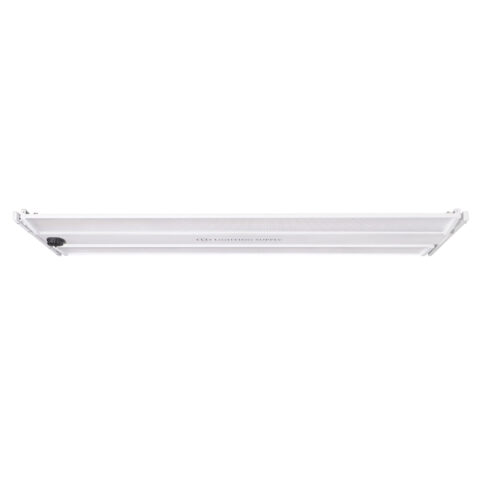
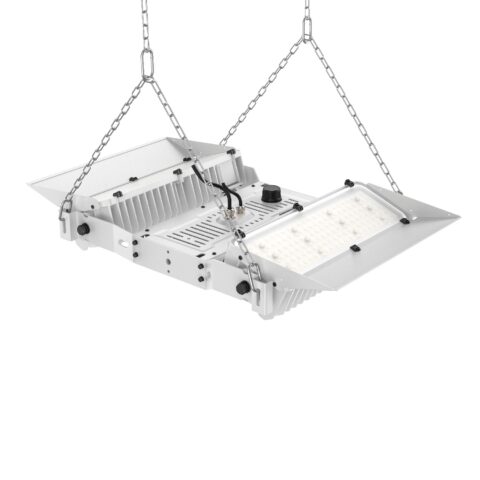
Our High Bay Indirect LED Lighting includes indirect linear high bay fixtures with 180-degree adjustable heads for direct or indirect illumination. Available models include 180W to 240W wattage-adjustable fixtures with 120-277V input, 4000K and 5000K color-adjustable options, 1-10V dimming, and motion sensor compatibility.
These fixtures are commonly used in warehouses, gymnasiums, manufacturing facilities, tennis courts, pickleball courts, and large commercial spaces.



What Are LED Indirect Linear High Bays?
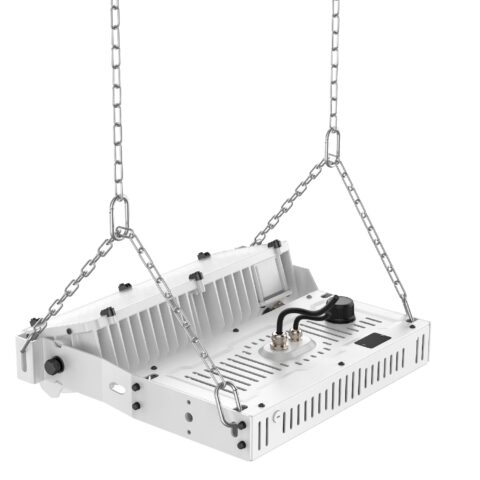
LED Indirect Linear High Bays are high-output fixtures designed to provide adjustable direct, indirect, or combined illumination in large indoor spaces. Selected models use 180-degree adjustable heads that allow the light distribution to be aimed downward, upward toward reflective ceiling surfaces, or at intermediate angles depending on the application.
When selecting indirect high bay lighting, consider ceiling height, ceiling and wall reflectance, room geometry, task requirements, fixture mounting location, target foot-candles, uniformity, glare, preferred direct-to-indirect balance, color temperature, controls, and available voltage.
When fixtures are aimed upward, part or all of the light reaches the occupied space after reflecting from ceilings or upper wall surfaces. This can create softer distribution, brighten ceiling surfaces, improve perceived uniformity, and reduce direct view of high-luminance LED sources compared with some downward-only high bay systems. Indirect lighting can therefore help reduce direct glare and harsh contrast, but it does not eliminate glare in every installation. Visual comfort still depends on fixture luminance, aiming, mounting position, viewing direction, room geometry, surface reflectance, and the amount of direct and reflected light.
Indirect and direct/indirect lighting can be useful in warehouses, gymnasiums, manufacturing facilities, indoor tennis facilities, indoor pickleball facilities, fieldhouses, and other large commercial spaces where ceiling surfaces and room geometry support reflected lighting.
For indoor sports where players frequently look upward, a direct/indirect approach may offer a useful balance between glare control, uniformity, and visibility. Direct light can support modeling and depth perception, while indirect light can help soften distribution. Final performance should be confirmed with fixture photometric data and a lighting layout.
Selected linear LED high bay fixtures may offer rated lumen-maintenance values of 50,000 hours or more and input ranges such as 120-277V, depending on the exact model.
Benefits of LED Indirect Linear High Bays for Commercial and Sports Applications
- Adjustable Light Direction: Adjustable fixture heads can allow direct, indirect, or combined light distribution. The appropriate aiming angle depends on ceiling height, ceiling reflectance, room geometry, fixture photometrics, task requirements, and target light levels. There is no single upward aiming angle that is optimal for every application. A photometric lighting plan can help determine the appropriate orientation and fixture layout.
- Improved Uniformity: Reflected light can help distribute illumination over broader surfaces and soften localized bright and dark areas. Actual uniformity depends on fixture distribution, spacing, mounting height, room dimensions, and the reflectance of ceilings and walls.
- Brighter Ceiling and Upper Surfaces: Indirect light increases luminance on ceilings and upper walls, which can make large interior spaces appear brighter and more open. This can be especially useful in gyms, fieldhouses, warehouses, and multipurpose spaces with light-colored reflective ceilings.
- Direct / Indirect Flexibility: Adjustable fixtures can allow some light to be directed toward the work or playing surface while another portion is reflected from the ceiling. This can help balance visual comfort with modeling, contrast, and task visibility in spaces where a fully indirect system may produce lighting that is too flat for the activity.
- Selectable Output on Applicable Models: Some models may offer adjustable wattage or lumen output, allowing the installer or facility to select from available settings. Confirm the adjustment method, available wattages, lumen output at each setting, and whether adjustment is intended during installation or remains accessible later.
- Color Temperature Options: Models may be available in 4000K, 5000K, or selectable-CCT configurations. Select color temperature based on the application, room appearance, sports or task requirements, existing lighting, and facility preference.
- Color Rendering Options: CRI varies by model. A CRI of 70+ may be suitable for many general high-bay industrial or sports applications, while applications requiring stronger color discrimination, camera performance, merchandising, inspection, or more natural color appearance may call for higher CRI or additional color-quality criteria.
- Flicker Performance Can Be Evaluated: LED flicker and temporal light modulation depend on the driver, controls, dimming level, and electrical design. Do not assume an LED fixture is automatically flicker-free. For sports, camera, manufacturing, or other applications where flicker matters, review model-specific flicker or temporal-light-modulation data, especially when the fixture will be dimmed.
- Instant-On LED Operation: LED fixtures typically reach useful output immediately rather than requiring the warm-up or restrike time associated with many HID systems. This can support occupancy controls, switching, and facilities with intermittent use.
- Cold-Temperature Operation on Applicable Models: LED lighting can perform well in unheated spaces, but minimum and maximum ambient temperature ratings vary by fixture. Confirm that the selected model is rated for the expected operating temperature rather than assuming all LED high bays are suitable for the same cold or hot environments.
- Multi-Voltage Options: Fixtures with a 120-277V input range can operate on compatible circuits within that listed voltage range without a separate step-down transformer. This does not eliminate all electrical compatibility requirements. Confirm supply voltage, frequency, branch circuit, driver input range, controls, dimming wiring, surge protection, and any 480V high-bay lighting requirements before ordering.
- Installation Flexibility: Adjustable housings and available mounting hardware may provide more installation flexibility than fixed-distribution fixtures. Installation difficulty still depends on fixture weight, mounting system, ceiling structure, wiring, controls, accessibility, and project conditions.
- Retrofit Potential: LED indirect high bays may replace older HID or fluorescent fixtures as part of a retrofit, but replacement should be based on lumen output, photometric distribution, fixture count, mounting height, reflectance, and target light levels rather than assuming one LED fixture will replace a fixed number of existing fixtures.
Direct vs Indirect vs Direct / Indirect High Bay Lighting
| Lighting Approach | What to Consider |
|---|---|
| Direct lighting | Places most of the light directly on the work or playing surface. It can provide strong modeling and efficient delivery of light to the task plane, but direct view of bright luminaires can increase glare if fixture placement, optics, shielding, or output are not properly controlled. |
| Indirect lighting | Directs most of the light toward ceilings or upper surfaces before it reaches the occupied area. It can provide soft, uniform illumination and reduce direct glare, but performance depends heavily on ceiling reflectance and room geometry. Fully indirect lighting can also reduce modeling and directional contrast. |
| Direct / indirect lighting | Combines reflected illumination with direct light to balance visual comfort, ceiling brightness, uniformity, task visibility, and modeling. The appropriate ratio depends on the space and application. |
Ceiling Reflectance Matters for Indirect High Bay Lighting
Indirect lighting relies on room surfaces to redirect light into the occupied space. Ceiling color, reflectance, cleanliness, geometry, structural obstructions, ducts, equipment, and surface condition can therefore have a major effect on system performance.
A light-colored, relatively reflective ceiling can return substantially more useful light than a dark, weathered, heavily textured, or obstructed surface. Warehouses and industrial spaces with dark ceilings, exposed structure, storage racks, ductwork, or equipment may not perform the same way as a gym or fieldhouse with a large light-colored ceiling.
Before specifying a primarily indirect layout, review:
- Ceiling height
- Ceiling and wall reflectance
- Ceiling color and surface condition
- Trusses, ducts, cranes, equipment, and other obstructions
- Fixture position and aiming
- Required foot-candle levels
- Uniformity requirements
- Glare and viewing directions
- Direct versus indirect light contribution
Photometric calculations should use realistic room-surface reflectance values rather than assuming every ceiling provides the same indirect-lighting performance.
Glare and Visual Comfort
Indirect lighting is often selected specifically to reduce direct glare because the brightest LED source can be aimed away from normal viewing directions and toward a larger reflecting surface. However, glare is a property of the complete lighting installation, not simply the fixture orientation.
Glare can still be influenced by:
- Direct view of the LED source
- Fixture luminance
- Fixture aiming and mounting location
- Viewing angle
- Ceiling or wall brightness
- Reflections from glossy surfaces
- Contrast between bright luminaires and darker surroundings
- The number and spacing of fixtures
- The balance between direct and indirect light
For sports facilities, glare deserves special attention because players may frequently look upward to track a basketball, volleyball, tennis ball, pickleball, or other object. The lighting layout should be evaluated from relevant player and spectator viewing positions rather than assuming indirect aiming alone eliminates glare.
Energy Savings and Retrofit Planning
LED high bay retrofits can reduce energy consumption compared with older metal halide or fluorescent lighting, but the savings percentage should be calculated from the actual existing and proposed systems.
For example, review:
- Existing fixture wattage
- Existing fixture quantity
- Proposed LED wattage
- Proposed fixture quantity
- Annual operating hours
- Dimming or occupancy-control schedules
- Required maintained light levels
- Utility rate
A lower-wattage LED fixture can provide substantial savings while maintaining or improving light levels, but energy savings should not be estimated solely from the nominal wattage of one old fixture compared with one new fixture. A photometric layout may change the fixture count, and controls can materially affect actual annual energy use.
Rated Life and Maintenance
LED fixture lifetime is commonly described using lumen-maintenance metrics such as L70 rather than as a guarantee that the fixture will suddenly fail at a particular hour. A 50,000-hour rating generally refers to a defined lumen-maintenance criterion supported by the manufacturer's lifetime data.
The complete luminaire also includes drivers, surge-protection components, controls, connectors, and other electronics that can have different life characteristics from the LEDs themselves. Operating temperature, electrical conditions, switching, dimming, contamination, vibration, and maintenance can also affect useful service life.
Before relying on a specific lifetime claim, confirm the exact model's published lumen-maintenance data, driver rating, ambient-temperature limits, warranty, and operating requirements.
What to Confirm Before Ordering Indirect Linear High Bays
- Fixture photometrics: Review IES files or manufacturer photometric data for the exact fixture and aiming configuration.
- Ceiling reflectance: Confirm that the room surfaces can effectively support the intended indirect lighting strategy.
- Ceiling height: Mounting height affects distribution, illuminance, glare, spacing, and the useful contribution of reflected light.
- Aiming: Do not assume a fixed aiming angle is appropriate for every project. Determine fixture orientation from room geometry and photometric performance.
- Target foot-candles: Establish the required maintained light level for the task or sport.
- Uniformity: Review average and minimum illumination rather than only average foot-candles.
- Glare: Evaluate fixture placement and aiming from normal occupant, worker, athlete, and spectator viewing positions.
- CRI and color quality: Confirm whether CRI 70+, CRI 80+, or another color-quality requirement is appropriate.
- Color temperature: Confirm fixed or selectable CCT and the adjustment method for the selected model.
- Flicker performance: Review model-specific data where sports, cameras, machinery, or dimming make temporal light modulation important.
- Dimming: Confirm whether the model supports 0-10V, 1-10V, or another control method and whether the controls are compatible.
- Sensors: Verify occupancy or motion-sensor compatibility and mounting location.
- Voltage: Match the fixture input range to the actual facility supply voltage.
- Ambient temperature: Verify that the selected model is rated for the expected minimum and maximum temperatures.
- Mounting: Confirm hardware, structure, suspension method, and service access.
Certifications, Rebates, and Warranty Support
LED Indirect Linear High Bays from LED Lighting Supply may carry safety listings or certifications from UL, ETL, CSA, or another recognized testing organization depending on the exact model. Do not assume every fixture carries every certification; verify the product specification and listing for the model being ordered.
Selected models may be listed on the DesignLights Consortium (DLC) Qualified Products List as Standard or Premium products. DLC qualification may support eligibility for participating utility incentive programs, but rebate eligibility depends on the utility, program, product category, location, installation, and exact model. DLC qualification by itself does not guarantee a rebate or tax incentive.
Most fixtures include a 5-year warranty unless otherwise specified, with USA-based warranty support. Before ordering, confirm the selected fixture’s safety listing, DLC status where applicable, rated lumen maintenance, voltage, wattage, lumen output, CRI, color temperature, dimming, controls compatibility, flicker performance where important, mounting method, ambient-temperature rating, and fit for your space.
LED High Bay Indirect Lights FAQs
How Should I Choose Between Direct, Indirect, And Direct/Indirect High Bay Lighting?
Choose the lighting approach based on the space, task needs, glare considerations, ceiling reflectance, and desired balance of uniformity, visibility, and modeling. Direct lighting places most light on the task surface, indirect lighting relies on ceilings or upper surfaces for reflected illumination, and direct/indirect lighting combines both approaches.
What Should I Evaluate Before Using A Primarily Indirect Lighting Layout?
Evaluate ceiling height, ceiling and wall reflectance, surface condition, room geometry, obstructions, fixture aiming, target foot-candles, uniformity, and glare. Photometric calculations should use realistic room-surface reflectance values because indirect lighting performance depends heavily on the surfaces that redirect the light.
Can Indirect Linear High Bays Reduce Glare?
Indirect linear high bays can reduce direct glare by aiming light away from normal viewing directions and toward reflective ceiling or wall surfaces, but they do not eliminate glare in every installation. Final glare performance also depends on fixture luminance, aiming, mounting position, viewing direction, room geometry, surface reflectance, and the direct-to-indirect light balance.
How Should Indirect High Bay Lighting Be Planned For Sports Facilities?
Sports lighting layouts should be evaluated from relevant player and spectator viewing positions because players may frequently look upward to track an object. IES guidance notes that a direct/indirect approach may provide a useful balance between glare control, uniformity, and visibility, but final performance should be confirmed with fixture photometric data and a lighting layout.
Can LED Indirect High Bays Replace Existing HID Or Fluorescent Fixtures?
LED indirect high bays may replace older HID or fluorescent fixtures as part of a retrofit, but replacement should be based on lumen output, photometric distribution, fixture count, mounting height, reflectance, and target light levels. Energy savings should be calculated from the actual existing and proposed systems rather than from a one-for-one wattage comparison.
What Fixture Details Should Be Confirmed Before Ordering?
Confirm the exact fixture's photometrics, aiming configuration, input voltage, wattage, lumen output, color temperature, CRI, dimming, controls compatibility, mounting method, ambient-temperature rating, and rated lumen-maintenance data. Selected models may also offer adjustable output, motion sensors, selectable CCT, or input ranges such as 120-277V, depending on the model.
Does A 50,000-Hour Rating Guarantee Fixture Life?
No, a 50,000-hour rating generally refers to a defined lumen-maintenance criterion supported by the manufacturer's lifetime data, not a guarantee that every fixture will operate for a specific number of calendar years. Drivers, controls, surge-protection components, operating temperature, electrical conditions, switching, dimming, contamination, vibration, and maintenance can affect useful service life.
