


Commercial LED Area Lighting for Outdoor Site & Facility Use
- Achieve 50-80% energy savings with DLC Premium certified fixtures
- Eliminate maintenance costs with 50,000+ hour LED lifespan
- Expert lighting plans ensure proper coverage and code compliance


-
 Strategic Placement Design for Optimal Security Coverage & Dark Spot Elimination
-
Precise Photometric Calculations for Footcandle Requirements & Light Uniformity Ratios
-
Reduce Energy Costs While Meeting Safety Standards & Municipal Lighting Codes


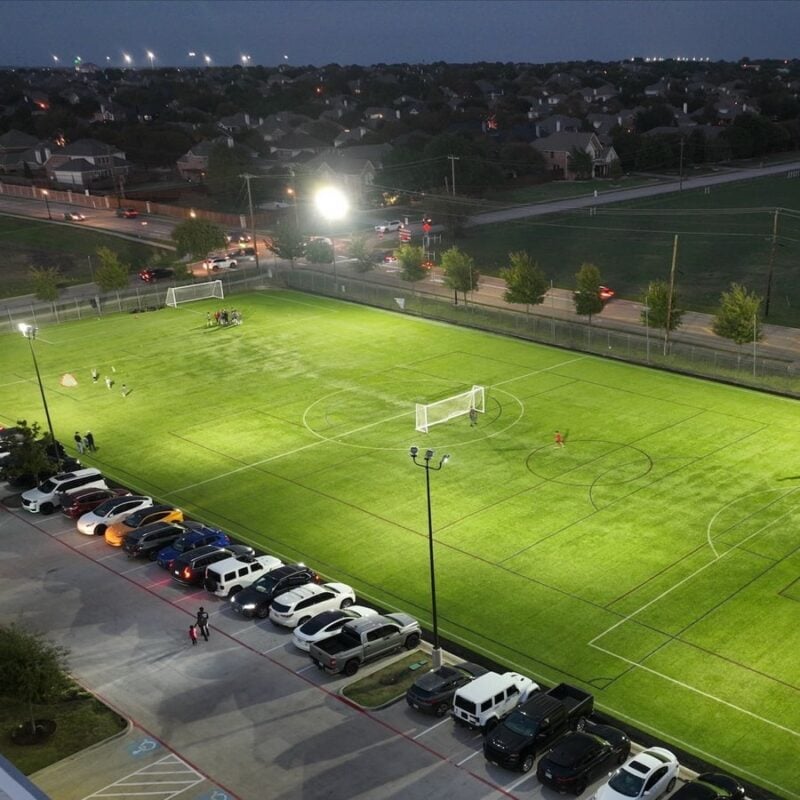
Commercial LED area lighting includes a range of outdoor fixtures built for installation on poles, building facades, and exterior perimeters in environments such as parking lots, sports courts, and industrial yards. Common form factors in this category include shoebox lights for pole mounting over open parking areas, flood-style fixtures positioned along building exteriors or irregular site layouts, and high mast lights set on tall poles for large-scale spaces. These products are frequently arranged throughout retail parking lots, distribution center yards, service facility exteriors, and athletic fields, forming the backbone of site-wide illumination infrastructure.
As part of our Commercial & Industrial Lighting Solutions, these area lights are selected for use in locations where broad, consistent outdoor coverage is needed across expansive paved surfaces, drive lanes, and facility boundaries. The category also includes wall-mounted packs for building perimeters and post-top fixtures for walkways or landscaped zones. Each fixture type is suited to specific site layouts, supporting the lighting needs of commercial properties, industrial complexes, and public venues.

LED Flood Lighting for Commercial & Industrial Applications


LED High Mast Lights for Highways, Ports & Large Outdoor Areas

LED Post Top Lighting for Outdoor Pathways, Parks & Pole Top Applications

LED Solar Area Lighting for Commercial Outdoor & Security Applications

LED Stadium Lighting for Professional, School, Municipal & Athletic Facilities

LED Wall Pack Lighting for Commercial Buildings & Outdoor Applications
Showing 1–12 of 22 results
 SKU:LLS-M-SB6-150A-CC | Web ID:2675Availability: 324 In Stock Ships 2-3 Days
- Watts: 80 | 100 | 150
- Lumens: 10400 | 13000 | 19500
- Lumens/Watt: 130
- Replaces: 250 | 400 Watt Metal Halide
- Color Temp: 3000K | 4000K | 5000K
- CRI: 80+
- IP Rating: IP65
- Voltage: 120V-277V
- Surge Protection: 6kV
- Operating Temp: -22°F to 113°F
- Rated Life: 50,000 hours
- Dimmable: 0-10V
- Beam Angle (Std): Type 3
- Optics: Polycarbonate Lens
- Fixture Color: Bronze
- Mount: Arm | Slip Fitter
- Dimensions (in): 15.55 L X 9.88 W X 2.6 H
- Weight (lbs): 7
- Warranty: 5 years
Starting At$167.47


- SKU:LLS-M-SB6-300A-CC | Web ID:2676Availability: 249 In Stock Ships 2-3 Days
- Watts: 200 | 240 | 300
- Lumens: 26000 | 31200 | 39000
- Lumens/Watt: 130
- Replaces: 400 | 1000 Watt Metal Halide
- Color Temp: 3000K | 4000K | 5000K
- CRI: 80+
- IP Rating: IP65
- Voltage: 120V-277V
- Surge Protection: 6kV
- Operating Temp: -22°F to 113°F
- Rated Life: 50,000 hours
- Dimmable: 0-10V
- Beam Angle (Std): Type 3
- Optics: Polycarbonate Lens
- Fixture Color: Bronze
- Mount: Arm | Slip Fitter
- Dimensions (in): 18.74 L x 12.68 W x 2.76 H
- Weight (lbs): 11
- Warranty: 5 years
Starting At$215.84 - SKU:LLS-SBHO4-90/120/150-CC | Web ID:2287Availability: 188 In Stock Ships 2-3 Days
- Watts: 90 | 120 | 150
- Lumens: 13950 | 18600 | 23250
- Lumens/Watt: 155
- Replaces: 400 Watt Metal Halide
- Color Temp: 3000K | 4000K | 5000K
- CRI: 70+
- IP Rating: IP65
- IK Rating: IK08
- Voltage: 100V-277V
- Surge Protection: 10kV line-earth
- Operating Temp: -22°F to 122°F
- Rated Life: 100,000 (L70) hours
- Dimmable: No
- Beam Angle (Std): Type 3
- Beam Angle (Opt): Type 4 | Type 5
- Optics: Polycarbonate Lens
- Housing: Die-Cast Aluminum
- Fixture Color: Bronze
- Mount: Arm | Slip Fitter
- EPA Rating: 1.52
- Dimensions (in): 18.31 L X 13.15 W X 2.64 H
- Weight (lbs): 10
- Warranty: 5 years
Starting At$159.52
- SKU:MLLG-LED-SBHO2-150-50 | Web ID:1762Availability: 329 In Stock Ships 2-3 Days
- Watts: 150
- Lumens: 24000
- Lumens/Watt: 160
- Replaces: 400 | 1000 Watt Metal Halide
- Color Temp: 4000K | 5000K
- CRI: 70+
- IP Rating: IP65
- IK Rating: IK08
- Voltage: 100V-277V | 277V-480V Optional
- Surge Protection: 6kV line-line, 10kV line-earth
- Operating Temp: -22°F to 113°F
- Rated Life: 244,000 (L70) hours
- Dimmable: No
- Beam Angle (Std): Type 3
- Beam Angle (Opt): Type 4 | Type 5
- Optics: Polycarbonate Lens
- Housing: Die-Cast Aluminum
- Fixture Color: Bronze
- Mount: Yoke | Arm | Slip Fitter
- EPA Rating: 1.5
- Dimensions (in): 15.63 X 11.25 X 3.22
- Cord Length: 5 Feet
- Weight (lbs): 9.5
- Warranty: 10 years (100-277V) - 5 years (277-480V)
Starting At$235.08 - SKU:MLLG-LED-SBHO2-300-50 | Web ID:1763Availability: 264 In Stock Ships 2-3 Days
- Watts: 300
- Lumens: 48000
- Lumens/Watt: 160
- Replaces: 1000 Watt Metal Halide
- Color Temp: 4000K | 5000K
- CRI: 70+
- IP Rating: IP65
- IK Rating: IK08
- Voltage: 100V-277V | 277V-480V Optional
- Surge Protection: 6kV line-line, 10kV line-earth
- Operating Temp: -22°F to 113°F
- Rated Life: 244,000 (L70) hours
- Dimmable: No
- Beam Angle (Std): Type 5
- Beam Angle (Opt): Type 3
- Optics: Polycarbonate Lens
- Housing: Die-Cast Aluminum
- Fixture Color: Bronze
- Mount: Yoke | Arm | Slip Fitter
- EPA Rating: 2
- Dimensions (in): 24.61 L X 11.93 W X 3.22 H
- Cord Length: 5 Feet
- Weight (lbs): 17
- Warranty: 10 years (100-277V) - 5 years (277-480V)
Starting At$380.63 - SKU:LLS-X-SB4-150/120/100/80-CC-[V] | Web ID:2041100V-277V:1402 In StockShips 2-3 Days277V-480V:198 In StockShips 3-5 Days
- Watts: 80 | 100 | 120 | 150
- Lumens: 12240 | 15300 | 18360 | 22950
- Lumens/Watt: 153
- Replaces: 400 Watt Metal Halide
- Color Temp: 3000K | 4000K | 5000K
- CRI: 70+
- IP Rating: IP65
- Voltage: 100V-277V | 277V-480V
- Surge Protection: 10kV
- Operating Temp: -40°F to 113°F
- Rated Life: 100,000 (L70) hours
- Dimmable: No
- Beam Angle (Std): Type 3
- Optics: Polycarbonate Lens
- Housing: Die-Cast Aluminum
- Fixture Color: Bronze
- Mount: Wall | Yoke | Arm | Slip Fitter
- EPA Rating: 1.35
- Dimensions (in): 13.3 L X 11.8 W X 3 H
- Weight (lbs): 7.2
- Warranty: 5 years
Starting At$175.00 - SKU:LLS-X-SB4-150/120/100/80-CC-[BK/W] | Web ID:2354Black:248 In StockShips 3-5 DaysWhite:6 In StockShips 3-5 Days
- Watts: 80 | 100 | 120 | 150
- Lumens: 12240 | 15300 | 18360 | 22950
- Lumens/Watt: 153
- Replaces: 400 Watt Metal Halide
- Color Temp: 3000K | 4000K | 5000K
- CRI: 70+
- IP Rating: IP65
- Voltage: 100V-277V
- Surge Protection: 10kV
- Operating Temp: -40°F to 113°F
- Rated Life: 100,000 (L70) hours
- Dimmable: No
- Beam Angle (Std): Type 3
- Optics: Polycarbonate Lens
- Housing: Die-Cast Aluminum
- Fixture Color: Black | White
- Mount (Opt): Yoke | Arm | Slip Fitter
- EPA Rating: 1.35
- Dimensions (in): 14 L X 11.8 W X 3 H
- Weight (lbs): 7.2
- Warranty: 5 years
Starting At$185.80 - SKU:LLS-X-SB4-240/220/200/170-CC | Web ID:2280Availability: 511 In Stock Ships 2-3 Days
- Watts: 170 | 200 | 220 | 240
- Lumens: 26000 | 30600 | 33660 |36720
- Lumens/Watt: 153
- Replaces: 400 | 1000 Watt Metal Halide
- Color Temp: 3000K | 4000K | 5000K
- CRI: 70+
- IP Rating: IP65
- Voltage: 100V-277V
- Surge Protection: 10kV
- Operating Temp: -40°F to 113°F
- Rated Life: 100,000 (L70) hours
- Dimmable: No
- Beam Angle (Std): Type 3
- Optics: Polycarbonate Lens
- Housing: Die-Cast Aluminum
- Fixture Color: Bronze
- Mount (Opt): Yoke | Arm | Slip Fitter
- EPA Rating: 1.4
- Dimensions (in): 16 X 11.8 X 3
- Weight (lbs): 9.1
- Warranty: 5 years
Starting At$203.08 - SKU:LLS-X-SB4-240/220/200/170-CC-W | Web ID:2360Availability: 275 In Stock Ships 2-3 Days
- Watts: 170 | 200 | 220 | 240
- Lumens: 26000 | 30600 | 33660 | 36720
- Lumens/Watt: 153
- Replaces: 400 | 1000 Watt Metal Halide
- Color Temp: 3000K | 4000K | 5000K
- CRI: 70+
- IP Rating: IP65
- Voltage: 100V-277V
- Surge Protection: 10kV
- Operating Temp: -40°F to 113°F
- Rated Life: 100,000 (L70) hours
- Dimmable: No
- Beam Angle (Std): Type 3
- Optics: Polycarbonate Lens
- Housing: Die-Cast Aluminum
- Fixture Color: White
- Mount (Opt): Yoke | Arm | Slip Fitter
- EPA Rating: 1.4
- Dimensions (in): 16 L X 11.8 W X 3 H
- Weight (lbs): 9.1
- Warranty: 5 years
Starting At$220.20 - SKU:LLS-X-SB4-310/280/260/240-CC-[V] | Web ID:2042100V-277V:144 In StockShips 3-5 Days277V-480V:335 In StockShips 3-5 Days
- Watts: 240 | 260 | 280 | 310
- Lumens: 36720 | 39780 | 42840 | 47430
- Lumens/Watt: 153
- Replaces: 1000 Watt Metal Halide
- Color Temp: 3000K | 4000K | 5000K
- CRI: 70+
- IP Rating: IP65
- Voltage: 100V-277V | 277V-480V
- Surge Protection: 10kV
- Operating Temp: -40°F to 113°F
- Rated Life: 100,000 (L70) hours
- Dimmable: No
- Beam Angle (Std): Type 3
- Optics: Polycarbonate Lens
- Housing: Die-Cast Aluminum
- Fixture Color: Bronze
- Mount (Opt): Wall | Yoke | Arm | Slip Fitter
- EPA Rating: 1.7
- Dimensions (in): 22 H X 11.8 W X 3 D
- Weight (lbs): 11.3
- Warranty: 5 years
Starting At$225.85 - SKU:LLS-X-SB4-310/280/260/240-CC-[BK/W] | Web ID:2355Black:13 In StockShips 3-5 DaysWhite:56 In StockShips 3-5 Days
- Watts: 240 | 260 | 280 | 310
- Lumens: 36720 | 39780 | 42840 | 47430
- Lumens/Watt: 153
- Replaces: 1000 Watt Metal Halide
- Color Temp: 3000K | 4000K | 5000K
- CRI: 70+
- IP Rating: IP65
- Voltage: 100V-277V
- Surge Protection: 10kV
- Operating Temp: -40°F to 113°F
- Rated Life: 100,000 (L70) hours
- Dimmable: No
- Beam Angle (Std): Type 3
- Optics: Polycarbonate Lens
- Housing: Die-Cast Aluminum
- Fixture Color: Black | White
- Mount (Opt): Yoke | Arm | Slip Fitter
- EPA Rating: 1.7
- Dimensions (in): 22 H X 11.8 W X 3 D
- Weight (lbs): 11.3
- Warranty: 5 years
Starting At$245.60 - SKU:LLS-X-SB4-310-5-HV | Web ID:2667Availability: 336 In Stock Ships 2-3 Days
- Watts: 310
- Lumens: 47430
- Lumens/Watt: 153
- Replaces: 1000 Watt Metal Halide
- Color Temp: 5000K
- CRI: 70+
- IP Rating: IP65
- Voltage: 277V-480V
- Surge Protection: 10kV
- Operating Temp: -40°F to 113°F
- Rated Life: 100,000 (L70) hours
- Dimmable: No
- Beam Angle (Std): Type 3
- Optics: Polycarbonate Lens
- Housing: Die-Cast Aluminum
- Fixture Color: Bronze
- Mount (Opt): Wall | Yoke | Arm | Slip Fitter
- EPA Rating: 1.7
- Dimensions (in): 22 H X 11.8 W X 3 D
- Weight (lbs): 11.3
- Warranty: 5 years
Starting At$280.91






What are LED Area Lights?
Commercial LED area lights are outdoor fixtures designed for lighting large spaces like parking lots, sports facilities, and industrial yards. With over 15 years in commercial lighting, we have seen these fixtures used in everything from small retail parking areas to large distribution centers. Available in wattages from 50W to 1200W, our area lights provide high lumen output and operate on standard 120-277V or 347-480V building power. Our solutions are ideal for businesses seeking reliable LED area lighting for their properties.
Modern LED area lights are effective retrofit solutions for older HID systems. Integrated drivers adapt to your building's voltage, reducing compatibility issues during upgrades. Shoebox designs work well for parking lot pole mounting, while flood-style area lights offer flexibility for building facades and perimeter security. Most customers select 4000K or 5000K color temperatures for visibility and safety in commercial environments, making them a popular choice for LED parking lot lighting projects.

Use When / Don't Use When
Use Commercial LED Area Lights When
- Illuminating large outdoor spaces such as parking lots, sports facilities, or industrial yards.
- Retrofitting HID systems to improve energy efficiency and reduce maintenance.
- Uniform, high-quality light is needed for safety, security, or code compliance.
- Utility rebates or certifications (DLC Premium, UL, ETL) are required for your project.
- Automated controls (dimming, photocells, occupancy sensors) are desired for energy management.
Don't Use Commercial LED Area Lights When
- Mounting on poles or structures with unknown or inadequate structural integrity - always verify with a qualified professional.
- Local codes require specific optics or dark sky compliance, and the fixture does not meet those requirements.
- Mixing incompatible optic types (e.g., Type III and Type V) in the same area without a lighting plan.
- Skipping photometric validation - do not install based solely on wattage or lumen charts.
- Environmental or application requirements (such as hazardous locations or special ratings) are not met by the selected model - verify on datasheet.
What We Verify Before You Order
We confirm
- Existing pole and mounting compatibility
- Required certifications and rebate eligibility (model dependent)
- Appropriate wattage and lumen output for your application
- Optic type and distribution pattern for site geometry
- Control options (dimming, sensors, photocells) as needed
If we provide a lighting plan, you will get
- Validated light levels and uniformity for your specific site
- Fixture layout optimized for energy savings and code compliance
- Documentation to support rebate applications and permitting
Note: Guidance is general planning information. Final selection should be validated with a photometric plan and confirmed by a licensed professional when required for code- or safety-critical areas.
Quick Selection Guide
- Commonly used for parking lots, sports fields, and industrial yards that need broad, even outdoor lighting. Our LED outdoor area lighting options are designed to deliver reliable performance in these demanding environments.
- If replacing metal halide fixtures, use the provided lumen replacement table as a starting point - actual needs depend on mounting height and layout.
- Shoebox styles are typically used for pole-mounted parking lot lighting; flood styles offer more flexibility for building facades and perimeter areas.
- Standard color temperatures are 4000K or 5000K for visibility and safety in commercial settings.
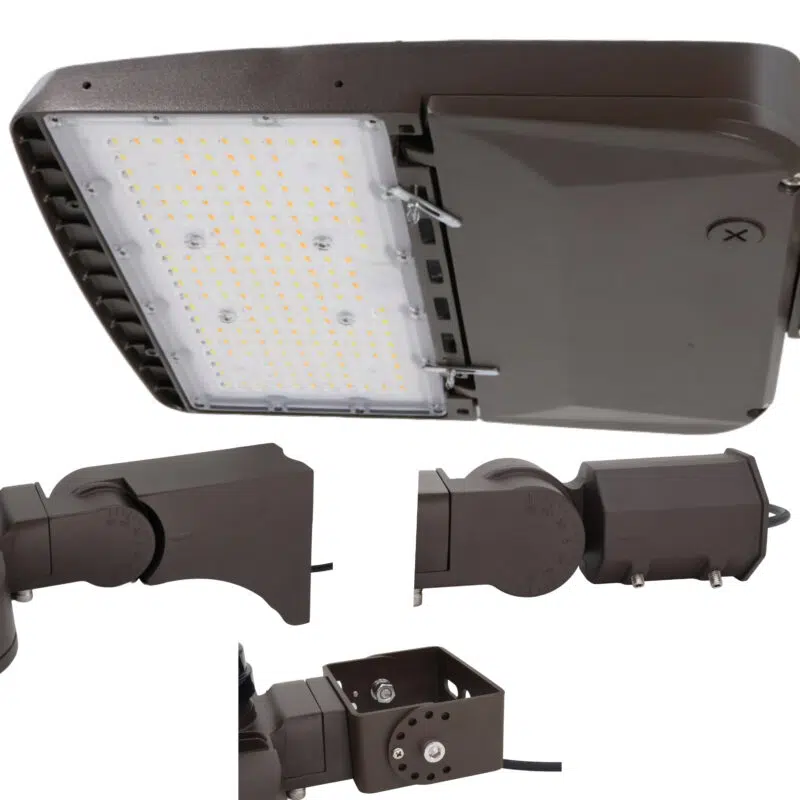
- Verify the mounting method (arm, slip-fitter, trunnion, etc.) matches your existing poles or structures.
- Check for required certifications (DLC Premium, UL, ETL) if utility rebates or code compliance are important for your project.
- Consider integrated controls (photocells, motion sensors, 0-10V dimming) for added energy savings and automation.
- Always confirm pole structural integrity before upgrading to heavier or higher-wind-load LED fixtures.
- Consult local lighting codes for dark sky or cutoff requirements before selecting optics or distribution types.
Tip: Do not rely only on wattage conversion charts - run a photometric plan to confirm proper light levels and uniformity for your site.
What Different Types of LED Area Lights Are Available?
- LED flood lights: Versatile flood fixtures offer power options from 50W to 1200W with multiple mounting configurations. Various optic packages provide beam angles from 15 deg to 120 deg for precise light control. These fixtures are used for building facades, loading docks, and irregular-shaped outdoor areas that need flexible positioning.
- LED high mast lights: Designed for mounting heights of 60 feet and above, these powerful fixtures illuminate ports, airports, and container yards. High-output models producing 40,000 to 180,000 lumens distribute light across large spaces while reducing the number of required poles.
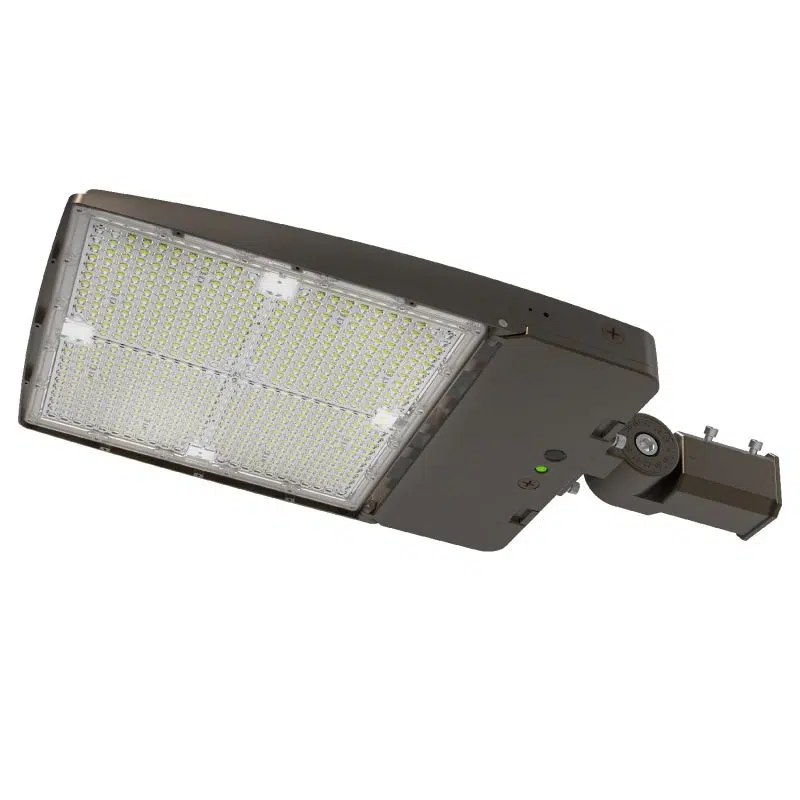
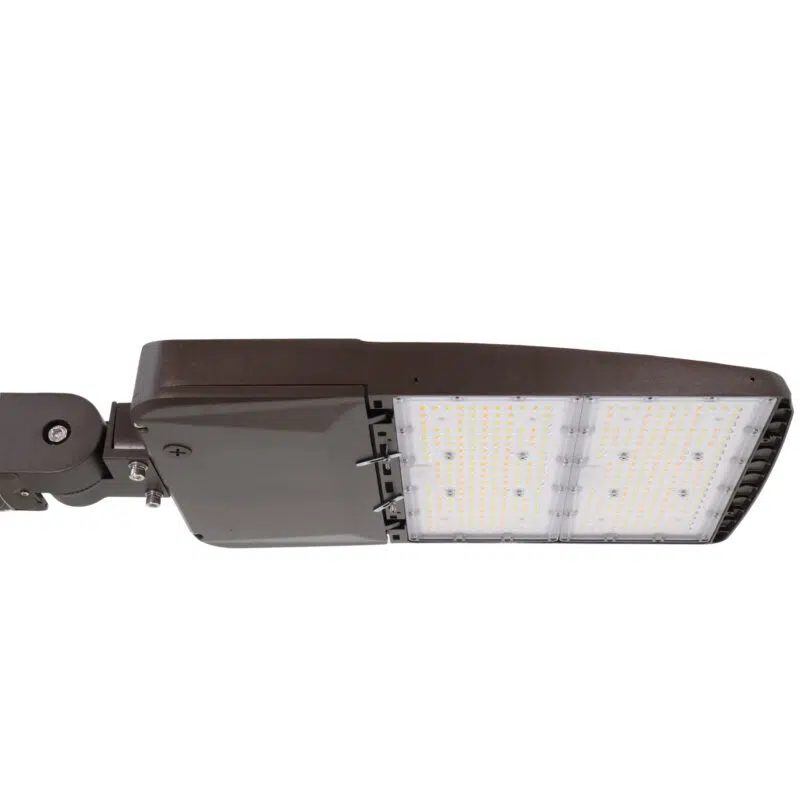
- LED shoebox lights: The standard for parking lot illumination, shoebox fixtures mount on 15-35 foot poles with slip-fitter or arm mounting. Available in 100W to 600W configurations, they provide uniform coverage patterns ideal for rectangular parking areas and roadways. These are the most common lights used for LED area lighting for parking lots and are a top choice for those seeking dependable LED pole lights for commercial properties.
- LED pole top lights: Post-top fixtures provide illumination for parks, walkways, and decorative applications. Round and acorn-style housings combine aesthetics with functionality while providing 360-degree light distribution.
- LED solar area lighting: Self-contained solar systems eliminate electrical infrastructure costs in remote locations. Advanced battery technology enables 3-5 nights of autonomous operation while producing up to 20,000 lumens during peak demand periods.
- LED stadium lights: High-performance fixtures designed for athletic facilities and large outdoor venues. These powerful units generate 40,000 to 180,000 lumens with precise beam control to meet demanding illumination requirements for sports and broadcast applications.
- LED wall packs: Building-mounted fixtures provide perimeter security and general area lighting. Compact designs with forward throw optics maximize ground coverage while minimizing building glare and light pollution.
Each fixture category serves specific architectural and functional requirements. We help customers select the right combination of wattage, optics, and mounting based on site geometry, existing infrastructure, and local lighting codes. Whether you need LED area light solutions for a new installation or a retrofit, our team can help you find the best fit for your project.

How Many LED Lumens Do You Need To Replace Metal Halide Area Lighting?
Successful LED retrofits require matching both lumen output and light distribution patterns from your existing HID fixtures. Based on thousands of retrofit projects, we have developed these lumen replacement guidelines using actual field performance. LED efficiency allows lower lumen outputs to achieve similar illumination due to better light quality and distribution control.
| 250-Watt Metal Halide | 9,000 - 12,000 LED lumens |
| 400-Watt Metal Halide | 15,000 - 25,000 LED lumens |
| 1000-Watt Metal Halide | 35,000 - 50,000 LED lumens |
| 1500-Watt+ Metal Halide | 50,000 - 90,000 LED lumens |
Actual requirements vary based on mounting height, spacing, and application needs. A professional lighting calculation considers factors like uniformity ratios, foot-candle requirements, and local code compliance. We provide photometric analysis at no charge to help ensure your retrofit delivers good results and energy savings.
Many lighting professionals use the Illuminating Engineering Society (IES) recommended practices for determining appropriate light levels and uniformity in outdoor areas. For more information on lighting calculations and standards, refer to the IES's ANSI/IES RP-8-21: Recommended Practice for Design and Maintenance of Roadway and Parking Facility Lighting.
Safety and Performance Certifications
All our fixtures carry essential certifications, including DLC Premium, UL Listed, and ETL Listed approvals. These certifications confirm safety, performance, and energy efficiency while qualifying your project for utility rebates and tax incentives. DLC Premium certification meets high efficiency standards and maximum rebate eligibility.
Industry certifications provide important validation of LED fixture performance and safety standards. The Design Lights Consortium (DLC) Qualified Products List sets efficiency requirements for utility rebate eligibility, while UL safety certification ensures electrical safety and compliance with national electrical codes for outdoor lighting installations.
The National Electrical Code (NEC), published by NFPA, sets requirements for safe electrical installation and operation of lighting systems, including outdoor area lighting. For more information on electrical safety and code compliance, visit the NFPA 70: National Electrical Code.


5-Year Warranty and Warranty Support
All our lights come with at least a 5-year warranty, and all warranty support is based in the USA. We handle customer support directly and will work quickly to resolve any warranty issues. Our support team understands the importance of keeping your lighting operational.
What are the Benefits of Using LED Area Lights?
- Energy Efficient: Achieve 50 to 80 percent energy savings compared to metal halide and HPS fixtures. The U.S. Department of Energy confirms that LED technology delivers significant energy savings for outdoor area lighting. According to the DOE's Outdoor Area Lighting guidance, LED fixtures typically use 50-70% less energy than traditional high-intensity discharge systems while providing better light quality and longer operational life. Businesses looking for efficient LED area lighting will benefit from these savings.
- Superior Light Quality: LEDs convert electricity into usable light, not waste heat. High CRI ratings above 80 create clear illumination that improves visibility and enhances property appearance.
- Utility Rebates: Most fixtures carry DLC Premium certification, qualifying them for utility rebate programs. These incentives often offset 20-40% of your initial investment costs.
- Reduced Maintenance: LED fixtures do not require bulb or ballast replacements during their operational life. Since area lights are mounted at heights that require lifts or bucket trucks, this reduces maintenance costs.
- Precision Optics: Choose from Type I through Type V distributions, plus narrow to wide beam angles for targeted light placement. Proper optics help eliminate dark spots and light trespass while maximizing coverage efficiency.
- Enhanced Safety: Consistent, high-quality illumination reduces liability risks and deters criminal activity. Well-lit areas help prevent accidents and create safer environments for employees and visitors. OSHA's safety standards specify minimum illumination requirements for work areas, and the Illuminating Engineering Society provides guidance on recommended lighting practices for parking facilities to ensure adequate visibility and security.
- Extended Lifespan: LED fixtures operate for 50,000 to 100,000 hours compared to 15,000 hours for metal halide (model dependent). This means years of reliable operation with minimal intervention.
- Smart Controls: Integrate 0-10V dimming, photocells, and occupancy sensors for automated operation. These controls can increase energy savings by an additional 20-30% through scheduling and automation.
- Instant Performance: LEDs reach full brightness immediately, unlike HID fixtures that require 5-15 minute warm-up periods. This instant response is important for security applications and after power outages.
According to the U.S. Department of Energy, LED area lighting can reduce energy consumption and maintenance costs compared to traditional HID systems, while also improving lighting quality and safety in outdoor environments. For more information on best practices and energy savings, see the DOE's guidance on Outdoor Area Lighting and the Illuminating Engineering Society's resources on lighting standards and recommended practices. Our LED area light solutions are designed to help you achieve these benefits for your facility.

Need Help? Talk to an LED Area Light Expert.
Selecting the right area lighting solution means balancing performance requirements, energy goals, and budget. Our lighting engineers have decades of experience with project consultations. Share your needs with us, and we will recommend fixtures suited for your application and site conditions. Contact us for guidance and a free lighting plan that ensures proper illumination levels and uniform coverage across your area.
Common Mistakes and How to Avoid Them
We see the same costly mistakes on area lighting projects. Most problems happen when LED retrofits are treated like simple bulb swaps instead of engineered upgrades that require proper calculations and planning.
- Using HID conversion charts without considering LED light distribution: LEDs put light where you need it, unlike HID, which wastes lumens upward. Run actual photometric calculations instead of relying on generic wattage conversion tables.
- Installing fixtures without checking existing pole structural integrity: Old parking lot poles may not be designed for modern LED wind loads. Get a structural assessment before installing new fixtures, especially in hurricane zones (verify structural requirements with a qualified engineer).
- Mixing Type III and Type V optics in the same parking lot: Different distribution patterns create uneven lighting and hot spots. Use one optic type unless your lighting plan specifically calls for variations.
- Ignoring local dark sky ordinances until after fixture selection: Many cities now restrict light and require full cutoff optics. Check municipal lighting codes early in your planning process.
- Failing to account for mounting height changes during pole replacement: Switching from 20-foot to 30-foot poles changes your spacing calculation. Recalculate fixture spacing when pole heights change.
- Skipping surge protection in areas with frequent lightning activity: Area lights are expensive targets on tall poles. Install proper SPDs at the panel and consider fixtures with integrated surge protection.
- Selecting color temperature based on energy efficiency alone: 5000K might be more efficient, but 4000K often provides better visual comfort for security cameras and general visibility.
- Installing photocells without considering light pollution from adjacent properties: Nearby properties might trigger your photocells prematurely. Position sensors carefully or use astronomical time clocks instead.
Commercial LED Area Lighting for Outdoor Site & Facility Use Frequently Asked Questions
What Are the Key Considerations When Choosing LED Area Lights?
When selecting LED area lights, consider the size and purpose of the space, such as parking lots or sports facilities, to determine the appropriate wattage and lumen output. Ensure compatibility with your existing voltage (120-277V or 347-480V) and verify that the mounting method matches your infrastructure. Opt for color temperatures of 4000K or 5000K for optimal visibility and safety. Always check for necessary certifications like DLC Premium, UL, or ETL if utility rebates or compliance are required.
How Do LED Area Lights Compare to Traditional HID Systems?
LED area lights offer significant advantages over traditional HID systems, including 50-80% energy savings and reduced maintenance due to their longer lifespan of 50,000 to 100,000 hours. They provide superior light quality with high CRI ratings, ensuring better visibility and safety. Additionally, LEDs reach full brightness instantly, unlike HID fixtures that require warm-up periods.
What Types of LED Area Lights Are Available?
LED area lights come in various types to suit different applications. LED flood lights offer versatile mounting and beam angles for building facades. LED shoebox lights are ideal for parking lots with uniform coverage. LED high mast lights illuminate large spaces like ports. LED pole top lights provide decorative lighting for parks. LED solar area lights are self-contained for remote locations, and LED stadium lights cater to sports venues with high lumen output.
How Many LED Lumens Are Needed to Replace Metal Halide Lighting?
To replace metal halide lighting, match both lumen output and distribution patterns. For example, a 250-Watt metal halide can be replaced with 9,000-12,000 LED lumens, while a 1000-Watt metal halide requires 35,000-50,000 LED lumens. Actual needs depend on mounting height and layout, so a photometric analysis is recommended for precise planning.
What Certifications Should LED Area Lights Have?
Ensure LED area lights have essential certifications like DLC Premium, UL Listed, and ETL Listed. These certifications confirm safety, performance, and energy efficiency, qualifying your project for utility rebates and tax incentives. They also ensure compliance with national electrical codes for outdoor lighting installations.
What Are the Benefits of Using LED Area Lights?
LED area lights offer numerous benefits, including energy efficiency with up to 80% savings, superior light quality with high CRI ratings, and reduced maintenance due to their long lifespan. They also provide precision optics for targeted lighting, enhance safety by reducing liability risks, and support smart controls for automated operation and additional energy savings.
How Can I Avoid Common Mistakes When Installing LED Area Lights?
Avoid common mistakes by conducting a structural assessment of existing poles, verifying compatibility with local lighting codes, and using photometric calculations instead of relying solely on wattage conversion charts. Ensure consistent optic types for uniform lighting and consider surge protection in areas prone to lightning. Always account for changes in mounting height and potential light pollution from adjacent properties.