Class 4 Wood Poles
- Moderate-capacity option for lighting, utility, and communication projects
- CCA-treated options available for decay and pest resistance
- Product selection support for species, height, and treatment requirements


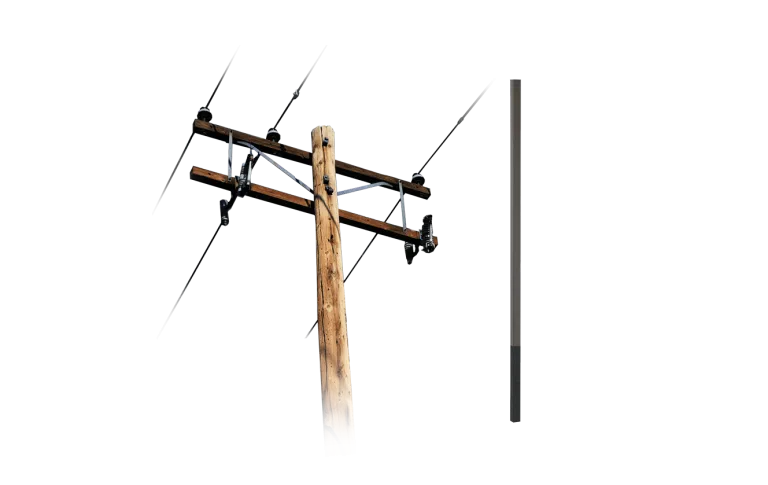

Our Class 4 Wood Poles include wood utility and light poles for lighting, communications, and utility projects. Available configurations vary by wood species, overall length, minimum circumference, taper, preservative treatment, and direct-embedment installation.
These poles are used for street and roadway lighting, parking areas, commercial properties, electrical distribution, telecommunications, broadband infrastructure, security and perimeter lighting, and recreational lighting projects.
-
 Starting At $263.64
-
Starting At $363.64
-
Starting At $481.82
-
Starting At $440.53
-
Starting At $600.00
-
Starting At $560.27
-
Starting At $772.73
-
Starting At $912.44
-
Starting At $1,094.69
-
Starting At $927.27
-
Starting At $1,216.36
-
Starting At $1,472.73
-
Starting At $1,725.45




What Is a Class 4 Wood Pole?
Class 4 wood poles may be used for lighting, communications, and utility projects with moderate structural loads. They generally have smaller minimum dimensions than Classes 1 through 3, which can reduce pole weight, freight requirements, handling demands, and excavation size when the additional capacity of a heavier class is not required.
Class 4 is appropriate only when the complete approved design supports its capacity for the required pole length, species, attachments, attachment height, and environmental loads. A Class 4 designation does not describe one universal pole size or guarantee suitability for a particular application. Wood species, overall length, minimum circumference, taper, attachment height, and environmental loading all affect the pole’s structural performance.
LED Lighting Supply offers wood light poles and wood utility poles in multiple classes and heights. Confirm the available species, dimensions, treatment, lead time, minimum order quantity, and project requirements before ordering.
When Is a Class 4 Wood Pole an Appropriate Choice?
Choose Class 4 only when the approved design confirms that its capacity is sufficient for the required pole length, species, attachments, attachment height, and environmental loads. It may be appropriate when the approved loads exceed the capacity of Classes 5 through 10 but do not require a larger Class 1, Class 2, or Class 3 pole.
This can make Class 4 a practical option for projects that need adequate structural capacity while controlling pole size, shipping weight, and installation requirements.
Potential Class 4 applications include:
- Street and roadway light poles, parking-area, and commercial property lighting
- Electrical distribution with lighter span and equipment loads
- Telecommunications, broadband, and service-line infrastructure
- Security and perimeter lighting poles
- Recreational lighting where wood poles are permitted by the project design
- Projects whose plans or utility standards specifically identify Class 4
These applications do not automatically establish that Class 4 is suitable. Pole length, attachment height, fixture or conductor loading, wind, ice, line angles, soil conditions, and installation design must also be evaluated.
Class 4 Compared with Heavier and Lighter Pole Classes
For comparable pole lengths and species, Classes 1 through 3 generally have larger minimum dimensions and greater capacity than Class 4. Classes 5 and 6 generally have smaller minimum dimensions and may be appropriate where the approved loads are lower.
Specifying a heavier class than necessary may increase material, freight, unloading, excavation, and installation costs without improving the project outcome. Selecting a class that is too small can leave insufficient capacity for the proposed attachments and environmental loads.
The correct selection is not necessarily the heaviest or least expensive pole. It is the class that satisfies the complete approved design with suitable capacity for the intended service conditions.
Understanding ANSI O5.1 Class 4 Requirements
ANSI O5.1 establishes minimum quality and dimensional requirements for wood poles used as single-pole utility structures. Pole classification accounts for wood species, overall length, minimum circumference, taper, and associated strength characteristics.
A Class 4 pole generally has a minimum top circumference of approximately 21.5 inches. Its required circumference six feet from the butt is larger and varies according to pole length and species. One six-foot circumference should not be applied to every Class 4 pole.
Use LED Lighting Supply’s wood pole dimension estimation calculator for preliminary planning. Confirm final dimensions against the selected product data and requirements governing the project.
Typical Class 4 Pole Characteristics
- Minimum top circumference: Approximately 21.5 inches, subject to species and applicable specifications
- Circumference six feet from the butt: Varies by pole length and wood species
- Relative capacity: Below Classes 1 through 3 but above Classes 5 through 10 for comparable lengths and species
- Installation style: Typically installed using direct embedment
- Available species and lengths: Vary by manufacturer, region, and project requirements
Selecting Class 4 Wood Poles for Lighting
Class 4 poles may be used for area, street, parking-lot, security, or recreational lighting when the selected pole provides sufficient capacity for the fixture arrangement and site conditions. The pole class and lighting performance should be evaluated as separate parts of the project.
A photometric plan can help determine:
- Required pole quantity and placement
- Fixture mounting heights
- Fixture wattages and lumen output
- Optics and light distribution
- Target foot-candle levels and uniformity
- Spill-light and property-line considerations
The structural review must then account for the number of fixtures on each pole, fixture and bracket weight, projected area or EPA, attachment height, mounting orientation, wind speed, exposure category, and applicable ice loading.
Do not select Class 4 from wattage alone. A lower-wattage fixture can still create significant pole loading when it has a large projected area, is mounted high on the pole, or is installed with multiple fixtures and brackets.
Avoiding Oversized Poles in Lighting Projects
Using a heavier pole class does not improve light levels or allow wider pole spacing by itself. Lighting performance is determined by mounting height, fixture output, optics, aiming, site geometry, surface reflectance, and obstructions.
Where a photometric and structural review supports Class 4, moving to a larger pole may add freight and installation cost without improving illumination. Conversely, a photometric layout that appears suitable does not confirm that Class 4 can support the proposed equipment.
Coordinate the lighting plan and structural review before ordering so the fixture arrangement, pole height, class, and setting depth work together.
Selecting Class 4 Poles for Utility and Communications Work
Utility and communications poles must be evaluated as part of the complete line design. Conductors, service drops, crossarms, transformers, communications cables, cabinets, and other equipment can contribute to the total load.
Straight-line installations may have different requirements from poles installed at corners, line-angle changes, termination points, or equipment locations. Span length, attachment height, wind, ice, unbalanced loads, and guying can substantially change the required pole class.
The utility or project engineer should confirm the pole class, length, setting depth, attachment configuration, clearances, and guying before purchase.
Wood Species and Product Availability
Wood species influence pole dimensions, strength properties, taper, weight, treatment performance, and regional availability. Southern Yellow Pine utility poles are commonly used because the species can provide suitable strength characteristics and accepts pressure treatment effectively.
Other recognized pole species may also be available, but dimensions and design properties should not be assumed to be identical. Confirm the species offered for the required Class 4 length and whether the project specification restricts acceptable species.
CCA Treatment and Wood Preservation
Class 4 poles may be pressure treated with chromated copper arsenate, commonly called CCA. This preservative helps protect the wood against fungal decay, termites, and other wood-destroying organisms.
CCA treatment does not establish the pole class or make a pole suitable for every environment. Treatment type, penetration, retention, field treatment requirements, and intended use should comply with the applicable product and project specifications.
For more information about treatment options, review our comparison of CCA, DCOI, and pentachlorophenol wood pole treatments.
Direct Embedment and Usable Pole Height
Class 4 wood poles are typically installed by placing part of the pole below grade and compacting approved backfill around it. Because a portion of the pole is embedded, the nominal pole length is greater than its usable height above grade.
For lighting projects, the required fixture mounting height should account for:
- Setting depth below grade
- Fixture arm or bracket position
- Clearance from the top of the pole
- Changes in site elevation
- Final grade around the pole location
Setting depth, hole diameter, backfill, and stabilization depend on the approved design and site conditions. Soil bearing capacity, groundwater, frost depth, slopes, erosion, and environmental loading may affect the installation requirements.
Delivery and Installation Planning
Although Class 4 poles are generally smaller than comparable Class 1 through Class 3 poles, they may still require specialized freight and mechanical unloading. Confirm delivery access, turning space, overhead clearances, unloading responsibility, and the equipment needed to position the poles safely.
Store poles in a stable area and support them off the ground where practical. Avoid dragging the poles or damaging the preservative-treated outer surface. Field drilling, cutting, or trimming should follow the manufacturer’s instructions, including any required treatment of exposed wood.
Installation should be completed by a qualified contractor familiar with pole handling, excavation, underground and overhead utilities, required clearances, and applicable safety procedures.
What to Confirm Before Ordering Class 4 Poles
- Required pole class and overall length
- Required fixture or equipment height above grade
- Wood species and product-specific dimensions
- Preservative type, treatment requirements, and retention level
- Fixture, bracket, conductor, cable, and equipment loads
- Wind, ice, exposure, and site-specific environmental conditions
- Setting depth, backfill, and stabilization requirements
- Utility, municipality, engineer, or owner approval requirements
- Minimum order quantity and production lead time
- Delivery access, unloading responsibility, and storage plan
LED Lighting Supply’s Product Specialists can help identify available Class 4 configurations, obtain product documentation, and prepare a pole quote. Structural suitability, attachment design, clearances, embedment, and code compliance should be verified by the qualified professional responsible for the project.
Class 4 Pole Standards and Documentation
Required documentation varies by manufacturer and project. Submittals may identify the ANSI O5.1 pole class, species, overall length, dimensions, preservative treatment, retention level, pole branding, and plant quality-control information.
A Class 4 marking does not by itself establish acceptance by a utility, municipality, public works department, or other approving authority. Confirm the required documentation and obtain approval before purchase when formal submittals are required.
Class 4 Wood Pole Warranty
Warranty terms vary by manufacturer, species, treatment, application, handling, and installation. Confirm the warranty period, covered conditions, required records, and exclusions before ordering.
Keep the purchase documents, pole identification, treatment records, delivery information, and installation records. Damage from improper unloading, storage, field modification, untreated cuts, or installation outside the approved design may affect coverage.
Explore Poles by Height
- 10 to 15 Foot Light Poles
- 20 to 25 Foot Light Poles
- 30 to 35 Foot Light Poles
- 40 to 45 Foot Light Poles
- 50 to 55 Foot Light Poles
- 60 to 65 Foot Light Poles
- 70 Foot Light Poles
Compare Other Wood Pole Classes
Compare nearby classes when the structural requirements have not been finalized. Classes 1 through 3 may be required for greater loading demands, while Classes 5 and 6 may be appropriate when the approved design allows a smaller pole.
Class 4 Wood Poles FAQs
When Is a Class 4 Wood Pole an Appropriate Choice?
Class 4 may be appropriate when approved loads exceed the capacity of Classes 5 through 10 but do not require a larger Class 1, 2, or 3 pole. Suitability still depends on the complete approved design, including pole length, attachment height, equipment loading, wind, ice, soil conditions, and installation design.
How Does Class 4 Compare With Other Wood Pole Classes?
For comparable lengths and species, Class 4 generally has less capacity than Classes 1 through 3 and more capacity than Classes 5 through 10. The correct class is the one that satisfies the complete approved design with suitable capacity for intended service conditions.
Can a Class 4 Wood Pole Be Used for Lighting Projects?
Class 4 poles may be used for area, street, parking-lot, security, or recreational lighting when the selected pole has sufficient capacity for the fixture arrangement and site conditions. Lighting performance and pole structural capacity should be evaluated separately.
Should I Select a Class 4 Pole Based on Fixture Wattage?
No, Class 4 should not be selected from fixture wattage alone. Fixture projected area or EPA, mounting height, multiple fixtures and brackets, wind speed, exposure category, ice loading, and attachment orientation can affect pole loading.
How Does Direct Embedment Affect Usable Pole Height?
Because Class 4 wood poles are typically direct embedded, their nominal length is greater than their usable height above grade. Fixture mounting height should account for setting depth, bracket position, clearance from the pole top, site elevation changes, and final grade.
What Dimensions Are Required for a Class 4 Wood Pole?
A Class 4 pole generally has a minimum top circumference of approximately 21.5 inches, subject to species and applicable specifications. The required circumference six feet from the butt varies by pole length and wood species, so one dimension should not be applied to every Class 4 pole.
What Should Be Confirmed Before Ordering Class 4 Wood Poles?
Before ordering, confirm the required class, overall length, equipment height, species, product-specific dimensions, treatment requirements, loads, environmental conditions, setting requirements, approvals, lead time, and delivery plan. Available species, dimensions, treatment, minimum order quantity, and lead time should also be confirmed for the specific project.
Does a Class 4 Marking Confirm Project Approval?
No, a Class 4 marking alone does not establish acceptance by a utility, municipality, public works department, or other approving authority. Confirm required documentation and obtain approval before purchase when formal submittals are required.