LED Distribution Center Lighting
- High bays, linear fixtures, and dock lights for different zones
- Motion sensors and dimming options available on select models
- Free lighting plans help evaluate fixture spacing and placement


Get Your Custom Lighting Plan With Product Recommendations
- Strategic Layout Designed for High-Rack Aisles, Sorting Areas & Loading Docks
- Foot-Candle Calculations & Fixture Placement Optimized for Fast-Paced Pick & Pack Operations
- Reduce Energy Costs & Enhance Worker Accuracy Across 24/7 Fulfillment Operations


Our LED Distribution Center Lighting includes UFO and linear high bays, warehouse aisle lights, loading dock lights, and wall pack lights for indoor and exterior facility areas. Available fixtures include motion sensor, 0-10V dimming, daylight harvesting, and emergency backup options.
These products are commonly used in receiving areas, shipping areas, staging zones, rack aisles, loading docks, trailer interiors, exterior dock doors, building perimeters, service areas, and logistics operations.


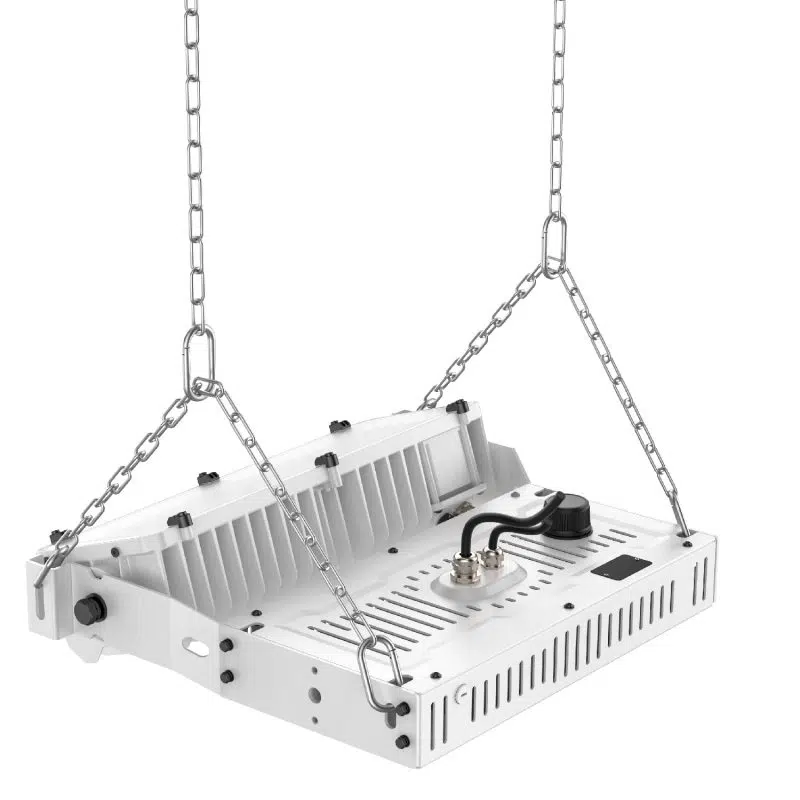
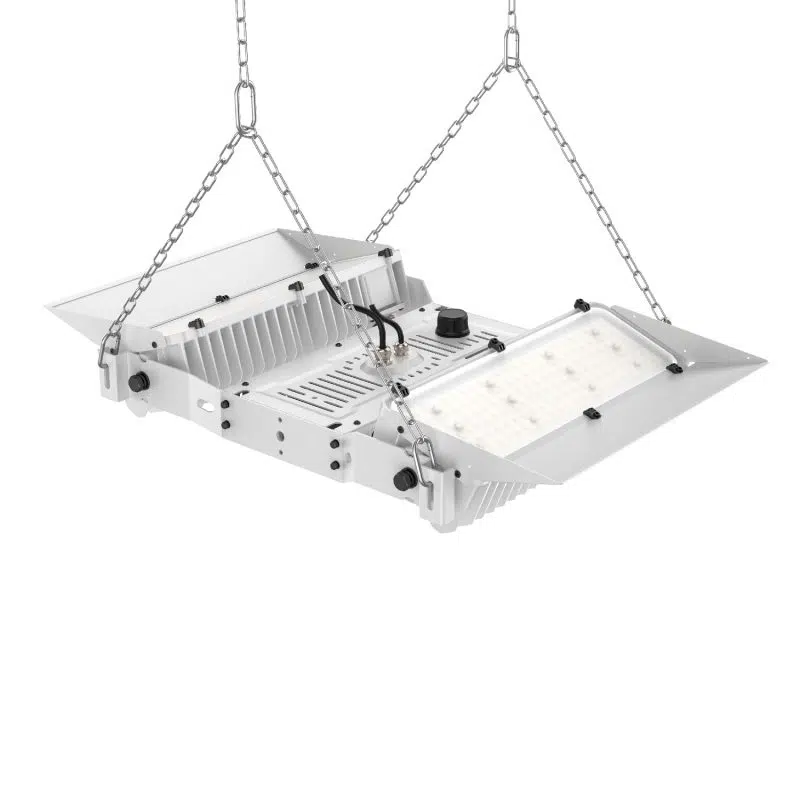
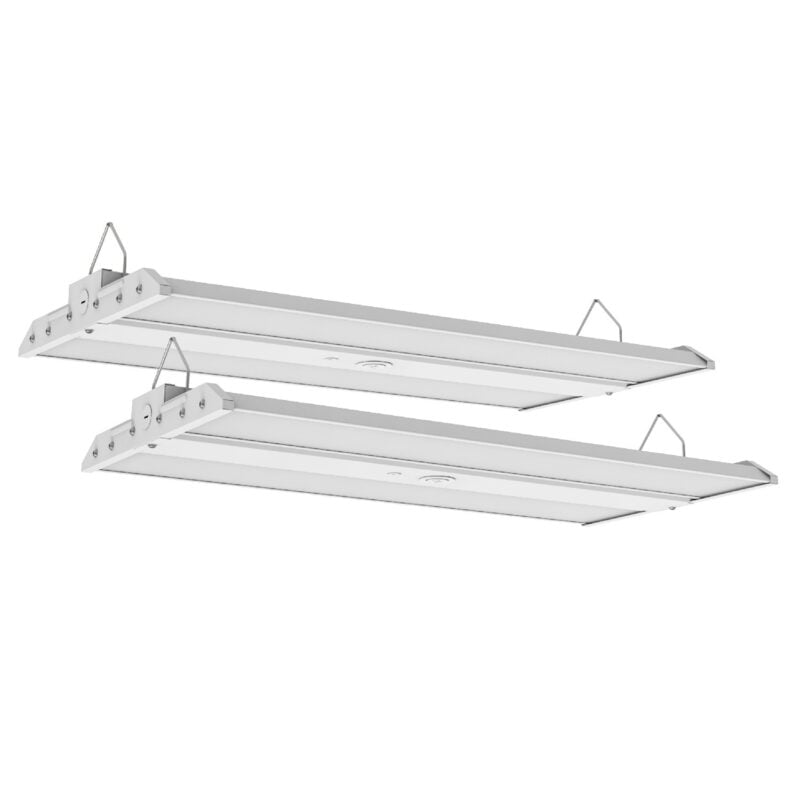



LED Distribution Center Lighting for Shipping, Receiving, Staging, and Logistics Operations
LED distribution center lighting is designed for facilities where products move quickly through receiving, storage, staging, loading, and outbound shipment areas. Unlike general warehouse lighting that may focus mainly on storage and rack visibility, a distribution center often needs lighting that supports forklift traffic, dock activity, pallet movement, staging lanes, trailer loading, and clear visibility across multiple work zones.
Start by reviewing each work zone - open staging, rack aisles, receiving, shipping, dock doors, and exterior loading areas - because fixture type, placement, light levels, and controls may differ across the facility. Key selection factors include ceiling height, rack layout, dock door locations, staging areas, forklift routes, target foot-candle levels, controls, voltage, and environmental conditions. Use high bays for open or high-ceiling areas, aisle-focused layouts for rack rows, and dedicated dock or exterior fixtures where loading activity extends beyond the building. A lighting plan can help confirm fixture count, spacing, beam angle, and expected light levels for high-activity logistics spaces.
Selection and Installation Note: Product specifications, ratings, controls, certifications, and warranty coverage vary by model. Confirm fixture voltage, mounting method, controls, emergency lighting requirements, and environmental ratings before ordering. For code-sensitive, electrical, emergency, exterior, or safety-critical applications, verify requirements with your local inspector or a licensed electrical professional.
When Distribution Center Lighting Is Different From Warehouse Lighting
Distribution centers usually have more movement, more dock activity, and more defined traffic patterns than a standard storage warehouse. That does not always require different fixtures, but it does change how fixtures should be selected, spaced, aimed, and controlled.
| Area | Lighting Decision |
|---|---|
| Receiving areas | Lighting should support visibility for incoming pallets, labels, equipment movement, and dock-adjacent traffic. |
| Shipping areas | Outbound areas often need consistent illumination for pallet checks, staging lanes, order verification, and trailer loading. |
| Loading docks | Dock areas may require a mix of interior high bays, dock lights, wall packs, or exterior area lights depending on layout and operating hours. |
| Staging lanes | Open staging areas need even light distribution so workers and equipment operators can see pallets, labels, floor markings, and traffic paths. |
| Forklift routes | Lighting should reduce dark spots and glare along travel paths, intersections, rack ends, and dock approaches. |
| Rack aisles | Linear high bays or aisle-focused layouts may be better when visibility is needed along long rack rows. |
Best LED Fixtures for Distribution Centers
Most distribution center projects use a combination of high bay fixtures, aisle lighting, dock lighting, emergency lighting, and exterior security lighting. The best fixture depends on ceiling height, layout, activity level, mounting location, and whether the area is open, racked, dock-adjacent, or exterior-facing.
| Fixture Type | Best Fit |
|---|---|
| UFO High Bays | Open distribution areas, staging zones, high ceilings, and broad general illumination where strong downward light is needed. |
| Linear High Bays | Rack aisles, rectangular layouts, long rows, and areas where more directional or evenly distributed coverage is needed. |
| Warehouse Aisle Lighting | Pallet racking, long storage aisles, and narrow pathways where beam spread and uniformity are important. |
| Loading Dock Lights | Dock doors, trailer interiors, loading bays, and receiving areas where workers need focused visibility near trucks and dock equipment. |
| Wall Pack Lights | Exterior dock doors, building perimeters, employee entrances, service areas, and security lighting around the facility. |
Distribution Center Lighting by Work Zone
A good distribution center lighting layout should not treat the entire building as one uniform area. Light levels, fixture placement, and controls may need to change by zone.
| Work Zone | What to Review |
|---|---|
| Open staging areas | Review ceiling height, fixture spacing, pallet layout, floor markings, and forklift movement. |
| Dock doors | Check transitions between interior and exterior lighting, trailer access, task visibility, and emergency egress paths. |
| Rack aisles | Confirm vertical visibility, aisle width, rack height, beam angle, and fixture alignment with rack rows. |
| Traffic intersections | Look for shadowing, glare, blocked sight lines, and areas where forklifts, pedestrians, and pallets cross paths. |
| Exterior loading areas | Review pole lights, wall packs, dock lighting, security coverage, spill light, and vehicle movement after dark. Larger exterior operations may also require dedicated logistics yard lighting. |
Controls and Sensors for Distribution Centers
Distribution centers often have changing activity levels throughout the day. Some zones may run continuously, while others may sit empty between receiving, staging, or outbound shipment cycles. Controls can help reduce energy use without sacrificing visibility where work is active.
- Motion sensors: Useful for aisles, storage rows, and lower-traffic zones where lights do not need to run at full output all day. Review LED high bay lights with motion sensors for compatible configurations.
- 0-10V dimming: Allows light output to be adjusted by zone, task, or operating schedule when supported by the fixture.
- Daylight harvesting: May be useful near skylights, dock doors, glass areas, or perimeter zones with natural light.
- Emergency backup: Should be reviewed for egress paths, exit routes, dock areas, and code-required emergency lighting locations. Available options include LED high bay lights with battery backup, subject to model and project requirements.
- Zone-based control: Helps separate receiving, staging, rack aisles, loading docks, exterior doors, and lower-activity storage areas.
Foot-Candles and Lighting Plans for Distribution Centers
Distribution center lighting should be selected by target foot-candle levels, fixture spacing, beam angle, mounting height, and uniformity. Open staging areas, rack aisles, dock-adjacent zones, and exterior loading areas may each need different light levels.
LED High Bay Lighting Layout Estimator
Use this estimator to calculate approximate fixture count, spacing, and average foot-candles for warehouses, shops, gyms, industrial spaces, and commercial interiors using LED high bay fixtures. Enter your room dimensions, mounting height, target foot-candles, light loss factor, and room/layout condition to generate a preliminary lighting layout. When IES photometry is available, workplane height and room reflectance controls are shown.
Project Inputs
Estimated Results
Estimated average foot-candles are preliminary and should be verified with a lighting plan for project-critical applications.
Room / Layout Condition: This field is used only when usable IES photometry is not available. In fallback mode, it acts as a simplified room utilization factor for reflectance, fixture distribution, racking, obstructions, and how much fixture light reaches the work area. Open / light-colored spaces use 0.90, typical warehouses or shops use 0.75, racked or obstructed spaces use 0.60, and dark or complex spaces use 0.45. When IES photometry is active, this field is hidden and the estimator uses the selected workplane height, LLF, and simplified reflectance adjustment instead.
Photometry / Simulation Note: When usable IES photometry is available for the selected fixture, this estimator uses the fixture’s IES candela data, selected workplane height, light loss factor, and simplified reflectance adjustment to estimate fixture count, average foot-candles, and visual light distribution. The reflectance adjustment is a conservative approximation and is not a full zonal-cavity, radiosity, or professional photometric room calculation. When IES photometry is not available, the estimator uses a simulated beam model based on lumens, mounting height, room/layout condition, light loss factor, and beam angle.
Preliminary Estimate Only: This estimator is intended for simple square or rectangular spaces and should be used as a planning aid, not a final photometric lighting plan. Actual light levels may vary based on fixture optics, selected IES file, mounting conditions, workplane height, ceiling height, surface reflectance, obstructions, controls, voltage, installation conditions, and site-specific requirements. Project-critical applications should be verified with a formal lighting plan.
This estimate is a starting point. Warehouses, industrial facilities, hazardous locations, sports areas, schools, healthcare spaces, public areas, and code-sensitive projects may require a reviewed lighting layout before purchase or installation.
A photometric plan is strongly recommended when the project includes tall ceilings, multiple rack rows, dock doors, large staging areas, exterior loading zones, or a full fixture replacement. A lighting plan can help confirm fixture count, spacing, mounting height, beam angle, and expected light levels before installation.
Common Distribution Center Lighting Mistakes
- Using one fixture layout for every area: Receiving, staging, rack aisles, dock doors, and exterior loading areas may require different fixture placement or light levels.
- Ignoring forklift routes: Poor uniformity, glare, or dark intersections can affect visibility where equipment and pedestrians move through the facility.
- Choosing fixtures by wattage alone: LED selection should be based on delivered lumens, mounting height, beam spread, spacing, and target foot-candles.
- Under-lighting dock areas: Dock doors, trailer loading areas, and exterior approaches often need more careful review than open storage areas.
- Skipping controls: Distribution centers often have zones with different activity levels, making sensors and dimming worth reviewing.
- Forgetting exterior lighting: Wall packs, area lights, pole lights, and dock-area lighting can affect nighttime safety, traffic movement, and security.
Get Help Choosing Distribution Center Lighting
LED Lighting Supply can help review your distribution center layout, ceiling height, dock locations, rack aisles, staging areas, forklift routes, voltage, controls, and target light levels. Our Product Specialists can recommend fixture types and help determine whether a photometric plan is needed before ordering.
Request a free distribution center lighting plan, and we can help match the right fixture type, output, spacing, beam angle, voltage, and control configuration to your facility.
LED Distribution Center Lighting FAQs
How Is Distribution Center Lighting Different From Warehouse Lighting?
Distribution centers often have more movement, dock activity, and defined traffic patterns than standard storage warehouses, which can change how fixtures are selected, spaced, aimed, and controlled.
Which LED Fixture Types Fit Different Distribution Center Areas?
UFO high bays are a best fit for open distribution areas, staging zones, high ceilings, and broad general illumination, while linear high bays fit rack aisles, rectangular layouts, and long rows. Loading dock lights fit dock doors, trailer interiors, loading bays, and receiving areas, while wall packs fit exterior dock doors, building perimeters, entrances, service areas, and security lighting.
What Should Be Reviewed When Planning Lighting For Rack Aisles?
Rack aisle lighting plans should confirm vertical visibility, aisle width, rack height, beam angle, and fixture alignment with rack rows. Linear high bays or aisle-focused layouts may be better where visibility is needed along long rack rows.
How Should Lighting Be Planned For Forklift Routes And Intersections?
Lighting along forklift routes should reduce dark spots and glare at travel paths, intersections, rack ends, and dock approaches. At traffic intersections, review shadowing, glare, blocked sight lines, and areas where forklifts, pedestrians, and pallets cross paths.
Which Controls Are Worth Reviewing For A Distribution Center?
Motion sensors, 0-10V dimming, daylight harvesting, emergency backup, and zone-based control are options to review based on activity levels and work zones. Motion sensors are useful for aisles, storage rows, and lower-traffic zones, while 0-10V dimming allows output adjustment by zone, task, or operating schedule when supported by the fixture.
How Should Light Levels Be Selected For Different Work Zones?
Distribution center lighting should be selected by target foot-candle levels, fixture spacing, beam angle, mounting height, and uniformity. Open staging areas, rack aisles, dock-adjacent zones, and exterior loading areas may each need different light levels.
When Is A Photometric Plan Recommended For Distribution Center Lighting?
A photometric plan is strongly recommended for projects with tall ceilings, multiple rack rows, dock doors, large staging areas, exterior loading zones, or a full fixture replacement. A lighting plan can help confirm fixture count, spacing, mounting height, beam angle, and expected light levels before installation.
What Should Be Confirmed Before Ordering Distribution Center Fixtures?
Confirm fixture voltage, mounting method, controls, emergency lighting requirements, and environmental ratings before ordering because specifications, ratings, controls, certifications, and warranty coverage vary by model.