LED Solar Street Lighting
- Self-powered lighting for roads where grid power is impractical
- Motion, dimming, and scheduling controls available on select models
- Product specialists help review solar exposure and fixture selection



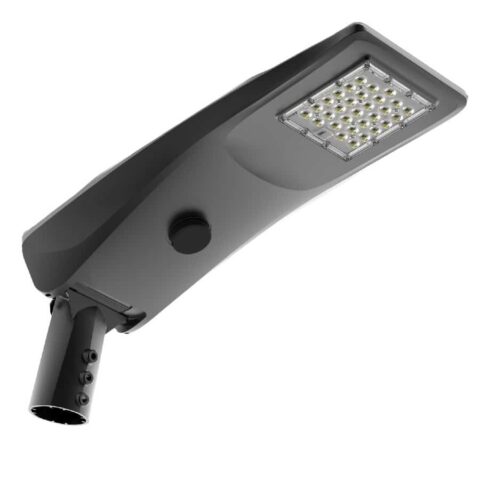
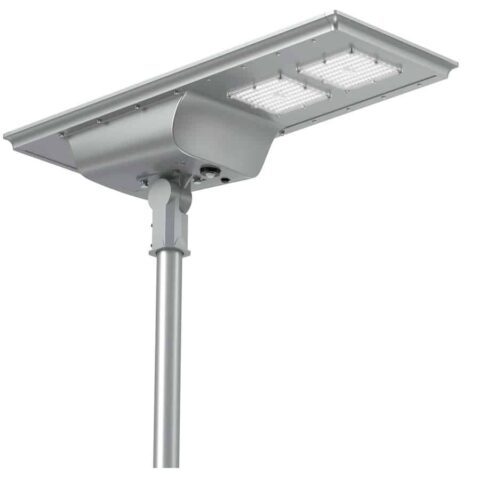
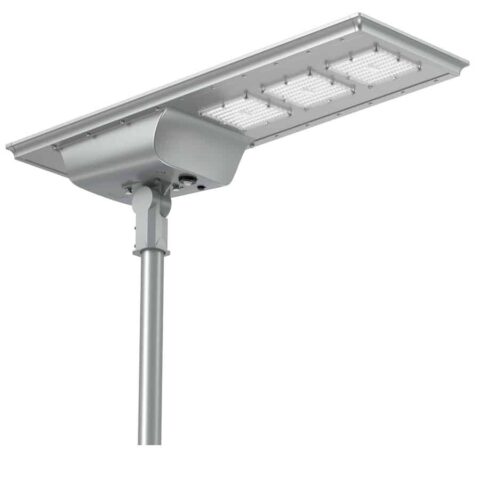
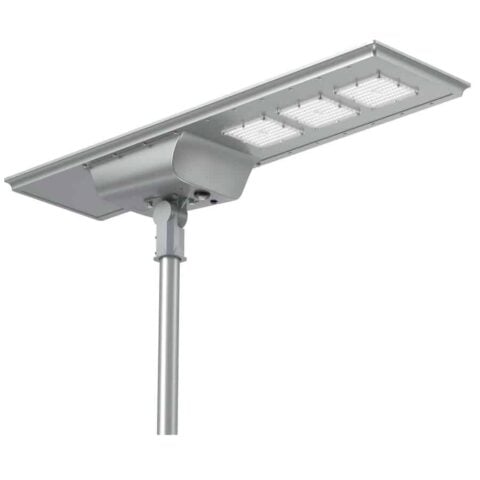
Our LED Solar Street Lights include self-powered roadway fixtures with solar panels, battery storage, charge controllers, poles or mounting structures, and controls. Available systems include motion sensing, dimming, scheduled operation, dusk-to-dawn operation, and hybrid solar models with line-voltage backup.
These solar street lights are commonly used on private roads, campus roads, access roads, service roads, remote roadways, parking-lot drive aisles, gate entries, and road access points.

What Are Commercial LED Solar Street Lights?
Commercial LED solar street lights are self-powered outdoor lighting systems used for roadway-style lighting where utility power may be unavailable, expensive to extend, or disruptive to install. They combine an LED luminaire, solar panel, battery storage, charge controller, pole or mounting structure, and controls to provide nighttime lighting without a standard grid connection.
Solar street lights are commonly used on private roads, campus roads, access roads, service roads, remote roadways, parking-lot drive aisles, gate entries, and roadway-style areas on commercial, municipal, industrial, or institutional properties. They are different from general solar area lights because the layout is usually planned around a linear path of travel, pole spacing, road width, fixture distribution, glare control, and vehicle or pedestrian movement.
Start with the road layout and required nighttime operation, then confirm road width, pole height, fixture spacing, solar exposure, battery capacity, operating schedule, motion settings, required light level, weather, wind exposure, and local requirements. Solar street lighting works best where the panel receives strong sun exposure and the lighting target is realistic for the fixture, battery, and controls package.
Selection and Installation Note: Product specifications, solar panel wattage, battery capacity, fixture wattage, lumen output, optics, pole height, mounting hardware, controls, motion settings, autonomy, environmental rating, certifications, and warranty coverage vary by model. Confirm the selected product specification before ordering. For solar street lights, private roads, campus roads, access roads, service roads, remote roadways, public-facing areas, code-sensitive applications, or safety-critical areas, verify requirements with the facility team, project specifier, local inspector, authority having jurisdiction, or a licensed electrical professional.
How to Choose Commercial Solar Street Lights
Choosing solar street lighting starts with the roadway layout and required operation. A private drive, campus road, service road, remote access route, and parking-lot drive aisle can each need a different pole height, fixture spacing, optics, controls profile, and battery capacity.
| Selection Factor | What to Confirm |
|---|---|
| Road width and layout | Confirm road width, curves, intersections, entrances, pedestrian crossings, and the required coverage zone. |
| Pole height and spacing | Review pole height, setback, spacing, foundations, wind exposure, and maintenance access. Pole, fixture, solar-panel, mounting, and foundation requirements should follow manufacturer information and applicable engineering requirements. |
| Fixture distribution | Choose optics that fit the roadway layout. The wrong distribution can create glare, dark gaps, or wasted light. |
| Solar exposure | Confirm panel orientation, shade, seasonal sun angle, trees, buildings, snow, dust, and other site conditions that affect charging. |
| Battery capacity and autonomy | Review expected runtime, cloudy-day autonomy, dimming settings, climate, battery chemistry, and anticipated replacement needs. |
| Operating profile | Confirm whether the fixture runs at fixed output, dims during idle periods, follows a schedule, or raises output when activity is detected. |
| Code or roadway requirements | Public roads, emergency routes, municipal projects, and safety-critical areas may require additional lighting, electrical, or agency review. |
| Power-source strategy | Determine whether solar-only operation can meet the required schedule and light level, or whether a hybrid or grid-powered system is more appropriate. |
Recommended Foot-Candles for Solar Street Lighting
Solar street lighting levels vary by road type, traffic speed, pedestrian activity, pole height, fixture spacing, fixture distribution, battery capacity, operating schedule, controls, and solar exposure. Use the widget below for early planning ranges. Final fixture count, pole spacing, light levels, uniformity, and autonomy should be verified for the specific roadway-style area using the selected fixture photometrics and project requirements.
How Commercial Solar Street Lights Work
Solar street lights use photovoltaic panels to charge onboard batteries during the day. At night, a controller powers the LED fixture based on the programmed operating schedule, photocell input, motion sensor activity, or dimming profile. Some systems operate at a reduced output until motion is detected, while others follow a fixed schedule or provide higher output for a limited number of hours.
Battery capacity, solar exposure, fixture output, and controls all work together. A fixture that performs well on an open campus road may not perform the same way on a shaded service road, a northern site with long winter nights, or a road that requires full output throughout the night.
Where Solar Street Lights Are Used
Solar street lights are suited to roadway-style areas where a pole-mounted fixture lights a path of vehicle or pedestrian movement. They can be especially useful where trenching, conduit, utility coordination, or extending line voltage would add significant cost or disruption.
| Application | What to Review |
|---|---|
| Private roads | Review road width, vehicle speed, pole spacing, glare, solar exposure, battery autonomy, and local requirements. |
| Campus roads | Review pedestrian crossings, building entrances, shuttle or vehicle traffic, campus standards, controls, and operating schedule. |
| Access roads and service roads | Review truck movement, staff access, gates, security cameras, motion settings, and whether lower output is acceptable during inactive periods. |
| Remote roadways | Review solar exposure, weather, wind exposure, maintenance access, battery autonomy, and whether a solar-only system can meet the project requirements. |
| Parking-lot drive aisles | Review traffic flow, pedestrian routes, pole locations, glare, fixture distribution, and whether the project is closer to a roadway layout or an area-lighting layout. |
| Gate entries and road access points | Review vehicle stops, card readers, keypads, cameras, motion sensor coverage, fixture aiming, and required operating hours. |
Solar Street Lights vs. Solar Area Lights
Solar street lights are generally used for linear roadway-style layouts, while solar area lights are used for broader open areas. The products may look similar, but the layout goals are different. Street lighting is usually planned around road width, pole spacing, drive lanes, glare, and traffic movement. Area lighting is usually planned around open coverage zones such as parking areas, yards, pathways, or general site spaces.
| Lighting Type | Best Fit |
|---|---|
| Solar street lights | Private roads, campus roads, access roads, service roads, remote roadways, gate entries, and parking-lot drive aisles. |
| Solar area lights | Parking areas, pathways, perimeters, storage yards, parks, remote lots, and general outdoor site lighting. |
Choosing Solar-Only, Hybrid, or Grid-Powered Street Lighting
Solar-only street lighting is often a practical choice when the installation location receives reliable sunlight and extending utility power would be costly or disruptive. The system must still have sufficient panel capacity, battery storage, and an operating profile that supports the required nighttime lighting.
| Option | When to Consider It |
|---|---|
| Solar-only street lighting | Open-sun locations, remote roads, phased development, temporary access routes, and projects where the required output and operating schedule can be supported by the solar and battery system. |
| Hybrid solar street lighting | Access roads, gates, service routes, or other areas where solar operation is preferred but line-voltage backup may be needed for continuity of operation. |
| Grid-powered street lighting | Locations with substantial shade, high-output all-night requirements, limited battery autonomy, or project requirements that a solar-only system cannot reliably support. |
Higher-speed roads, public roads, emergency routes, and code-sensitive or safety-critical applications may have specific lighting and uniformity requirements. Confirm the applicable project criteria with the responsible project authority before selecting solar-only equipment.
Why a Solar Street Lighting Plan Helps
A solar street lighting plan helps review pole locations, fixture spacing, light distribution, roadway coverage, dark areas, glare, and expected light levels before products are ordered. For solar projects, the plan should also account for solar panel exposure, battery capacity, motion settings, and operating schedule.
| Lighting Plan Review | Why It Matters for Solar Street Lighting |
|---|---|
| Road coverage | Helps review whether the layout provides useful light across the travel path, shoulders, entrances, or crossings. |
| Pole spacing | Helps compare fixture distance, dark gaps, mounting height, and glare. |
| Solar panel placement | Helps identify locations where the panel has a better chance of receiving consistent sunlight. |
| Foot-candle targets | Helps review whether the planned fixture output is realistic for the road type and operating schedule. |
| Controls and autonomy | Helps review dimming, motion activation, fixed-output operation, and battery runtime assumptions. |
Request a solar street lighting plan
Solar Street Light Cost Considerations
Solar street light pricing depends on fixture output, solar panel size, battery capacity, pole requirements, controls, mounting hardware, foundations, and site conditions. The equipment cost may be higher than a standard grid-powered LED street light, while solar may reduce trenching, conduit, utility coordination, and electrical use where the site is a good fit.
Compare solar and grid-powered street lights using total installed and lifecycle considerations, not fixture cost alone. Review trenching and utility access, operating schedule, battery replacement, panel maintenance, expected autonomy, and whether the available solar exposure can support the required light level.
Sunlight, Climate, and Battery Autonomy
Solar street light performance depends on how much energy the system can collect and store. Shading, cloudy weather, snow, dust, panel angle, and short winter days can all affect charging. Colder temperatures may also reduce battery capacity, depending on battery chemistry and product design.
For sites with long winters, heavy shade, frequent storms, dust, salt spray, or extended cloudy periods, review battery capacity, panel size, fixture settings, maintenance access, materials and environmental documentation, and whether hybrid backup or grid-powered lighting is more appropriate.
Common Solar Street Lighting Mistakes
- Ignoring shade: Trees, buildings, slopes, signs, parked vehicles, and seasonal sun angle can reduce solar charging.
- Assuming full output all night: Many systems rely on dimming, motion activation, or scheduled output to preserve battery runtime.
- Choosing by fixture price alone: Review total installed cost, trenching avoided, pole requirements, battery capacity, maintenance, and expected operating schedule.
- Using area-light spacing for a roadway: Roads, drive aisles, and service routes need layouts based on travel path, pole spacing, glare, and fixture distribution.
- Skipping autonomy review: Confirm how long the system can operate during cloudy weather or limited charging conditions.
- Using solar-only lighting where minimum light levels are mandatory: Code-sensitive or safety-critical roadways may require additional review, hybrid backup, or wired lighting.
- Forgetting wind and pole requirements: Solar panels add surface area and should be reviewed for wind exposure, street light pole selection, mounting hardware, foundation requirements, and applicable structural criteria.
- Overlooking battery replacement: Batteries have a different service life than the LED fixture and should be included in long-term maintenance planning.
Solar Street Light Certifications, Rebates, and Warranty Support
Safety certifications, DLC qualification, environmental ratings, and warranty coverage vary by product. Selected LED solar street light models may be certified or listed by a nationally recognized testing laboratory, such as UL Solutions or Intertek/ETL. Selected models may also be DLC qualified or DLC Premium qualified where applicable. DLC qualification is an efficiency and performance program, not an electrical safety certification. Confirm the exact product certification, DLC status, and utility rebate eligibility before ordering.
Warranty terms vary by model and component, including the fixture, battery, solar panel, and controls. Confirm certifications, warranty coverage, controls compatibility, mounting method, environmental rating, and suitability for the roadway layout and surrounding conditions before purchase. An IP rating addresses enclosure protection against solids and water ingress; it does not by itself confirm corrosion resistance, salt-spray resistance, or suitability for chemical exposure.
Contact us about LED solar street lighting, and our Product Specialists can help review road layout, pole height, solar exposure, fixture spacing, foot-candle targets, battery autonomy, operating settings, power-source options, and product specifications.
LED Solar Street Lighting FAQs
When Is Solar Street Lighting A Good Fit?
Solar street lighting is often a good fit for roads or drive aisles with open sun exposure where wiring would be costly, disruptive, or impractical. It can also be useful for phased site development, temporary access roads, remote property areas, and locations without utility-powered lighting.
How Do Solar Street Lights Differ From Solar Area Lights?
Solar street lights are generally used for linear roadway-style layouts, while solar area lights are used for broader open areas. Street lighting layouts focus on road width, pole spacing, drive lanes, glare, and traffic movement, while area lighting focuses on open coverage zones.
What Should Be Reviewed Before Choosing Commercial Solar Street Lights?
Review the roadway layout, road width, curves, intersections, pedestrian crossings, pole height, fixture spacing, optics, solar exposure, battery capacity, and required operating schedule. Motion and dimming settings, wind exposure, maintenance access, local requirements, and potential hybrid backup needs may also affect the selection.
How Do Solar Street Lights Operate At Night?
At night, a controller powers the LED fixture based on the programmed operating schedule, photocell input, motion sensor activity, or dimming profile. Some systems operate at reduced output until motion is detected, while others follow a fixed schedule or provide higher output for a limited number of hours.
What Can Affect Solar Street Light Charging And Battery Runtime?
Solar charging and battery runtime can be affected by shading, cloudy weather, snow, dust, panel angle, short winter days, solar exposure, fixture output, and control settings. Colder temperatures may also reduce battery capacity, depending on battery chemistry and product design.
When Should A Hybrid Solar Street Light Be Considered?
Hybrid solar street lights may be useful for access roads, gates, service routes, or roadway-style areas where solar operation is preferred but lighting reliability is more critical. They use solar power as the primary source and line voltage as a backup.
Why Is A Solar Street Lighting Plan Helpful Before Ordering?
A solar street lighting plan helps review pole locations, fixture spacing, light distribution, roadway coverage, dark areas, glare, expected light levels, solar panel exposure, battery capacity, motion settings, and operating schedule before products are ordered. Final fixture count, pole spacing, light levels, uniformity, and autonomy should be verified for the specific roadway-style area.
What Should Be Compared When Evaluating Solar Street Light Cost?
Compare total installed cost, required trenching, utility access, operating schedule, battery replacement, panel maintenance, expected autonomy, and available solar exposure rather than fixture cost alone. Solar street light pricing also depends on fixture output, solar panel size, battery capacity, pole requirements, controls, mounting hardware, foundations, and site conditions.