


LED Class 1 Division 1 Lighting
- ETL, UL & DLC Premium Listed for the highest quality performance
- All of our products come with a hassle free 5-year warranty
- Trusted by Contractors with over 500 5-star reviews


-
 Professionally Designed Lighting Layout
-
Fixture Count & Recommendation
-
Improved Energy Efficiency & Reduced Maintenance


LED Class 1 Division 1 lighting includes explosion-proof LED fixtures built for installation in areas where flammable gases or vapors are present during normal operations. These luminaires are typically mounted in petroleum refineries, chemical processing plants, oil and gas facilities, distilleries, waste treatment plants, and similar hazardous locations. Common form factors include pendant, ceiling, wall, and yoke-mounted housings, with options suited for both indoor and outdoor placement around process equipment, walkways, tank farms, and marine engine rooms.
As part of our Commercial & Industrial Lighting Solutions, these fixtures are specified for environments classified as Class I, Division 1 under the National Electrical Code, where continuous or frequent exposure to explosive atmospheres is documented. Typical applications involve installation in production areas, service bays, and elevated structures within facilities handling acetylene, hydrogen, ethylene, propane, or related substances. Each fixture is certified for use in these demanding settings, supporting safe and compliant lighting layouts across critical industrial sites.


Showing 13–24 of 30 results
 SKU:MLLG-E-LED-EXPLD-150-50-[V]-C1D1 | Web ID:1282100V-277V:205 In StockShips 3-5 Days277V-480V:41 In StockShips 3-5 Days
- Watts: 150
- Lumens: 21000
- Lumens/Watt: 140
- Replaces: 400 Watt Metal Halide
- Color Temp: 5000K
- CRI: 70+
- IP Rating: IP66
- IK Rating: IK10
- Voltage: 100V-277V | 277V-480V
- Surge Protection: 10kV
- Operating Temp: -22°F to 122°F
- Rated Life: 50,000 (L70) hours
- Dimmable: 1-10V
- Beam Angle (Std): 120°
- Beam Angle (Opt): 40° | 60° | 90°
- Optics: Tempered Glass Lens
- Fixture Color: Gray
- Mount: Yoke
- Dimensions (in): 15.7 X 11.2 X 9.96
- Weight (lbs): 26.9
- Warranty: 5 years
Starting At$1,200.00


 SKU:MLLG-E-LED-EXPLI2-50-50-U-C1D1 | Web ID:1928Availability: 157 In Stock Ships 3-5 Days
- Watts: 50
- Lumens: 7000
- Lumens/Watt: 140
- Replaces: 250 Watt Metal Halide
- Color Temp: 5000K
- CRI: 70+
- IP Rating: IP66
- IK Rating: IK10
- Voltage: 100V-277V
- Operating Temp: -22°F to 122°F
- Rated Life: 50,000 (L70) hours
- Dimmable: 1-10V
- Beam Angle (Std): 120°
- Optics: Tempered Glass Lens
- Fixture Color: Gray
- Mount: Yoke | 3/4 in NPT Pendant
- Dimensions (in): 24 x 5.5 x 8.1
- Weight (lbs): 20
- Warranty: 5 years
Starting At$1,020.00
 SKU:MLLG-E-LED-EXPLI-40-50-[V]-C1D1 | Web ID:1288100V-277V:112 In StockShips 3-5 Days277V-480V:Built to Order 6 Weeks
- Watts: 40
- Lumens: 5600
- Lumens/Watt: 140
- Replaces: 175 Watt Metal Halide
- Color Temp: 5000K
- CRI: 70+
- IP Rating: IP66
- IK Rating: IK10
- Voltage: 100V-277V | 277V-480V
- Operating Temp: -22°F to 122°F
- Rated Life: 50,000 (L70) hours
- Dimmable: 1-10V
- Beam Angle (Std): 120°
- Optics: Tempered Glass Lens
- Fixture Color: Gray
- Mount: Yoke | 3/4 in NPT Pendant
- Dimensions (in): 47 X 5.5 X 8.1
- Weight (lbs): 26
- Warranty: 5 years
Starting At$1,160.00 SKU:MLLG-E-LED-EXPLI-60-50-[V]-C1D1 | Web ID:1603100V-277V:134 In StockShips 3-5 Days277V-480V:Built to Order 6 Weeks
- Watts: 60
- Lumens: 8400
- Lumens/Watt: 140
- Replaces: 250 Watt Metal Halide
- Color Temp: 5000K
- CRI: 70+
- IP Rating: IP66
- IK Rating: IK10
- Voltage: 100V-277V | 277V-480V
- Operating Temp: -22°F to 122°F
- Rated Life: 50,000 (L70) hours
- Dimmable: 1-10V
- Beam Angle (Std): 120°
- Optics: Tempered Glass Lens
- Fixture Color: Gray
- Mount: Yoke | 3/4 in NPT Pendant
- Dimensions (in): 47 in X 5.5 in X 8.1 in
- Weight (lbs): 26
- Warranty: 5 years
Starting At$1,250.00- SKU:MLLG-E-LED-EXPLI-80-50-[V]-C1D1 | Web ID:1289100V-277V:111 In StockShips 3-5 Days277V-480V:Built to Order 6 Weeks
- Watts: 80
- Lumens: 11200
- Lumens/Watt: 140
- Replaces: 250 Watt Metal Halide
- Color Temp: 5000K
- CRI: 70+
- IP Rating: IP66
- IK Rating: IK10
- Voltage: 100V-277V | 277V-480V
- Operating Temp: -22°F to 122°F
- Rated Life: 50,000 (L70) hours
- Dimmable: 1-10V
- Beam Angle (Std): 120°
- Optics: Tempered Glass Lens
- Fixture Color: Gray
- Mount: Yoke | 3/4 in NPT Pendant
- Dimensions (in): 47 X 5.5 X 8.1
- Weight (lbs): 26
- Warranty: 5 years
Starting At$1,320.00 - SKU:MLLG-E-LED-EXPLI-100-50-[V]-C1D1 | Web ID:1927100V-277V:176 In StockShips 3-5 Days277V-480V:Built to Order 6 Weeks
- Watts: 100
- Lumens: 14000
- Lumens/Watt: 140
- Replaces: 400 Watt Metal Halide
- Color Temp: 5000K
- CRI: 70+
- IP Rating: IP66
- IK Rating: IK10
- Voltage: 100V-277V | 277V-480V
- Operating Temp: -22°F to 122°F
- Rated Life: 50,000 (L70) hours
- Dimmable: 1-10V
- Beam Angle (Std): 120°
- Optics: Tempered Glass Lens
- Fixture Color: Gray
- Mount: Yoke | 3/4 in NPT Pendant
- Dimensions (in): 47 X 5.5 X 8.1
- Weight (lbs): 26
- Warranty: 5 years
Starting At$1,340.00 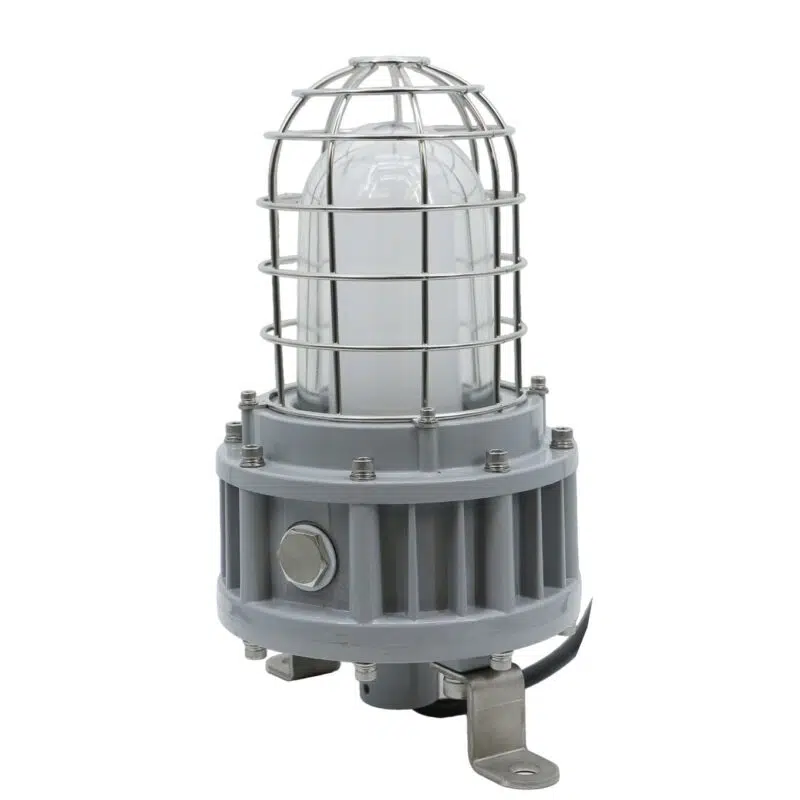 SKU:MLLG-E-LED-EXPLG-20-50-C1D1 | Web ID:2081Availability: 257 In Stock Ships 3-5 Days
- Watts: 20
- Lumens: 2800
- Lumens/Watt: 140
- Replaces: 100 Watt Metal Halide
- Color Temp: 5000K
- CRI: 70+
- IP Rating: IP66
- IK Rating: IK10
- Voltage: 100V-277V
- Operating Temp: -22°F to 122°F
- Rated Life: 50,000 (L70) hours
- Dimmable: No
- Beam Angle (Std): 360°
- Optics: Spherical Tempered Glass Dome
- Mount: Surface | 3/4 in NPT Pendant
- Dimensions (in): 12.5 X 8.8
- Weight (lbs): 14
- Warranty: 5 years
Starting At$500.00- SKU:MLLG-E-LED-EXPLG-30-50-C1D1 | Web ID:1286Availability: 228 In Stock Ships 3-5 Days
- Watts: 30
- Lumens: 3900
- Lumens/Watt: 130
- Replaces: 100 Watt Metal Halide
- Color Temp: 5000K
- CRI: 70+
- IP Rating: IP66
- IK Rating: IK10
- Voltage: 100V-277V
- Operating Temp: -22°F to 122°F
- Rated Life: 50,000 (L70) hours
- Dimmable: 1-10V
- Beam Angle (Std): 360°
- Optics: Spherical Tempered Glass Dome
- Mount: 3/4 in NPT Pendant
- Dimensions (in): 12.5 X 8.8
- Weight (lbs): 14
- Warranty: 5 years
Starting At$520.00 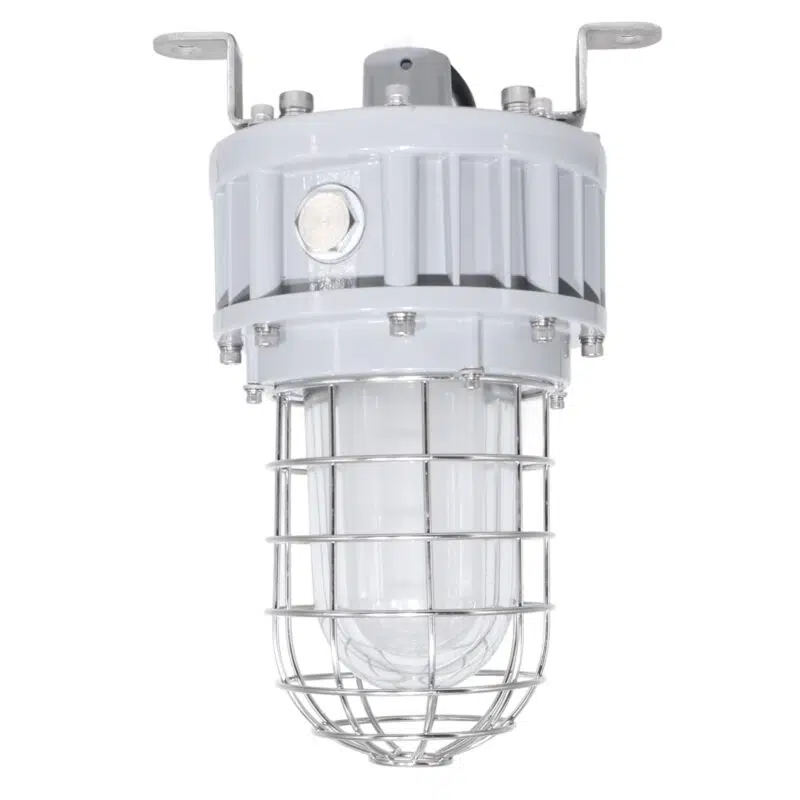 SKU:MLLG-E-LED-EXPLG-40-50-C1D1 | Web ID:1611Availability: 130 In Stock Ships 2-3 Days
- Watts: 40
- Lumens: 5200
- Lumens/Watt: 130
- Replaces: 150 Watt Metal Halide
- Color Temp: 5000K
- CRI: 70+
- IP Rating: IP66
- IK Rating: IK10
- Voltage: 100V-277V
- Operating Temp: -40°F to 149°F
- Rated Life: 50,000 (L70) hours
- Dimmable: 1-10V
- Beam Angle (Std): 360°
- Optics: Spherical Tempered Glass Dome
- Fixture Color: Gray
- Mount: 3/4 in NPT Pendant
- Dimensions (in): 6.8 W X 16.1 H
- Weight (lbs): 14
- Warranty: 5 years
Starting At$560.00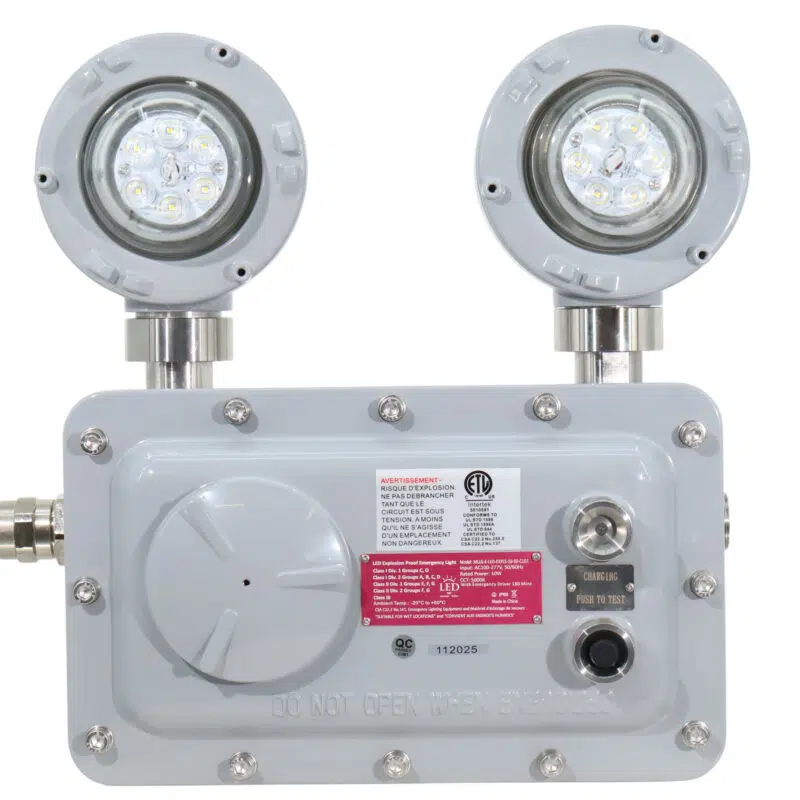 SKU:MLLG-E-LED-EXPLS-10-50-C1D1 | Web ID:1897Availability: 31 In Stock Ships 2-3 Days
- Watts: 10
- Lumens: 1300
- Lumens/Watt: 130
- Color Temp: 5000K
- IP Rating: IP66
- IK Rating: IK10
- Voltage: 100V-277V
- Surge Protection: 10kV
- Operating Temp: -40°F to 140°F
- Rated Life: 50,000 (L70) hours
- Dimmable: No
- Fixture Color: Gray
- Mount: Wall
- Dimensions (in): 15.6 L x 14.7 W x 5.76 D
- Weight (lbs): 17.6
- Warranty: 5 years
Starting At$1,224.00
 SKU:MLLG-E-LED-EXPLJ-3-50-C1D1 | Web ID:1766Built to Order 6 Weeks
- Watts: 3
- IP Rating: IP66
- IK Rating: IK10
- Voltage: 100V-277V
- Operating Temp: -40°F to 140°F
- Rated Life: 50,000 (L70) hours
- Dimmable: No
- Optics: Tempered Glass Lens
- Mount: Chain-Cable | 3/4 in NPT Pendant
- Dimensions (in): 16 X 11.7
- Weight (lbs): 14
- Warranty: 5 years
Starting At$1,867.40- SKU:MLLG-E-LED-EXPLJ-5-50-C1D1 | Web ID:1767Built to Order 6 Weeks
- Watts: 5
- Color Temp: 5000K
- IP Rating: IP66
- IK Rating: IK10
- Voltage: 100V-277V
- Surge Protection: 10kV
- Operating Temp: -40°F to 140°F
- Rated Life: 50,000 (L70) hours
- Dimmable: No
- Optics: Tempered Glass Lens
- Mount: Chain-Cable | 3/4 in NPT Pendant
- Dimensions (in): 16 x 11.7
- Weight (lbs): 14
- Warranty: 5 years
Starting At$2,048.00
Class 1 Div 1 LED Lighting Solutions for Class 1 Division 1 Hazardous Environments
Class 1 Division 1, or C1D1, is the most critical explosion-proof classification defined by the National Electrical Code for hazardous locations. These areas contain explosive atmospheres where concentrations of flammable vapors, gases, or liquids may be present continuously or during normal operating conditions.
With over 15 years of experience in hazardous location lighting, LED Lighting Supply's expertise ensures proper fixture selection for these demanding environments. Our Product Specialists understand how standard lighting can become an ignition source, making specialized explosion proof LED lighting fixtures mandatory for worker safety and regulatory compliance.
According to OSHA's hazardous locations standards, electrical equipment in Class 1 Division 1 areas must be specifically approved and marked for use in explosive atmospheres. The agency emphasizes that improper electrical equipment can serve as ignition sources, making compliance with National Electrical Code requirements essential for worker protection in facilities handling flammable substances and for hazardous location LED lighting compliance.
Understanding Class 1 Division 1 Hazardous Area Classifications
The National Electrical Code (NEC), published by the National Fire Protection Association (NFPA 70), classifies Class I hazardous locations based on the presence of flammable gases or vapors under normal operating conditions.
Within Class I, hazardous atmospheres are divided into Groups A through D, based on ignition energy, explosion pressure, and gas characteristics.
| Hazardous Group | Common Materials | Key Considerations |
|---|---|---|
| Group A | Acetylene | Highest-risk group due to extremely low ignition energy and aggressive combustion characteristics. |
| Group B | Hydrogen or gases of equivalent hazard | Requires equipment approved for gases with high flame speeds and demanding explosion-protection requirements. |
| Group C | Ethylene or gases of equivalent hazard | Common in chemical processing and manufacturing environments. |
| Group D | Propane, butane, methane, benzene, and similar hydrocarbons | Frequently encountered in fuel-handling, petroleum, and industrial applications. |
Groups A and B represent the highest explosion risk due to low ignition energy thresholds and aggressive combustion. Equipment approved for these environments is subject to more stringent design, testing, and certification requirements.
LED Lighting Supply specifies and supplies Class 1 Div 1 LED lighting luminaires in strict accordance with NEC gas group classification requirements. Most Class I Div 1 fixtures offered are certified for Groups C and D, with select models approved for Group B applications where required.
All Class I, Division 1 luminaires supplied by LED Lighting Supply are certified by nationally recognized testing laboratories (NRTLs) in accordance with applicable NEC, UL, and CSA standards. Gas group compatibility must be verified during the lighting design and submittal process, as incorrect group selection can result in failed inspections, insurance conflicts, and serious safety violations.
Critical Safety and Compliance Notice: Class I, Division 1 hazardous locations involve the presence of flammable gases or vapors under normal operating conditions and require equipment specifically certified for continuous or frequent exposure to explosive atmospheres.
Information provided regarding Class I, Division 1 LED lighting is intended for general technical guidance only and does not replace applicable codes, standards, or site-specific engineering evaluation. Final equipment selection, installation, and approval must be performed by qualified professionals and accepted by the authority having jurisdiction (AHJ) in accordance with NFPA 70 (National Electrical Code), OSHA regulations, and all applicable local requirements.
Barrette Outdoor Living Paint Booth Upgrades to LED Fixtures & Saves $7K+
The Backstory
Barrette Outdoor Living, an Oldcastle APG brand, struggled to properly illuminate an existing paint booth with inadequate, exposed fluorescent lighting, leading to a remodel. The Operations Manager, Brandon Hiller, sought LED Lighting Supply's Product Specialist, Joe Hawkins, for expert guidance on the LED lighting upgrade.
The Customer Challenge
The customer needed support in selecting the proper lighting solution for their demanding environment. Barrette Outdoor Living required fixtures for an area that frequently contains flammable paint chemicals and sprays such as lacquers and gelcoat. Additionally, the customer was renovating parts of the booth, including pulling down the ceiling, reframing the walls, and rewiring, while leaving the sprinkler system in place. Due to the intended use of the property, the flammable paint chemical exposure in the environment was not only a concern but also required specialized lighting specifications to comply with local standards. Our team understood that upgrading lighting in hazardous locations involves more complex planning than traditional spaces. The goal was to achieve brighter, safer lighting with minimal shadowing.
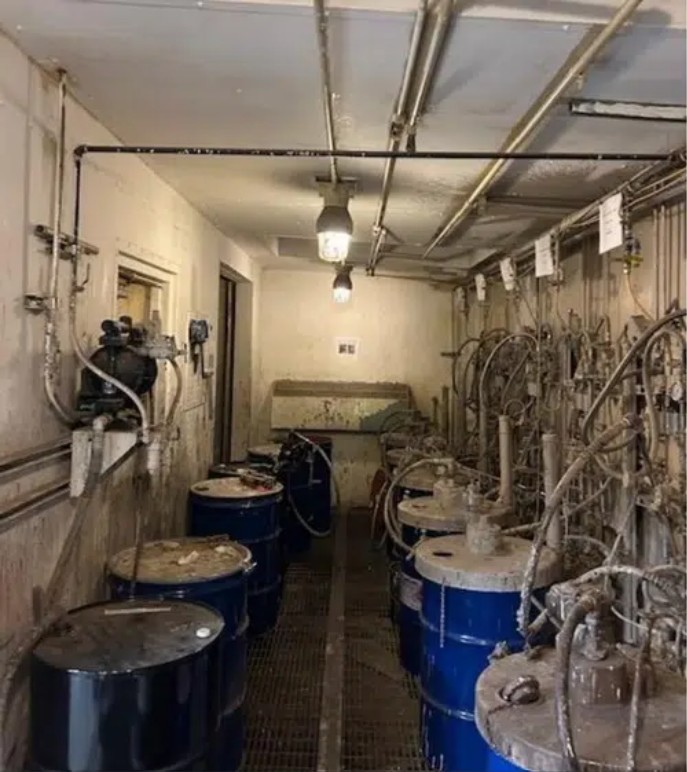
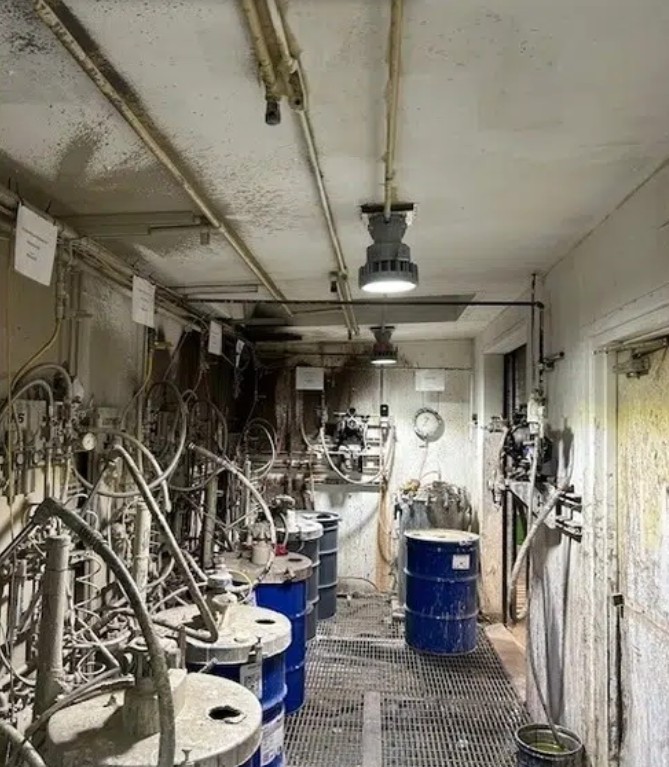
Lighting Plan We Created for the Customer
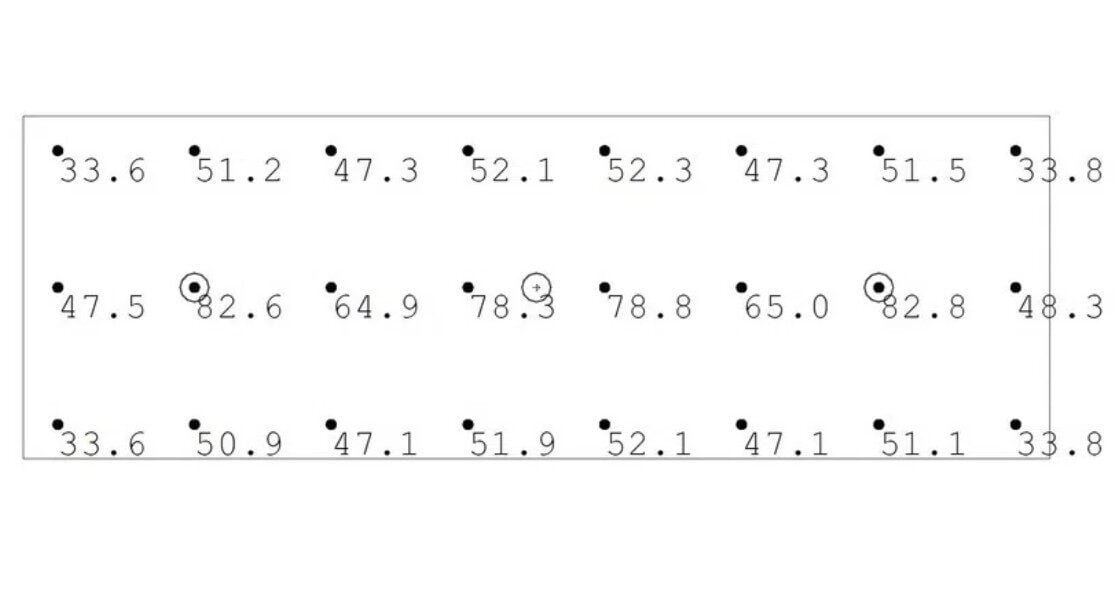

Lighting Plan Metrics:
- Mounting Height: 10 ft
- Fixture Used: 50 Watt Round Explosion Proof LED Light
- Average Foot Candles Achieved: 53
- Product(s) Used: MLLG-E-EXPLS2-150-50-C1D1
Use When / Don't Use When
Class 1 Division 1 fixtures are used in the most demanding Class I hazardous locations, where flammable gases or vapors may be present during normal operation. They should not be used as a substitute for proper area classification, fixture certification, or qualified professional review.
| Use Class 1 Division 1 LED Fixtures When | Do Not Use Class 1 Division 1 LED Fixtures When |
|---|---|
| Hazardous atmospheres may exist during normal operation. Flammable vapors, gases, or liquids may be present continuously or frequently. |
Hazardous conditions occur only occasionally or abnormally. Class 1 Division 2 fixtures may be appropriate when hazardous atmospheres are present only during abnormal conditions. |
| The application is safety-critical. Common examples include petroleum refineries, chemical processing plants, oil platforms, drilling rigs, and distilleries. |
The area is non-hazardous. Standard LED high bays or industrial fixtures may provide better value in ordinary industrial spaces. |
| Gas groups A through D are documented. Facility hazmat documentation identifies the combustible substances present. |
Gas group classification is unknown. Fixture selection requires confirmed compatibility with the specific combustible gases or vapors. |
| Worker safety and compliance are mandatory. Preventing ignition sources in explosive atmospheres is required for safe operation. |
Budget constraints are overriding safety requirements. Certified hazardous-location fixtures should not be compromised in classified areas. |
| The AHJ requires Class 1 Division 1 equipment. Local codes, OSHA requirements, and NEC classification may mandate explosion-proof electrical equipment. |
The installation team lacks hazardous-location experience. Improper installation can void certifications and create safety violations. |
What We Verify Before You Order
| Verification Item | Why It Matters |
|---|---|
| Division 1 vs. Division 2 requirements | Confirms whether hazardous atmospheres may be present during normal operation or only under abnormal conditions. |
| Environmental protection needs | Accounts for IP ratings, corrosion resistance, washdown conditions, marine exposure, and other site-specific factors. |
| Mounting requirements | Confirms pendant, yoke, wall mount, structural, and access considerations. |
| Electrical specifications | Reviews voltage, conduit requirements, sealing needs, and fixture compatibility with the electrical system. |
If We Provide a Lighting Plan
| Deliverable | How It Helps |
|---|---|
| Fixture placement recommendations | Optimizes layout around hazardous area boundaries, access points, and safety requirements. |
| ROI analysis | Compares current explosion-proof fixtures with LED solutions, including energy and maintenance savings. |
| Foot-candle and uniformity calculations | Shows expected illumination performance across the area or workspace. |
Note: Guidance is general planning information. Final selection should be validated with a photometric plan and confirmed by a licensed professional when required for code- or safety-critical areas.
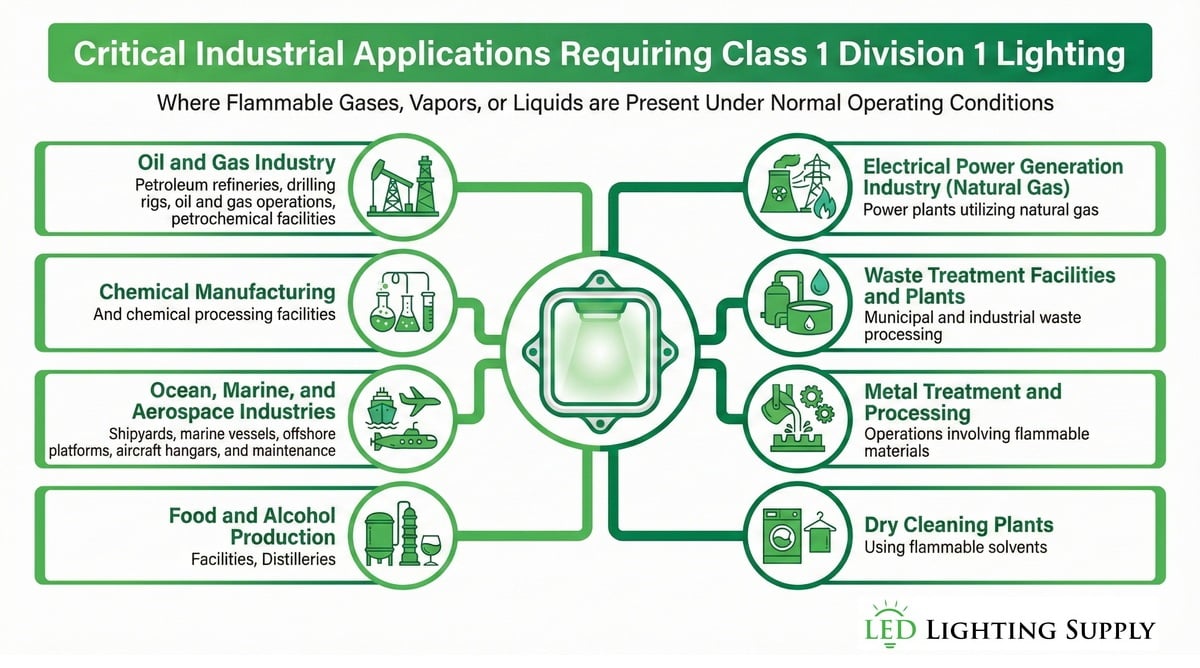
Critical Industrial Applications Requiring Class 1 Division 1 Lighting
Class 1 Division 1 lighting is commonly required in industrial environments where flammable gases or vapors may be present during normal operations. These applications require properly certified fixtures, compatible electrical components, and qualified installation practices.
| Application Area | Typical Class 1 Division 1 Considerations |
|---|---|
| Oil and Gas Industry | Petroleum refineries, drilling rigs, oil and gas operations, and petrochemical facilities may require fixtures certified for continuous or frequent vapor exposure. |
| Chemical Manufacturing | Chemical processing areas may involve documented gas groups and require fixture compatibility with specific flammable materials. |
| Ocean, Marine, and Aerospace Industries | Marine and aerospace environments often require hazardous-location certification along with corrosion, vibration, and environmental protection. |
| Food and Alcohol Production | Distilleries and alcohol production areas may involve flammable vapors and sanitation requirements. |
| Electrical Power Generation | Natural gas power generation areas may require fixtures rated for the relevant gas group and operating environment. |
| Waste Treatment Facilities | Wastewater and treatment plants may require corrosion-resistant hazardous-location lighting around tanks, walkways, and processing areas. |
| Metal Treatment and Processing | Processing operations may require rugged fixtures that can withstand harsh industrial conditions while maintaining hazardous-location compliance. |
| Dry Cleaning Plants | Some dry cleaning environments may involve flammable solvents and require proper classification and approved electrical equipment. |
Quick Selection Guide
Use this guide as a starting point when reviewing Class 1 Division 1 LED lighting. Final fixture selection should be based on area classification, gas group, temperature rating, environmental exposure, and qualified professional review.
| Step | What to Confirm | Why It Matters |
|---|---|---|
| 1 | Confirm that flammable gases or vapors may be present continuously or during normal operations. | This determines whether Division 1 protection is required instead of Division 2. |
| 2 | Confirm gas group classification: A, B, C, or D. | Facility hazmat documentation should identify the combustible substances, and fixture certification must match. |
| 3 | Verify nameplate marking shows Class I Div 1 certification. | Division 2 fixtures are not acceptable in Division 1 areas. |
| 4 | Confirm electrical components carry appropriate ratings. | Junction boxes, conduit fittings, disconnects, and related components must support the required hazardous-location protection. |
| 5 | Calculate voltage drop for long conduit runs. | Explosion-proof fixtures may be less tolerant of low-voltage conditions. |
| 6 | Confirm environmental protection beyond explosion-proof requirements. | Washdown, corrosive, marine, dusty, or outdoor conditions may require additional IP, material, or finish considerations. |
Tip: Never retrofit LED explosion proof light boards into old explosion-proof housings. This voids certifications and creates serious liability during insurance inspections.
Optimized Solutions for Specific Applications
| Application | Recommended Considerations |
|---|---|
| Petrochemical Refineries | Require pendant or yoke-mounted explosion-proof fixtures supporting 120-277V input. Continuous vapor presence demands the highest hazardous-location certifications for safe, compliant operation. |
| Oil Platforms | Need marine-grade housings with IP66 saltwater protection. Instant-on LED startup eliminates dangerous delays during shift changes or emergency evacuations. |
| Chemical Processing Plants | Operate with combustible ethylene vapors and require Group C-certified fixtures. Wall-mount options improve access in areas where overhead fixtures conflict with process equipment. |
| Natural Gas Facilities | Require Group D certified lighting with vibration-resistant mounting. Sealed optical chambers prevent methane infiltration while maintaining stable illumination. |
| Distillery Operations | Need a combination of NSF food-grade compliance and explosion-proof performance. Stainless steel housings resist harsh sanitizing chemicals and prevent alcohol vapor ignition. |
| Waste Treatment Plants | Demand corrosion-resistant finishes and IP65 wet-location protection. Pendant-mounted fixtures effectively illuminate tanks, walkways, and elevated structures. |
| Drilling Rigs | Require portable explosion-proof lighting with temporary mounting options. Battery-backup systems provide safe illumination during power failures in critical operations. |
| Marine Engine Rooms | Benefit from compact fixtures with vibration-resistant drivers and shock-mounted hardware. Low heat output reduces compartment temperatures while providing reliable task lighting. |
Comprehensive Safety and Performance Certifications
All our fixtures carry essential certifications, including DLC Premium for energy efficiency and rebate eligibility, UL Listed and ETL Listed for electrical safety and compliance, and NSF for sanitation and cleanability in applicable models.
LED Lighting Supply's expertise ensures these certifications support safety, performance, and energy efficiency while helping qualifying projects pursue utility rebates and tax incentives. DLC Premium certification supports high-efficiency performance and may improve rebate eligibility for cost-effective operations.


Comprehensive 5-Year Warranty and USA-Based Support
All our Class 1 Division 1 fixtures include a comprehensive 5-year warranty, model dependent, with warranty support provided by our USA-based team. Our Product Specialists understand the critical importance of keeping your Class 1 Division 1 lighting operational and will work quickly to resolve warranty issues.
With over 15 years of experience, we take customer support seriously and help support compliance and safety throughout your fixture's operational life. Contact our specialists today to discuss your Class 1 Division 1 lighting requirements and receive a customized solution for your facility.
Proven Benefits of LED Lighting Supply's Class 1 Div 1 Solutions
Properly specified Class 1 Division 1 LED fixtures can improve safety visibility, reduce maintenance demands, and lower operating costs compared with many legacy explosion-proof lighting systems. Actual performance depends on fixture model, operating conditions, installation quality, and the system being replaced.
| Benefit | Operational Impact |
|---|---|
| Certified Hazardous Location Safety | Fixtures are tested and qualified for Class I, Division 1 environments to help prevent ignition sources in explosive atmospheres. |
| Extended Operational Life | 50,000+ hour fixture lifespans reduce routine bulb and ballast changes, helping minimize downtime and maintenance exposure in hazardous areas. |
| Energy Reduction | LED upgrades can reduce energy consumption compared with metal halide or fluorescent explosion-proof lighting, depending on the existing system and selected fixture. |
| Lower Heat Output | LEDs generate less wasted heat than many legacy technologies, supporting more stable illumination and potentially reducing heat load in enclosed spaces. |
| Improved Area Security | Flicker-free LED illumination supports consistent visibility in safety-critical environments. |
| Harsh Environment Durability | Galvanized and powder-coated housings help fixtures withstand temperature extremes, moisture, vibration, and corrosive atmospheres while maintaining enclosure integrity. |
| Immediate Full Output | LED fixtures reach 100% brightness instantly, eliminating HID warm-up periods during shift changes or emergency conditions. |
| Streamlined Installation | Fixtures designed for explosion-proof mounting and wiring methods can support retrofit installation while maintaining hazardous-location compliance requirements. |
The U.S. Department of Energy's LED lighting research demonstrates that LED technology can reduce energy consumption by 75% or more compared to traditional lighting sources. This efficiency advantage is especially valuable in industrial facilities where lighting operates continuously, as the combination of lower energy costs and reduced maintenance delivers substantial operational savings over the fixture lifespan.

Expert Technical Support and Custom Lighting Design Services
LED Lighting Supply provides complimentary custom lighting plans specifically designed for your Class 1 Division 1 facility layout. Our Product Specialists analyze your hazardous areas to determine fixture placement, wattage requirements, and group compatibility for safety and compliance planning.
We calculate projected energy savings by comparing your current explosion-proof fixtures to LED solutions, including estimated maintenance cost reductions from long-life LED operation. Our technical team has supported thousands of hazardous location projects, giving us practical insight into optimizing illumination levels while controlling fixture quantities and project cost.
Common Installation and Specification Mistakes
Class 1 Division 1 lighting mistakes can create serious compliance, safety, and insurance issues. The most common problems usually involve incorrect area classification, incompatible gas group ratings, improper components, or installation methods that do not preserve the hazardous-location protection system.
| Common Mistake | Why It Matters | How to Avoid It |
|---|---|---|
| Using Division 2-rated fixtures in Division 1 areas because they look identical | Division 2 fixtures are not acceptable where Division 1 protection is required. | Verify the nameplate marking shows Class I Div 1 certification before approval or installation. |
| Installing Group D fixtures where Group B or C gases are present | Incorrect gas group compatibility can result in failed inspections and unsafe operation. | Check facility hazmat documentation and confirm fixture certification matches the specific gas group. |
| Mixing standard electrical components with explosion-proof fixtures | The system is only as safe as its weakest component. | Use properly rated junction boxes, conduit fittings, disconnects, and related components for the classified area. |
| Retrofitting LED boards into old explosion-proof housings | This can void certifications and create serious liability during inspections or insurance reviews. | Use complete certified fixtures rather than modifying legacy explosion-proof housings. |
| Overlooking conduit sealing requirements between hazardous and non-hazardous areas | Improper sealing can allow vapor migration and compromise the protection method. | Confirm NEC 501.15 sealing requirements with the qualified electrical professional responsible for the installation. |
| Specifying insufficient IP ratings for washdown or corrosive environments | Explosion-proof certification alone does not guarantee suitability for moisture, washdown, or corrosion exposure. | Confirm IP rating, housing material, lens material, and finish for the actual operating environment. |
| Forgetting voltage drop in long conduit runs | Low-voltage conditions can affect fixture operation and reliability. | Calculate voltage drop during design, especially for long conduit runs or remote fixture locations. |
LED Class 1 Division 1 Lighting Frequently Asked Questions
What Is Class 1 Division 1 LED Lighting
Class 1 Division 1 LED lighting is designed for environments where flammable vapors, gases, or liquids may be present continuously or during normal operations. These fixtures are explosion-proof and meet stringent safety standards to prevent ignition in hazardous locations.
When Should I Use Class 1 Division 1 LED Fixtures
Use Class 1 Division 1 LED fixtures in environments with continuous exposure to flammable substances, such as petroleum refineries, chemical processing plants, and oil platforms. These fixtures are essential when worker safety and compliance with local codes and OSHA standards are critical.
What Are the Key Considerations for Selecting Class 1 Division 1 LED Lighting
Key considerations include verifying gas group classification (A, B, C, or D), ensuring fixtures are certified for Class 1 Division 1, and confirming compatibility with environmental conditions like IP ratings. Proper selection prevents safety violations and ensures compliance with hazardous location standards.
Can I Use Class 1 Division 2 Fixtures in Division 1 Areas
No, Class 1 Division 2 fixtures are not suitable for Division 1 areas. Division 1 environments require fixtures specifically certified for continuous exposure to explosive atmospheres. Using Division 2 fixtures in these areas can lead to safety violations and failed inspections.
What Certifications Should Class 1 Division 1 LED Fixtures Have
Class 1 Division 1 LED fixtures should be certified by nationally recognized testing laboratories (NRTLs) and meet NEC, UL, and CSA standards. These certifications ensure the fixtures are safe for use in explosive atmospheres and comply with regulatory requirements.
How Do I Verify the Correct Fixture for My Hazardous Location
Verify the correct fixture by confirming the gas group classification from facility documentation and ensuring the fixture's certification matches. Check the nameplate marking for "Class I Div 1" certification and consult with a licensed professional if necessary for code-critical areas.
What Are Common Mistakes When Specifying Class 1 Division 1 Lighting
Common mistakes include using Division 2-rated fixtures in Division 1 areas, selecting incorrect gas group fixtures, and mixing standard electrical components with explosion-proof fixtures. Always verify certifications and compatibility with hazardous location requirements.