


LED Flat Panel Lights and Troffer Lights
- Achieve 50%+ energy savings with 50,000+ hour lifespan reliability
- DLC Premium certified fixtures qualify for maximum utility rebates
- Zero flicker, instant-on performance with 5-year USA warranty support


-
 Professional Grid Layout Design for Seamless Ceiling Integration & Visual Appeal
-
Precise Panel Count, Spacing & Wattage Calculations for Optimal Office Illumination
-
Reduce HVAC Costs with Low-Heat LED Panels & Extended Lifespan


LED Flat Panel Lights and Troffer Lights for offices, schools, and healthcare facilities include versatile 1x4, 2x2, and 2x4 configurations. These slim, low-profile fixtures are designed for suspended ceiling grids, providing broad, uniform illumination ideal for replacing outdated fluorescent troffers. With selectable wattage and color temperature, they offer flexibility in light output and appearance, making them suitable for various professional interiors. Some models feature motion sensors, emergency battery backup, and TAA compliance, catering to specific project needs.
When selecting LED panel lights, consider factors such as room dimensions, ceiling height, target foot-candles, and fixture spacing. These panels are best suited for environments requiring a clean ceiling appearance and efficient general lighting. Ensure compatibility with existing controls and confirm specifications for emergency lighting, procurement standards, and mounting methods. For specialized applications, verify requirements with a qualified professional to ensure compliance with safety and project standards.



Showing all 13 results
 SKU:LLS-M-BLP-2X2-40A-CC | Web ID:2779Back in Stock 7/27
- Lumens: 2500 | 3750 | 5000
- Replaces: Fluorescent Troffer
- Color Temp: 3500K | 4000K | 5000K
- CRI: 80+
- Rated Life: 50,000 hours - driver
- Dimmable: 0-10V
- Beam Angle (Std): 110°
- Mount: Recessed
- Dimensions (in): 23.78 L x 23.78 W x 1.3 H
- Weight (lbs): 4.5
Starting At$47.31


- SKU:LLS-AL-BLP-2X2-20/25/30-CC-4P | Web ID:2299Availability: 4531 In Stock Ships 2-3 Days
- Lumens: 2500 | 3125 | 3750
- Replaces: Fluorescent Troffer
- Color Temp: 3500K | 4000K | 5000K
- CRI: 80+
- Rated Life: 50,000 (L70) hours
- Dimmable: 0-10V
- Beam Angle (Std): 110°
- Mount: Recessed
- Mount (Opt): Chain-Cable | Surface
- Dimensions (in): 23.75 X 23.75 X 1.25
- Weight (lbs): 4.5 lbs
Starting At$198.93
- SKU:LLS-AL-BLP-2X2-30A-CC-EM-2P | Web ID:2036Availability: 2148 In Stock Ships 2-3 Days
- Lumens: 2500 | 3125 | 3750
- Replaces: Fluorescent Troffer
- Color Temp: 3500K | 4000K | 5000K
- CRI: 80+
- Rated Life: 100,000 (L70) hours
- Dimmable: 1-10V
- Beam Angle (Std): 110°
- Mount: Recessed
- Mount (Opt): Chain-Cable | Surface
- Dimensions (in): 23.8 in X 23.8 X 2.5
- Weight (lbs): 6.8 lbs
Starting At$268.36 - SKU:LLS-AL-BLP-2X2-20/25/30-CC-MS2P | Web ID:2357Availability: 850 In Stock Out of Stock
- Lumens: 2500 | 3125 | 3750
- Replaces: Fluorescent Troffer
- Color Temp: 3500K | 4000K | 5000K
- CRI: 80+
- Rated Life: 50,000 (L70) hours
- Dimmable: 0-10V
- Beam Angle (Std): 110°
- Mount: Recessed
- Mount (Opt): Chain-Cable | Surface
- Dimensions (in): 23.75 X 23.75 X 1.25
- Weight (lbs): 4.5 lbs
Starting At$123.24 - SKU:LLS-M-BLP-2X4-50A-CC | Web ID:2766Back in Stock 7/27
- Lumens: 3750 | 5000 | 6250
- Replaces: Fluorescent Troffer
- Color Temp: 3500K | 4000K | 5000K
- CRI: 80+
- Rated Life: 50,000 (L70) hours
- Dimmable: 0-10V
- Beam Angle (Std): 110°
- Mount: Recessed
- Mount (Opt): Chain-Cable | Surface
- Dimensions (in): 47.81 L x 23.78 W x 1.3 H
- Weight (lbs): 7
Starting At$69.89 - SKU:LLS-AL-BLP-2X4-25/30/40-CC-4P | Web ID:2352Availability: 5489 In Stock Ships 2-3 Days
- Lumens: 3250 | 3900 | 5200
- Replaces: Fluorescent Troffer
- Color Temp: 3500K | 4000K | 5000K
- CRI: 80+
- Rated Life: 150,000 (L70) hours
- Dimmable: 0-10V
- Beam Angle (Std): 140°
- Mount: Recessed
- Mount (Opt): Chain-Cable | Surface
- Dimensions (in): 23.75 X 47.75 X 2.25
- Weight (lbs): 8 lbs
Starting At$298.38 - SKU:LLS-AL-BLP-2X4-40A-CC-EM-2P | Web ID:1824Availability: 2846 In Stock Ships 2-3 Days
- Lumens: 3250 | 3900 | 5200
- Replaces: Fluorescent Troffer
- Color Temp: 3500K | 4000K | 5000K
- CRI: 80+
- Rated Life: 150,000 (L70) hours
- Dimmable: 0-10V
- Beam Angle (Std): 140°
- Mount: Recessed
- Mount (Opt): Chain-Cable | Surface
- Dimensions (in): 23.75 X 47.75 X 2.25
- Weight (lbs): 8.8 lbs
Starting At$312.45 - SKU:LLS-AL-BLP-2X4-25/30/40-CC-MS2P | Web ID:2356Availability: 83 In Stock Ships 2-3 Days
- Lumens: 3250 | 3900 | 5200
- Replaces: Fluorescent Troffer
- Color Temp: 3500K | 4000K | 5000K
- CRI: 80+
- Rated Life: 150,000 (L70) hours
- Dimmable: 0-10V
- Beam Angle (Std): 140°
- Mount: Recessed
- Mount (Opt): Chain-Cable | Surface
- Dimensions (in): 23.75 X 47.75 X 2.25
- Weight (lbs): 8 lbs
Starting At$175.50 - SKU:MLLG-AL-LED-PANBLH-2X4-40-40 | Web ID:1710Availability: 552 In Stock Ships 2-3 Days
- Lumens: 5558
- Replaces: Fluorescent Troffer
- Color Temp: 4000K
- CRI: 80+
- Rated Life: 50,000 (L70) hours
- Dimmable: 1-10V
- Beam Angle (Std): 140°
- Mount: Recessed
- Mount (Opt): Chain-Cable | Surface
- Dimensions (in): 23.75 X 47.75 X 1.25
- Weight (lbs): 9 lbs
Starting At$60.70 - SKU:MLLG-WD-LED-PANBLH-1X4-30-CC | Web ID:2479Availability: 571 In Stock Ships 3-5 Days
- Lumens: 2760 | 3250 | 3900
- Replaces: 32 Watt Fluorescent
- Color Temp: 3500K | 4000K | 5000K
- CRI: 80+
- IP Rating: IP40
- Rated Life: 70,000 hours
- Dimmable: 0-10V
- Beam Angle (Std): 110°
- Mount: Recessed
- Mount (Opt): Chain-Cable | Surface
- Dimensions (in): 11 7/8 X 47 3/4 X 1 3/4
- Weight (lbs): 12 lbs
Starting At$100.00 - SKU:LLS-WD-PANTH-1X4-28A-CC | Web ID:2761Availability: 198 In Stock Ships 3-5 Days
- Lumens: 1890 | 2360 | 2750 | 3700
- Replaces: Fluorescent Troffer
- Color Temp: 3000K | 3500K | 4000K | 5000K | 6500K
- CRI: 80+
- Rated Life: 50,000 hours
- Dimmable: 0-10V
- Beam Angle (Std): 120°
- Mount: Recessed
- Dimensions (in): 47.8 L x 11.75 W x 2 H
- Weight (lbs): 7.7
Starting At$99.01 - SKU:LLS-WD-PANTH-2X2-28A-CC | Web ID:1980Availability: 2316 In Stock Ships 2-3 Days
- Lumens: 1979 | 2452 | 2844 | 3845
- Replaces: Fluorescent Troffer
- Color Temp: 3000K | 3500K | 4000K | 5000K | 6500K
- CRI: 80+
- Rated Life: 50,000 hours
- Dimmable: 0-10V
- Beam Angle (Std): 120°
- Mount: Recessed
- Dimensions (in): 23.75 x 23.75 x 2.13
- Weight (lbs): 11.4 lbs
Starting At$88.68 - SKU:LLS-WD-PANTH-2X4-41A-CC | Web ID:2733Availability: 4987 In Stock Ships 2-3 Days
- Lumens: 3390 | 4629 | 5375 | 6442
- Replaces: Fluorescent Troffer
- Color Temp: 3000K | 3500K | 4000K | 5000K | 6500K
- CRI: 80+
- Rated Life: 70,000 hours
- Dimmable: 0-10V
- Beam Angle (Std): 120°
- Mount: Recessed
- Dimensions (in): 23.75 x 47.75
- Weight (lbs): 11.4 lbs
Starting At$137.74




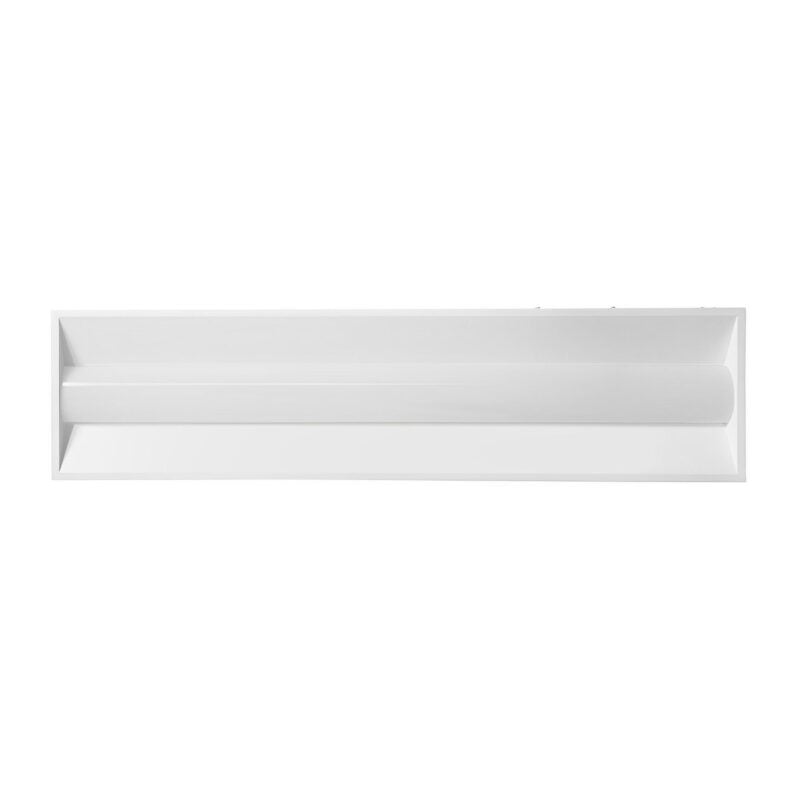


What Are LED Panel Lights?
LED panel lights are slim, low-profile commercial ceiling fixtures designed to provide broad, uniform illumination across offices, schools, healthcare facilities, retail stores, conference rooms, corridors, and other professional interiors. They are commonly installed in suspended ceiling grids and used to replace fluorescent troffers and older fluorescent panel fixtures.
Our commercial LED panels are available in standard 1x4, 2x2, and 2x4 sizes. They offer selectable wattage and selectable color temperature, allowing installers to adjust light output and CCT for the room instead of committing to a single factory setting. Select models are also available with motion sensors, emergency battery backup, TAA compliance, and alternate mounting accessories.
The correct panel depends on more than ceiling-grid size. Room dimensions, ceiling height, target foot-candles, lumen output, fixture spacing, color temperature, dimming controls, mounting method, emergency-lighting requirements, and procurement specifications should all be reviewed before ordering.

Selection and Installation Note: Product specifications, lumen output, wattage settings, color-temperature settings, CRI, dimming type, motion-sensor operation, emergency output, mounting accessories, certifications, TAA compliance, and warranty coverage vary by model. Confirm the selected product specification before ordering. For emergency egress, healthcare, education, government procurement, code-sensitive, or safety-critical applications, verify project requirements with your local inspector, project specifier, purchasing authority, or a licensed electrical professional.
Airtho Upgrades Cleanroom Facilities to LED Lighting Case Study
The Backstory:
Airtho designs modular, pre-engineered structures for controlled environments. Building these types of facilities requires the proper lighting solution the first time. Airtho needed a supplier who could move fast and understand cleanroom-specific requirements.
Airtho’s President, Brandon Bogart, reached out to LED Lighting Supply in 2020 with a time-sensitive need for 10 LED panel lights. The lighting would be installed in a cleanroom drop ceiling system for a job that ships out the following week. Our Product Specialist, Jeff Cesenaro, was quick to respond and provided his consultative expertise, walking Brandon through kelvin temperature and lumen output options.
He recommended 2x4 edge-lit panel lights with an emergency battery backup option, all in time to meet the deadline. Jeff showed their team that we can plan, quote, revise, and deliver controlled environment lighting solutions across multiple projects promptly. That first exchange led to LED Lighting Supply becoming the preferred lighting supplier for Airtho.
The Challenge of Airtho’s Controlled Environment Lighting:
Cleanroom and controlled environment projects require specialized lighting fixtures and expert guidance. Airtho's work called for lighting layout direction, target illumination planning, and communication they could count on at every stage.
Airtho needed a partner that offers:
- Expert advice tailored to the strict cleanliness and performance demands of controlled environments
- Consistent light output and quality across every fixture, critical for maintaining uniform conditions in controlled spaces
- Custom-tailored layout plans matched to each facility's individual dimensions and classification requirements, rather than a generic approach
LED Lighting Supply gave Airtho the support they needed to meet these requirements.
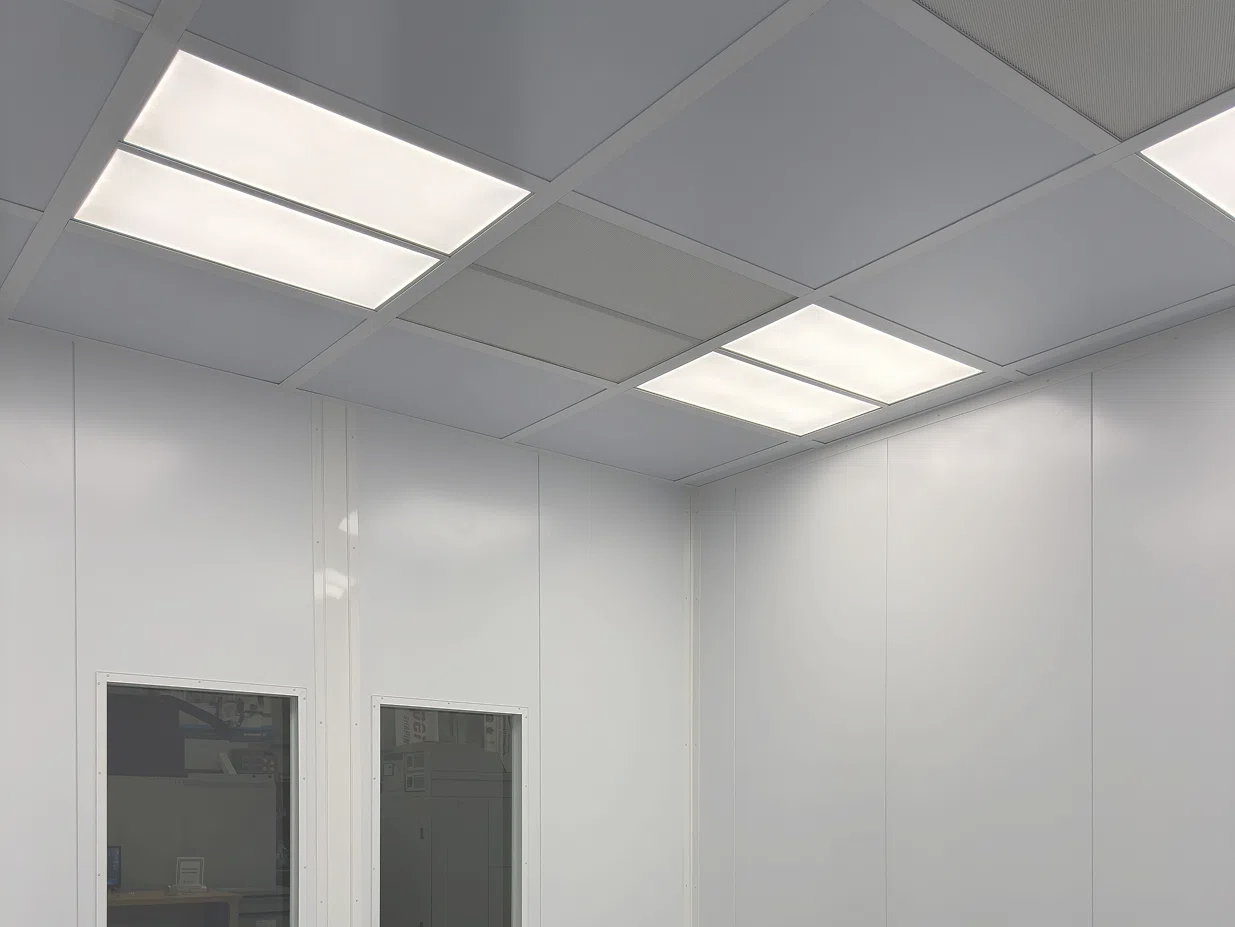
Lighting Plan Created for Techni-Glass in Hawkins County, Tennessee
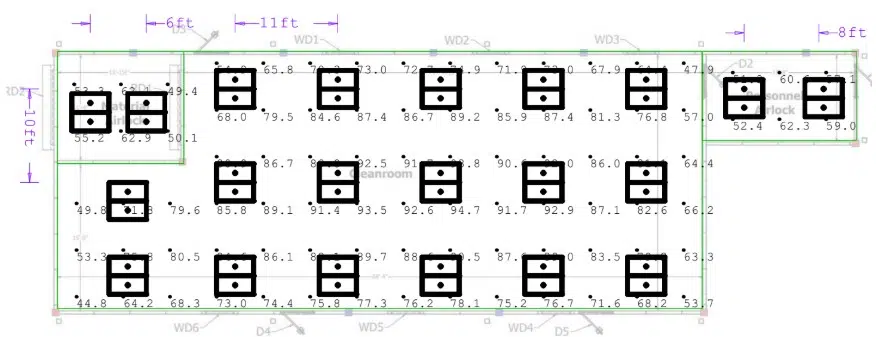
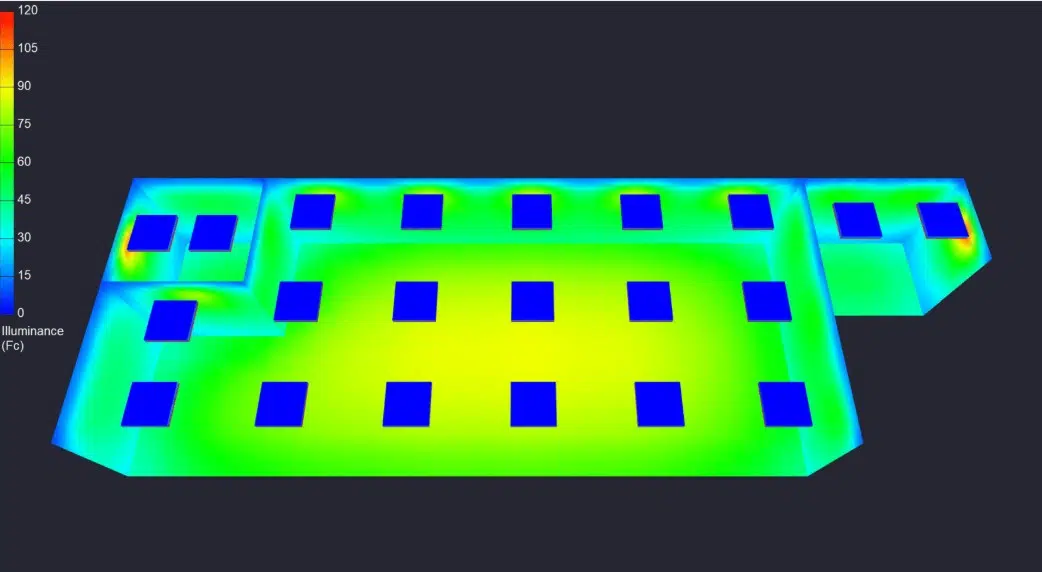
Lighting Plan Metrics:
- Mounting Height: 13 feet
- Fixture Used: 42 MLLG-AL-LED-PANBLH-2X4-4
- FC Achieved: 78 foot-candles
- Uniformity (Avg/Min): 2.11
- Product(s) Used: MLLG-AL-LED-PANBLH-2X4-40-40
Choose LED Panel Lights by Size or Project Requirement
LED panels can be selected by physical size, control requirements, emergency operation, or procurement compliance. A single panel may appear in more than one category when it meets multiple project requirements.
| LED Panel Category | Best Used For |
|---|---|
| 1x4 LED Panel Lights | Corridors, hallways, narrow rooms, offices, and suspended ceiling layouts that use long, narrow grid openings. |
| 2x2 LED Panel Lights | Private offices, smaller classrooms, conference rooms, healthcare spaces, corridors, and 2x2 ceiling grids. |
| 2x4 LED Panel Lights | Open offices, classrooms, retail interiors, large meeting rooms, and commercial spaces that use 2x4 ceiling grids. |
| LED Panel Lights with Emergency Battery Backup | Projects that require designated fixtures to provide reduced emergency illumination after normal power is interrupted. |
| LED Panel Lights with Motion Sensors | Offices, corridors, storage rooms, break rooms, utility areas, and other spaces where lighting should respond to occupancy. |
| TAA-Compliant LED Panel Lights | Federal, military, government, institutional, and other projects where documented Trade Agreements Act compliance is required. |
Selectable Wattage and Color Temperature
Our LED panel lights offer selectable wattage and selectable color temperature. These adjustments help contractors, facility managers, and project teams standardize fewer fixture models while adapting output and light appearance to different rooms.
Selectable wattage changes the panel’s power consumption and lumen output. A lower setting may be appropriate for corridors, private offices, or rooms with generous fixture spacing, while a higher setting may be needed for larger rooms, higher ceilings, or greater target light levels.
Selectable color temperature allows the installer to choose the light appearance before or during installation. Common settings include 3500K, 4000K, and 5000K, depending on the model. Many offices, classrooms, healthcare offices, and commercial interiors use 3500K or 4000K, while 5000K may be selected where a cooler appearance is preferred.
Wattage and CCT settings should be selected consistently across the room. Confirm the switch positions before completing installation, especially when multiple fixtures must produce the same output and color appearance.
When LED Panel Lights Are the Right Fit
LED panels work best in indoor commercial spaces that need a clean ceiling appearance, broad light distribution, and efficient general illumination. Standard panels are not designed for every environment.
| Use LED Panel Lights When | Choose Another Fixture Type When |
|---|---|
| Replacing fluorescent troffers or fluorescent panel fixtures in compatible suspended ceiling systems. | The space has a high ceiling. Warehouses, factories, gymnasiums, and similar facilities normally require high bay lighting. |
| A clean, low-profile ceiling appearance is preferred in offices, schools, healthcare offices, retail stores, and conference rooms. | The location is wet, washdown, outdoor, or harsh. Select fixtures specifically rated for those environmental conditions. |
| The ceiling grid accepts 1x4, 2x2, or 2x4 fixtures or compatible surface-mount accessories are available. | The area is hazardous or classified. Hazardous locations require fixtures approved for the applicable classification. |
| The project needs selectable output, selectable CCT, dimming, motion controls, or emergency options. | The fixture will experience direct impact, severe vibration, high heat, or industrial contamination beyond its listed ratings. |
Where LED Panel Lights Are Commonly Installed
| Application | Panel Selection Considerations |
|---|---|
| Corporate offices | Uniform general illumination, visual comfort, appropriate CCT, dimming, fixture spacing, and compatibility with occupancy controls. |
| Conference rooms | Dimmable panels can support meetings, presentations, and video calls when paired with compatible controls. |
| Schools and classrooms | Consistent light levels, glare control, room layout, controls, emergency-lighting requirements, and any applicable procurement standards. |
| Healthcare offices | Clean ceiling appearance, dependable general illumination, appropriate CRI, visual comfort, and compliance with project-specific requirements. |
| Retail stores | Broad illumination for sales floors, checkout areas, fitting rooms, offices, and back-of-house spaces. |
| Corridors and hallways | 1x4 and 2x2 panels can fit narrow grid layouts. Motion controls and emergency backup may be appropriate depending on occupancy and egress requirements. |
| Hospitality interiors | Low-profile general lighting for meeting rooms, corridors, offices, service areas, and back-of-house spaces. |
| Government and institutional buildings | Confirm panel size, lighting controls, emergency operation, certifications, and TAA compliance where required by the procurement specification. |
Recommended Foot-Candles for LED Panel Lighting
Use the tool below for general starting foot-candle ranges by application. Final fixture count and spacing should be reviewed based on ceiling height, room size, panel size, lumen output, controls, daylight, work performed in the room, surface reflectance, and visual comfort.
Step 1: Find Your Foot-Candle Levels
Step 2: Estimate Fixture Count and Spacing
LED Panel Lighting Layout Estimator
Use this estimator to calculate approximate fixture count, spacing, and average foot-candles for offices, schools, healthcare spaces, and commercial interiors using LED panel fixtures. Enter your room dimensions, mounting height, target foot-candles, light loss factor, and room/layout condition to generate a preliminary lighting layout.
Project Inputs
Estimated Results
Estimated average foot-candles are preliminary and should be verified with a lighting plan for project-critical applications.
Room / Layout Condition: This is a simplified room utilization factor. It accounts for room reflectance, fixture distribution, racking, obstructions, and how much fixture light reaches the work area. Open / light-colored spaces use 0.90, typical warehouses or shops use 0.75, racked or obstructed spaces use 0.60, and dark or complex spaces use 0.45.
Photometry / Simulation Note: When usable IES photometry is available for the selected fixture, this estimator uses the fixture’s IES candela data to improve the visual floor-level light distribution. When IES photometry is not available, the estimator uses a simulated beam model based on lumens, mounting height, room/layout condition, light loss factor, and beam angle.
Preliminary Estimate Only: This estimator is intended for simple square or rectangular spaces. Actual light levels may vary based on fixture optics, mounting conditions, ceiling height, surface reflectance, obstructions, controls, voltage, installation conditions, and site-specific requirements.
This estimate is a starting point. Warehouses, industrial facilities, hazardous locations, sports areas, schools, healthcare spaces, public areas, and code-sensitive projects may require a reviewed lighting layout before purchase or installation.
How to Choose LED Panel Lights
Panel lights should not be selected only by fixture dimensions or wattage. The following factors affect whether the panel will fit the ceiling, provide the required illumination, and work with the building’s electrical and control systems.
| Planning Factor | What to Confirm |
|---|---|
| Panel size | Confirm whether the ceiling layout requires 1x4, 2x2, or 2x4 panels. Check the actual fixture dimensions rather than relying only on the nominal size. |
| Room layout and ceiling height | Room dimensions, workstation placement, ceiling height, daylight, and fixture spacing affect required lumen output and uniformity. |
| Lumen output | Select output based on target foot-candles, room size, mounting height, and fixture spacing rather than fluorescent wattage alone. |
| Wattage setting | Choose the selectable wattage that provides the required output without unnecessarily overlighting the room. |
| Color temperature | Select a consistent CCT for the room based on the application, interior finishes, visual comfort, and project requirements. |
| CRI | CRI 80+ is common for general commercial panel lighting. Spaces with demanding color-evaluation requirements may need specialized fixtures with higher CRI. |
| Dimming | Confirm whether the panel uses 0-10V, 1-10V, or another dimming method and whether the existing controls are compatible. |
| Motion and occupancy controls | Confirm the sensor type, detection coverage, mounting height, sensitivity, hold time, standby level, daylight function, and dimming compatibility. |
| Emergency battery backup | Review emergency lumen output, runtime, test switch, charging indicator, circuit requirements, and whether the emergency system is factory installed or added as an option. |
| Mounting method | Determine whether the panel will be recessed into a ceiling grid, installed in a surface-mount frame, or suspended using compatible accessories. |
| Voltage | Confirm the panel’s supported input-voltage range against the actual circuit voltage before ordering. |
| TAA compliance | For applicable government projects, confirm documented TAA compliance for the exact panel. UL, ETL, DLC, or country-of-origin marketing does not independently establish TAA compliance. |
| Environment | Standard indoor panels are not substitutes for wet-location, washdown, outdoor, high-temperature, hazardous-location, or harsh-environment fixtures. |
| Certifications and rebates | Confirm the required UL, ETL, CSA, DLC, DLC Premium, RoHS, rebate, and procurement documentation for the selected product. |
Can LED Panel Lights Be Surface Mounted?
LED panel lights are commonly installed in suspended T-grid ceilings, but compatible surface-mount frames allow select panels to be installed on drywall, concrete, and other hard ceilings where a recessed grid opening is not available.
A surface-mount frame attaches below the ceiling and holds the panel, driver, wiring, and related components inside a finished enclosure. The completed installation is deeper than a recessed panel because the fixture and frame sit below the ceiling surface.
Before choosing a surface-mounted panel installation, confirm:
- Panel and frame compatibility: The surface-mount frame must match the exact panel size and supported model.
- Finished dimensions: Verify the frame’s external length, width, and depth against the available ceiling space.
- Driver and wiring clearance: Confirm there is sufficient room for the driver, junction box, wiring, connectors, and strain relief.
- Ceiling construction: Fasteners and anchors must be suitable for the ceiling material and total installed weight.
- Installation access: The frame design should allow the panel to be installed, wired, and serviced safely.
- Accessory availability: Surface frames, suspension cables, and other mounting accessories may be sold separately and vary by panel model.
Some panels may also support suspended installation using compatible cables or chains. Confirm the approved mounting methods and accessories on the selected product specification.
LED Panel Lights with Motion Sensors
LED panel lights with motion sensors can reduce unnecessary operating time in spaces that are not continuously occupied. They are commonly used in private offices, conference rooms, corridors, storage rooms, break rooms, utility rooms, restrooms, and similar commercial interiors.
Depending on the model and sensor, the fixture may turn on and off, dim to a standby level, or respond to both occupancy and available daylight. Sensor options may use PIR, microwave, or another detection technology.
Before ordering, confirm whether the sensor is integrated, installed in a fixture receptacle, supplied as an accessory, or mounted remotely. Detection range, ceiling height, hold time, sensitivity, daylight thresholds, standby settings, and 0-10V or 1-10V compatibility vary by model.
LED Panel Lights with Emergency Battery Backup
LED panel lights with emergency battery backup use a battery and emergency driver to provide reduced illumination when normal power is interrupted. They may be used as part of an emergency-lighting design in corridors, offices, classrooms, healthcare facilities, public buildings, and other commercial interiors.
Emergency operation is not the same as normal panel output. Confirm the published emergency lumens, required runtime, battery charging requirements, test switch, indicator light, ambient-temperature limits, circuit arrangement, and installation instructions for the selected model.
An emergency battery panel does not by itself establish that the complete lighting layout meets egress requirements. Fixture placement, delivered emergency light levels, duration, testing, inspection, and local code requirements must be addressed as part of the project.
TAA-Compliant LED Panel Lights
TAA-compliant LED panel lights are available for federal, military, government, institutional, and other projects requiring documented Trade Agreements Act compliance. Confirm TAA status for the exact product and configuration because UL, ETL, CSA, DLC, and DLC Premium listings do not independently establish TAA compliance.
Backlit LED Panel Construction
Many current commercial LED panels use a backlit design, with the LEDs positioned behind the diffuser to distribute illumination directly through the face of the fixture. Backlit panels can provide broad, uniform illumination with a low-profile housing suitable for commercial ceiling applications.
Edge-lit panels place the LEDs along the fixture edges and use a light-guide assembly to distribute illumination across the panel. They may offer a thinner profile, depending on the design. Construction type, fixture depth, efficiency, mounting compatibility, and available options vary by model.

LED Panel Light Certifications, Rebates, and Warranty Support
LED panel lights from LED Lighting Supply carry safety listings such as UL, ETL, or CSA, depending on the product. Many models are DLC or DLC Premium listed for utility rebate support where applicable. Rebate requirements vary by utility, region, and product listing, so eligibility should be confirmed for the selected fixture before ordering.
TAA-compliant options are available for applicable procurement projects, but compliance varies by product and should be verified separately from safety certifications and DLC status.
Most LED panel lights include a 5-year warranty unless otherwise specified, with USA-based warranty support. Confirm the selected panel’s certifications, voltage, wattage settings, color-temperature settings, dimming compatibility, control options, emergency configuration, mounting method, TAA status, and warranty before ordering.
Common LED Panel Light Selection Mistakes
- Assuming all nominal panel sizes have identical dimensions: Verify the actual fixture dimensions and ceiling-grid opening before ordering.
- Selecting by fluorescent wattage alone: Compare LED lumens, fixture spacing, ceiling height, room layout, and target foot-candles.
- Using inconsistent selectable settings: Confirm wattage and CCT switch positions across all panels in the room.
- Ignoring dimming compatibility: Existing controls may not support the selected panel’s dimming protocol or wiring requirements.
- Overlooking sensor coverage: Motion and occupancy sensors must be matched to room dimensions, mounting height, obstructions, and expected movement.
- Assuming emergency backup provides full output: Emergency operation normally produces reduced light and must be evaluated as part of the complete egress-lighting design.
- Assuming certifications establish TAA compliance: Verify documented TAA status for the exact fixture required by the procurement specification.
- Using the wrong mounting accessory: Surface frames and suspension kits must be compatible with the exact panel size and model.
- Using standard panels in unsuitable environments: Standard indoor panels are not substitutes for wet-location, washdown, outdoor, high-temperature, impact-resistant, or hazardous-location fixtures.
Need Help Choosing LED Panel Lights?
Contact us about your LED panel lighting project, and our Product Specialists can help review ceiling type, panel size, room dimensions, lumen output, fixture spacing, selectable wattage, color temperature, dimming, motion controls, emergency backup, TAA requirements, mounting accessories, and product specifications.
This Content on LED panel and troffer lighting layout guidance and fixture selection content Was Professionally Reviewed By:

Dwayne Kula
Founder, President & CTO
LED Lighting Supply
Dwayne has spent over 17 years working directly with LED lighting systems for commercial, industrial, municipal, and specialty lighting applications. His work focuses on helping customers select appropriate fixtures based on application, mounting height, lumen output, optics, controls, voltage, environment, safety requirements, and long-term performance expectations.
He has extensive experience with industrial and commercial lighting projects, including warehouses, manufacturing facilities, parking lots, sports facilities, hazardous locations, exterior building lighting, and large-scale LED retrofit projects.
This content was reviewed for technical accuracy, real-world application, product selection relevance, and clarity for the stated lighting topic.
LED Flat Panel Lights and Troffer Lights Frequently Asked Questions
What Are LED Panel Lighting Fixtures
LED panel lighting fixtures are designed for installation in dropped or suspended ceiling systems, providing a modern alternative to fluorescent panels and LED troffer lights. Their ultra-thin profile, just 0.75 inches thick, makes them ideal for spaces with limited ceiling clearance. These fixtures are popular in offices and retail environments for their sleek appearance and effective illumination.
When Should I Use LED Panel Lights
Use LED panel lights when replacing fluorescent troffers in commercial spaces with dropped ceilings, when ceiling clearance is limited, or when flicker-free illumination is necessary for tasks like computer work or photography. They are also suitable for cold storage or unheated facilities where instant-on performance is needed, and when energy savings and reduced maintenance costs are priorities.
When Should I Avoid Using LED Panel Lights
Avoid using LED panel lights in high-bay applications that require concentrated light from elevated heights, in harsh outdoor environments needing weatherproof housing, or in hazardous locations requiring explosion-proof certifications. They are also not suitable for direct task lighting needing focused beams or when existing magnetic ballast dimmers cannot be upgraded to 0-10V systems.
What Should Be Verified Before Ordering LED Panel Lights
Before ordering, verify ceiling grid dimensions and structural load capacity, plenum clearance for driver installation, voltage compatibility (120V to 277V), color temperature requirements, and emergency backup and egress code requirements. This ensures the panels meet your specific installation and operational needs.
What Are the Benefits of LED Panel Lighting Compared to Fluorescent Troffers
LED panel lighting offers significant energy savings, reducing energy use by 50-75% compared to fluorescent troffers. They provide high-quality illumination with a high CRI and consistent color over their lifespan, reducing maintenance costs by eliminating tube and ballast replacements. LED panels also operate without flicker or noise, reach full brightness instantly, and are compatible with advanced controls like motion sensors.
What Is the Difference Between Edge Lit and Backlit LED Panels
Backlit LED panels have LED arrays mounted directly behind a frosted diffuser, offering uniform light distribution and superior output. Edge-lit panels have LEDs along the perimeter, directing light inward through a light guide plate, resulting in a thinner profile but typically less light output than backlit versions.
What Voltage Compatibility and Driver Technology Do LED Panels Offer
Our LED panels feature universal voltage drivers compatible with 120V to 277V systems, automatically adjusting to your building's electrical setup. This flexibility simplifies installation in both residential and commercial applications, accommodating mixed-use buildings with varying voltages.
How Do Dimming and Controls Integration Work with LED Panels
LED panels support 0-10V dimming down to 10% output, providing smooth, flicker-free dimming. Integration with building automation systems allows for scheduling, daylight harvesting, and zone control, maximizing energy efficiency and user comfort.
What Additional Features Are Available with LED Panels
Additional features include color-selectable panels with switchable color temperatures from 3000K to 5000K, wattage-selectable panels for post-installation brightness adjustment, integrated emergency backup systems for 90-minute illumination during outages, and occupancy sensors for automatic lighting control based on room occupancy.
What Safety and Performance Certifications Do LED Panels Have
Our LED panels carry essential certifications such as DLC Premium, UL Listed, and ETL Listed, ensuring safety, performance, and energy efficiency. These certifications qualify your project for utility rebates and tax incentives when properly installed, guaranteeing the highest efficiency standards.
What Warranty and Support Are Available for LED Panels
All our LED panels come with at least a 5-year warranty, with support based in the USA. Our experienced team is dedicated to resolving any warranty issues quickly to keep your lighting operational.