Best Practices for Electrical Contractors Installing Warehouse Lighting
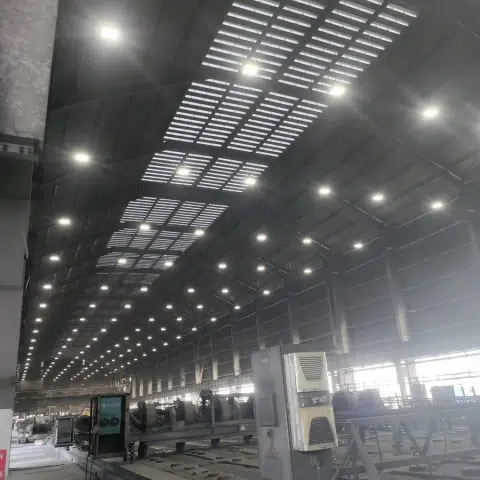
Warehouse lighting projects present unique challenges for electrical contractors, including mounting height, fixture layout, energy-efficiency targets, electrical compatibility, controls, emergency lighting, environmental conditions, and long-term reliability. Based on more than 15 years of experience supporting warehouse and industrial lighting projects, these best practices address common issues that can affect installation quality and lighting performance.
Use these considerations as general project guidance. Final fixture selection and installation should follow the applicable electrical code, project specifications, manufacturer instructions, and requirements of the authority having jurisdiction (AHJ).

Understand the Benefits of LED Fixtures
Before selecting fixtures, it is helpful to understand the potential benefits LED high bay lights can provide in warehouse environments. LED warehouse lighting solutions can use substantially less power than older fluorescent, metal halide, or high-pressure sodium systems when properly selected for the required light levels and layout.
Actual energy savings depend on:
- Existing system wattage
- Proposed LED wattage
- Fixture quantity
- Annual operating hours
- Dimming and occupancy controls
- Required light levels
Additional savings may be available when compatible fixtures are paired with motion or occupancy controls that reduce output or switch lights off in unoccupied areas.
Many commercial LED fixtures also have published lumen-maintenance or expected-life ratings of 50,000 hours or more, but rated life varies by model, operating temperature, driver design, electrical conditions, and duty cycle. Confirm the manufacturer’s data for the selected fixture rather than assuming every LED system will provide a specific number of years of service.
Understanding Light Quality
Lighting quality depends on several characteristics, including illuminance, uniformity, glare, color temperature, color rendering, fixture distribution, flicker performance, and the visual requirements of the work being performed.
Color Rendering Index (CRI) is one measure used to describe how colors appear under a light source compared with an appropriate reference source.
A CRI of approximately 70 or higher is common for general warehouse lighting, but higher CRI may be appropriate for:
- Product inspection
- Color matching
- Painting and finishing
- Quality-control areas
- Retail or customer-facing warehouse spaces
CRI should be specified separately from color temperature. A 5000K fixture does not automatically have better color rendering than a 4000K fixture.
Dimming and Motion Sensors
Not all LED fixtures support the same dimming or control methods. Compatibility depends on the driver, controls, wiring, sensors, and fixture configuration.
Commercial LED fixtures may support:
- 0-10V dimming
- 1-10V dimming
- Occupancy or motion sensors
- Daylight harvesting
- Networked lighting controls
- Programmable high-end and low-end trim
- Other manufacturer-specific control systems
Older metal halide and high-pressure sodium systems generally offer fewer practical dimming options than modern LED systems. Fluorescent systems may support dimming when compatible ballasts and controls are installed.
Contractors evaluating compatible options can review dimmable LED high bays and LED high bay lights with motion sensors.
Contractors should confirm the exact driver and controls compatibility before ordering fixtures or sensors.
Choose the Right Color Temperature
For warehouse applications, 4000K and 5000K are commonly selected color temperatures. The choice is primarily about the visual appearance of the light rather than brightness.
4000K provides a neutral-white appearance, while 5000K provides a cooler, more blue-white appearance.
5000K should not be described as inherently brighter than 4000K. Brightness and delivered light depend on fixture lumen output, optical distribution, mounting height, spacing, and resulting illuminance.
Likewise, color temperature does not determine CRI. If color accuracy is important, confirm the CRI and available color-quality data for the selected fixture separately.
Lighting Certifications and Product Approval
Electrical lighting equipment installed in U.S. workplaces should have the product approval required by the applicable electrical code, OSHA requirements where applicable, project specifications, and the authority having jurisdiction.
For many electrical products used in workplaces, OSHA requires approval through a Nationally Recognized Testing Laboratory (NRTL). An NRTL evaluates and certifies products to applicable U.S. product-safety standards within the laboratory’s OSHA-recognized scope.
UL and Intertek / ETL are well-known examples of organizations that provide NRTL certification, but they are not the only acceptable NRTLs. OSHA recognizes multiple testing and certification organizations and does not require one particular NRTL brand when another recognized NRTL is authorized for the applicable product and standard.
When reviewing a fixture, confirm:
- The certification mark on the exact product
- That the certifying organization is recognized for the applicable product safety standard
- That the certification covers the intended use and environment
- That installation will follow the listing or labeling instructions
- Any additional requirements from the AHJ, owner, engineer, utility, or project specification
OSHA requires listed or labeled electrical equipment to be installed and used according to the instructions associated with its listing or labeling.
What About CE-Marked Lighting Fixtures?
CE marking should not be treated as a substitute for a required U.S. NRTL certification. CE marking relates to conformity with applicable European Union requirements and does not, by itself, demonstrate compliance with OSHA’s NRTL product-approval requirements in the United States. OSHA specifically states that the CE mark is unrelated to its U.S. NRTL product-safety requirements.
That does not mean the presence of a CE mark automatically makes a product prohibited in the United States. A fixture may carry CE marking in addition to an appropriate U.S. certification or approval.
The practical question is whether the exact fixture has the approval required for the U.S. installation. For a typical commercial warehouse project, verify the applicable NRTL certification or other approval method accepted under the governing requirements and confirm acceptance with the AHJ when necessary.
Do not rely on CE marking alone when the installation requires NRTL-approved electrical equipment.
UL vs. ETL vs. Other NRTL Marks
A UL mark and an ETL mark are not different grades of electrical safety. Both can represent NRTL certification when the product has been certified within the organization’s OSHA-recognized scope to the applicable U.S. product-safety standard.
Other OSHA-recognized NRTLs may also provide acceptable certification for products within their recognized scopes.
Contractors should therefore ask:
- Is the fixture certified by an OSHA-recognized NRTL?
- Is that NRTL recognized for the applicable product-safety standard?
- Does the certification cover the exact fixture and intended application?
- Does the AHJ or project specification impose additional requirements?
Do not reject a properly certified fixture merely because its certification mark is not UL or ETL.
DLC Qualification Is Different From Safety Certification
DesignLights Consortium (DLC) qualification is not an electrical safety listing. DLC qualification is primarily related to energy-efficiency and performance requirements for eligible commercial lighting products.
Selected DLC-qualified products may qualify for utility incentives, but rebate eligibility varies by:
- Exact fixture model
- DLC listing status
- Utility provider
- Project type
- Program rules
- Installation date
Confirm the exact product on the applicable DLC Qualified Products List and verify the utility’s current rebate requirements before promising an incentive.
Voltage: 120-277V, 277-480V, and Other Driver Options
Contractors should confirm the available supply voltage before selecting fixtures. Many commercial LED fixtures are available with broad input-voltage drivers such as 120-277V, while selected products are available with 277-480V, 347V, 480V, or other input configurations. For applicable projects, review 480-volt LED high bay lights.
Voltage ranges are model-specific and should be verified from the fixture specification.
Connecting a driver to a voltage outside its rated input range can damage the driver or fixture and may create a safety hazard. It may also affect warranty coverage.
Before installation, confirm:
- Nominal facility voltage
- Actual branch-circuit voltage
- Fixture input-voltage range
- Phase and wiring configuration where relevant
- Controls voltage requirements
- Emergency-driver voltage requirements
Surge Protection
Electrical transients can damage LED drivers, controls, and other electronic components. Industrial facilities with motors, conveyors, switching equipment, transformers, or other electrical loads may experience transient conditions that should be considered during fixture selection.
Depending on the project, protection may include:
- Surge protection incorporated into the fixture or driver
- An additional fixture-level surge protective device
- Panel-level or facility-level surge protection
- A coordinated surge-protection strategy
Surge ratings and protection configurations vary by product. Confirm the fixture’s published surge-test information and any project-specific surge requirements rather than assuming all commercial LED fixtures provide the same protection.
Emergency Backup Batteries
Where emergency egress lighting is required, the emergency-lighting system must meet the applicable life-safety, building, fire, and electrical requirements.
Selected warehouse fixtures can be equipped with an Emergency Backup driver or battery system that operates the fixture at reduced output when normal power is lost.
A 90-minute emergency duration is common in U.S. life-safety applications, but contractors should verify:
- Required emergency duration
- Required illumination levels
- Fixture compatibility
- Emergency-driver output
- Recharge requirements
- Test-switch and indicator requirements
- Applicable building and life-safety code
- AHJ requirements
Do not assume that adding an emergency battery to any high bay automatically creates a compliant emergency-lighting system. Emergency performance should be evaluated for the actual layout and product configuration.
Warranty Coverage and Long-Term Support
Warranty terms and post-sale support should be evaluated regardless of fixture supplier.
Important considerations include:
- Warranty duration
- Driver coverage
- LED-board coverage
- Sensor and control coverage
- Emergency-component coverage
- Labor exclusions
- Environmental exclusions
- Operating-temperature limitations
- Surge-related exclusions
- Replacement-product availability
- Technical support
A stated five- or ten-year warranty does not necessarily mean every failure mode or installation expense is covered. Review the actual manufacturer warranty terms.
Importance of Lighting Plans
Lighting plans use fixture-specific photometric data to predict light levels and distribution within a warehouse before installation.
A photometric plan can help evaluate:
- Fixture quantity
- Fixture placement
- Mounting height
- Average foot-candles
- Minimum and maximum light levels
- Uniformity
- Aisle distribution
- Work-area lighting
- Potential glare or excessive illumination
Lighting plans are fixture-specific. Substituting a different fixture after the calculations are completed can change the results because lumen output, optical distribution, fixture geometry, and photometric performance vary by product.
If a fixture substitution is made, update the lighting plan using the IES file for the replacement fixture rather than assuming equivalent wattage or lumens will produce the same layout.
Installation
LED warehouse fixture installation should follow the manufacturer’s instructions, electrical code, listing or labeling requirements, and project documents.
Installation complexity can increase when the project includes:
- Occupancy sensors
- Networked controls
- 0-10V or other dimming wiring
- Emergency backup
- High-voltage circuits
- High mounting heights
- Fixture whips or cord connections
- Wet, damp, dusty, corrosive, or high-temperature environments
Confirm that mounting hardware, electrical connections, controls, environmental seals, and required clearances are compatible with the exact fixture.
Keeping It Safe
Warehouse lighting installations should comply with the applicable electrical code, workplace electrical-safety requirements, manufacturer installation instructions, project specifications, and requirements of the authority having jurisdiction.
Product approval should not be reduced to a rule stating that only UL or ETL products are permitted. Where NRTL approval is required, verify certification by an OSHA-recognized NRTL for the applicable product and standard. OSHA recognizes multiple NRTLs and requires properly certified products to carry the appropriate certification mark.
Likewise, CE marking alone should not be relied upon as evidence of required U.S. electrical approval. A CE-marked product may also have appropriate U.S. certification, but the U.S. approval should be verified independently.
When there is uncertainty about product acceptance, certification, field evaluation, installation requirements, or local amendments, confirm requirements with the electrical contractor, engineer, NRTL where appropriate, and the AHJ before installation.