Golf Course and Driving Range Lighting: How to Plan a Better Installation
Golf Course and Driving Range Lighting: How to Plan a Better Installation
Lighting a golf facility is not simply a matter of placing high-output fixtures around a field. A driving range must allow players to follow a ball through the air; a practice green needs comfortable, consistent illumination; and an existing course may have limited locations for new poles. Neighbors, roads, trees, netting, and the facility’s operating hours can complicate every decision.
The best place to start is with the experience you want golfers to have, then work backward to the lighting layout, fixtures, mounting and controls. For owners and contractors, the practical question is not “Which beam angle is best?” It is “Will this proposed system help players see the ball and targets without creating avoidable glare, spill light or maintenance problems?” The answer should be supported by a project-specific lighting plan, not just fixture wattage or a product photograph.
Start with the Golfer’s View, Not the Fixture Specification
Stand at a hitting station and look downrange. A player must see the ball at address, identify a landing target and pick up the ball soon after impact. Bright lights in the line of sight can make that harder, even when the turf is well illuminated. A range can look bright from the clubhouse and still have poor ball-flight visibility from the tee line.
This is why driving range lighting needs both horizontal illumination on the hitting surface and target areas and consideration of vertical illumination along the flight path. Horizontal foot-candles help describe the amount of light reaching the ground; vertical illumination helps evaluate light reaching objects viewed in flight. Neither value, taken alone, guarantees that a golfer will track a ball against the actual nighttime background.
Before comparing fixtures, identify the full hitting-line width, intended carry distances, target locations, terrain changes and typical viewing directions. Note any homes or roads beyond the range. Also identify whether the facility needs full-length ball tracking or primarily illuminated near-field targets. Those two operating goals can call for different lighting systems and budgets.
How the Areas of a Golf Facility Change the Lighting Decision
| Area | What the user needs to see | What to check before choosing fixtures |
|---|---|---|
| Driving range | Ball leaving the clubface, flight path and landing targets | Vertical and horizontal light, tee-line glare, long-range coverage, net location and boundaries |
| Tee box | Ball position, stance, nearby people and the intended shot direction | Fixture visibility from the stance, shadows and available mounting positions |
| Fairway | Landing area, ball location and general navigation | Terrain, trees, pole setback, uniformity and the amount of area that actually needs lighting |
| Putting green | Ball, cup, green contours and nearby players | Comfortable illumination, shadows, reflected glare and pole placement outside play |
| Short-game practice area | Chipping targets, bunker edges, green and ball flight over short distances | Overlap between lighting zones and glare from multiple approach directions |
| Paths and gathering areas | Steps, turns, crossings, people and obstacles | Appropriate local lighting and separation from high-output sports fixtures |
Lighting the entire course is a different proposition from illuminating a practice range or a par-three facility. Many projects benefit from defining a smaller number of nighttime playing zones rather than trying to make every part of the property equally bright. This can reduce infrastructure requirements and help contain light to the areas in use.

Driving Range Lighting: Three Decisions That Matter Most
1. Decide how far players need to follow the ball
For a range that operates primarily for beginner instruction or short-game practice, good visibility around the tee line and nearby targets may be sufficient. A full-distance practice facility has a more demanding task: the lighting system should support ball tracking much farther from the golfer, including against dark sky, trees or distant buildings. Be specific about the distance and locations where visibility matters rather than assuming every range requires the same throw.
2. Put glare-sensitive viewpoints on the plan
Lighting positions should be considered from every hitting bay, not only the center of the range. Fixtures behind or to the side of players can be useful, but the final aiming must avoid prominent bright sources in the player’s viewing direction. A shift in pole position or mounting height can sometimes improve visual comfort more effectively than adding more lumens. Evaluate instructors, spectators and elevated or multi-level hitting bays as well.
3. Verify where the light goes at the edges
Carefully examine the last hitting stations at either end of the tee line, the range perimeter and adjacent property boundaries. An arrangement that lights the center well may leave edge targets underlit or direct excessive light beyond the property. Shielding, asymmetric optics, revised aiming or additional lower-output fixtures may be better than simply installing a brighter fixture.
LED Lighting Supply offers LED golf course and driving range lighting with different outputs, optics, mounting configurations and voltage options. Actual product suitability should be verified with the selected fixture’s IES file and site-specific design.
Why Beam Angle Is Only Part of Choosing the Right Optic
Beam angle describes part of a luminaire’s distribution, not the complete pattern of useful light on the course. A narrow optic can concentrate illumination over a longer throw, but an excessively narrow beam may create bright spots and darker gaps between fixtures. A wider distribution may improve coverage near a green or teeing area, yet also increase glare or spill if the mounting and aiming are poorly matched.
Asymmetric and elliptical distributions can help shape illumination along a range or across a rectangular practice area. But two products advertising the same nominal beam angle may have different intensity patterns, high-angle output and optical efficiency. Compare actual photometric files rather than assuming they will perform identically.
Mounting geometry matters just as much. A high fixture aimed steeply down may illuminate a nearer zone differently from a lower fixture aimed outward. Pole setback, slope, trees and netting can change what is achievable. The correct combination should emerge from a calculated layout that includes fixture orientations, mounting heights and the terrain, not from a fixed beam-angle chart.

What a Golf Lighting Plan Should Show You Before You Buy
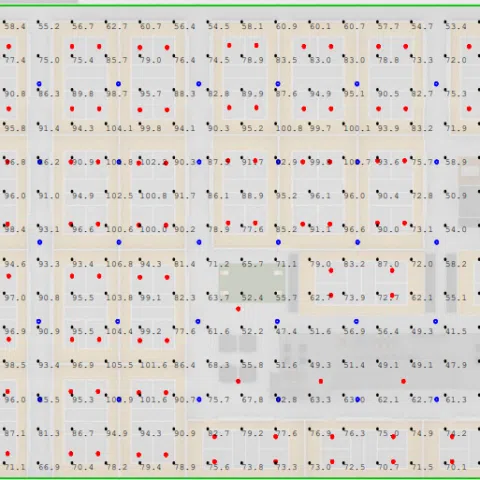
A useful photometric plan should answer practical questions a facility manager can act on. It should identify exactly which areas are evaluated, the fixture models and quantities, pole positions and mounting heights, aiming directions, and predicted illuminance. For a driving range, request appropriate vertical calculation planes as well as horizontal calculations, with the measurement locations and assumptions clearly identified.
- Maintained light levels: Confirm whether the calculation accounts for expected light depreciation and other project-specific maintenance factors, rather than showing only initial output.
- Uniformity: Review darker areas and excessive bright patches, not just the average foot-candle number. Ask which uniformity calculation is being used.
- Player sightlines: Evaluate likely glare from hitting positions, greens and paths. A ground-level heat map does not fully represent visual comfort.
- Boundary impact: Check predicted spill onto homes, roads and neighboring parcels, and confirm local outdoor-lighting limits.
- Installation details: Confirm aiming instructions, acceptable mounting arrangements and any shields or visors required by the design.
Published foot-candle ranges can help begin the conversation, but they are not universal code requirements. The appropriate design depends on facility use, applicable standards, player expectations, local rules and the defined calculation planes. The ANSI/IES RP-6-24 Recommended Practice for Lighting Sports and Recreational Areas is a relevant professional reference for evaluating sports-lighting performance.
For public facilities, have the final design reviewed by qualified lighting and electrical professionals. For a proposed layout, LED Lighting Supply provides a golf course lighting design resource and project-specific lighting plan assistance.
Where Tall Driving Range Netting Poles Fit Into the Project
At many driving ranges, lighting is only one part of the installation. Taller perimeter netting and its supporting poles may be needed to help contain balls where the range is bordered by homes, roads, parking lots or other occupied areas. Planning the lighting and the netting together can reduce conflicts over pole locations, access, underground utilities and future maintenance.
However, a netting pole is not automatically a lighting pole. A tall net can impose significant wind and cable-tension loads, particularly at corners and ends. Adding fixtures introduces more weight, wind-exposed area, mounting offsets, wiring and maintenance requirements. Both systems must be considered together before a shared pole is specified.
LED Lighting Supply offers driving range netting poles in wood, steel and composite fiberglass options. Selection should start with the netting system’s required height, mesh and porosity, cable arrangement, pole spacing, soil conditions, wind exposure and structural loads, not pole height alone.
| Pole consideration | Why it matters for a driving range |
|---|---|
| Above-grade height versus total length | A direct-burial pole extends below ground; the catalog length is not necessarily the installed net height. |
| Intermediate, end and corner positions | Cable forces and foundation demands may differ substantially by position. |
| Material and deflection | Wood, steel and fiberglass have different stiffness, corrosion and attachment considerations. |
| Wind and net loads | The net, cables and supports can create loads not captured by a lighting-fixture EPA rating. |
| Access and maintenance | Net replacement, fixture aiming, lifts, irrigation and underground services must be considered early. |
If lights are proposed on netting poles, the netting-system designer, pole manufacturer and qualified structural engineer should verify the combined loads, attachments and foundations. Do not assume a netting pole can support a light simply because it is tall enough.
Ball-containment performance also requires a separate assessment of range layout, ball-flight exposure and netting design; the pole catalog alone does not establish that balls will be contained.
Existing Golf Lighting: Retrofit the Fixtures or Rework the Layout?
Replacing older metal halide equipment with LED fixtures can reduce electricity use and eliminate routine lamp replacement, but a one-for-one swap preserves the limitations of the original pole layout. If the old design produced glare at the hitting line or left portions of the range dark, replacing fixtures solely by nominal wattage equivalent may not solve the problem.
Start by assessing the existing pole structures, crossarms, foundations, wiring, voltage, grounding, fixture mounts and remaining service life. A structural professional should confirm the new fixtures’ combined weight, effective projected area and wind loads. Also consider whether alternate optics or aiming can address existing coverage problems before choosing a new fixture count.
For a new installation, coordinate electrical service with pole foundations and netting work before construction begins. Trenching twice across an operational golf facility can be disruptive and expensive. For either retrofit or new construction, confirm any required ball-impact protection where lights could be struck by errant shots.
Controls, Environment and Lifetime Cost
A useful cost comparison includes more than purchase price. Consider annual operating hours, fixture input watts, expected maintenance access, driver replacement procedures and controls. A range that runs evening lessons, occasional events and late-night practice sessions may benefit from separately controlled lighting zones instead of operating every fixture at full output throughout the evening. Confirm dimming method and control compatibility for the specific products being considered.
Golf facilities also expose outdoor equipment to irrigation, fertilizer, moisture, wind, storms and, in coastal locations, salt. Verify the fixture’s outdoor and wet-location suitability, relevant IP rating, operating temperature range, corrosion provisions and mounting hardware for the site. Review surge protection, grounding and serviceability with a licensed electrical professional. High-mounted equipment should be selected with realistic access for inspection, cleaning, re-aiming and repairs.
Certifications, Local Requirements and Warranty
Before ordering, verify the actual model’s electrical safety listing, such as a listing from a recognized testing laboratory to an applicable standard, along with the product’s environmental rating and installation instructions. DLC qualification, where applicable, may be relevant to utility incentives, but it is not a substitute for an electrical safety listing. Confirm rebate eligibility against the specific product and utility program rather than assuming every sports light qualifies.
Golf properties near residences, roadways or sensitive habitats may be subject to outdoor-lighting ordinances covering operating hours, aiming, shielding, color temperature, brightness or light trespass. Projects involving public use, roadway exposure and tall pole structures require review by the relevant authorities and qualified professionals. Structural and electrical permits may be required.
Warranty coverage varies by product and may treat fixtures, drivers, finish, labor, shipping and accessories differently. Ask for the written terms for the exact fixture and pole model, including exclusions related to environmental exposure or installation. For netting poles, verify structural documentation and applicable manufacturer warranty separately from the lighting warranty.
Questions to Resolve Before Requesting a Quote
- What areas must be usable after dark, and how far must golfers follow a ball?
- Where are the tee lines, greens, target areas, cart paths and neighboring properties?
- Are there existing poles? If so, what are their height, location, condition and documented load capacities?
- Is perimeter netting needed, and has a netting-system designer established its height, cable layout and loads?
- What electrical voltages, operating hours, controls and maintenance access are available?
- Does the project have a required illumination level, glare or light-trespass limit, or local approval process?
A site plan or marked aerial image showing dimensions, boundaries, existing structures and intended operating areas is an excellent starting point. A properly scoped lighting plan can help compare alternatives before equipment is purchased.
Frequently Asked Questions
Can the same LED sports light be used for a driving range and a putting green?
Possibly, but the optic, output, mounting and aiming may need to be different. A long-distance range and a nearby putting green have different viewing conditions. Verify both applications with the selected model’s photometric data rather than assuming one configuration will work in both places.
How high should driving range lighting poles be?
There is no single correct height. The answer depends on throw distance, pole setback, glare, range width, aiming and structural constraints. Compare proposed mounting heights in a photometric layout and have structural suitability checked for the final configuration.
Are foot-candles on the ground enough to confirm ball visibility?
No. Ground-level illumination is important, but ball tracking also depends on vertical illumination, contrast, lighting direction, glare and the background against which the ball is seen. A driving range design should consider the golfer’s actual viewing position and intended ball-flight distance.
Can lighting fixtures be installed on existing driving range netting poles?
Only after the exact pole and netting system are evaluated for the added equipment. Pole capacity, cable tension, wind loading, mount offsets, electrical work and maintenance access all matter. The pole manufacturer and a qualified structural professional should confirm the proposed arrangement.
What should I check when replacing metal halide golf lights?
Check the condition and load capacity of existing poles, the electrical supply, mounting compatibility, and whether the current layout delivers acceptable coverage. Use the new LED fixture’s IES file to evaluate actual illuminance and glare rather than relying solely on a wattage-equivalent claim.
Plan the Lighting and Range Infrastructure Together
A successful golf lighting project begins with a clear definition of what players need to see, where they need to see it and which parts of the property must remain dark. Fixture optics, poles, glare control, netting and operating controls should support that goal rather than drive it.
LED Lighting Supply can help review golf lighting options and driving range netting pole options for the proposed site. Final photometric, structural, electrical and containment requirements should be confirmed by the appropriate project professionals.