


LED Tennis Court Lights for Indoor & Outdoor Tennis Facilities
- 50%+ energy reduction with professional LED tennis court lighting systems
- Professional-quality illumination with instant-on LED performance and glare-free visibility
- 5-year warranty backed by USA-based customer service and support


-
 Professional Court Layout Ensuring Proper Illumination & Glare Control
-
Precise Fixture Count, Aiming Angles & Photometric Analysis for Uniform Play
-
Maximize Energy Savings While Eliminating Frequent Lamp Replacements & Outages


LED tennis court lights include both ceiling-mounted fixtures for indoor courts and pole-mounted area or flood lights for outdoor installations. Indoor systems are typically arranged above the playing surface, using direct or indirect (upshine) designs to distribute light evenly across the court. Outdoor tennis court lighting is commonly positioned along the perimeter, with fixtures mounted on poles to illuminate the entire playing area while controlling light spill beyond court boundaries. These lighting solutions are found in dedicated tennis facilities, school and university courts, private clubs, and multi-sport complexes.
This category features Commercial & Industrial Lighting Solutions tailored for tennis court layouts, supporting installations in both recreational and competitive environments. Fixtures are selected and arranged to suit the physical requirements of indoor gymnasiums, covered courts, and open-air tennis venues. Applications often include club-level courts, tournament facilities, and community sports centers where consistent, balanced lighting is essential for play.


Showing 25–28 of 28 results
 SKU:LLS-X-SB4-310/280/260/240-CC-[BK/W] | Web ID:2355Black:5 In StockShips 3-5 DaysWhite:52 In StockShips 3-5 Days
- Watts: 240 | 260 | 280 | 310
- Lumens: 36720 | 39780 | 42840 | 47430
- Lumens/Watt: 153
- Replaces: 1000 Watt Metal Halide
- Color Temp: 3000K | 4000K | 5000K
- CRI: 70+
- IP Rating: IP65
- Voltage: 100V-277V
- Surge Protection: 10kV
- Operating Temp: -40°F to 113°F
- Rated Life: 100,000 (L70) hours
- Dimmable: No
- Beam Angle (Std): Type 3
- Optics: Polycarbonate Lens
- Housing: Die-Cast Aluminum
- Fixture Color: Black | White
- Mount (Opt): Yoke | Arm | Slip Fitter
- EPA Rating: 1.7
- Dimensions (in): 22 H X 11.8 W X 3 D
- Weight (lbs): 11.3
- Warranty: 5 years
Starting At$245.60


- SKU:LLS-X-SB4-310-5-HV | Web ID:2667Availability: 336 In Stock Ships 2-3 Days
- Watts: 310
- Lumens: 47430
- Lumens/Watt: 153
- Replaces: 1000 Watt Metal Halide
- Color Temp: 5000K
- CRI: 70+
- IP Rating: IP65
- Voltage: 277V-480V
- Surge Protection: 10kV
- Operating Temp: -40°F to 113°F
- Rated Life: 100,000 (L70) hours
- Dimmable: No
- Beam Angle (Std): Type 3
- Optics: Polycarbonate Lens
- Housing: Die-Cast Aluminum
- Fixture Color: Bronze
- Mount (Opt): Wall | Yoke | Arm | Slip Fitter
- EPA Rating: 1.7
- Dimensions (in): 22 H X 11.8 W X 3 D
- Weight (lbs): 11.3
- Warranty: 5 years
Starting At$280.91 - SKU:LLS-X-SAL-400A-CC-T3-BZ | Web ID:2679Availability: 359 In Stock Ships 3-5 Days
- Watts: 240 | 320 | 400
- Lumens: 36000 | 48000 | 60000
- Lumens/Watt: 150
- Replaces: 1000 | 2000 Watt Metal Halide
- Color Temp: 4000K | 5000K
- CRI: 70+
- IP Rating: IP65
- Voltage: 100V-277V | 277V-480V Optional
- Surge Protection: 20kV
- Operating Temp: -40°F to 122°F
- Rated Life: 100,000 (L70) hours
- Dimmable: No
- Beam Angle (Std): Type 3
- Beam Angle (Opt): Type 4
- Optics: Polycarbonate Lens
- Fixture Color: Bronze
- Mount: Yoke | Arm | Slip Fitter
- EPA Rating: 1.8
- Dimensions (in): 23 X 18 X 3
- Weight (lbs): 19.8
- Warranty: 5 years
Starting At$399.24 - SKU:LLS-X-SAL-600A-CC-T3-BZ | Web ID:2677Availability: 257 In Stock Ships 3-5 Days
- Watts: 360 | 480 | 600
- Lumens: 54000 | 72000 | 90000
- Lumens/Watt: 150
- Replaces: 1000 | 2000 Watt Metal Halide
- Color Temp: 4000K | 5000K
- CRI: 70+
- IP Rating: IP65
- Voltage: 100V-277V | 277V-480V Optional
- Surge Protection: 20kV
- Operating Temp: -40°F to 122°F
- Rated Life: 100,000 (L70) hours
- Dimmable: No
- Beam Angle (Std): Type 3
- Beam Angle (Opt): Type 4
- Optics: Polycarbonate Lens
- Fixture Color: Black | Bronze
- Mount: Yoke | Arm | Slip Fitter
- EPA Rating: 2.0
- Dimensions (in): 31 X 18 X 3
- Cord Length: 2 Feet
- Weight (lbs): 23.1
- Warranty: 5 years
Starting At$511.11


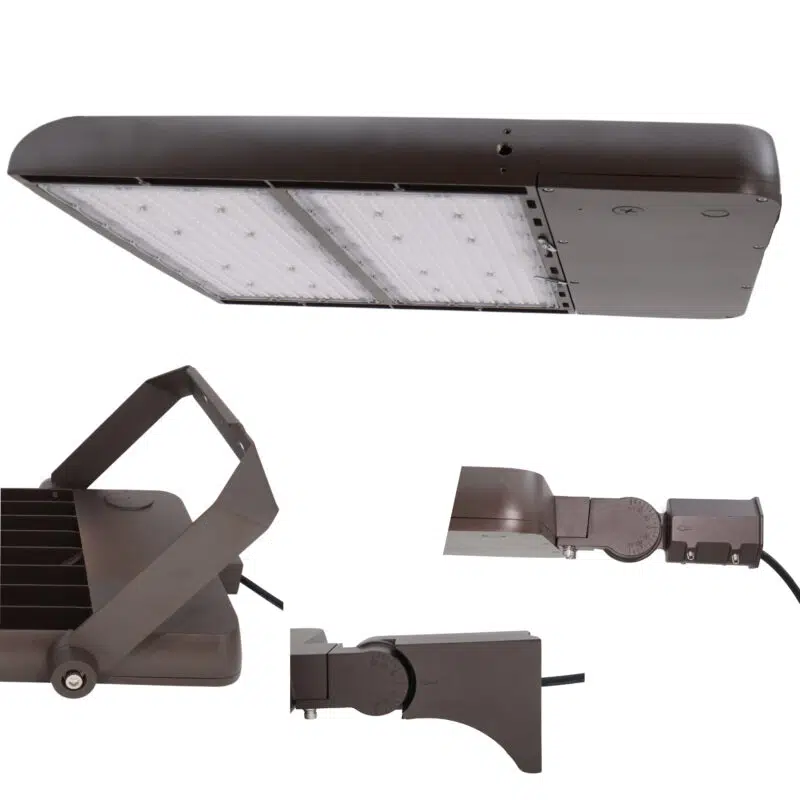

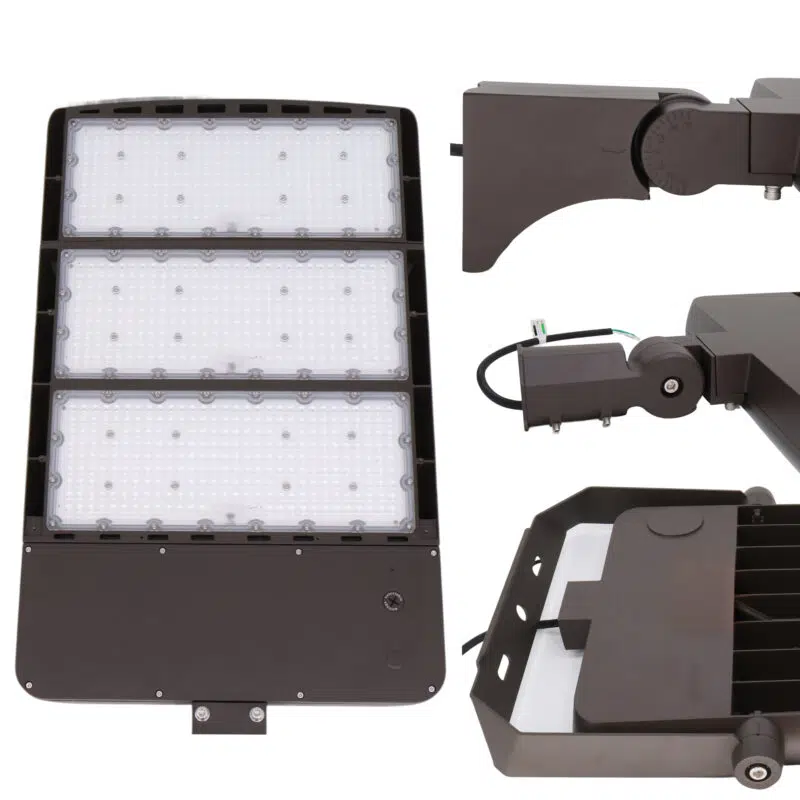
What is LED Tennis Court Lighting?
LED tennis court lighting is a purpose-built lighting system engineered to deliver bright, uniform illumination that improves ball tracking, depth perception, and player comfort for both indoor and outdoor courts. Indoor tennis lighting typically uses ceiling-mounted fixtures (direct or indirect/upshine designs) to produce even, glare-controlled light across the full court surface.
Outdoor tennis lighting commonly uses pole-mounted area or flood fixtures with precision optics (often Type III) to maintain balanced coverage and limit light spill beyond the court. Our tennis court lighting design process ensures optimal placement and performance for every facility.
Compared to metal halide or fluorescent systems, LED solutions provide instant-on performance, long service life, and significant reductions in energy and maintenance, making them suitable for new installations or one-for-one upgrades using existing electrical infrastructure when properly specified.
LED Tennis Court Lighting Solutions for Superior Play and Energy Efficiency
Facility managers often face outdated tennis court lighting that increases electricity costs and delivers poor illumination. LED Lighting Supply's expertise ensures you get the right tennis court lighting solution to transform your facility and reduce operational expenses, while also helping you understand tennis court lighting cost factors for budgeting purposes.
Our Product Specialists know tennis lighting requires specialized solutions for both indoor and outdoor courts. With over 15+ years of experience, we have found that facilities using LED tennis court lights achieve up to 62% energy reduction while providing clear visibility for all skill levels.
According to the U.S. Department of Energy's solid-state lighting program, LED technology can reduce energy consumption by 75% or more compared to traditional lighting sources like metal halide and high-pressure sodium systems. The DOE also notes that LED fixtures maintain their light output over time, unlike conventional lighting that degrades significantly during operation.
For indoor tennis courts, ceiling-mounted fixtures deliver optimal downward illumination. We also offer upshine models that reflect off highly reflective roofs for glare-free lighting, making our tennis court LED lighting solutions ideal for a variety of indoor environments.
Outdoor tennis court installations typically use pole-mounted fixtures, with Type III optic shoebox fixtures providing effective court coverage. These solutions replace traditional lighting while delivering instant-on capability and minimal maintenance.
All our LED fixtures feature automatic voltage adjustment from 100 to 277 Volts or 277 to 480 Volts, ensuring integration with existing electrical infrastructure, depending on model.
Customers often find 5000K color temperature effective for metal halide replacement, while 4000K works well for fluorescent upgrades. We offer toggle-adjustable fixtures for post-installation color temperature selection.
LED Lighting Supply's 15+ years of experience show that optimal fixture selection requires professional lighting design. We create lighting plans detailing fixture specifications, wattage, lumen output, optics, quantities, and positioning for maximum performance, and our LED tennis court lighting fixtures are engineered for both efficiency and durability.
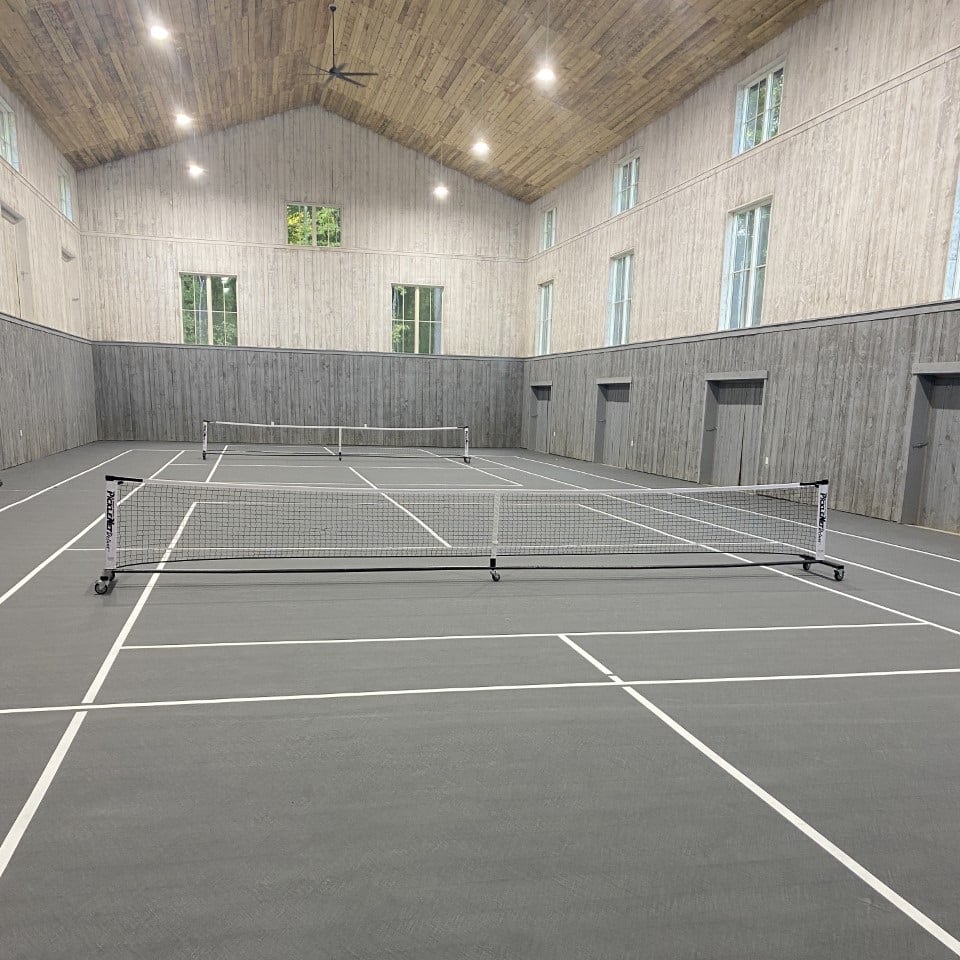
We outfitted this indoor tennis court and sport court with our wattage adjustable 100 / 120 / 150 / 200 Watt Adjustable UFO Fixture | 14000 to 28000 Lumens
Use When / Don't Use When
Use LED Tennis Court Lighting When
- Upgrading from metal halide or fluorescent systems - LED provides instant-on, 50-75% energy reduction, and eliminates frequent bulb changes
- Need consistent illumination for competitive play - LEDs maintain brightness over decades unlike metal halide 30% first-year degradation
- Want minimal maintenance operation - LED systems operate for years without ballast or bulb replacement
- Existing electrical infrastructure is adequate - Most LED conversions work with current voltage (100-277V or 277-480V model dependent)
- Facility requires flexible usage patterns - Motion sensors and photocells maximize energy savings for irregular court schedules
Don't Use LED Tennis Court Lighting When
- Skipping photometric analysis to save costs - Poor planning creates expensive dark spots and glare problems that proper design prevents
- Electrical panel capacity is unknown or insufficient - Calculate total electrical demand and verify capacity before fixture selection
- Pole placement ignores maintenance access - Plan locations to accommodate lift equipment for future servicing
- Mounting height is below 25 feet - Low fixtures create severe glare for players at the net
- Selecting fixtures by price or wattage alone - Choose based on lumen output, beam distribution, and photometric performance
What We Verify Before You Order
We confirm
- Indoor vs outdoor application and mounting requirements
- Current lighting type (metal halide, fluorescent, etc.) for proper replacement
- Required light levels (recreational, club, or competition standards)
- Electrical voltage and load capacity constraints
- Pole height, placement, and maintenance access needs
If we provide a lighting plan, you will get
- Precise fixture specifications with appropriate optics and wattage
- Exact fixture quantities and strategic placement locations
- Confirmed light levels and uniformity across court surfaces
Note: Guidance is general planning information. Final selection should be validated with a photometric plan and confirmed by a licensed professional when required for code- or safety-critical areas.
Quick Selection Guide
- Indoor Courts: Use 150-200 watt ceiling-mounted fixtures with direct or upshine designs - verify final wattage with photometric plan
- Outdoor Courts: Use 200-400 watt pole-mounted fixtures with Type III optics on 25-30 foot poles - confirm fixture count with lighting design
- Color Temperature: Select 5000K for metal halide replacement, 4000K for fluorescent upgrades, or toggle-adjustable for flexibility
- Light Levels: Target 30-50 fc recreational, 40-70 fc club, 70-100 fc competition indoor; 20-40 fc recreational, 30-70 fc club, 60-100 fc competition outdoor
- Controls: Add motion sensors for irregular usage patterns, photocells for automatic activation - verify electrical load capacity first
- Professional Design Required: Get photometric plan to determine exact fixture specifications, quantities, and positioning
Tip: Avoid placing poles within 15-20 feet of court boundaries to prevent glare during overhead shots.
Professional Tennis Court LED Solutions by Application
Indoor Tennis Court Lighting
Our indoor tennis court lights feature ceiling-mounted LED fixtures for optimal downward illumination. These systems deliver bright, uniform light distribution throughout indoor tennis facilities, similar to professional gymnasiums and sports installations.
For glare reduction, we offer indirect lighting solutions that direct illumination upward toward reflective ceiling surfaces. This approach provides glare-free illumination for player comfort and visibility during extended play.
Our LED indoor tennis court systems feature wattage and lumen toggle switches for field adjustment. With multiple wattage and color temperature options, we engineer solutions for both tournament and recreational requirements when properly specified, and our tennis court lighting installation services ensure a seamless process from start to finish.
Outdoor Tennis Court Lighting
Our outdoor tennis court lights use pole-mounted LED fixtures positioned around court perimeters. These systems typically feature shoebox lights or floodlights, with Type III optic shoebox fixtures providing effective court coverage and center-focused distribution.
For larger courts, we use higher wattage fixtures and broader beam angles to ensure sufficient illumination. Our outdoor LED systems are weather-resistant and deliver instant-on capability with minimal maintenance compared to traditional lighting.
LED Lighting Supply's lighting plans optimize fixture selection, optic packages, and placement to achieve optimal intensity and balance. Proper pole placement and fixture selection minimize glare and dark spots for enhanced visibility.
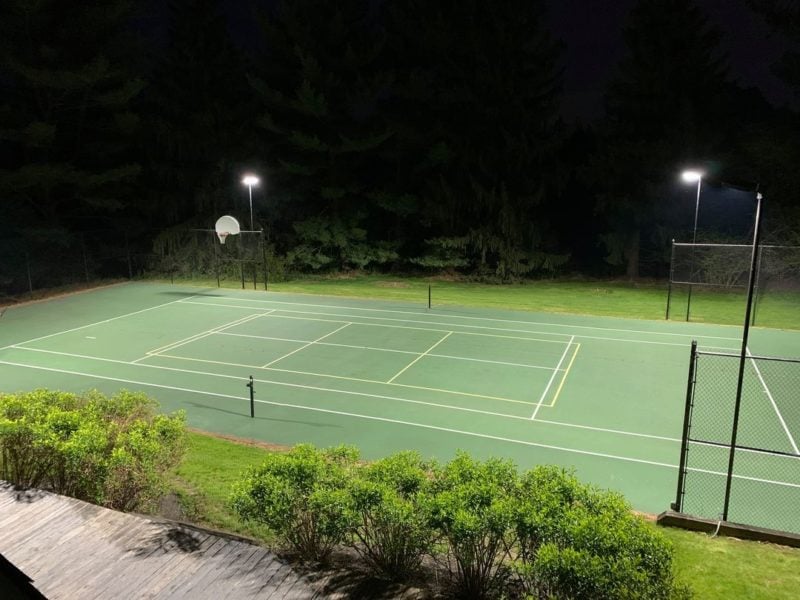
Our pole mounted shoebox fixtures are suitable for sport court lighting when properly specified.
Advanced Controls and Smart Technology Integration
Our Product Specialists know that control systems maximize energy savings and efficiency. Motion sensors provide automatic activation only when courts are in use, delivering cost savings for facilities with irregular usage. Photocells ensure courts illuminate automatically at appropriate times, maintaining consistent availability for scheduled play.
LED technology reduces electrical load requirements. Our systems often eliminate the need for electrical panel upgrades when converting from traditional lighting, simplifying installation and reducing project costs.
Industry-Standard Illumination Levels for Optimal Performance
Indoor Tennis Court Light Levels
- Recreational Level: 30-50 fc
- Club Level: 40-70 fc
- Competition Level: 70-100 fc
Outdoor Tennis Court Light Levels
- Recreation Level: 20-40 fc
- Club Level: 30-70 fc
- Competition Level: 60-100 fc
The Illuminating Engineering Society (IES) recommended practices for sports lighting provide guidance on illumination levels, uniformity ratios, and glare control for tennis court applications. These standards help ensure lighting installations meet visual requirements for safe and effective play at all competition levels.

Using the customer's existing fixtures, we supplied retrofit kits to convert their lighting to LED
Other Court Lighting Solutions
Proven Solutions Based on 15+ Years of Tennis Court Experience
LED Lighting Supply's extensive tennis court experience has identified effective solutions for different facility types. A popular specification features 5000K cool white light fixtures with Type III optics for outdoor court installations.
Customers often find toggle-adjustable fixtures provide flexibility, allowing field adjustment of wattage/lumen output and color temperature without fixture replacement. Our tennis court LED lighting options are designed to meet the needs of both recreational and competitive facilities.
While photocell controls and motion sensors are not required for every installation, these features can deliver additional energy savings for recreational facilities with irregular usage patterns.
Comprehensive Warranty Protection and USA-Based Support
LED Lighting Supply backs every tennis court fixture with a minimum 5-year warranty, supported by our USA-based customer service team with quick shipping. We understand the critical nature of sports lighting and prioritize rapid resolution of any issues during the warranty period.
Our dedicated support specialists understand tennis court lighting needs and work quickly to minimize facility downtime. This commitment to customer support ensures your investment remains protected throughout the warranty period.
Professional Certifications and Safety Compliance
All LED Lighting Supply tennis court fixtures meet rigorous safety and performance standards. Our systems are UL Listed or ETL Listed for electrical safety compliance, ensuring installations meet professional building code requirements.
Many models achieve DLC Listed and DLC Premium certification, meeting energy efficiency standards and qualifying facilities for utility rebates and incentive programs.
These certifications provide confidence that your lighting investment meets professional standards for safety, performance, and energy efficiency. DLC Premium qualification may unlock additional utility incentives that improve return on investment.
UL's lighting testing and certification programs ensure that LED fixtures meet electrical safety requirements for commercial and sports lighting applications. The Design Lights Consortium (DLC) Qualified Products List validates energy efficiency performance and enables facilities to access utility rebate programs that can reduce project costs.


Proven Benefits of LED Lighting Supply's Tennis Court Solutions
- Superior Court Visibility: Tennis players track the ball with precision under professionally designed LED systems. Enhanced clarity can reduce missed shots and lower injury risk. Results may vary by installation.
- Minimal Glare Illumination: Engineered optics reduce harsh light spill and eye strain. Players and spectators benefit from comfortable vision and clear sightlines.
- Immediate Energy Savings: Facilities can achieve 50-75% energy cost reduction as LED fixtures deliver higher brightness using less power than metal halide systems.
- Professional-Grade Light Output: LED fixtures provide consistent, uniform brightness across court surfaces, improving depth perception and ball tracking.
- Virtually Maintenance-Free Operation: No frequent bulb or ballast replacements. LED systems operate for years, reducing maintenance workload and downtime.
- Sustained Performance: LED fixtures maintain brightness for decades. Unlike metal halides, which lose 30% output in the first year, LEDs deliver stable, long-term illumination.
- Instant-On Capability: Courts reach full brightness immediately. No waiting for warm-up cycles common with HID systems.
- Tournament-Quality Lighting: Professional-grade illumination meets tournament standards with accurate, natural color rendering and no yellow tinting when properly specified.
- Enhanced Player & Spectator Experience: Uniform, high-quality lighting elevates recreational and competitive play, creating a superior environment for athletes and spectators.

We outfitted this backyard court with a 300 Watt LED Shoebox Area Light | 46500 Lumens. Lighting is bright and balanced.
Professional Tennis Court Lighting Design Process
The most effective approach begins with understanding your specific illumination requirements and any installation constraints. Our Product Specialists recommend comprehensive lighting plans that eliminate guesswork and ensure optimal results.
Professional lighting plans achieve multiple critical objectives:
- Confirm precise light levels and uniform balance across court surfaces
- Specify optimal fixtures with appropriate optic packages for your application
- Determine exact fixture quantities and strategic placement locations
This professional approach eliminates installation risk while ensuring you achieve the exact performance results your facility requires.

Outdoor sport court lighting - ceiling mounted - used our high impact UFO high bays
Expert Tennis Court Lighting Consultation and Free Professional Design
With numerous fixture options and technical considerations, selecting the optimal tennis court lighting solution requires expert guidance. LED Lighting Supply's Product Specialists bring 15+ years of tennis court lighting expertise to every project consultation.
We analyze your specific requirements and engineer solutions that meet your exact performance and budget objectives. Our comprehensive approach ensures you receive the most cost-effective lighting system for your application with long-term savings.
Request your free professional tennis court lighting plan to ensure optimal illumination levels and balanced light distribution. This eliminates guesswork and helps your facility achieve high-quality lighting performance when properly implemented.
Common Mistakes and How to Avoid Them
Tennis court lighting projects fail when facility managers skip photometric analysis or choose fixtures based on price alone. We have seen installations where basic planning errors created expensive problems that proper design would have prevented.
- Mounting fixtures too low creates severe glare for players at the net. Set pole height at a minimum 25 feet for standard courts and 30 feet for competitive facilities to achieve proper light distribution without direct sight lines.
- Placing poles too close to the court sidelines puts fixtures in players' vision during overhead shots. Position poles at least 15-20 feet beyond court boundaries with proper aiming to eliminate glare while maintaining coverage.
- Selecting fixtures based on wattage instead of lumen output and beam distribution leads to uneven lighting. Specify fixtures using actual light output and appropriate optics for your pole configuration and court dimensions.
- Installing without considering existing electrical load capacity can cause circuit overloads. Calculate total electrical demand and verify panel capacity before finalizing fixture quantities to avoid costly upgrades.
- Choosing the wrong color temperature affects ball visibility and player comfort. Use 5000K for metal halide replacements and 4000K when converting from fluorescent systems to maintain familiar light quality.
- Ignoring maintenance access during pole placement creates safety hazards and expensive service calls. Plan pole locations to accommodate lift equipment access and ensure fixtures can be serviced without disrupting adjacent courts.
LED Tennis Court Lights for Indoor & Outdoor Tennis Facilities Frequently Asked Questions
What Are the Key Benefits of LED Tennis Court Lighting?
LED tennis court lighting offers instant-on performance, reducing energy consumption by up to 75% compared to traditional systems. It provides consistent illumination that enhances player visibility and comfort, while also minimizing maintenance due to its long service life. These features make LED lighting ideal for both new installations and upgrades.
How Do I Choose the Right LED Lighting for Indoor Tennis Courts?
For indoor courts, select ceiling-mounted fixtures with direct or indirect designs to ensure even light distribution. Consider the required light levels for recreational, club, or competition standards, and verify fixture specifications with a photometric plan to achieve optimal performance.
What Should I Consider When Selecting Outdoor Tennis Court Lighting?
Outdoor tennis courts benefit from pole-mounted fixtures with Type III optics for balanced coverage. Ensure poles are placed strategically to minimize glare and confirm fixture wattage and placement with a lighting design plan to meet your facility's specific needs.
Why Is Photometric Analysis Important for Tennis Court Lighting?
Photometric analysis is crucial to prevent dark spots and glare issues. It helps determine the precise fixture specifications, quantities, and placement needed to achieve uniform light distribution and meet the required illumination levels for safe and effective play.
What Voltage Options Are Available for LED Tennis Court Lighting?
Our LED fixtures offer automatic voltage adjustment, accommodating 100 to 277 Volts or 277 to 480 Volts depending on the model. This flexibility ensures compatibility with existing electrical infrastructure, simplifying installation.
How Can I Ensure My Tennis Court Lighting Is Energy Efficient?
To maximize energy efficiency, consider adding motion sensors and photocells for automatic activation based on usage patterns. These controls help reduce energy consumption by ensuring lights are only on when needed.
What Color Temperature Is Best for Tennis Court Lighting?
For metal halide replacements, a 5000K color temperature is effective, while 4000K is suitable for fluorescent upgrades. Toggle-adjustable fixtures offer flexibility for post-installation adjustments to meet specific lighting preferences.
What Are the Common Mistakes to Avoid in Tennis Court Lighting Projects?
Avoid mounting fixtures too low, as this can cause glare for players. Ensure poles are placed at least 15-20 feet from court boundaries to prevent visual interference during play. Select fixtures based on lumen output and beam distribution rather than wattage alone to achieve even lighting.