Buyers Guide to LED Stadium and Sports Field Lighting
Helpful Tips Before Purchasing LED Sports Field Lighting
Outdoor athletic events draw massive crowds worldwide, from weekend Little League games to professional soccer matches and evening concerts. Night events require powerful illumination across expansive outdoor spaces, often using fixtures mounted on light poles for sports and athletic fields. Pole heights and fixture quantities vary by field size, lighting class, pole design, wind loading, fixture EPA, and applicable engineering requirements.
Many existing stadiums use HID sources such as metal halide and high-pressure sodium. Compared with these systems, properly designed LED sports field and stadium lighting can reduce energy use, provide instant starting, and reduce relamping needs. Actual energy savings depend on the existing system, operating schedule, controls, fixture efficacy, optics, and the final lighting design.
The U.S. Department of Energy notes that LED lighting can provide substantial energy savings compared with conventional lighting technologies, while offering instant-on operation and long service life. See the DOE overview of LED lighting systems.
- Many HID systems require warm-up time to reach full output and may require additional time to restrike after an interruption. LED fixtures typically reach full output immediately.
- Selected premium LED models are rated for long operating lives, often up to 100,000 hours under specified test conditions. Actual service life depends on operating conditions, driver performance, thermal management, controls, and maintenance.
- LED systems can provide more consistent light output over time than traditional HID lamp systems, although all light sources experience lumen depreciation.
- Dimming and controls are available on compatible LED systems and can help reduce energy use when lower lighting levels are appropriate.
Summary: Stadium LED upgrades succeed when the design addresses optics, aiming, illuminance, uniformity, glare, and spill light – not just wattage or raw lumen output.
Upgrading existing stadium lighting requires careful planning, proper fixture selection, and understanding key performance factors. We will guide you through the critical decisions that determine project success.
This guide is written for facility managers, athletic directors, engineers, and contractors responsible for specifying, upgrading, or maintaining outdoor sports field and stadium lighting systems.
What Is LED Stadium and Sports Field Lighting?
LED stadium and sports field lighting refers to high-output outdoor lighting systems designed to illuminate large athletic surfaces from pole-mounted fixtures. These systems can be designed to meet project-specific illuminance, uniformity, glare, spill-light, and broadcast requirements while reducing energy consumption and maintenance compared with HID systems.
Lighting Plans are the Key to Sports Lighting Success
Selecting fixtures by wattage alone can produce poor results. Lumens provide useful information because they measure luminous flux rather than power consumption. However, fixture optics, mounting height, aiming, field geometry, and glare control determine where that light reaches the playing surface. Even lumen-based decisions can disappoint without fixture-specific photometric analysis.
Professional stadium or sports field lighting plan development is an important part of a successful project. Computer modeling can predict field illumination before equipment is purchased. Design software uses fixture photometry to evaluate quantities, positions, and aiming for target light levels and uniformity. The plan can identify appropriate optics, fixture output, and aiming information for each fixture.
The Illuminating Engineering Society (IES) publishes recommended practices for sports lighting design that address illumination, uniformity, glare, and other project considerations. Applicable league, school, broadcast, owner, and local requirements should also be confirmed for the specific facility.
Takeaway: A fixture-specific photometric analysis can evaluate predicted illuminance and uniformity across the playing surface before installation begins.
The case studies below show how fixture selection, optics, and photometric planning translate into on-field results, including measured average foot-candle levels and uniformity ratios.
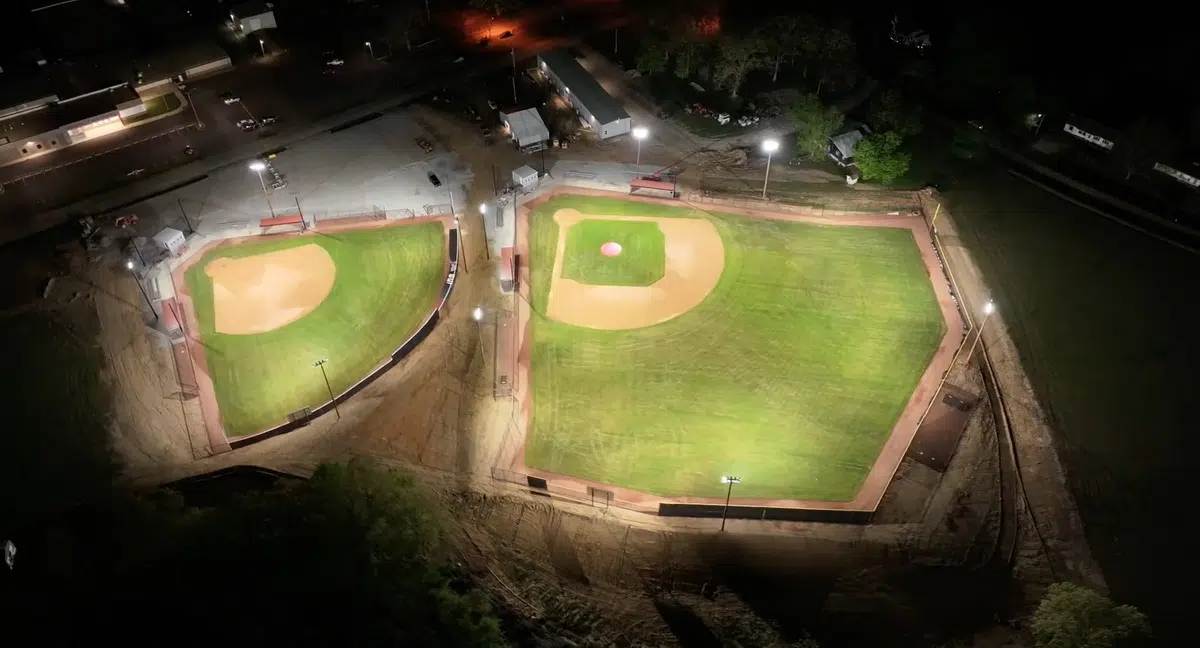
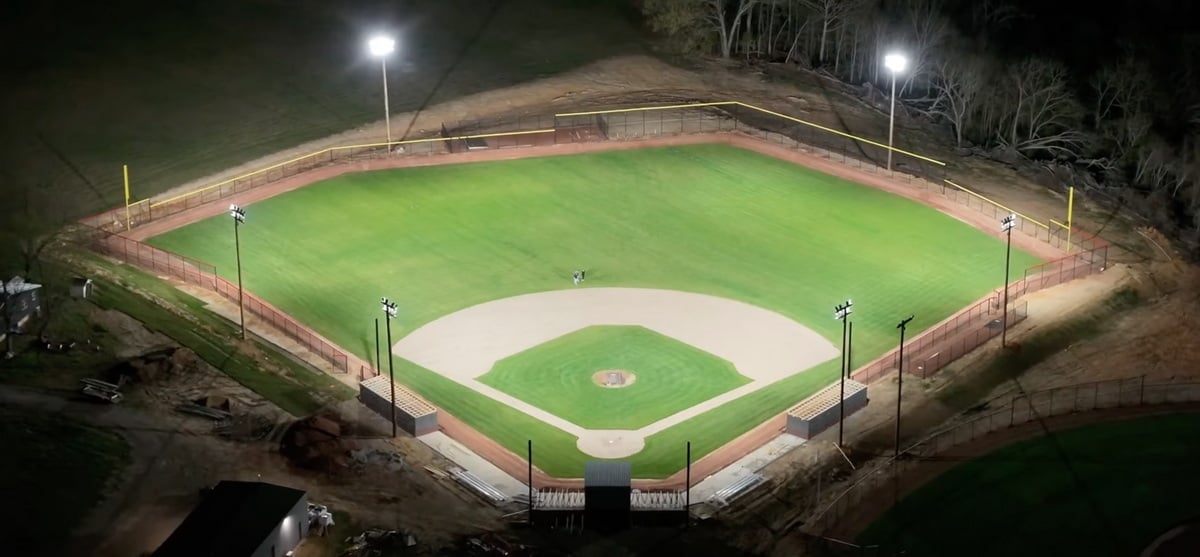
Case Study: Conversion of existing lighting in Baseball / Softball Field to LED Lighting Supply 600 Watt LED Sports Lights at Gainesville High school in Gainseville, MO
|
After: 600 Watt LED Area Sports Flood Light | 84000 Lumens |
After: 600 Watt LED Area Sports Flood Light | 84000 Lumens |
 |
 |
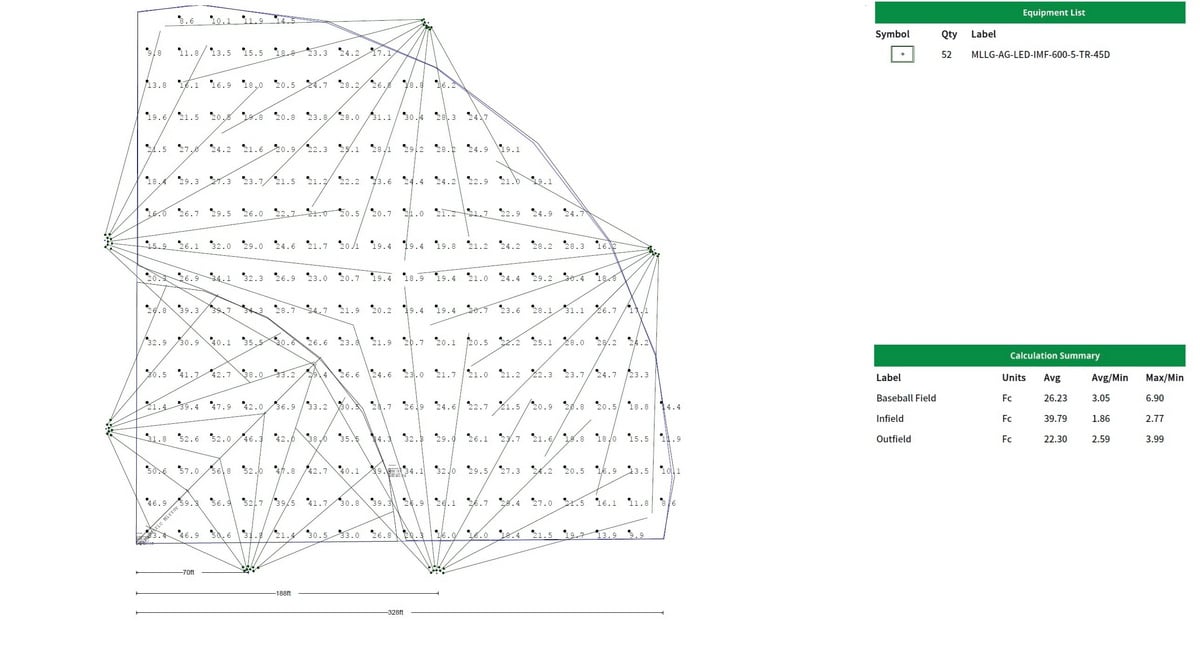
Lighting Plan We Created for the Customer
|
Lighting Plan |
Heat Map |
 |
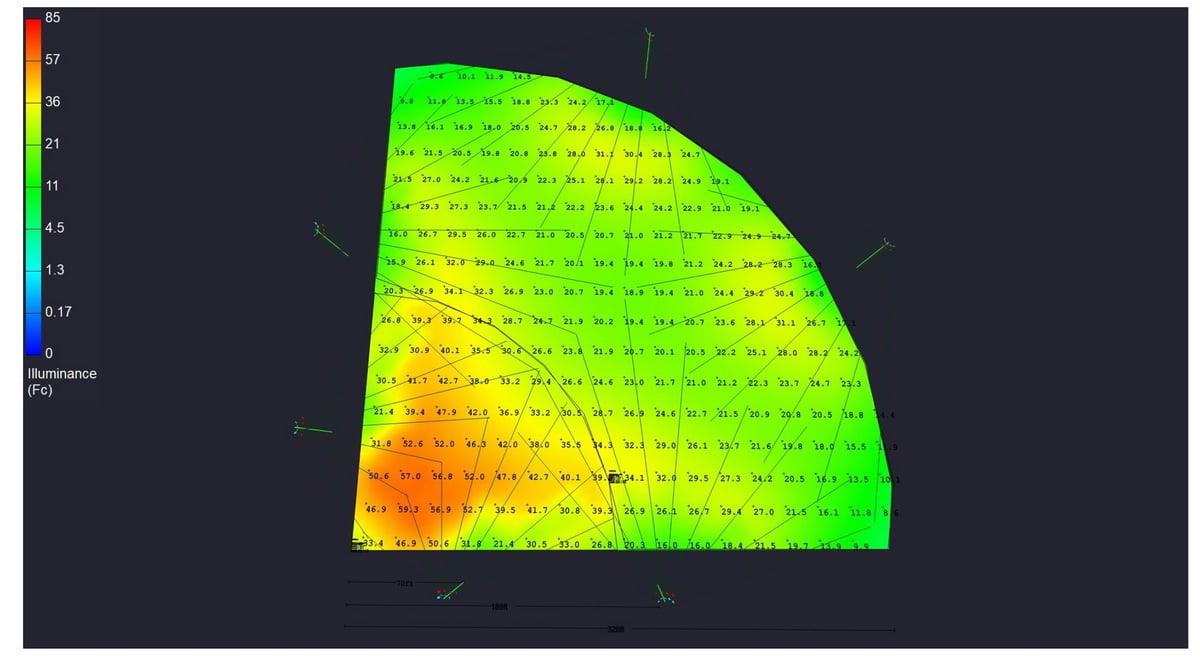 |
Baseball / Softball Field Lighting Installation Plan Metrics
- Mounting height: 47 and 50 ft
- Fixture Used: MLLG-AG-LED-IMF-600-5-[Optic]-TR-[V]: 600 Watt LED Flood Light | 84000 Lumens | 5000K | 100V-277V or 277V-480V
- FC achieved: 39.79 FC (infield), 22.30 FC (outfield) average
- Uniformity (Avg/Min): 2.35
LED Sports Fixtures are Powerful Enough to Replace Metal Halide
LED stadium fixtures are available in output packages suitable for replacing many metal halide sports-lighting systems. A one-for-one fixture replacement is not always appropriate: LED fixture quantity, output, optics, mounting positions, electrical conditions, and aiming should be evaluated with an updated photometric plan.
- 1000-Watt Metal Halide: LED replacement output is often evaluated in the approximate 50,000- to 60,000-lumen range, depending on optics and layout.
- 1500-Watt Metal Halide: LED replacement output is often evaluated in the approximate 80,000- to 90,000-lumen range, depending on optics and layout.
- 2000-Watt Metal Halide: Higher-output LED fixtures may be required; final output and fixture quantity should be determined by photometric analysis.

Narrow Beam Optics are Important for Lighting a Sports Field
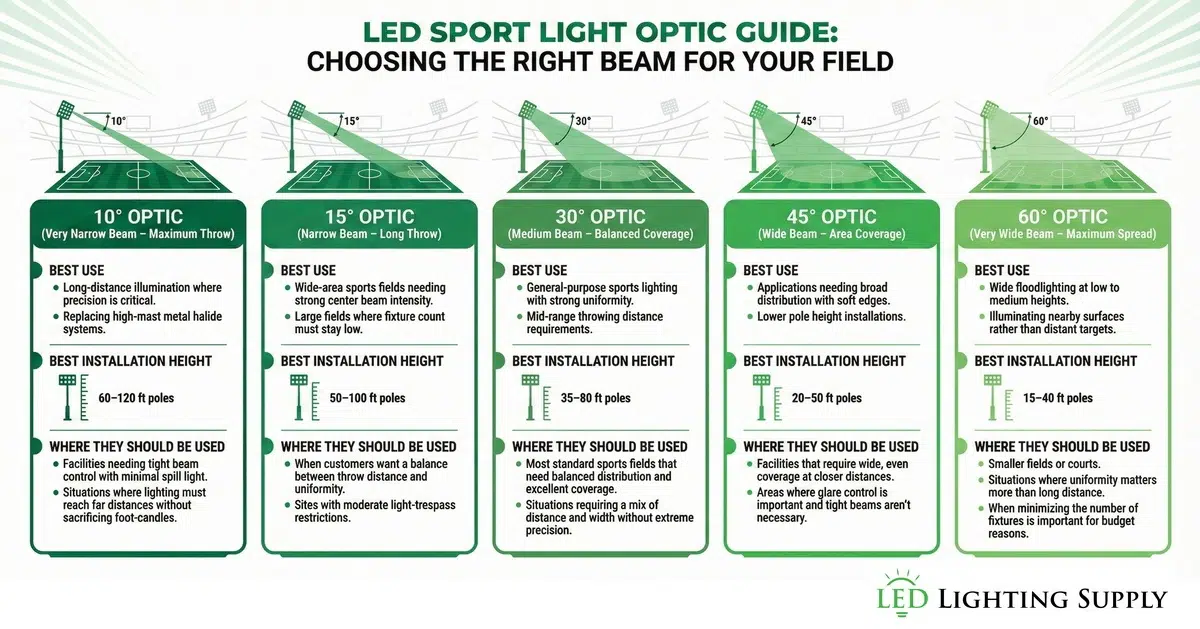
Stadium lighting differs from standard outdoor LED sports lights through precise beam control and targeted illumination. Narrow optics can be useful for long throws from tall poles, while medium or wider distributions may be appropriate for other field zones. The correct optic depends on pole locations, mounting height, aiming, field geometry, target illuminance, uniformity, glare, and spill-light limits.
Takeaway: Optic selection directly affects lighting quality, glare, spill light, and energy use. Fixture-specific photometric design helps identify suitable distributions.
NEMA Beam Spread Classifications
- Very Narrow:
- NEMA Type: 1
- Beam Spread: 10° – 18°
- Narrow:
- NEMA Type: 2
- Beam Spread: 18° – 29°
- Medium Narrow:
- NEMA Type: 3
- Beam Spread: 29° – 46°
- Medium:
- NEMA Type: 4
- Beam Spread: 46° – 70°
- Medium Wide:
- NEMA Type: 5
- Beam Spread: 70° – 100°
- Wide:
- NEMA Type: 6
- Beam Spread: 100° – 130°
- Very Wide:
- NEMA Type: 7
- Beam Spread: 130° and above
Determine How Many Foot Candles You Need to Light Up Your Sports Field
Sports lighting designs use target foot-candle levels, uniformity ratios, glare considerations, and, where applicable, broadcast requirements. The ranges below are general planning references only; final criteria should be confirmed against the requirements of the owner, governing sports organization, applicable IES recommendations, and the specific project.
LED lights for baseball fields and LED lights for softball fields
- Collegiate (Televised):
- Outfield FC: 70
- Infield FC: 100
- Outfield FCs (Max/Min): 2.5
- Infield FCs (Max/Min): 2
- Collegiate:
- Outfield FC: 50
- Infield FC: 70
- Outfield FCs (Max/Min): 2.5
- Infield FCs (Max/Min): 2
- High School:
- Outfield FC: 30
- Infield FC: 50
- Outfield FCs (Max/Min): 2.5
- Infield FCs (Max/Min): 2
- Little League:
- Outfield FC: 30
- Infield FC: 50
- Outfield FCs (Max/Min): 2.5
- Infield FCs (Max/Min): 2
- Recreational:
- Outfield FC: 20
- Infield FC: 30
- Outfield FCs (Max/Min): 2.5
- Infield FCs (Max/Min): 2
LED lights for football fields
- Recreational Football: 20 – 30 foot candles
- Middle School: 30 – 50 foot candles
- Small High School: 30 – 50 foot candles
- Larger High School: 50 – 70 foot candles
- College: 80 – 150 foot candles
- Recreational Soccer: 20 – 30 foot candles
- Middle School Soccer: 30 – 50 foot candles
- Small High School Soccer: 30 – 50 foot candles
- Larger High School Soccer: 40 – 70 foot candles
- College: 50 – 100 foot candles
- Recreation Level: 20 – 35 foot candles
- Club Level Tennis: 30 – 60 foot candles
- Competition Level Tennis: 50 – 80 foot candles
- College / NCAA Level Tennis: 90 – 120 foot candles
Important: The foot-candle ranges and ratios shown here are general planning references. Final lighting levels, pole heights, fixture aiming, electrical design, structural capacity, and code compliance must be verified for the specific project by the appropriate qualified professionals and authorities having jurisdiction.
What is the Lumen Output of LED Stadium Lights?
Sports-lighting fixtures are available in a wide range of outputs, with many stadium models beginning around 60,000 lumens and selected high-output models reaching 150,000 lumens or more. Raw fixture lumens differ significantly from actual field illumination measured in foot-candles because optics, mounting geometry, aiming, and field conditions determine how light is distributed.

What is the Best Color Temperature for Stadiums and Sports Fields?
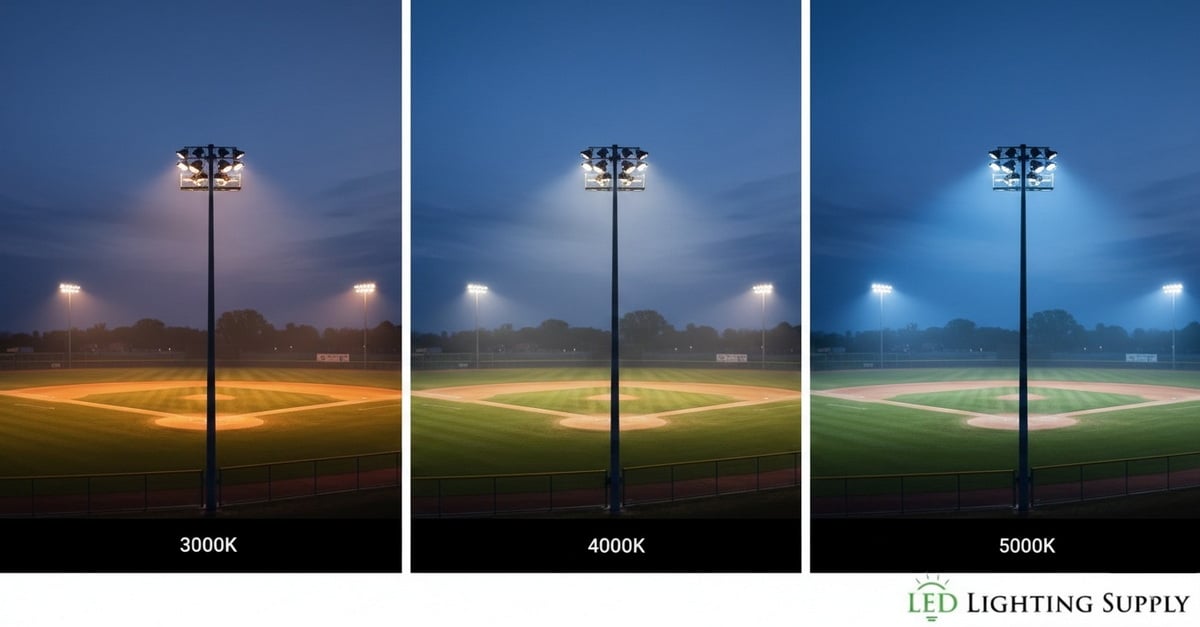
Commercial fixtures are available in a range of correlated color temperatures (CCT), commonly including 4000K and 5000K for sports applications. CCT describes the apparent warm or cool color of white light; it does not measure brightness, color rendering, or light level.
Takeaway: 4000K and 5000K are common choices for sports lighting. The preferred CCT should be selected based on owner preference, surrounding environment, camera requirements where applicable, and the exact fixture specification.
Make Sure the Lights Have Been Tested to Withstand Rain and Snow
Outdoor fixtures should have an enclosure rating appropriate for their actual exposure and be installed according to manufacturer instructions. IP ratings address protection against solids and water ingress; they do not establish corrosion resistance, chemical resistance, or hazardous-location suitability. IP65 is dust-tight and protected against water jets, while IP66 provides protection against powerful water jets. IP67 and IP68 address immersion under defined conditions.
Takeaway: Many outdoor sports fixtures are rated IP65 or higher, but the appropriate rating depends on the installation environment. Verify the exact fixture rating, materials, seals, coatings, hardware, ambient-temperature rating, and manufacturer environmental documentation for the project.
What is CRI, and How Does it relate to LED Sports Field and Stadium Lighting?
Color Rendering Index (CRI) describes how faithfully a light source renders object colors compared with a reference source. Lumens measure luminous flux, while foot-candles measure illuminance on the playing surface. CRI is separate from light level, efficacy, and fixture optics.
- High-pressure sodium systems commonly have warm yellowish light and relatively poor color-rendering performance, which can make colors appear less natural.
- Modern LED sports fixtures are available with CRI values commonly ranging from approximately 70 to 90+, depending on model.
Appropriate CRI can support color discrimination, natural appearance, and camera presentation where relevant. It does not reduce the sport-specific illuminance or uniformity targets required for a field. Select CRI together with the project’s required foot-candle levels, uniformity, glare control, CCT, and any broadcast or governing-organization criteria. Many sports-lighting applications use fixtures with a CRI of 70 or higher; verify the required performance for the specific venue.
How to Determine if a Sports Field / Stadium Light Has the Quality You Need
Quality evaluation covers applicable product certification, warranty coverage, photometric performance, environmental ratings, surge protection, controls compatibility, and supplier support. Certifications, ratings, voltage ranges, warranties, and service-life ratings vary by model and should be verified in the exact product documentation.
For U.S. installations, the authority having jurisdiction may require a fixture certified by an appropriate Nationally Recognized Testing Laboratory (NRTL), such as UL Solutions or Intertek/ETL, for the intended application. DLC qualification, where available, is an energy-efficiency and performance program; it is not an electrical safety certification. See UL lighting information and the DLC qualified products list.
Choose companies with established business history, responsive pre-sales and post-sales support, and clear warranty processes. LED Lighting Supply can help customers review published fixture specifications, photometric files, dimensions, weights, EPA values, certifications, and manufacturer warranty information for a proposed project. Our excellent reviews reflect our commitment to helpful service and project support.
Why LED Lighting Supply is Your Trusted Partner for Sports Field Lighting Projects
Our lighting specialists support sports-lighting projects ranging from Little League diamonds to college and municipal facilities. We can prepare custom photometric lighting plans using fixture-specific IES data to help evaluate predicted field performance before equipment is purchased.
Our energy-savings calculations can estimate operating-cost reductions and payback periods using the utility rates, operating schedule, and system information supplied for the project. We can also help compare product specifications and provide manufacturer documentation for selected fixtures. Final electrical design, structural suitability of poles and foundations, field classification requirements, and code compliance remain the responsibility of the qualified project professionals and applicable authorities.
Click Here to See All Our LED stadium lights