Commercial LED Flood Lighting Buyers Guide: Selection, Optics, and Applications
Selecting and purchasing flood lights to illuminate outdoor areas can be a tricky endeavor. Why is that? It’s because the term “flood light” is very general. The type of flood light fixture that you need depends on what exactly you are using it for. And there are many types of them. For example, you wouldn’t use a landscape light to light up a parking lot. Or you wouldn’t use a stadium light to illuminate the side of a building.
LED flood lights are commonly used for outdoor illumination and security-lighting applications. These versatile fixtures can project light across large areas when the fixture output, optics, mounting location, aiming, and environmental rating are selected for the application.
According to the U.S. Department of Energy, LED lighting can use substantially less energy than conventional lighting technologies. Actual energy savings, light levels, and operating life depend on the existing system, selected luminaires, controls, operating schedule, and installation conditions.
After specifying and installing flood lighting systems across commercial, industrial, and sports facilities, we’ve found that many performance issues stem from improper optic selection and lack of photometric planning – not necessarily fixture quality alone.
Our LED flood lights are commonly used as LED baseball field lights, LED soccer field lights, LED football field lights, and for illuminating racetracks and LED horse arena lights. LED flood lights can also be used for LED perimeter security lighting. For offshore, marine, or coastal installations, select fixtures and finishes based on the documented environmental exposure and manufacturer specifications.
If you’re lighting a commercial parking lot, consider using LED parking lot lights instead.
It’s all a function of picking the right type of light, output, color temperature, optics, controls, and environmental construction for your project. There is no one-size-fits-all flood light for every application. The application itself, supported by fixture-specific photometric data, determines the best LED flood lights for you.
LED flood lights can reduce energy use and maintenance compared with many traditional HID systems, particularly where lamp and ballast replacement has been frequent. Expected service life and maintenance requirements vary by product, operating conditions, ambient temperature, electrical conditions, and driver performance.

This guide explains how to select an LED flood light based on application, mounting height, beam angle, lumen output, photometric distribution, controls, and environmental conditions. It is written for facility managers, contractors, and engineers responsible for outdoor commercial and industrial lighting.
1. LED Can Replace Metal Halide or High-Pressure Sodium Flood Lights
For example, you may have an outdoor area that uses Metal Halide or High-Pressure Sodium Lighting. Existing fixtures may be 400 watts, 1,000 watts, 1,500 watts, or more. LED replacement is often possible, but it should not be treated as an automatic one-for-one fixture replacement. HID wattage and initial lamp lumens do not predict delivered light on the target surface. Fixture optics, mounting height, aiming, depreciation, glare, and the desired illuminance all matter.
The following LED lumen ranges can be useful starting points when evaluating existing metal halide flood lighting, but a photometric plan using the selected fixture’s IES file should determine the final solution.
- 1000 Watt Metal Halide: approximately 50,000 to 60,000 LED lumens may be a starting range
- 1500 Watt Metal Halide: approximately 80,000 to 90,000 LED lumens may be a starting range
- 2000 Watt Metal Halide: approximately 110,000 or more LED lumens may be a starting range

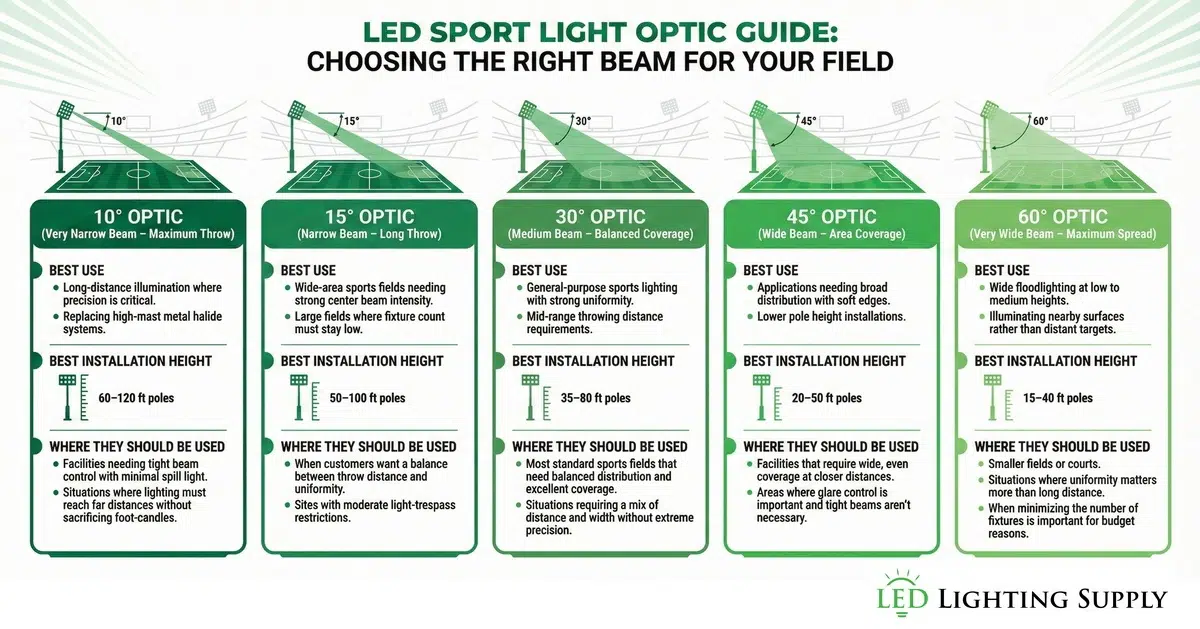
2. Picking the Right Optic / Beam Angle Is Crucial for Outdoor LED Flood Light Coverage
The main difference between “flood” lights and “spot” lights is often the beam angle and photometric distribution. Flood lights are available with many optic options, from narrow distributions around 10 degrees to wide distributions of 130 degrees or more. Trying to light an area 200 feet away with a wide beam angle may not provide sufficient illuminance. Trying to light a horse arena 60 feet wide with a 10-degree optic may create an overly concentrated pattern.
Takeaway: Choosing the right optic for your flood light application is important. The correct choice should be confirmed with fixture-specific photometric analysis.
NEMA Beam Spread Classifications
- Very Narrow:
- NEMA Type: 1
- Beam Spread: 10° – 18°
- Narrow:
- NEMA Type: 2
- Beam Spread: More than 18° – 29°
- Medium Narrow:
- NEMA Type: 3
- Beam Spread: More than 29° – 46°
- Medium:
- NEMA Type: 4
- Beam Spread: More than 46° – 70°
- Medium Wide:
- NEMA Type: 5
- Beam Spread: More than 70° – 100°
- Wide:
- NEMA Type: 6
- Beam Spread: More than 100° – 130°
- Very Wide:
- NEMA Type: 7
- Beam Spread: More than 130°
Professional lighting designers often use fixture photometry and applicable Illuminating Engineering Society (IES) recommended practices to evaluate light distribution, uniformity, glare, and illuminance for specific outdoor applications.
3. The Key to a Successful Flood Light Conversion – Create a Lighting Plan!
With so many floodlight fixtures available, which one do you choose? Do you pick the light based on watts or lumens? Do you know the beam angle? Mounting type? Voltage? Watts and lumens are useful product specifications, but neither alone determines lighting performance. The fixture’s photometric distribution, mounting height, aiming, spacing, reflectance, and target light levels determine delivered foot-candles or lux on the area being illuminated.
The starting lumen ranges above can help with early product selection. But if you don’t understand which optic to choose, there’s a risk that you won’t be happy with the results. Our best advice is to start with a flood light lighting plan. It’s a report that models your outdoor area using selected fixture photometry. The plan can be modified to add or remove fixtures, adjust aiming, and compare optic options to help evaluate expected light levels and uniformity.
Takeaway: A lighting plan can help identify suitable fixture output, optics, and placement for the project. Final installation and code compliance should be verified by qualified project professionals. 
Get your Free Custom Flood Lighting Plan
4. Choose the Best Flood Light Color Temperature
LEDs are available commercially in a range of color temperatures, commonly from 2700K to 6500K. For outdoor commercial flood lights, 4000K and 5000K are common choices.
Color temperature describes the apparent warm or cool appearance of white light; it does not describe brightness, lumen output, efficacy, or color-rendering quality. Consider local preferences, surrounding lighting, visibility needs, and applicable ordinances when selecting CCT. CRI should be evaluated separately when color discrimination is important.
Takeaway: 5000K is a common selection for commercial flood-lighting applications, while 4000K may be preferred where a less cool appearance is desired.
5. Understanding IP Wet Weather Rating
Outdoor fixtures need an enclosure rating appropriate for their expected exposure. IP ratings address protection against solids and water ingress; they do not establish corrosion resistance, chemical resistance, marine suitability, sanitation suitability, or hazardous-location approval.
For reference, IP65 is dust-tight and protected against water jets, IP66 is dust-tight and protected against powerful water jets, IP67 addresses temporary immersion under defined test conditions, and IP68 addresses continuous immersion under manufacturer-specified conditions. IP69 or IP69K relates to high-pressure, high-temperature water-jet testing under the applicable standard.
Many flood lights are IP66-rated, but there is no universal minimum IP rating for every outdoor project. Select the rating based on the actual exposure, installation orientation, cleaning practices, and manufacturer documentation. Where salt, chemicals, or corrosive environments are present, also verify the housing materials, coatings, seals, hardware, and environmental suitability.
Takeaway: Choose an IP rating and fixture construction that match the actual outdoor exposure rather than relying on IP rating alone.
6. Understand What Voltage Support You Need
For LED flood lights, common input-voltage ranges include standard and high-voltage models. Understanding the available site voltage ensures that you order a compatible LED driver. Many drivers are multi-volt and automatically operate across their published input range, but this capability is model-specific and must be verified on the exact fixture specification.
- Common standard-voltage ranges include 100-277V or 120-277V, depending on model.
- Common high-voltage ranges include 277-480V or 347-480V, depending on model.
7. Automated Controls
- Dusk to Dawn lights: Fixtures equipped with a compatible photocell can turn on at dusk and off at dawn.
- Motion sensors: Compatible sensors can increase light output or switch lighting on when motion is detected, then dim or switch off after a programmed period of inactivity.
Confirm control compatibility, voltage, wiring requirements, programming, and any local energy-code requirements for the specific fixture and project.
Important Safety & Compliance Notice
The information in this guide is provided for general planning and educational purposes only. Final fixture selection, aiming, mounting height, structural support, electrical installation, and code compliance must be verified by qualified professionals and the authority having jurisdiction (AHJ).
8. Specialty Flood Lights – for Demanding Environments
- High Temperature: Do you have ambient temperatures exceeding 150°F? Selected high temperature LED flood lights are designed for elevated-ambient applications. Verify the exact model’s published maximum ambient rating, mounting requirements, and operating conditions; ratings up to 392°F may be available on certain specialized products.
- Hazardous Location: For a documented classified location, we offer selected Class I, Division 1 and Class I, Division 2 flood lights. A Class and Division marking alone is not sufficient for selection. The exact fixture listing and marking must match the established area classification, including the applicable gas/vapor Group, temperature code, ambient-temperature rating, and installation requirements. Class I addresses flammable gases or vapors; Class II addresses combustible dust; and Class III addresses ignitable fibers or flyings. LED Lighting Supply can help review product specifications against an established classification, but the facility’s qualified professionals and AHJ determine the area classification and compliance requirements.
- Marine Grade: Marine environments with salt water and fog may require corrosion-resistant materials, coatings, seals, and hardware. We offer LED marine grade flood lights and coating options on selected high-power flood lights. Verify the exact product’s environmental documentation and maintenance requirements for the intended exposure.
- Higher wattage lights: Higher-output flood lights are available for large outdoor areas. Selected models may provide lumen output comparable to or greater than some 2000 Watt metal halide systems, but the appropriate replacement depends on the fixture photometry, mounting height, aiming, target illuminance, and glare considerations. LED systems can be more energy efficient than traditional systems when properly selected for the application.
For hazardous-location applications, OSHA’s guidance on electrical safety standards for classified locations provides requirements for equipment used in hazardous locations. Hazardous-location luminaires should be listed or certified for the specific application by an appropriate nationally recognized testing laboratory, and the fixture marking should be verified before purchase and installation.