


Sport Court Light Poles for Multi-Sport and Recreational Court Lighting
- 15+ years expertise delivering tournament-grade court lighting solutions
- 50+ year lifespan poles resist hurricanes, corrosion, and fire
- Custom beam angles eliminate shadows for optimal player performance


Sport court light poles are structural supports installed around the perimeter or at the corners of outdoor athletic courts, including basketball, tennis, and multi-use play areas. These poles are typically fabricated from steel, fiberglass, or wood, with mounting heights and configurations suited to the layout and size of each court. Commonly found in public parks, school athletic complexes, and private recreational facilities, sport court light poles form the backbone of lighting systems for both tournament-level and recreational play.
Commercial & Industrial Lighting Solutions in this category include pole options compatible with LED fixtures, accommodating a range of court sizes and installation requirements. Poles are anchored in concrete footings or set as direct burial structures, depending on site conditions. Their placement and material selection are tailored to withstand outdoor environments and integrate with the overall lighting layout for sports courts and athletic fields.
Showing 1–12 of 19 results
 SKU:MLLG-WG-POLE-CP-18-4SQ-AB | Web ID:2563Minimum Order: 4Minimum Order Total: $3,483.16Built to Order 5 Weeks
- Pole Weight (lbs): 47
- Pole Width (in): 4
- Pole Color: Bronze | Black | White | Gray | Custom
- Pole Gauge: .205 in
- Warranty: 7 years
Starting At$870.79


- SKU:MLLG-WL-POLE-20-4RD-DB-BZ-TN | Web ID:2116Minimum Order: 2Minimum Order Total: $1,967.34Availability: 44 In Stock Ships 7-14 Days
- Height Above Grade (ft): 20
- Buried Depth Below Grade (ft): 5
- Pole Weight (lbs): 132
- Pole Color: Bronze
- Pole Gauge: 11
- Warranty: 1 year
Starting At$983.67 - SKU:LLS-LN-POLE-20FT-4.5-RD-BK | Web ID:2700Minimum Order: 2Minimum Order Total: $1,974.46Availability: 113 In Stock Ships 7-14 Days
- Pole Weight (lbs): 124
- Pole Color: Black
- Pole Gauge: 11
- Warranty: 1 year
Starting At$987.23 - SKU:MLLG-WL-POLE-20FT-4-SQ-[COLOR]-TN | Web ID:1912White:13 In StockShips 7-14 DaysBronze:228 In StockShips 7-14 Days
- Pole Weight (lbs): 169
- Pole Width (in): 4
- Pole Color: Bronze | White
- Pole Gauge: 11
- Warranty: 1 year
Starting At$773.47 - SKU:MLLG-WL-POLE-20FT-4-RD-BZ-TN | Web ID:1917Minimum Order: 2Minimum Order Total: $1,644.90Availability: 155 In Stock Ships 7-14 Days
- Pole Weight (lbs): 143
- Pole Color: Bronze
- Pole Gauge: 11
- Warranty: 1 year
Starting At$822.45 - SKU:MLLG-WG-POLE-CP-20-4SQ-DB | Web ID:2172Minimum Order: 4Minimum Order Total: $3,303.64Availability: 54 In Stock Ships 3-4 weeks
- Height Above Grade (ft): 20
- Buried Depth Below Grade (ft): 5
- Pole Weight (lbs): 68
- Pole Width (in): 4
- Pole Color: Bronze | Black | White | Gray | Custom
- Pole Gauge: .205 in
- Warranty: 7 years
Starting At$825.91 - SKU:MLLG-WG-POLE-CP-20-4SQ-AB | Web ID:2562Minimum Order: 4Minimum Order Total: $3,820.00Built to Order 5 Weeks
- Pole Weight (lbs): 52
- Pole Width (in): 4
- Pole Color: Bronze | Black | White | Gray | Custom
- Pole Gauge: .205 in
- Warranty: 7 years
Starting At$955.00 25 Foot Round Tapered Steel Light Pole | 6.5 Inch Base Diameter | Anchor Base | High Wind Zone Rated
SKU:MLLG-WL-POLE-25FT-65-TRD-BZ-T | Web ID:2170Minimum Order: 2Minimum Order Total: $2,016.00Availability: 19 In Stock Ships 7-14 Days- Pole Weight (lbs): 163
- Pole Color: Bronze
- Pole Gauge: 11
- Warranty: 1 year
Starting At$1,008.00- SKU:MLLG-WL-POLE-25FT-4-RD-BZ-TN | Web ID:1918Minimum Order: 2Minimum Order Total: $1,987.76Availability: 264 In Stock Ships 7-14 Days
- Pole Weight (lbs): 176
- Pole Color: Bronze
- Pole Gauge: 11
- Warranty: 1 year
Starting At$993.88 - SKU:MLLG-WL-POLE-25FT-4-SQ-[COLOR]-TN | Web ID:1916Bronze:186 In StockShips 7-14 DaysWhite:7 In StockShips 7-14 Days
- Pole Weight (lbs): 190
- Pole Width (in): 4
- Pole Color: Bronze | White
- Pole Gauge: 11
- Warranty: 1 year
Starting At$926.00 - SKU:MLLG-WG-POLE-CP-25-4SQ-DB | Web ID:2333Minimum Order: 4Minimum Order Total: $3,776.36Availability: 33 In Stock Ships 3-4 weeks
- Height Above Grade (ft): 25
- Buried Depth Below Grade (ft): 4.5
- Pole Weight (lbs): 80
- Pole Width (in): 4
- Pole Color: Bronze | Black | White | Gray | Custom
- Warranty: 7 years
Starting At$944.09 - SKU:MLLG-WG-POLE-CP-25-5SQ-AB | Web ID:2561Minimum Order: 4Minimum Order Total: $5,107.28Built to Order 5 Weeks
- Pole Weight (lbs): 103
- Pole Width (in): 5
- Pole Color: Bronze | Black | White | Gray | Custom
- Warranty: 7 years
Starting At$1,276.82






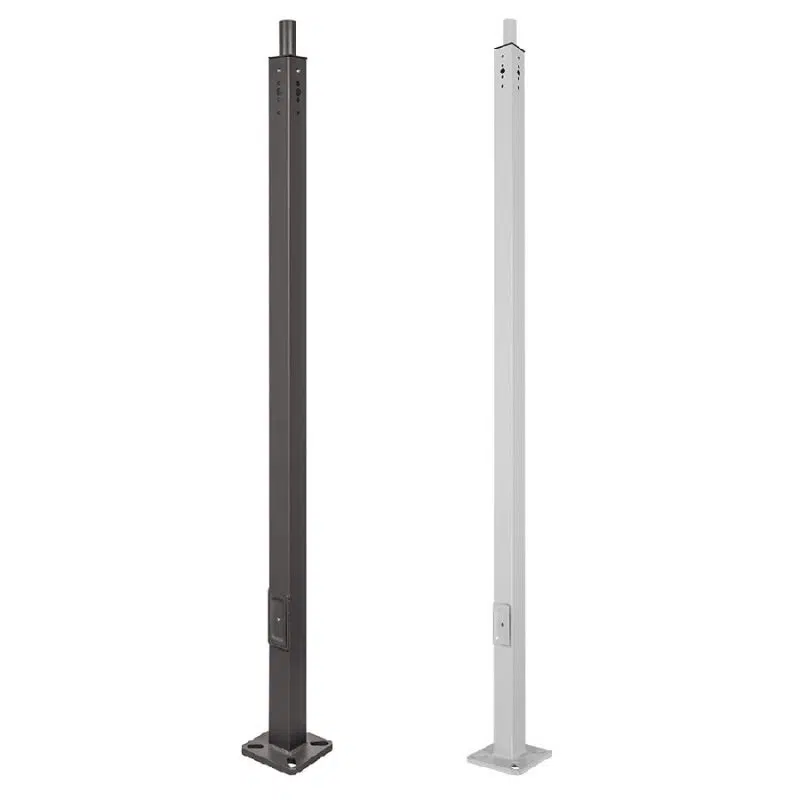


When illuminating sports courts for optimal play and visibility, the foundation of your lighting system -- the pole structure -- requires careful consideration. After 15+ years in commercial lighting, we have seen how proper pole selection transforms athletic facilities, ensuring players perform at their best and providing clear sightlines for officials and spectators. Sports court lighting solutions depend on choosing the right pole for your specific application.
Understanding Sport Court Lighting Requirements
Athletic facilities have unique lighting needs beyond basic illumination. Tournament-level play requires precise light distribution to eliminate shadows that affect ball tracking, while recreational courts need consistent coverage for player safety. Light requirements differ between indoor and outdoor courts; indoor venues often use lower mounting heights and different distribution patterns, while outdoor basketball court lighting must account for weather and environmental factors.
For most recreational sport courts, 20-foot poles with custom beam angles offer a balance of coverage, performance, and cost-effectiveness, depending on specific needs. Tennis court lighting typically uses 20-25 foot pole heights, while basketball court lighting generally requires 20-30 foot poles, depending on play level. To determine the right pole length and ensure adequate light levels for your project, contact a Product Specialist.
Light Pole Material Options and Installation Methods
Fiberglass light poles offer resilience through composite materials, resisting rot, rust, corrosion, and fire while weighing less than steel. Fiberglass construction flexes under wind loads rather than breaking, making them ideal for hurricane-prone coastal regions. They typically last 50+ years with minimal maintenance, making them a durable LED light pole option for many facilities.
Steel light poles provide robust support for high-fixture-count installations. Available in heights from 10 to 30 feet, steel poles resist fire, pests, and decay, making them suitable for courts with multiple fixtures or heavy lighting loads. Pole diameter varies based on height and wind load, with larger diameters for greater stability. Both steel and fiberglass poles are strong alternatives to aluminum poles, and can be paired with LED pole lights for energy efficiency.
Wood poles remain a cost-effective solution for recreational facilities in park settings, providing reliable performance where environmental harmony is important, though they require more frequent maintenance and replacement than metal alternatives. These are sometimes used as sports lighting poles for budget-conscious projects.
Sport court installations use anchor-based installations with concrete footings for stability in shifting soil, or direct burial poles for cost-effective solutions in stable soil, depending on site conditions. This installation method is crucial for long-term performance and safety.
Optimal spacing is typically 3 to 4 times the pole height for uniform illumination without dark spots, when properly engineered. LED fixtures, especially shoebox-style designs, are industry standard due to their efficiency and rectangular light distribution that matches court dimensions. Full cutoff optics are preferred for glare reduction, directing all light below the horizontal plane.
Frequently Asked Sport Court Light Pole Questions
How Tall Should a Sport Court Light Pole Be For Sufficient Illumination?
For most recreational sport courts, 20-foot poles with custom beam angles represent the optimal balance of coverage, performance, and cost-effectiveness. This height provides adequate elevation to minimize glare while ensuring proper light distribution across the playing surface. Professional venues may require installations from 30-35 feet to address large-area lighting challenges in stadiums and athletic fields, though these applications typically demand narrow beam fixtures and higher wattage systems. The price difference between standard and professional-grade installations can be significant due to these specialized requirements.
What Height Should Light Poles Be For a Tennis Court Lighting or Basketball Court Applications?
Tennis courts typically require poles with 20-25 foot heights to provide sufficient lighting without interfering with high lofted shots. Basketball courts generally require 20-30 foot poles depending on the playing level. Recreational courts function well at 20 feet, while competitive facilities may need 25-30 foot installations to accommodate spectator seating and eliminate player shadows during fast-paced gameplay. Indoor sports courts often require different mounting strategies due to ceiling height limitations.
What is a Suitable Light Fixture for Sports Courts?
LED light fixtures are the industry standard for modern sport court applications due to several factors, including energy savings, long service life, and controllability. Shoebox-style LED light fixtures work particularly well for sports courts due to their rectangular light distribution pattern, aligning naturally with court dimensions. These fixtures offer adjustable mounting options that become crucial for fine-tuning illumination patterns and eliminating shadows between poles. Many manufacturers keep popular fixture models in stock for quick delivery to meet project deadlines.
What Kind of Foundation or Anchoring is Required for Light Poles?
Sport court poles utilize two primary mounting methods. Anchor-based installations utilize concrete footings with embedded anchor bolts to secure the pole at ground level, providing superior stability in shifting soil conditions and enhanced structural performance in high-wind environments. Direct burial poles embed directly into excavated holes without requiring concrete foundations, offering a cost-effective installation method that works best in stable soil conditions. The choice between methods often affects both price and delivery timeline for the project.
How Do I Prevent Shadows and Dark Spots on the Court?
Shadow elimination requires strategic pole placement and proper fixture specification. Optimal spacing typically ranges 3-4 times the pole height for uniform illumination without dark spots or excessive overlap. For 20-foot poles, this translates to 60-80 foot spacing between units. Wide beam angle fixtures (120-140 degrees) work best with lower mounting heights to maximize ground coverage from reduced elevation.
How Do Wind Loads, Pole Deflection, and Structural Strength Affect Pole Design?
Wind resistance varies significantly by pole material and shape. Cylindrical poles channel wind flow around their surface, reducing drag and structural stress in high-wind locations. The diameter and wall thickness of poles directly impact their wind resistance capabilities. Commercial-grade flood light poles withstand wind speeds up to 130 mph while maintaining precise fixture positioning. Fiberglass construction flexes under wind loads rather than breaking, making them ideal for hurricane-prone coastal regions, while steel poles provide robust support for high-fixture-count installations. Regular maintenance inspections are crucial for ensuring continued structural integrity.
What Are The Zoning Laws For Pole Height and Light Pollution?
Local zoning regulations vary significantly by municipality, but most areas have restrictions on both maximum pole height and light trespass limits. Many jurisdictions limit recreational facility poles to 25-30 feet, while others impose stricter height restrictions in residential zones. Light pollution compliance typically requires fixtures with full cutoff optics that direct illumination downward rather than allowing upward light spillage.
What Electrical Code Applies to Outdoor Sports Lighting?
National Electrical Code (NEC) Article 411 governs outdoor sports lighting installations, requiring proper grounding, circuit protection, and weatherproof enclosures. Article 590 addresses temporary installations for construction or seasonal sports facilities. Local electrical codes may impose additional requirements for conductor sizing, conduit specifications, and disconnection methods. All installations must include proper grounding systems and GFCI protection where required. Compliance with these codes is crucial for safety and legal operation.
What Shields or Optics Help Reduce Glare?
Full cutoff optics represent the gold standard for glare reduction in sports court lighting. These precision-engineered optical systems direct all light output below the horizontal plane, eliminating upward light spillage that creates glare for players, officials, and spectators. Visor shields and glare guards provide additional protection by extending beyond the fixture housing to block direct light rays from reaching players' sight lines. The combination of proper mounting height, appropriate beam angles, and quality optical accessories creates the most effective glare reduction strategy. Quality optics also reduces the need for frequent replacement and maintenance of the lighting system.
Sport Court Light Poles for Multi-Sport and Recreational Court Lighting Frequently Asked Questions
What Are the Key Considerations When Selecting Light Poles for Sport Courts?
Choosing the right light poles for sport courts involves evaluating pole height, material, and installation method. For recreational courts, 20-foot poles with custom beam angles often provide a balance of coverage and cost-effectiveness. Material choice, such as fiberglass or steel, depends on environmental conditions and maintenance preferences. Installation methods, like anchor-based or direct burial, should align with site conditions to ensure stability and safety.
How Do Pole Heights Vary for Different Sports Courts?
Pole heights vary based on the type of sport and level of play. Basketball courts typically require 20-30 foot poles, while tennis courts often use 20-25 foot poles. The specific height should be chosen to ensure adequate light levels and coverage, which can be confirmed with a photometric plan.
What Are the Advantages of Fiberglass Light Poles?
Fiberglass light poles offer resilience and durability, resisting rot, rust, corrosion, and fire. They are lightweight and flex under wind loads, making them ideal for coastal regions prone to hurricanes. With a lifespan of 50+ years and minimal maintenance, they are a durable option for many facilities.
When Should Steel Light Poles Be Used?
Steel light poles are suitable for installations requiring robust support and high fixture counts. They resist fire, pests, and decay, making them ideal for courts with multiple fixtures or heavy lighting loads. Steel poles are available in various heights and diameters to accommodate different stability needs.
What Installation Methods Are Recommended for Sport Court Light Poles?
Sport court light poles typically use anchor-based installations with concrete footings for stability in shifting soil. Direct burial poles can be a cost-effective solution in stable soil conditions. The chosen method should ensure long-term performance and safety based on site conditions.
How Does Pole Spacing Affect Lighting Performance?
Proper pole spacing is crucial for uniform illumination. Optimal spacing is typically 3 to 4 times the pole height, which helps avoid dark spots and ensures consistent light distribution across the court. This should be confirmed with a photometric plan to meet specific lighting requirements.