An Expert Q and A with CEO Neil Peterson: The Importance of Explosion Proof Lights In Industrial Facilities
In a recent interview, our Digital Marketing Manager sat with Neil Peterson, CEO of LED Lighting Supply, to discuss common hazardous-location lighting challenges faced by industrial facilities and the role properly selected LED industrial lighting can play in these applications. Neil shares practical considerations for matching lighting equipment to established hazardous-area classifications and facility requirements.
What Is Explosion Proof Lighting?
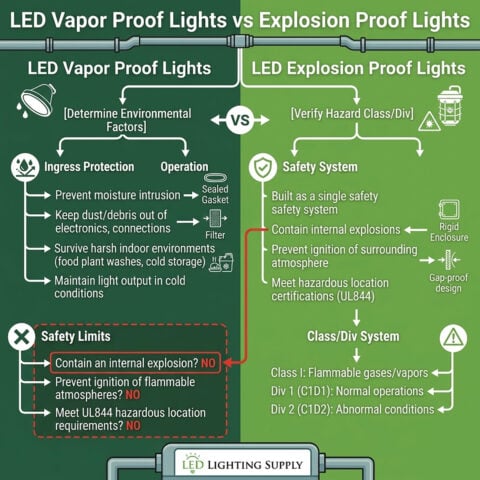
Explosion-proof lighting is a type of hazardous-location electrical equipment designed for specific classified environments. In Class I applications, explosionproof construction is intended to contain an internal explosion of specified gases or vapors and prevent it from igniting the surrounding hazardous atmosphere when the equipment is used within its approved rating and installation requirements.
Explosion-proof construction is only one hazardous-location protection method. Class II combustible-dust locations may use dust-ignitionproof equipment or other approved protection techniques, while Class III locations involving ignitible fibers or flyings have their own equipment and installation requirements.
“Hazardous-location lighting should always be matched to the documented classification of the installation area rather than selected from the facility type alone,” Neil explained.
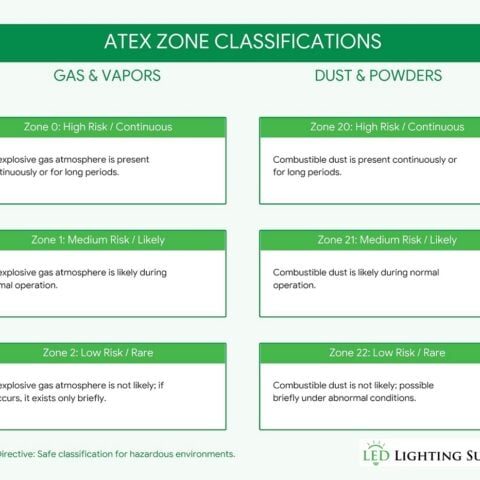
Hazardous areas are commonly classified using Classes and Divisions, and Class I may also use a Zone classification system. The broad Class categories are:
- Class I: Locations where flammable gases or vapors may be present in sufficient quantities to create a fire or explosion hazard.
- Class II: Locations where combustible dust may create an ignitable or explosive hazard.
- Class III: Locations where easily ignitible fibers or materials producing combustible flyings are handled, manufactured, used, or stored, but where those fibers or flyings are generally not expected to be suspended in the air in quantities sufficient to create ignitable mixtures.
These Classes should not be confused with Divisions. Division 1 and Division 2 describe how likely the hazardous material is to be present under normal or abnormal operating conditions within the specific Class.
For example, Class I, Division 1 lighting and Class I, Division 2 lighting both involve Class I flammable-gas or vapor hazards, but the likelihood and conditions under which those hazards are present differ.
Each hazardous area should be classified individually. A refinery, chemical plant, aircraft hangar, grain-processing facility, or manufacturing plant may contain classified and unclassified areas within the same facility.
Understanding Class I, Class II, and Class III Locations
Class I applies to flammable gases and vapors. Examples may include areas involving gasoline vapors, solvents, hydrogen, propane, methane, or other flammable gases or vapor-producing liquids when the area has been formally classified for those hazards.
Class II applies to combustible dust. Examples can include certain grain, flour, coal, metal, chemical, plastic, or other combustible-dust processes when dust is present in quantities or conditions that create a classified hazard.
Class III applies to easily ignitible fibers or flyings. Examples can include certain textile, cotton, woodworking, fiber-processing, or similar environments where ignitible fibers or flyings are handled or produced.
The exact Class, Division, Group, temperature code or maximum surface temperature, ambient temperature, and other project requirements must be established before selecting the fixture.
What Do Division 1 and Division 2 Mean?
Division designations describe the likelihood and conditions under which the hazardous material is present.
Division 1 generally applies where the hazardous material may be present under normal operating conditions or where the hazard is expected with sufficient frequency to require the more stringent classification.
Division 2 generally applies where the hazardous material is not normally present in ignitable concentrations but may become present because of abnormal operation, equipment failure, rupture, leakage, or other defined conditions.
The exact definitions vary by Class and should be determined from the applicable electrical code and project classification documents rather than summarized solely as “normal” versus “abnormal” without context.
Hazardous-Location Fixture Ratings Are Model-Specific
Hazardous-location fixtures from LED Lighting Supply are available with different classifications, certifications, environmental ratings, impact ratings, temperature codes, ambient-temperature ranges, voltages, and mounting options depending on model.
Selected products may carry listings or certifications applicable to hazardous-location use, including evaluation to standards such as UL 844 where appropriate. Other features such as IP66, IP67, IK ratings, marine ratings, corrosion-resistant construction, emergency backup, dimming, or high-temperature capability are model-specific and should be confirmed on the exact product specification.
Do not assume every explosion-proof fixture carries the same UL, ETL, CSA, IP, IK, Class, Division, Group, T-code, or ambient-temperature rating.
What Are High Temperature Light Fixtures?
High temperature LED lights are designed for applications where ambient temperature exceeds the operating range of standard LED fixtures.
High-temperature capability is separate from hazardous-location classification. A fixture designed for high ambient temperatures is not automatically approved for a hazardous location, and a hazardous-location fixture is not automatically suitable for every high-temperature environment.
Neil shares that high-temperature LED fixtures can be a practical alternative in applications where standard LED drivers, LEDs, seals, or other components would operate outside their specified temperature limits.
“The exact ambient-temperature rating should be confirmed from the fixture specification. Some industrial applications require high-temperature fixtures, some require hazardous-location fixtures, and some may require equipment that satisfies both sets of requirements.”
Industrial temperatures above the rated ambient limit of a fixture can shorten component life or cause premature failure. The correct product should be selected using the actual maximum and minimum ambient temperatures expected at the fixture location.
Selected high-temperature explosion-proof fixtures may be available for elevated ambient conditions, but ratings such as 50°C, 65°C, 80°C, 100°C, 150°C, or other temperature limits are product-specific and should not be generalized across the category.
High-temperature ratings also should not be described as “OSHA approval.” OSHA does not provide a generic approval based simply on a fixture operating at a particular temperature.
What Is Considered a Hazardous Environment and What Are the Different Types of Hazardous Conditions?
Hazardous classified locations are areas where fire or explosion hazards may exist because of flammable gases, vapors, combustible dust, or easily ignitible fibers or flyings.
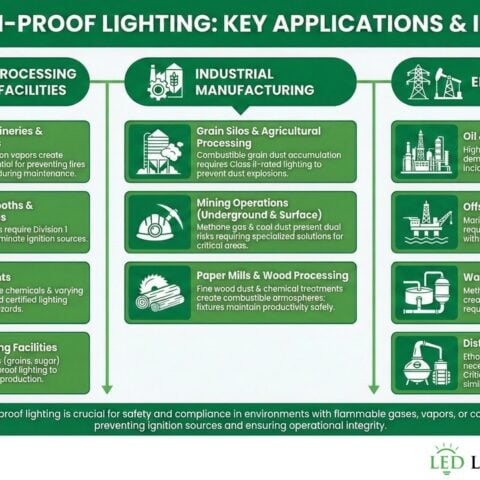
“Common hazardous-location projects may involve oil and gas processing, chemical facilities, manufacturing processes, grain or dust-handling operations, paint or solvent processes, and other industrial applications,” Neil explained.
The presence of one of these industries does not automatically mean the entire facility is classified. Each room, section, process area, or boundary should be evaluated individually.
Hazardous classification typically considers:
- Type of hazardous material
- Class
- Division or Zone where applicable
- Gas, vapor, dust, or fiber Group
- Ignition characteristics
- Temperature code or maximum permitted surface temperature
- Ambient temperature
- Ventilation
- Process equipment
- Potential leak or release points
- Distance and boundary from the hazard source
The classification should be established by the facility engineer, qualified electrical professional, safety professional, or other party responsible for hazardous-location classification and accepted by the authority having jurisdiction where applicable.
Are There Safety Considerations Relating to Explosion Proof Lighting?
Lighting in hazardous locations is part of the electrical installation and must be suitable for the specific classified area.
Important considerations can include:
- Correct Class and Division or Zone
- Correct Group for the hazardous material
- Temperature code or maximum surface temperature
- Ambient-temperature rating
- Voltage
- Wiring method
- Conduit seals and fittings where required
- Junction boxes and enclosures
- Mounting method
- Environmental exposure
- Maintenance and inspection requirements
Energy savings and reduced maintenance can be benefits of converting legacy HID systems to LED, but savings vary according to existing wattage, LED wattage, controls, fixture quantity, operating hours, and maintenance practices. A fixed 50-70% savings range should not be assumed for every project.
Hazardous-location junction boxes and lighting controls, conduit systems, seals, fittings, and other electrical components should also be matched to the specific classification and installation requirements. A general-purpose junction box is not a substitute for properly rated hazardous-location equipment where such equipment is required.
How Do These Safety Considerations Impact Industrial Lighting Solutions?
Fixture wattage and lumen output are important, but hazardous-location suitability comes first. A fixture with the right light output is not acceptable if its classification, Group, temperature code, ambient rating, or installation method does not match the project.
Older hazardous-location lighting systems may also have substantial lumen depreciation, dirty optics, damaged reflectors, outdated layouts, or maintenance limitations.
Our free lighting plans can help evaluate fixture quantity, placement, predicted foot-candle levels, and uniformity using the proposed fixture photometrics.
A lighting plan does not establish the hazardous-area classification. LED Lighting Supply can use an established classification to help identify fixtures with matching product ratings, while the facility or qualified project professional should establish the actual hazardous-area boundaries and electrical requirements.
Are Explosion Proof Lights a Necessity for Industrial Projects?
Not every industrial space requires explosion-proof lighting.
“The important first step is determining whether the actual fixture location is classified and what equipment protection technique is permitted for that classification,” Neil explained.
Many industrial facilities contain ordinary unclassified spaces alongside classified process areas. Installing hazardous-location equipment where it is not required may add unnecessary project cost, while installing general-purpose lighting in a classified area can create a serious safety and compliance problem.
Likewise, “explosion proof” is not the only acceptable hazardous-location protection technique. Depending on the Class, Division, and specific application, approved techniques can include explosionproof, dust-ignitionproof, dust-tight, purged and pressurized, intrinsically safe, nonincendive, hermetically sealed, or other methods permitted for the location.
LED Lighting Supply can help match lighting products to a classification already established for the project. The determination of whether an area is classified, and its exact classification and boundaries, should come from the facility or qualified professional responsible for the electrical design.
What Are the Important Considerations When Selecting Explosion Proof Lighting Fixtures?
Before selecting hazardous-location lighting, confirm the documented classification of the fixture location.
Important product-selection information includes:
- Class
- Division or Zone where applicable
- Gas, vapor, dust, or fiber Group
- Temperature code or maximum surface temperature
- Minimum and maximum ambient temperature
- Voltage
- Fixture wattage and lumen output
- Mounting method
- Required environmental rating
- Corrosion or chemical exposure
- Emergency or controls requirements
For Class I applications, areas where flammable gases or vapors are expected under normal operating conditions may be classified as Division 1, while certain areas where ignitable concentrations are expected only under abnormal conditions may be classified as Division 2. The exact classification should come from the project documentation rather than from a general description alone.
Class II and Class III locations have different definitions and protection requirements and should not be treated as variations of Class I gas or vapor hazards.
Are There Any Recently Evolving Hazardous-Location Lighting Trends?
Industrial facilities continue to replace older HID and metal halide hazardous-location fixtures with LED products where suitable LED options are available for the required classification.
Benefits can include lower wattage, reduced relamping, instant-on operation, improved optical control, and longer maintenance intervals depending on the selected product and existing system.
Retrofitting a hazardous-location fixture requires special care. A field modification can affect the original fixture listing, thermal performance, sealing, flame paths, wiring, or hazardous-location suitability.
A retrofit should only be performed using a kit and installation method specifically approved for the host fixture and application. Do not assume the original hazardous-location rating remains valid after replacing internal components.
In many projects, replacing the complete fixture with a new listed LED hazardous-location fixture may be simpler than modifying an older fixture, but that decision should be based on cost, condition, classification, product availability, and project requirements rather than a universal rule.
What Other Types of Products Can Help Industrial Facilities Meet Lighting Requirements?
- Industrial Grade High Bays: Industrial high bays can be appropriate for unclassified warehouses, manufacturing areas, and other high-ceiling spaces when their environmental and temperature ratings match the application.
- Outdoor Area Lighting: Outdoor area fixtures can be used for parking lots, staging areas, roadways, yards, and security lighting when the fixture and location are not subject to hazardous-location requirements or when a properly rated product is selected.
Do not substitute ordinary industrial, high-temperature, vapor-tight, waterproof, or IP-rated lighting for hazardous-location equipment where the area classification requires approved hazardous-location products.
How Do LED Hazardous-Location Lights Differ from Traditional HID Systems?
LED hazardous-location fixtures can provide lower power consumption, instant-on operation, reduced lamp-replacement maintenance, and more controlled optical distribution than many legacy HID systems.
Rated life varies by product. Do not assume all HID fixtures have only 20,000-30,000 operating hours or that all LED fixtures provide 150,000 hours. Compare the published life, lumen-maintenance data, driver life, ambient-temperature limits, warranty, and operating conditions for the exact products being considered.
CRI also varies by product and should not be treated as automatically superior merely because a fixture uses LED technology.
What Impact Does the Proper Lighting Solution Have on Facility Safety and Efficiency?
Properly selected hazardous-location lighting can support visibility, maintenance access, operational continuity, and energy-efficiency goals, but those benefits depend on the complete lighting system and correct equipment selection.
Selected hazardous-location LED fixtures may offer IP66 or other ingress-protection ratings, vapor-tight construction, corrosion-resistant materials, or washdown capability. These features are model-specific.
IP66 does not mean a fixture is automatically explosion proof or suitable for a hazardous location. IP ratings address solid and water ingress. Hazardous-location approval is a separate requirement.
Likewise, “vapor-tight” describes enclosure construction and should not be used as a substitute for Class/Division/Zone certification.
Potential benefits of properly selected LED hazardous-location lighting include:
- Reduced Energy Use: LED fixtures can use less power than older HID systems when the replacement is properly selected. Actual savings depend on the existing and proposed systems.
- Reduced Maintenance: Longer maintenance intervals may reduce relamping and service requirements compared with legacy lamp-based systems.
- Improved Lighting Performance: Modern LED optics can improve distribution, uniformity, and delivered light when the lighting layout is properly designed.
- Hazardous-Location Suitability: Properly rated equipment can be matched to an established Class, Division or Zone, Group, temperature, and ambient requirement.
The lighting system should support the facility’s safety goals, but lighting alone does not establish a safe workplace. Hazardous-area classification, electrical design, process safety, ventilation, maintenance, inspection, and operational controls all remain important parts of the overall facility safety program.