ATEX Lighting Guide: Understanding Hazardous Location Zones vs Divisions
This guide explains how ATEX (ATmosphères EXplosibles) Zones work, how they differ from the North American NEC/CEC hazardous-location classification systems, and how to interpret common ATEX and IECEx markings when selecting hazardous-location lighting for international or multinational projects.
This content is intended for educational reference only and does not replace site-specific hazardous-area classification. ATEX, IECEx, NEC/CEC classifications, and standards such as UL 844 are related to hazardous-location equipment, but they do not serve the same function.
North America commonly uses NEC or CEC Class/Division and Zone classifications. The European Union uses ATEX requirements for equipment and workplaces involving potentially explosive atmospheres, while IECEx is an international conformity-assessment and certification system based on IEC standards for equipment used in explosive atmospheres.
This guide focuses on how those systems apply when selecting ATEX and IECEx hazardous-location lighting.
Who This ATEX and IECEx Guide Is For
- Electrical engineers working on European Union or international industrial projects
- Facility managers responsible for hazardous-location equipment selection
- OEMs and contractors sourcing hazardous-location lighting internationally
- North American teams working with projects that specify ATEX or IECEx equipment
- Project teams reviewing equipment markings across multiple regulatory systems
How ATEX and IECEx Differ From North American Hazardous-Location Classification
Hazardous locations are classified according to the likelihood and nature of an explosive atmosphere. The classification system and equipment-certification requirements depend on the jurisdiction.
In North America, hazardous locations may be classified using the Class/Division system or a Zone system under the applicable NEC or CEC requirements.
In the European Union, ATEX provides the legal framework for equipment and workplaces involving potentially explosive atmospheres. Internationally, IECEx provides conformity-assessment and certification schemes for equipment, services, and personnel associated with explosive atmospheres.
These frameworks use related hazardous-area concepts, but certification and acceptance requirements are jurisdiction-specific. Equipment should be selected using the exact classification and approval requirements established for the project rather than by assuming one system automatically substitutes for another.
What Does ATEX Mean?
ATEX comes from the French phrase “ATmosphères EXplosibles.” It refers to European Union legislation addressing equipment and workplaces associated with potentially explosive atmospheres.
- Directive 2014/34/EU: Applies to equipment and protective systems intended for use in potentially explosive atmospheres.
- Directive 1999/92/EC: Addresses minimum requirements for improving the safety and health protection of workers potentially at risk from explosive atmospheres.
Directive 2014/34/EU establishes requirements for equipment and protective systems placed on the EU market for use in potentially explosive atmospheres. Manufacturers must complete the applicable conformity-assessment process and provide the required markings and documentation.
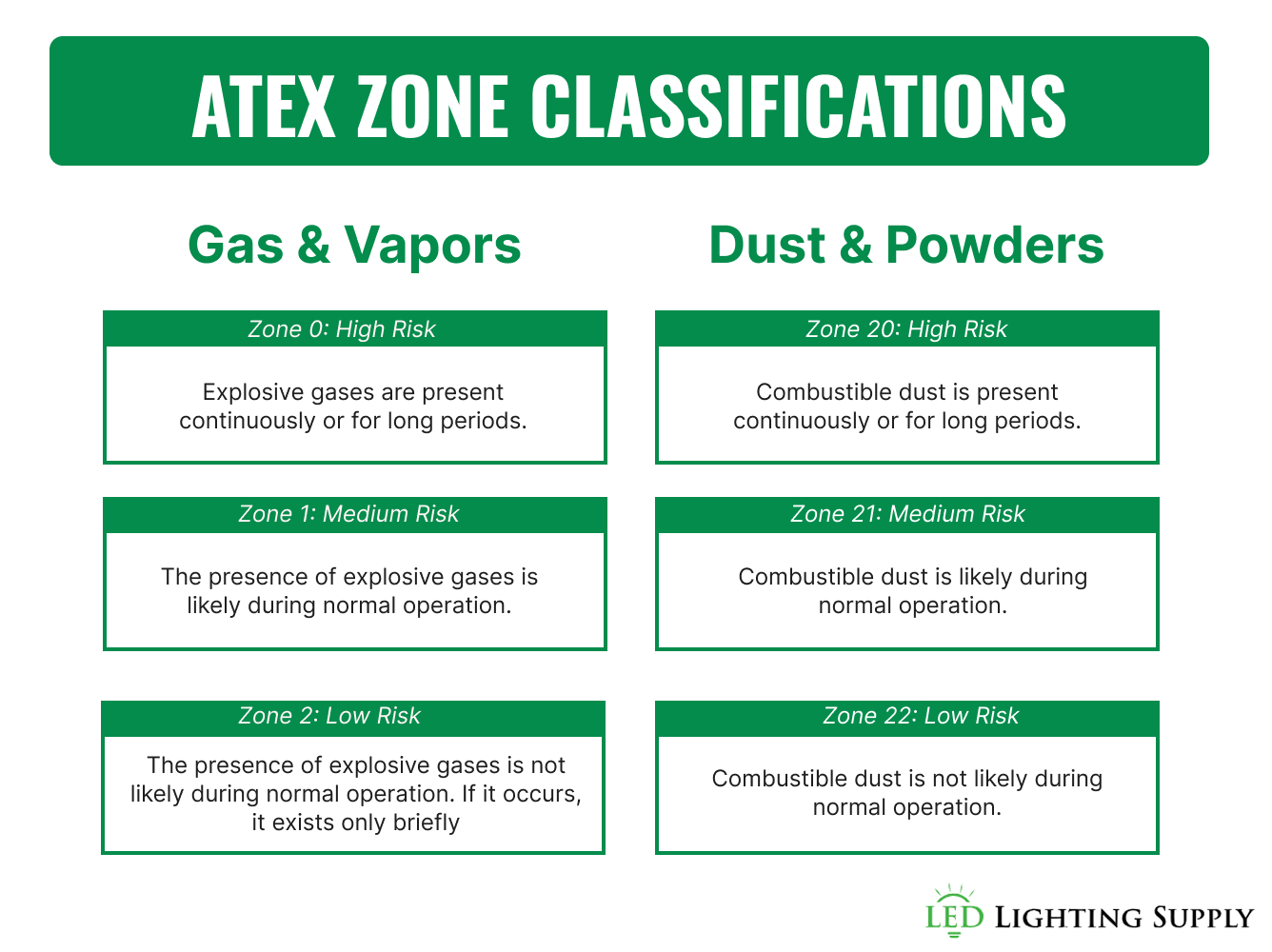
ATEX Gas and Vapor Zone Classifications
| Zone 0 | An explosive atmosphere consisting of flammable gas, vapor, or mist is present continuously, for long periods, or frequently. |
| Zone 1 | An explosive atmosphere consisting of flammable gas, vapor, or mist is likely to occur occasionally during normal operation. |
| Zone 2 | An explosive atmosphere consisting of flammable gas, vapor, or mist is not likely to occur during normal operation and, if it does occur, exists only for a short period. |
ATEX Dust Zone Classifications
| Zone 20 | An explosive atmosphere in the form of a cloud of combustible dust in air is present continuously, for long periods, or frequently. |
| Zone 21 | An explosive atmosphere in the form of a combustible-dust cloud is likely to occur occasionally during normal operation. |
| Zone 22 | An explosive atmosphere in the form of combustible dust is not likely to occur during normal operation and, if it does occur, persists only for a short period. |
NEC/CEC, UL 844, ATEX, and IECEx: What Each One Does
These terms are often mentioned together, but they represent different parts of hazardous-location design, classification, product evaluation, or certification.
| System / Standard | Primary Role |
| NEC / CEC | Electrical-code frameworks used in North America that include hazardous-location classification and installation requirements using Class/Division and, where applicable, Zone methods. |
| UL 844 | A product safety standard used for certain luminaires intended for hazardous/classified locations. It is a luminaire standard, not a hazardous-area classification system. |
| ATEX | European Union legal and conformity framework covering equipment and protective systems intended for use in potentially explosive atmospheres, along with workplace requirements under the related worker-protection directive. |
| IECEx | An international certification system that verifies equipment and other Ex-related products or services against applicable IEC standards. |
Important: UL 844 should not be presented as the North American equivalent of ATEX or IECEx. UL 844 addresses product evaluation for applicable hazardous-location luminaires, while NEC/CEC establish the North American classification and installation framework.
Comparing North American Divisions and Zone-Based Classifications
North American Class/Division classifications and ATEX/IECEx Zone classifications describe hazardous environments differently. They share similar underlying concepts involving the likelihood and duration of hazardous atmospheres, but they should not be treated as direct one-for-one conversions.
| Hazard Type | North American Classification | Zone-Based Classification |
| Gas / Vapor | Class I, Division 1 or Division 2 | Zone 0, Zone 1, or Zone 2 |
| Combustible Dust | Class II, Division 1 or Division 2 | Zone 20, Zone 21, or Zone 22 |
Do not assume:
- Class I, Division 1 automatically equals Zone 1
- Class I, Division 2 automatically equals Zone 2 in every project
- Class II, Division 1 automatically equals Zone 21
- Class II, Division 2 automatically equals Zone 22 without reviewing the actual classification criteria
The systems may produce similar equipment-selection outcomes in some circumstances, but classification boundaries and protection requirements should be established according to the governing code or regulatory framework.
Why Division 1 Does Not Equal a Single Zone
Division 1 can encompass hazardous conditions that may correspond to more than one Zone depending on how frequently the explosive atmosphere is present.
For example, the Zone system distinguishes between:
- Zone 0: Continuous, long-duration, or frequent presence of a gas or vapor explosive atmosphere
- Zone 1: Occasional presence during normal operation
- Zone 2: Unlikely presence during normal operation and short duration if it occurs
That additional distinction is one reason a simple Division-to-Zone conversion table should not be used as the sole basis for selecting equipment.
ATEX Categories and IECEx Equipment Protection Levels
ATEX and IECEx use related equipment-protection concepts, but their markings and legal roles are different.
ATEX equipment for Group II applications may use Categories such as 1G, 2G, and 3G for gas atmospheres and 1D, 2D, and 3D for dust atmospheres.
IECEx equipment markings use Equipment Protection Levels (EPLs) such as Ga, Gb, Gc, Da, Db, and Dc. IECEx provides third-party conformity assessment against applicable IEC standards and maintains an online certification system for certified Ex equipment.
| Zone | Typical ATEX Category | Typical IECEx EPL | General Protection Level |
| Zone 0 – Gas | 1G | Ga | Very high equipment protection level |
| Zone 1 – Gas | 2G | Gb | High equipment protection level |
| Zone 2 – Gas | 3G | Gc | Enhanced equipment protection level |
| Zone 20 – Dust | 1D | Da | Very high equipment protection level |
| Zone 21 – Dust | 2D | Db | High equipment protection level |
| Zone 22 – Dust | 3D | Dc | Enhanced equipment protection level |
These relationships are useful for understanding equipment-protection concepts but should still be verified against the applicable ATEX directive, IECEx certificate, equipment marking, and project requirements.
What Is IECEx?
IECEx is the IEC System for Certification to Standards Relating to Equipment for Use in Explosive Atmospheres. It provides international conformity-assessment schemes for Ex equipment, service facilities, and personnel.
Under the IECEx Certified Equipment Scheme, approved certification bodies and test laboratories assess equipment against applicable IEC Ex standards. A valid IECEx Certificate of Conformity indicates that the certified product has undergone the required independent assessment and testing.
IECEx itself does not create hazardous-location standards. It provides certification showing conformity with applicable internationally recognized standards.
What Does UL 844 Cover?
UL 844 is used in North America for the evaluation of certain luminaires intended for hazardous/classified locations.
Its role is fundamentally different from NEC hazardous-area classification, ATEX legislation, or the IECEx certification system.
A project may therefore involve several separate concepts:
- The area is classified using the applicable NEC, CEC, ATEX/EN, IEC, or other jurisdictional framework
- The fixture is evaluated to the applicable product safety standard
- The equipment carries certification or markings recognized by the jurisdiction
- The installer follows the electrical and hazardous-location installation requirements applicable to the site
A statement such as “UL 844 Class I, Division 1 fixture” may be used to describe a luminaire evaluated for that hazardous-location application, but UL 844 itself does not create the Class I, Division 1 classification.
“Ex” Markings Explained: Ex d, Ex e, Ex t, and More
ATEX and IECEx equipment markings may identify the protection technique used to reduce ignition risk.
- Ex d: Flameproof enclosure protection for applicable gas atmospheres
- Ex e: Increased-safety protection
- Ex t: Protection by enclosure for combustible-dust atmospheres
Other Ex protection concepts may also apply depending on the equipment and application.
A fixture described generically as “explosion proof” should not be selected from that marketing term alone. Verify the complete certification marking, including:
- Gas or dust application
- Zone or other area classification
- Equipment Group
- Gas or dust Group
- Protection technique
- Equipment Protection Level
- Temperature classification or maximum surface temperature
- Ambient-temperature range
- Certificate information
Gas and Dust Groups Matter
Zone classification alone does not establish complete equipment suitability. The hazardous material must also be considered.
For gases and vapors, equipment may carry classifications such as IIA, IIB, or IIC depending on the applicable system and product certification.
For combustible dust, equipment may carry classifications such as IIIA, IIIB, or IIIC depending on the applicable system.
A fixture rated for one gas or dust group should not be assumed suitable for another group without confirming the exact certification marking.
Temperature Classification and Maximum Surface Temperature
Equipment must also be suitable for the ignition characteristics of the hazardous material.
Gas applications commonly use temperature classes such as T1 through T6. Combustible-dust applications may identify a maximum permitted surface temperature rather than relying solely on the gas T-class framework.
Temperature suitability must be verified together with the ambient-temperature range of the equipment. A fixture may have different permitted surface-temperature or T-class ratings at different ambient temperatures.
Common ATEX and IECEx Classification Mistakes to Avoid
- Treating UL 844 as a hazardous-location classification system: UL 844 is an equipment safety standard for applicable hazardous-location luminaires, not the North American equivalent of ATEX or IECEx.
- Assuming Class I, Division 1 automatically equals Zone 1: Division 1 can encompass conditions represented differently under Zone classifications.
- Using a Division-to-Zone conversion chart as the final classification: Use the actual project classification rather than a simplified equivalency table.
- Assuming ATEX and IECEx are identical: They use related IEC/EN technical concepts, but ATEX is an EU legal framework and IECEx is an international certification system.
- Selecting equipment by Zone alone: Also verify gas or dust Group, protection technique, EPL or Category, temperature rating, ambient range, and certificate.
- Overlooking combustible-dust hazards: Gas and dust hazards use different Zone numbers and may require different protection techniques.
- Using “explosion proof” as a universal certification term: Review the actual certification marking and protection method.
- Assuming an IECEx certificate automatically provides legal acceptance everywhere: National and regional approval requirements can still apply.
Can You Convert an NEC Classification to ATEX or IECEx?
There is no universal one-step conversion that should replace a project hazardous-area assessment.
If a North American facility specification identifies an NEC Class and Division but the project requires ATEX- or IECEx-certified equipment, the engineering team should review the actual hazardous material, release conditions, frequency and duration of the explosive atmosphere, ventilation, area boundaries, and applicable jurisdictional requirements.
That information can then be used to establish the appropriate Zone classification and equipment requirements.
LED Lighting Supply can help identify fixtures whose certifications and markings match an already established project requirement, but we do not establish or convert hazardous-area classifications for a facility.
Important Safety and Compliance Notice
This guide is provided for general educational purposes only.
Hazardous-area classifications should be established by the facility engineer, qualified electrical or process-safety professional, or other party responsible for the project classification and accepted by the applicable authority where required.
Lighting manufacturers and suppliers do not determine the hazardous-zone boundaries for a facility simply from the industry or application type.
Final fixture selection should match the documented:
- Jurisdiction and regulatory framework
- Zone, Division, or other area classification
- Gas or dust Group
- Protection technique
- Equipment Category or EPL where applicable
- Temperature classification or maximum surface temperature
- Ambient-temperature range
- Certification or listing requirements
- Installation requirements
Need Help Matching ATEX or IECEx Requirements to a Fixture?
If your hazardous-area documentation already identifies the required ATEX Zone, IECEx EPL, gas or dust Group, temperature classification, ambient-temperature range, and certification requirements, LED Lighting Supply can help identify lighting products whose published ratings match those requirements.
Start here: Explosion Proof LED Lights.