


Pickleball Light Poles for Outdoor Court Lighting Systems
- Designed and certified for the highest quality performance
- All of our products come with a hassle free warranty
- Trusted by Contractors with over 500 5-star reviews


Pickleball courts require a focused lighting approach due to their smaller playing surface and frequent use in residential, park, and multi-court environments. Properly selected pickleball light poles help position fixtures at the correct height and angle to deliver even coverage across the court while minimizing glare. Because courts are often placed close together, lighting systems must be designed to avoid spill light and excessive brightness that can affect adjacent courts or nearby properties.
Most pickleball court lighting systems use poles in the 15 to 30 foot range depending on the number of courts and the level of play. Lower mounting heights are common in single-court or residential applications, while taller poles are often used in multi-court complexes to improve uniformity and reduce the total number of fixtures. A well-designed system balances pole height, fixture output, and placement to create consistent visibility without over-lighting the space.
Showing 1–12 of 17 results
 SKU:MLLG-WG-POLE-CP-18-4SQ-AB | Web ID:2563Minimum Order: 4Minimum Order Total: $3,483.16Built to Order 5 Weeks
- Pole Weight (lbs): 47
- Pole Width (in): 4
- Pole Color: Bronze | Black | White | Gray | Custom
- Pole Gauge: .205 in
- Warranty: 7 years
Starting At$870.79


- SKU:MLLG-WL-POLE-20-4RD-DB-BZ-TN | Web ID:2116Minimum Order: 2Minimum Order Total: $1,967.34Availability: 44 In Stock Ships 7-14 Days
- Height Above Grade (ft): 20
- Buried Depth Below Grade (ft): 5
- Pole Weight (lbs): 132
- Pole Color: Bronze
- Pole Gauge: 11
- Warranty: 1 year
Starting At$983.67 - SKU:LLS-LN-POLE-20FT-4.5-RD-BK | Web ID:2700Minimum Order: 2Minimum Order Total: $1,974.46Availability: 85 In Stock Ships 7-14 Days
- Pole Weight (lbs): 124
- Pole Color: Black
- Pole Gauge: 11
- Warranty: 1 year
Starting At$987.23 - SKU:MLLG-WL-POLE-20FT-4-SQ-[COLOR]-TN | Web ID:1912White:13 In StockShips 7-14 DaysBronze:341 In StockShips 7-14 Days
- Pole Weight (lbs): 169
- Pole Width (in): 4
- Pole Color: Bronze | White
- Pole Gauge: 11
- Warranty: 1 year
Starting At$773.47 - SKU:MLLG-WL-POLE-20FT-4-RD-BZ-TN | Web ID:1917Minimum Order: 2Minimum Order Total: $1,644.90Availability: 186 In Stock Ships 7-14 Days
- Pole Weight (lbs): 143
- Pole Color: Bronze
- Pole Gauge: 11
- Warranty: 1 year
Starting At$822.45 - SKU:MLLG-WG-POLE-CP-20-4SQ-DB | Web ID:2172Minimum Order: 4Minimum Order Total: $3,303.64Availability: 54 In Stock Ships 3-4 weeks
- Height Above Grade (ft): 20
- Buried Depth Below Grade (ft): 5
- Pole Weight (lbs): 68
- Pole Width (in): 4
- Pole Color: Bronze | Black | White | Gray | Custom
- Pole Gauge: .205 in
- Warranty: 7 years
Starting At$825.91 - SKU:MLLG-WG-POLE-CP-20-4SQ-AB | Web ID:2562Minimum Order: 4Minimum Order Total: $3,820.00Built to Order 5 Weeks
- Pole Weight (lbs): 52
- Pole Width (in): 4
- Pole Color: Bronze | Black | White | Gray | Custom
- Pole Gauge: .205 in
- Warranty: 7 years
Starting At$955.00 25 Foot Round Tapered Steel Light Pole | 6.5 Inch Base Diameter | Anchor Base | High Wind Zone Rated
SKU:MLLG-WL-POLE-25FT-65-TRD-BZ-T | Web ID:2170Minimum Order: 2Minimum Order Total: $2,016.00Availability: 19 In Stock Ships 7-14 Days- Pole Weight (lbs): 163
- Pole Color: Bronze
- Pole Gauge: 11
- Warranty: 1 year
Starting At$1,008.00- SKU:MLLG-WL-POLE-25FT-4-RD-BZ-TN | Web ID:1918Minimum Order: 2Minimum Order Total: $1,987.76Availability: 270 In Stock Ships 7-14 Days
- Pole Weight (lbs): 176
- Pole Color: Bronze
- Pole Gauge: 11
- Warranty: 1 year
Starting At$993.88 - SKU:MLLG-WL-POLE-25FT-4-SQ-[COLOR]-TN | Web ID:1916Bronze:247 In StockShips 7-14 DaysWhite:7 In StockShips 7-14 Days
- Pole Weight (lbs): 190
- Pole Width (in): 4
- Pole Color: Bronze | White
- Pole Gauge: 11
- Warranty: 1 year
Starting At$926.00 - SKU:MLLG-WG-POLE-CP-25-4SQ-DB | Web ID:2333Minimum Order: 4Minimum Order Total: $3,776.36Availability: 33 In Stock Ships 3-4 weeks
- Height Above Grade (ft): 25
- Buried Depth Below Grade (ft): 4.5
- Pole Weight (lbs): 80
- Pole Width (in): 4
- Pole Color: Bronze | Black | White | Gray | Custom
- Warranty: 7 years
Starting At$944.09 - SKU:MLLG-WG-POLE-CP-25-5SQ-AB | Web ID:2561Minimum Order: 4Minimum Order Total: $5,107.28Built to Order 5 Weeks
- Pole Weight (lbs): 103
- Pole Width (in): 5
- Pole Color: Bronze | Black | White | Gray | Custom
- Warranty: 7 years
Starting At$1,276.82






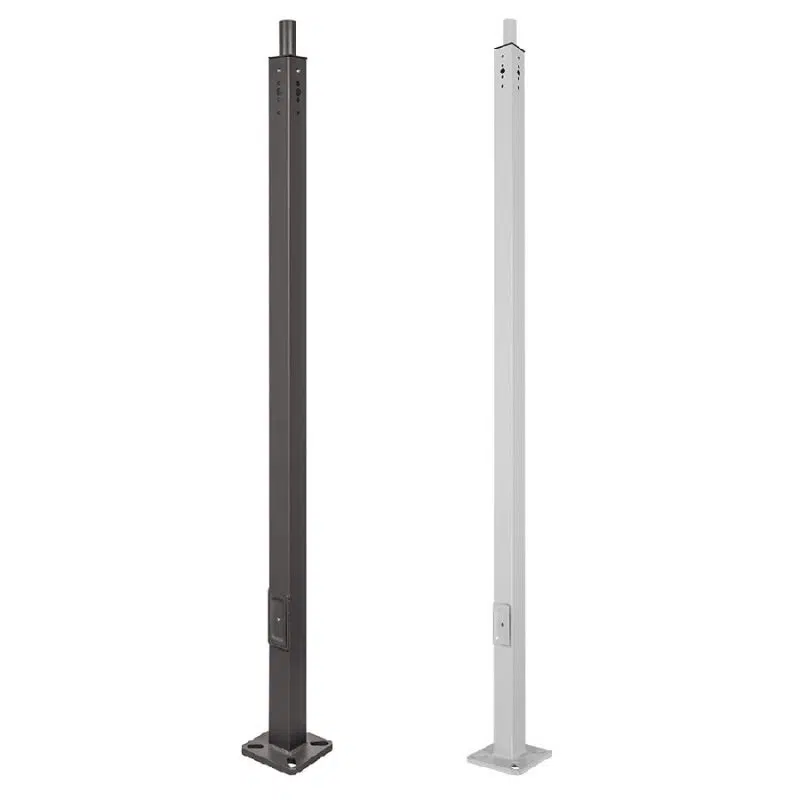


Planning Pickleball Court Light Pole Systems
Pickleball light poles are a key component in delivering consistent and usable lighting for outdoor courts. Because pickleball is played on a smaller surface compared to other sports, lighting systems must be designed with precision. The goal is to provide even illumination across the entire court while minimizing glare and avoiding bright spots or shadows that can interfere with play. Proper pole selection directly impacts how well the lighting system performs under real conditions.
Pole Height and Court Size Considerations
Most outdoor pickleball courts use light poles between 15 and 30 feet in height. The correct height depends on whether the installation is a single court, a group of courts, or part of a larger recreational facility. Lower poles are often used for residential or backyard courts, where lighting needs are more limited and surrounding structures must be considered. Taller poles are more common in multi-court complexes, where higher mounting positions help improve light distribution and reduce the number of fixtures required.
Selecting the right pole height is important for both performance and efficiency. Poles that are too low can create uneven lighting and increase glare, while poles that are too high may lead to wasted light and unnecessary cost. Matching pole height with fixture output and beam angle ensures the court is evenly lit without over-lighting the area.
Layout and Pole Placement
Pole placement plays a major role in achieving consistent coverage. For single courts, poles are typically installed along the perimeter, often positioned near the corners or along the sides of the court. In multi-court layouts, poles may be shared between courts to improve efficiency and reduce installation costs. The goal is to create overlapping light patterns that eliminate dark areas while maintaining a balanced level of brightness across all playing surfaces.
Careful layout planning also helps reduce glare. Fixtures should be aimed so that light is directed onto the court surface rather than into the line of sight of players. This is especially important in pickleball, where players frequently look upward to track the ball.
Durability and Outdoor Conditions
Pickleball courts are often located in parks, schools, and recreational areas where lighting systems are exposed to weather and regular use. Steel light poles are commonly used because they provide the strength needed to support fixtures while resisting wind and environmental stress. Proper coatings help protect against corrosion, which is especially important in humid or coastal environments.
Wind load is another consideration. Even smaller fixtures can create stress on poles during high wind conditions. Selecting poles that are properly rated for the environment helps ensure long-term stability and reduces the risk of structural issues.
Glare Control and Light Spill
Managing glare and light spill is critical in pickleball lighting design. Courts are often located near residential areas or shared recreational spaces, making it important to keep light focused on the playing surface. Proper pole height and fixture selection help control how light is distributed, reducing unwanted spill into surrounding areas.
Good lighting design improves both player experience and community acceptance. Systems that minimize glare and light trespass are less likely to generate complaints and are more suitable for extended evening use.
Maintenance and Long-Term Use
Maintenance should be considered during the planning phase. While pickleball courts are smaller than other sports facilities, the lighting system still needs to be accessible for inspection and servicing. Pole height and mounting configuration can affect how easy it is to maintain fixtures over time. Choosing reliable pole systems reduces maintenance frequency and helps keep the courts operational with minimal downtime.
Making the Right Pole Selection
Selecting the right pickleball light poles involves balancing height, placement, durability, and lighting performance. A well-designed system supports consistent play, improves visibility, and ensures the court can be used safely during evening hours. By focusing on proper pole selection and layout, facility owners can create a lighting system that performs reliably and meets the needs of both recreational and competitive players.