Lighting Maintenance Factor Explained
What Does Maintenance Factor Mean?
The Maintenance Factor (MF) is a critical calculation for LED lighting design in industrial and commercial facilities. This factor predicts how lighting performance will decline over time due to lamp depreciation and environmental conditions.
For facility managers and engineers, MF helps determine the initial lighting levels needed to maintain adequate illumination throughout the fixture’s operational life. While traditional lighting systems typically use a standard 0.8 MF, LED technology requires different calculations due to its superior lumen maintenance and extended lifespan.
Important: Maintenance factor calculations affect safety, energy efficiency, and code compliance. Consult with qualified lighting engineers for specific installation requirements and local code compliance.
Why LEDs Require Different Maintenance Factor Calculations
Traditional MF standards were developed for conventional lighting before LED technology became prevalent. The standard 0.8 baseline maintenance factor often doesn’t accurately reflect LED lighting performance characteristics.
Key differences include:
- Lower lumen depreciation rates over time
- Longer operational lifespans (50,000+ hours)
- Better resistance to environmental factors
- More predictable performance degradation patterns
These characteristics mean LED installations can often achieve higher maintenance factors, reducing initial lumens required and improving energy efficiency.
How to Calculate Maintenance Factor for LED Lighting
The complete maintenance factor formula considers multiple variables:
MF = (LLMF × LSF) × LMF × RMF
Formula Variables:
- LLMF – Lamp Lumen Maintenance Factor
- LSF – Lamp Survival Factor
- LMF – Luminaire Maintenance Factor
- RMF – Room Maintenance Factor
Individual Factor Considerations
Lamp Lumen Maintenance Factor (LLMF): Measures light output degradation over the fixture’s rated life. LED modules typically maintain 70-90% of initial lumens at end of rated life.
Lamp Survival Factor (LSF): Percentage of lamps expected to remain operational. Quality LED fixtures often achieve near 1.0 due to long lifespans and low failure rates.
Luminaire Maintenance Factor (LMF): Accounts for dirt accumulation on fixtures. Depends on fixture design and environmental conditions. Harsh industrial environments require more frequent cleaning.
Room Maintenance Factor (RMF): Considers surface reflectance reduction due to dirt accumulation on walls and ceilings.

Maintenance Factor Examples by Application
Different environments require different MF calculations. Here are practical examples:
Clean Office Environment
Scenario: 50-person office, 4,000 hours/year, 10-year renovation cycle
Lighting: Closed LED luminaires (IP40)
- Room Surface MF: 0.97 (very clean)
- Luminaire MF: 0.92 (closed fixture)
- Lamp Survival Factor: 1.0 (minimal failure risk)
- Lamp Lumen Maintenance: 0.9 (50,000-hour rating)
- Total MF: 0.80
Industrial Factory Environment
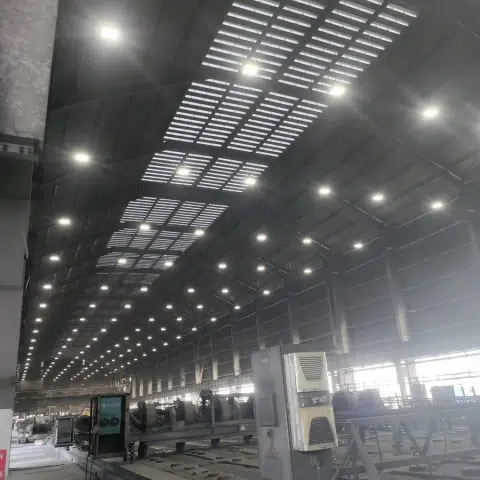
Scenario: 2,000 sq ft factory, 6,800 hours/year, 15-year cycle
Lighting: Pendant LED luminaires (IP64)
- Room Surface MF: 0.9 (dusty environment)
- Luminaire MF: 0.94 (sealed fixture)
- Lamp Survival Factor: 1.0 (quality LED modules)
- Lamp Lumen Maintenance: 0.7 (100,000-hour exposure)
- Total MF: 0.60

Maintenance Planning Best Practices
Effective maintenance planning balances performance requirements with operational costs:
Scheduled Cleaning: Regular luminaire and surface cleaning maintains higher light levels and extends effective fixture life. Clean facilities can achieve maintenance factors above 0.8.
Environmental Assessment: Consider dust, humidity, and chemical exposure when selecting fixtures and planning maintenance intervals.
Group Replacement Strategy: For large installations, plan group replacements rather than individual fixture replacement to reduce labor costs.
Access Planning: Consider maintenance access requirements during initial design to minimize future service costs.
Why Standard 0.8 MF May Not Apply to LED Projects
The traditional 0.8 maintenance factor became the industry standard for conventional lighting, but may not optimize LED installations:
Over-lighting Risk: Using 0.8 MF for LED projects with actual 0.88+ performance wastes energy and increases operating costs.
Environment-Specific Factors: Clean offices may achieve 0.9+ MF while dusty warehouses might require 0.6-0.7 MF calculations.
Technology Differences: LED lumen maintenance curves differ significantly from HID or fluorescent depreciation patterns.

LED Lighting Advantages for Maintenance Planning
LED technology offers significant maintenance advantages for indoor lighting applications:
Extended Lifespans: 50,000-100,000 hour ratings reduce replacement frequency and associated labor costs.
Predictable Performance: LED degradation follows predictable curves, enabling accurate long-term planning.
Energy Savings: Higher maintenance factors combined with LED efficiency reduce the total cost of ownership.
Quality Control: Consistent lumen output maintains lighting uniformity throughout operational life.
Even in short-term applications (5-7 year leases), LED lighting typically provides positive ROI through energy savings and reduced maintenance requirements before replacement becomes necessary.
Note: Actual maintenance factors depend on specific environmental conditions, fixture selection, and maintenance practices. Work with qualified lighting professionals to determine appropriate values for your application.