


Buyers Guide to LED Lights and Color Temperature
 Written by Cory Peterson
Last Updated Jan 8, 2026
Published on Oct 2, 2020
Although often overlooked, color temperature deserves careful consideration when installing new LED lighting fixtures. Two LED bulbs producing identical lumen output can create dramatically different lighting environments based solely on their color temperatures. This difference goes beyond aesthetics-it can influence visual comfort, alertness, and how people experience a space.
Warm-toned lights (below ~3200K) are commonly preferred for comfort-focused environments, while cooler temperatures (4000K and above) are often selected for task visibility, perceived brightness, and daytime alertness. After 15+ years in commercial lighting, we’ve seen how the right color temperature selection can transform a workspace or facility.
Research by the U.S. Department of Energy supports that LED technology provides more precise control over color temperature than many traditional lighting sources, helping facility managers better match lighting conditions to tasks and environments.
Important note: Color temperature guidance is provided for general planning. Final lighting decisions should consider task requirements, local codes, IES recommendations, and professional lighting design review.
Understanding Light Spectrum Fundamentals
Quality light contains the complete visible spectrum-violet, indigo, blue, green, yellow, orange, and red (VIBGYOR). You can observe this by holding a CD in sunlight, where its prismatic surface separates white light into component colors. Violet carries the highest energy, while red represents the lowest energy in the visible range. Beyond visible light lie ultraviolet (after violet) and infrared (before red), both invisible to human eyes. While we cannot see these wavelengths, UV and infrared can contribute to material fading and heat-related effects in certain applications.
Traditional incandescent bulbs waste a significant portion of their energy as heat (infrared) rather than useful visible light. LED technology is more efficient at converting power into visible light output, which helps explain why LEDs achieve superior energy efficiency compared to many legacy lighting technologies.

Human Color Perception and White Light
White light appears colorless because it contains all visible colors in balanced proportions. When white light strikes an object, most wavelengths get absorbed while specific colors reflect to our eyes. The reflected wavelengths determine an object’s perceived color. For accurate color perception, lighting sources must emit a balanced spectrum. Narrow-spectrum sources like high-pressure sodium produce light heavily weighted toward yellow/orange wavelengths, typically with a color temperature around 2000K – 2300K.
Under sodium lighting, many objects can appear yellow-orange because fewer wavelengths are available for reflection. LED fixtures can provide more balanced white light, improving visibility and color recognition in many applications.
Color Rendering Index and Spectrum Quality
Color Rendering Index (CRI) measures how accurately a light source reproduces colors compared to a reference source at the same color temperature. While CRI and color temperature are related concepts, they measure different aspects of light. CRI evaluates color fidelity (how “true” colors look), while color temperature describes the appearance of the light (warm vs cool).
Incandescent bulbs can reach CRI 100 because their heated filaments produce continuous-spectrum light. However, high CRI does not automatically mean “best” for every application, glare control, and energy performance still matter.
LEDs commonly range from CRI 70 – 95+, depending on fixture design, optics, and price point. For many commercial and industrial applications, CRI 70 – 80 is typical and performs well. Retail, hospitality, healthcare, and color-critical environments often benefit from CRI 80 – 90+ choices.
Typical CRI Ranges by Lighting Technology
- Low-pressure sodium (LPS): CRI ~0 (very poor color rendering)
- High-pressure sodium (HPS): CRI ~20 to 40 (often perceived as yellow/orange)
- Mercury vapor: CRI ~15 to 50 (varies by lamp type and age)
- Metal halide (probe-start): CRI ~60 to 70
- Metal halide (pulse-start / ceramic MH): CRI ~80 to 95
- Standard LED fixtures: CRI ~70 to 80
- High-CRI / specialty LED fixtures: CRI ~80 to 95+
The Design Lights Consortium (DLC) establishes efficiency and performance requirements for many commercial LED products, while UL (Underwriters Laboratories) provides safety testing and certification for fixtures used across commercial and industrial applications.
Modern Lighting Technology Spectrum Performance
LEDs can produce well-balanced spectral output across the visible range, unlike some legacy technologies that create uneven color distribution. Incandescent bulbs, while high in CRI, are weighted more heavily toward longer (warmer) wavelengths, which can influence how certain colors appear compared to daylight or higher-CCT sources.
It’s also worth noting that CRI is an older measurement system and doesn’t always capture the full picture of modern LED spectral performance. In practice, many CRI 80 – 90 LED fixtures deliver excellent real-world color appearance when matched to the right CCT and application.
LED fixtures typically maintain more consistent color output over long operating life, while some HID sources (including certain metal halide lamps) can experience noticeable color shift over time.
Color Temperature Definition and Measurement
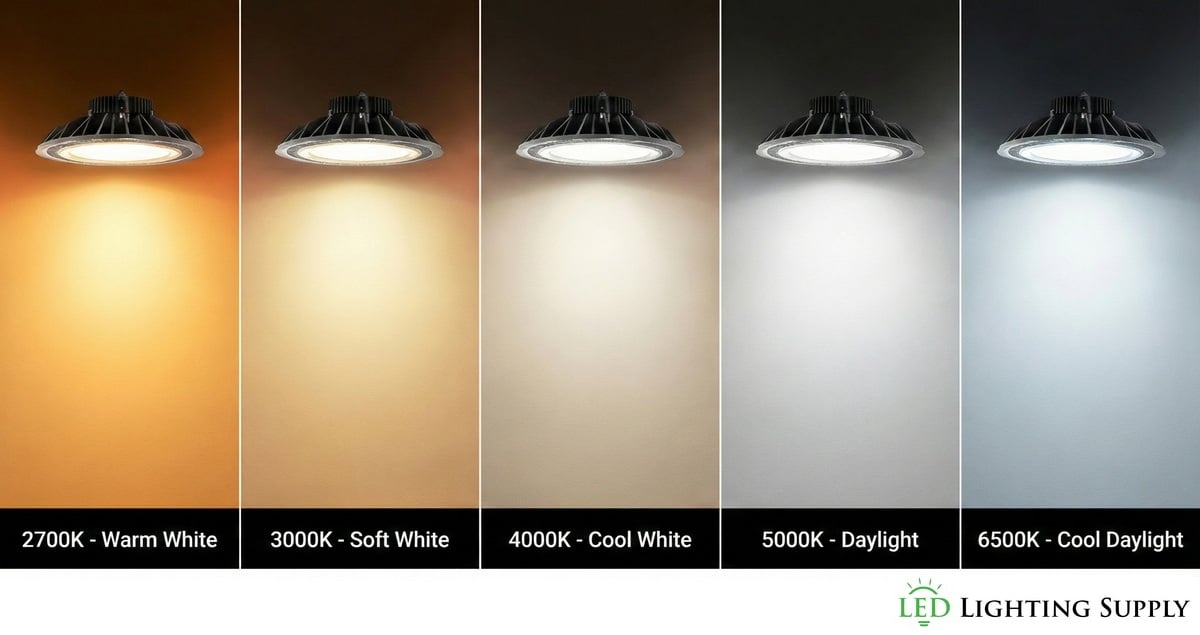
Color temperature describes the hue of light emitted by a theoretical black body radiator heated to specific temperatures, measured in Kelvin (K). Warm light sources have lower Kelvin values, while cool light sources have higher Kelvin values.
Most modern lighting technologies don’t generate light through heated materials. LEDs use semiconductor technology to generate light, and manufacturers tune the output (via phosphors and design) to produce a range of color temperatures.
Correlated Color Temperature (CCT) Explained
LED and other modern lighting sources use Correlated Color Temperature (CCT) for color specification. CCT describes how closely a light source’s chromaticity matches the black body curve on a chromaticity diagram. In short: CCT is the standard way LEDs are labeled as 3000K, 4000K, 5000K, etc., even though LEDs don’t produce light in the same way incandescent filaments do.

Why Color Temperature Selection Matters
Color temperature impacts visual comfort, perceived brightness, and how people experience a space. “Warm” lighting has lower Kelvin temperatures, while “cool” lighting has higher Kelvin values. These terms describe perception-not heat.
Warm lighting is often chosen for comfort-focused environments. Cooler lighting is frequently selected for task visibility and “daylight-like” clarity. Preferences can vary by region, site design goals, and the type of activity the space supports.
The Illuminating Engineering Society (IES) provides guidance on applying color temperature and lighting quality to support visual comfort and task performance in commercial and industrial environments.
Practical CCT Recommendations
- 2700 – 3200K (Warm White): welcoming tone; common for lobbies, hospitality, reception areas, restaurants, and residential-style spaces.
- 3500K (Warm-Neutral): balanced warmth with improved task clarity; often used in retail, corridors, and mixed-use spaces.
- 4000 – 4500K (Neutral White): clean, natural appearance; common in offices, schools, and general commercial lighting.
- 5000 – 5500K (Day White): crisp, high-visibility light; common for warehouses, manufacturing, and many outdoor/parking applications.
- 6000K+ (Cool/Daylight): very bright blue-white; can feel harsh in some settings; used in select color-critical or high-contrast tasks.
Choosing Between Warm and Cool LED Lighting
Most residential and hospitality environments favor warmer CCTs for comfort. Commercial and industrial settings often choose neutral-to-cool CCTs for visibility, focus, and “daytime” clarity. Cooler CCTs are commonly associated with increased alertness during daytime hours, while warmer CCTs are typically preferred for relaxation-oriented spaces in the evening.
For mixed-use sites, it’s common to apply different CCTs by zone – for example, warm in customer-facing areas, neutral in offices, and cooler in task or industrial zones.
Best Color Temperature by Application
Commercial Lighting
- Offices: 4000K (balanced, neutral)
- Retail Stores: 3500 – 4000K (inviting, good color appearance)
- Showrooms: 4000 – 5000K (higher clarity; consider higher CRI)
- Restaurants: 2700 – 3000K (warm, comfortable)
- Hotels: 3000 – 3500K (welcoming tone)
- Schools: 4000 – 5000K (focus, clarity)
- Hospitals: 4000 – 5000K (clean, bright; varies by area)
- Supermarkets: 4000 – 5000K (product visibility)
- Car Dealerships: 5000K (true color display)
- Parking Garages: 4000K (safety, reduced harshness)
Industrial Lighting
- Warehouses: 4000 – 5000K (clear visibility)
- Manufacturing Floors: 5000K (task clarity, safety)
- Machine Shops / Assembly: 5000K (precision work)
- Food Processing: 5000K (sanitation, brightness)
- Cold Storage: 5000K (crisp, efficient light)
Sports Lighting
- Outdoor Fields: 5000K (daylight-like visibility)
- Baseball Fields: 5000K (contrast, ball tracking)
- Football Fields: 5000K (high clarity)
- Tennis Courts: 5000K (contrast, visual tracking)
LED Performance Versus Legacy Technologies
High-pressure sodium lighting typically produces CRI ~20 – 40 with color temperatures around 2000K – 2300K, which can make accurate color identification difficult. Metal halide generally offers better color quality than HPS, but color shift over time is common in some MH systems.
LED fixtures are available in a wide range of CCT and CRI combinations, and they typically maintain a more consistent color appearance across a long operating life. Premium LED options can exceed CRI 90 in many fixture categories when color-critical performance is required.

Expert Support for Your Color Temperature Selection
Selecting the right color temperature requires understanding your facility needs, workflow patterns, occupant preferences, and the visual goals of each area. Our lighting specialists help customers compare options and choose practical CCT and CRI targets for each zone.
We provide energy savings calculations comparing your current lighting system to optimized LED solutions and can support projects with complimentary lighting plans when needed. If you’re upgrading outdoor areas, parking structures, or exterior sites, matching CCT and glare control strategies can be just as important as lumen output.
About The Author
Cory Peterson is Vice President of Marketing & Sales Operations at LED Lighting Supply where he focuses on improving customer experience and revenue operations. Cory writes about commercial & industrial lighting, along with topics important to contractors and facility managers. In his free time, Cory enjoys traveling, snorkeling, exercise and cooking.


