Cleanroom Lighting Requirements: How to Choose the Right LED Fixtures
Cleanroom Lighting Requirements: How to Choose the Right LED Fixtures
Choosing cleanroom lighting starts with understanding what the room needs to protect. A fixture above an inspection bench must provide clear visibility. That same fixture may also need to maintain a sealed ceiling boundary, tolerate repeated disinfection, and allow maintenance without disrupting production.
The right choice depends on the process, ceiling system, cleaning procedure, and visual task. Before comparing wattage or price, establish those requirements with the facility team. Then evaluate fixtures against the documented specification.
What Makes a Light Fixture Suitable for a Cleanroom?
A cleanroom fixture needs to work with the room’s contamination controls. Review how its exposed surfaces can be cleaned, how it seals to the ceiling, and how its materials perform under the facility’s cleaning procedures.
For example, a sealed housing may protect the electrical components while leaving a gap between the fixture frame and ceiling. That installation detail matters when the ceiling forms part of the room’s pressure boundary. Evaluate the complete installed assembly, including the frame, gaskets, mounting hardware, and ceiling connection.
Standard office panels and general-purpose vapor tight lights should only be considered where their documented construction and installation details meet the room specification. Similar dimensions or appearance do not establish equivalent performance.
Cleanroom Classification and Fixture Ratings Serve Different Purposes
ISO 14644-1 classifies air cleanliness by airborne particle concentration. It does not establish a universal lighting level or certify an individual fixture. Selecting a light described as suitable for an ISO-classified space does not, by itself, establish that the completed room meets its classification.
For sterile pharmaceutical and cleanroom lighting projects, EU GMP Annex 1 also addresses cleanroom grades and contamination control. ISO classes and GMP grades should not be treated as interchangeable labels. Start with the facility’s actual requirements and the conditions under which the room will be qualified.
| Rating or Standard | What to Review |
|---|---|
| ISO 14644-1 | Room air cleanliness classification. Review fixture suitability within the complete room design. |
| NSF P442 | Controlled-environment fixture certification covering sanitation-related construction, dust and water protection, and pressure testing. |
| NSF/ANSI 2 | Sanitation requirements for food equipment, including applicable lighting uses. This listing alone does not establish NSF P442 certification. |
| IP rating | Enclosure protection against solids and water under defined tests. Review chemical compatibility and ceiling sealing separately. |
| Hazardous-location approval | Suitability for the classified hazard. Cleanability or ingress protection does not establish this approval. |
NSF explains that P442 combines sanitation testing drawn from NSF/ANSI 2, dust and water protection testing, and pressure testing. Where a project specifies P442, verify the exact model and configuration against the certification listing.
Match the Fixture to the Ceiling and Cleaning Procedure
Coordinate fixture selection with the ceiling layout early. Lights compete for space with filters, air supplies, and other services. Recessed fixtures, surface-mounted fixtures, and fixtures designed for cleanroom grids have different installation requirements.
Review these details before ordering:
- Ceiling connection: Confirm grid dimensions, panel thickness, opening size, flange design, and the specified sealing method.
- Exposed surfaces: Look for accessible, cleanable surfaces and details that limit particle accumulation around edges, fasteners, and lens frames.
- Cleaning compatibility: Check the housing, lens, coating, gasket, and hardware against the actual cleaners and disinfectants used.
- Airflow coordination: Review fixture locations with the cleanroom designer so the layout works with filtration and air distribution.
IP65 indicates dust-tight construction and protection against water jets under the applicable test conditions. It is not a universal minimum for every cleanroom, nor does it establish resistance to every cleaning method. A room cleaned by wiping has different exposure conditions from an area subjected to hot, high-pressure washdown.
Give the manufacturer the cleaning chemical, concentration, temperature, and exposure frequency. A high IP rating alone cannot tell you whether a lens will haze or a gasket will deteriorate under repeated chemical exposure.
How Much Light Does a Cleanroom Need?
Set light levels around the work being performed. Reading labels, assembling small components, inspecting surfaces, and moving materials can require different lighting conditions within the same facility.
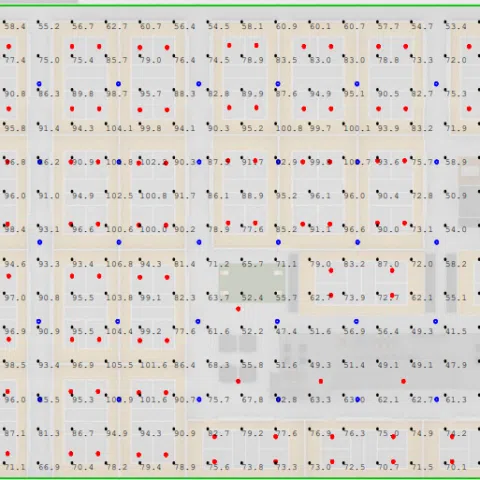
Specify illuminance in foot-candles or lux at the relevant work surface. Then use a photometric lighting plan to evaluate fixture output, placement, and distribution. A floor-level average does not establish the light available on a raised bench or vertical inspection surface.
Include equipment and workstation locations in the layout. A bright room can still have poor visibility where machinery blocks overhead light or an operator casts a shadow over the task. Review minimum light levels and uniformity alongside the average.
Color Quality and Glare Affect Inspection
Color temperature describes the appearance of white light; it does not tell you how bright a fixture is or how accurately it renders colors. Options such as 4000K and 5000K should be evaluated against the task and facility preference.
Where staff compare colors or inspect subtle defects, establish the required color rendering and viewing conditions. Also check reflections on stainless steel, glass, glossy components, and screens. More light can make those reflections worse. The review should include optics, diffusion, and fixture placement.
When Does a Cleanroom Need Specialized Light Output?
Some processes require control over the wavelengths reaching the product. Amber lighting may be used around photosensitive materials, but the visible color of a light is not enough to establish process compatibility.
For photolithography, obtain the photoresist supplier’s lighting restrictions and compare them with the fixture’s spectral output. Review exposure intensity and duration as well as wavelength. For pharmaceutical materials, follow the product’s established light-exposure limits. A UV-free source may still emit visible wavelengths that affect a sensitive material.
Animal research facilities also need lighting matched to the research protocol. Red light should not be assumed to be biologically invisible to every species. Have the research team establish the spectrum, intensity, timing, and permitted exposure.
Plan for Maintenance Before Installation
A driver replacement can involve more than the repair itself. Entering the room, accessing the ceiling, cleaning afterward, and completing the facility’s release procedures can affect the maintenance schedule.
Determine whether service will take place from inside the cleanroom or from an accessible space above it. Check which seals must be disturbed, which components are replaceable, and how the fixture will be resealed. Top-access designs can be useful where the building provides a suitable service area; the access arrangement must fit the actual ceiling construction.
Also confirm voltage, ambient operating limits, dimming compatibility, and any emergency-lighting requirements. Compare energy use using the proposed fixture count, input watts, and operating hours. Evaluate expected maintenance access alongside the initial equipment price.
Does a Cleanroom Need Hazardous-Location Lighting?
That depends on the materials and process. A room containing flammable vapors or combustible dust may require explosion-proof lighting approved for a classified location in addition to its cleanroom requirements.
OSHA requires hazardous-location equipment to be suitable for the applicable hazard. Have the project electrical professional establish the classification and required approval, including the relevant Class, Division or Zone, material Group, temperature limits, and installation requirements. A vapor tight or NSF-certified fixture does not automatically meet those requirements.
Get Help Comparing Cleanroom Lighting Options
Send LED Lighting Supply your room dimensions, ceiling details, task locations, target light levels, cleaning procedure, and required fixture ratings. Include any spectral restrictions or maintenance-access requirements.
Our Product Specialists can help compare published fixture specifications and lighting layouts against your project requirements. The facility’s cleanroom design and quality teams should establish the contamination-control and qualification requirements so product selection supports the approved room design.
Cleanroom Lighting FAQs
Can I Use a Standard LED Panel in a Cleanroom?
Only if its documented construction, mounting, sealing, materials, and maintenance arrangement meet the room specification. Fitting the ceiling opening does not establish suitability.
Does IP65 Mean a Fixture Is Cleanroom Certified?
No. IP65 describes dust and water ingress protection under defined tests. It does not establish cleanroom classification, chemical resistance, pressure-boundary performance, or NSF P442 certification.
Is 5000K Required for Cleanroom Lighting?
No single color temperature fits every cleanroom task. Select white-light color temperature and color rendering for the work, and use a verified spectral specification where the process is light-sensitive.
Will a Lighting Plan Confirm Cleanroom Compliance?
A photometric plan evaluates predicted light levels and distribution. Room qualification also involves the facility’s contamination controls, construction, operation, and testing.