Microwave vs PIR Motion Sensors: Which is Better?
Lighting controls extend beyond basic dimmers and timers to include sensor technologies that automate lighting operation. Two common control types are photosensors, which respond to ambient light levels, and occupancy or motion sensors, which detect movement or occupancy-related activity.
Photosensors can control outdoor lighting based on available daylight, typically switching or dimming fixtures at dusk and dawn. Properly selected and commissioned controls can reduce unnecessary operating hours while supporting consistent nighttime illumination.
Motion sensors detect movement within a defined detection area to control LED high bays, low bays, and other fixtures. Depending on the sensor type and control settings, they can switch lights on and off or reduce output when an area is vacant.
When properly designed for the space, occupancy and motion controls can reduce lighting energy use by limiting full-output operation to periods when light is needed. Actual savings depend on operating schedules, daylight availability, sensor settings, fixture output, occupant behavior, and the application.
Two common technologies used for occupancy and motion detection are PIR (passive infrared) sensors and microwave sensors. Each has advantages and limitations that should be evaluated for the specific installation.
How Microwave Motion Sensors Work
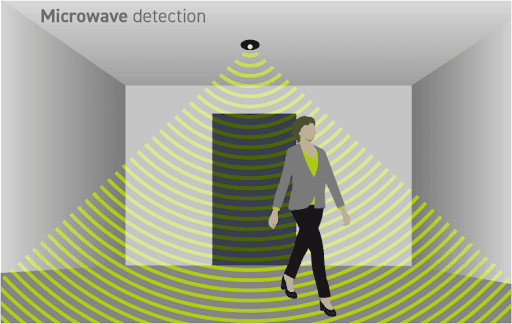
Microwave sensors emit low-power radio-frequency energy – commonly 5.8 GHz in many lighting-control products – and analyze reflections from objects within the sensing area. The sensor establishes a reflected-signal pattern for the space and looks for changes caused by movement.
When a person or object moves, it changes the frequency and phase of the reflected microwave signal. This Doppler effect can trigger the sensor to operate connected lighting or controls. Detection performance depends on the sensor design, sensitivity setting, mounting location, nearby materials, and movement within the coverage area.
The sensor generally responds to changes in reflected signals:
- Stable Reflections: Stationary surfaces and objects produce relatively stable reflected signals, and the sensor normally remains in its inactive state.
- Changing Reflections: Movement changes the reflected signal pattern, including its Doppler frequency characteristics, which can trigger the sensor when the change exceeds its detection threshold.
Some microwave sensors provide adjustable sensitivity, hold time, and daylight settings. Features such as direction detection, pet filtering, and coverage pattern vary by model and should be verified in the manufacturer specifications.
How PIR Motion Sensors Work
PIR (Passive Infrared) sensors detect changes in infrared energy from warm objects, including people and animals. Their core component is a pyroelectric sensor that converts changing infrared radiation into electrical signals.
PIR sensors commonly contain multiple pyroelectric sensing elements and use a Fresnel lens to divide the monitored area into detection zones. Movement across these zones produces changing infrared signals that the sensor can recognize.

Because PIR sensors respond to changes in infrared energy, they generally detect movement across their detection zones more effectively than a person moving directly toward or away from the sensor. Sensor placement, lens pattern, mounting height, and obstructions affect performance.
PIR sensors are passive devices: they do not transmit a detection signal. After activation, the connected control typically follows its programmed hold time before reducing or switching off lighting if no additional qualifying movement is detected.
Comparative Analysis: Microwave vs PIR Motion Sensors
Microwave Motion Sensor Advantages and Limitations
- Sensitivity to Small Movement: Microwave sensors can detect subtle movement, which can be useful where occupants may remain relatively still.
- Less Dependent on Thermal Contrast: Detection is not based on a person’s infrared signature, although real-world performance still depends on the installation environment and sensor settings.
- Potential Barrier Penetration: Some microwave signals may pass through certain nonmetallic materials, such as glass or lightweight partitions. This can be useful in limited applications but can also cause unwanted activations outside the intended area.
- Coverage Options: Coverage pattern and range vary by sensor model, mounting height, sensitivity setting, and surrounding construction. Verify the published coverage information for the exact sensor.
- Limitation – Nuisance Activation Risk: Sensors may respond to movement outside the intended space or to moving equipment, vehicles, fans, or other sources of changing reflections if not positioned and adjusted carefully.
- Limitation – Material Effects: Metal blocks or reflects microwave signals, and dense materials such as concrete can substantially attenuate them. Microwave detection through walls, floors, or barriers should not be assumed.
PIR Motion Sensor Advantages and Limitations
- Low Sensor Power Use: PIR sensors use little power and are commonly used in battery-powered and line-voltage control products.
- Passive Detection: PIR sensors do not emit radio-frequency energy as part of their detection method.
- Cost-Effective: PIR sensors are widely available and can provide reliable detection in appropriately defined spaces.
- Defined Coverage: PIR detection generally requires an unobstructed view of the monitored area, which can help limit detection to the intended space.
- Limitation – Environmental Effects: Performance can be affected by thermal conditions, direct sunlight, HVAC discharge, heat sources, and reduced contrast between a person and the background environment.
- Limitation – Line of Sight: PIR sensors cannot detect movement through solid barriers and may not detect occupants who remain still for extended periods.
Application Guidelines for Sensor Selection
Common Microwave Sensor Applications
- Warehouses and Industrial Facilities: Areas where small movement detection may be useful, and sensor placement can be evaluated with the actual ceiling height, rack layout, equipment, and traffic patterns.
- Parking Structures: Open parking areas where the sensor’s published coverage pattern can be contained within the intended zone and adjusted to avoid adjacent traffic areas.
- Security Lighting: Perimeter or access-area lighting where sensitivity, aiming, and detection boundaries are carefully set to minimize unwanted activation.
- Irregularly Shaped Spaces: Spaces that may benefit from microwave sensing, provided nearby rooms, corridors, exterior traffic, and barriers are considered during layout and commissioning.
- Suitable Applications May Include: Loading docks, open storage areas, and spaces with movable partitions, depending on the sensor model and site conditions.
Common PIR Sensor Applications
- Office Spaces: Individual rooms, cubicles, and defined work areas with clear sensor sightlines.
- Corridors and Hallways: Linear spaces when the selected sensor’s lens pattern and mounting location provide adequate detection for the expected direction of travel.
- Restrooms and Small Rooms: Enclosed spaces where the sensor can view likely occupant movement without obstructions.
- Stairwells: Vertical circulation areas when coverage is designed around landings, sightlines, and the selected sensor’s rated pattern.
- Suitable Applications May Include: Private offices, conference rooms, storage closets, and residential rooms.
Selection Criteria and Installation Considerations
Choose sensors based on the actual mounting height, room geometry, occupancy type, movement patterns, obstructions, environmental conditions, and required control sequence. Published mounting-height and coverage limits vary by model. For larger spaces, high-bay installations, aisles, or complex layouts, use the manufacturer’s coverage data and, where appropriate, a fixture-specific lighting and controls plan.
Local energy codes may require occupancy, vacancy, daylight-responsive, or other lighting controls in certain spaces. The applicable requirements depend on the adopted code, building type, space use, and local authority having jurisdiction.
Professional installation helps ensure suitable placement, proper electrical connections, adjustment, and commissioning. Lighting controls integration may require programming and commissioning for multi-zone applications.
Safety Notice: Motion sensor installation involves electrical connections that should be performed by qualified electricians in accordance with applicable electrical codes. Always disconnect power before installation and verify proper operation after completion.
Conclusion
Motion sensors can provide energy and operational benefits for residential and commercial lighting when they are selected and commissioned for the application. PIR sensors are often a cost-effective choice for defined spaces with clear sightlines, while microwave sensors can provide sensitive movement detection in suitable environments.
Neither technology is universally better. Proper sensor selection depends on the coverage requirement, room construction, environmental conditions, control objectives, and budget. Reviewing the exact sensor specifications and planning placement around actual site conditions helps achieve reliable motion-controlled lighting in new construction and retrofit projects.