Buyers Guide to LED Warehouse Lighting
Commercial and industrial warehouses across the nation are reducing energy use by upgrading to LED lights for warehouses. Over my 15+ years in commercial lighting, I’ve seen how properly selected fixtures can reduce energy consumption, lower maintenance needs, provide strong light output, and improve illumination uniformity. Warehouses may reduce operating costs by transitioning from traditional lighting systems to energy-efficient LED high bay systems.
The U.S. Department of Energy’s solid-state lighting program notes that LEDs can use substantially less energy than many conventional lighting technologies. Actual energy savings versus metal halide, high-pressure sodium, fluorescent, or other existing systems depend on the existing wattage, LED fixture efficacy, operating hours, controls, and the photometric design.
Beyond lower energy bills, LED warehouse fixtures can reduce relamping and ballast-maintenance needs compared with legacy HID and fluorescent systems. Warehouse lighting solutions are available to replace metal halide, fluorescent, halogen, and incandescent fixtures throughout warehouse environments. Large warehouse spaces with high ceilings present unique lighting challenges, and fixture output and distribution must be selected to provide the required illumination at the work surface.
Warehouse Lighting Selection Checklist
- Target foot-candles by task (picking, aisles, docks, etc.)
- Mounting height and spacing constraints
- Fixture type: UFO vs Linear (and where each fits)
- Beam angle/optics for open areas vs racking aisles
- Controls: 0-10V dimming, occupancy sensing, and daylight harvesting where appropriate
- Environment: IP rating for anticipated dust and water exposure; temperature limits and materials for the environment
- Impact risk: IK rating where impact protection is specified
- Certifications & warranty: electrical safety listing, DLC qualification where applicable, and support terms
Warehouse Lighting Buyer’s Guide: How to Choose the Right System
This buyer’s guide walks warehouse managers, facility engineers, and contractors through key decisions for selecting an LED warehouse lighting system – from light levels and fixture types to controls, environmental considerations, and long-term energy savings.

Starting with a Professional Lighting Plan
Complimentary Warehouse Lighting Design Services
Creating a comprehensive lighting plan should be a priority before purchasing LED fixtures. Different warehouse spaces can require different lighting solutions based on operations, ceiling heights, rack layouts, surface reflectances, daylight contribution, and work requirements. No two facilities share identical requirements, making proper planning important. Overlighting, insufficient illumination, glare, and uneven coverage can create operational problems. A lighting plan using fixture-specific photometric data helps identify appropriate fixture quantities, output, optics, and placement.
Professional lighting designers often reference the Illuminating Engineering Society (IES) recommended practices when developing warehouse lighting plans. These resources provide guidance for illumination, uniformity, visual conditions, and application-specific design considerations.
Case Study: Conversion of (72) T5 6 tube fixtures to LED Lighting Supply 200 Watt LED UFO Fixtures (one-for-one replacement) in Williston, ND
|
Before: T5 54W HO Fluorescent Fixtures |
After: 200 W LED UFO Fixtures |
 |
 |
Lighting Plan We Created for the Customer
|
Lighting Plan |
Heat Map |
 |
 |
LED High Bays Warehouse Installation Lighting Plan Metrics
- Mounting height: 20 ft
- Fixture Used: MLLG-LED-HBC-200-5-120: 100 / 120 / 150 / 200 Watt Adjustable LED UFO High Bay | 15000 to 30000 Lumens | 5000K | 100-277V | White Housing
- FC achieved: 60.33 FC average
- Uniformity (Avg/Min): 1.42
Tatsumi Intermodal U.S.A. Inc.’s Linear High Bay Warehouse Lighting Case Study
The Backstory
Tatsumi Intermodal U.S.A. Inc. faced challenges with consistent and effective lighting throughout its warehouse areas. They were operating with a legacy fluorescent lighting system that consumed excess energy while producing minimal brightness. Tatsumi approached LED Lighting Supply to provide a custom-tailored lighting solution that aligns with OSHA (Occupational Safety and Health Administration) requirements.
The Customer's Challenge
The facility consists of three separate warehouse spaces with 300 fluorescent fixtures. Each section required a lighting solution that would increase overall brightness levels to meet OSHA illumination standards while preserving the existing wiring system. The fluorescent lights were only producing about 20 foot candles (fc) across each warehouse floor section. Proper lighting levels for a warehouse environment typically fall between 40 and 60 fc, depending on the space dimensions.
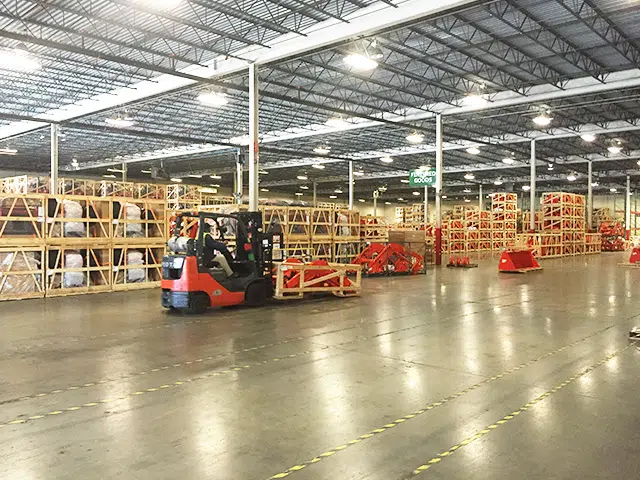
Lighting plan metrics:
- Product(s) Used: MLLG-X-LED-HBLIN6-(240/270/310)-CC-[V]
Calculating Fixture Requirements
Existing mounting locations may be usable when their spacing, mounting height, wiring condition, and fixture photometrics support the required light levels and uniformity. New construction projects benefit from custom lighting plans that demonstrate calculated illumination levels, uniformity, fixture quantities, and placement positions. Our design team can prepare lighting plans using application information and fixture-specific photometric data.
Eliminating Purchase Uncertainty
We’ve completed thousands of complimentary warehouse lighting plans using available LED fixtures to address diverse requirements and budgets. Our warehouse maintains inventory ready for shipment. This approach can help move a project from lighting-plan review to fixture delivery and installation efficiently.

Establishing Required Light Levels
Understanding the required illumination level is one of the most important selection factors. Do not begin fixture selection by assuming a specific wattage. Focus on target illuminance at the relevant work plane, then select fixtures based on mounting height, spacing, optics, reflectances, obstructions, and desired uniformity.
Mounting height affects the output and distribution required to achieve a given ground-level or work-plane illuminance, but there is no universal lumen requirement by mounting height. A fixture-specific photometric lighting plan is the reliable way to determine fixture quantity, lumen package, optic, and layout.
Recommended Foot-Candle Levels for Warehouse Areas
| Task / Area | Typical Design Range |
|---|---|
| Warehousing – Inactive Area | 5-10 fc |
| Warehousing – Active – Large Items | 10-20 fc |
| Warehousing – Active – Small Items | 15-60 fc |
| Warehousing – Active – Medium Items | Approximately 20 fc |
| Warehousing – Active – Fine Items | 20-50 fc |
| Shipping and Receiving Area | Approximately 30 fc |
| Receiving and Shipping Dock | 5-20 fc |
| Receiving and Staging | 15-60 fc |
| Maintenance and Shop Areas | Approximately 50 fc |
| Cold Storage | 10-30 fc |
| Open Warehouse | 10-30 fc |
| Warehouse with Aisles | 10-30 fc |
These are typical planning ranges, not universal code requirements. The appropriate target depends on the work performed, item size, contrast, worker age, equipment traffic, applicable safety requirements, and the authority having jurisdiction where applicable.
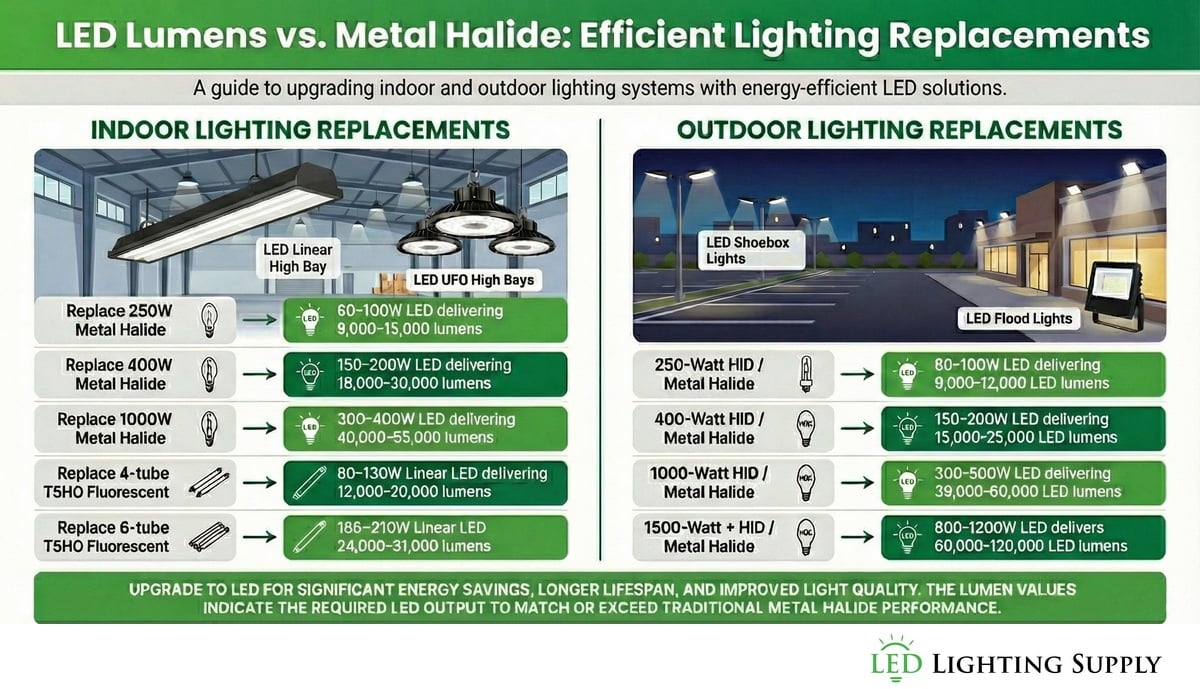
To explore available fixture options after reviewing this guide, visit our full selection of LED warehouse lighting designed for industrial and commercial facilities.
Selecting the Optimal LED Warehouse Fixture Type
Warehouse applications commonly use two fixture categories: Linear LED high bay lights (panel-style fixtures) and UFO LED high bay lights (compact, round fixtures). Linear high bays are often selected as replacements for fluorescent T8 and T5 HO systems, while UFO high bays are commonly used in open warehouse spaces and higher mounting applications. The best choice depends on the facility layout, mounting height, desired distribution, environment, and impact exposure.

UFO Round Fixtures – Metal Halide Replacement Option
UFO fixtures can provide compact replacements for metal halide and high-pressure sodium systems. They are frequently used in warehouses and gyms. Environmental ratings, impact ratings, available optics, voltage range, controls, and mounting options vary by model and should be verified on the exact product specification sheet.
- Available Wattages: Vary by model
- Light Output: Vary by model and selected wattage
- Efficiency: Compare published lumens per watt for the exact fixture
- Replacement: Select based on photometric performance rather than a one-for-one wattage comparison
- Color Temperatures: Commonly available in 4000K and 5000K, depending on model
- Color Quality: Often 70 CRI or higher, depending on model
- Weather Protection: Many models are IP65 rated; verify the exact model and installation requirements
- Voltage Compatibility: Common driver options include 100V-277V or 277V-480V, depending on model
- Impact Resistance: Available on selected models; verify the published IK rating
- Installation Options: Eye hook, pendant, surface, or other options depending on model
- Available Features: Surge protection, motion sensors, and controls on compatible models
For commercial LED products used in warehouse applications, the Design Lights Consortium (DLC) maintains performance and efficiency qualification programs for eligible products. DLC qualification is not an electrical safety certification. Electrical safety listings should be verified separately; UL and Intertek ETL are examples of U.S. Nationally Recognized Testing Laboratory (NRTL) certification marks.

Linear Panel Fixtures – Fluorescent Replacement Option
Linear fixtures can work well in gyms and warehouses and are often selected to replace T5 and T8-style high bay systems. Do not assume all linear fixtures are dry-location-only or lack impact protection; wet-location and impact ratings vary by product. Verify the exact fixture’s IP rating, IK rating, mounting method, and environmental suitability before installation.
- Available Wattages: Vary by model
- Light Output: Vary by model and selected wattage
- Efficiency: Compare published lumens per watt for the exact fixture
- Replacement: Select based on the lighting plan and photometric performance
- Color Temperatures: Commonly 4000K or 5000K, depending on model
- Color Quality: Often 70 CRI or higher, depending on model
- Weather Protection: Available on selected models only
- Voltage Compatibility: Verify the driver range for the selected model
- Installation Options: Pendant, cable, ceiling, or surface mounting depending on model
- Available Features: Surge protection, sensors, and control options on compatible models

Maximizing Energy Savings Through LED Efficiency
Efficacy measures how effectively a luminaire converts electrical power into light and is expressed as lumens per watt on specification sheets. You can calculate efficacy by dividing lumens by watts when both values are published. For fixtures delivering similar total lumens, a higher-efficacy fixture generally uses less power. However, lumens alone do not determine delivered foot-candles; fixture optics and photometric distribution determine where the light goes.
Consider this comparison:
- A 300-Watt LED at 150 lumens/watt produces 45,000 lumens
- A 500-Watt LED at 90 lumens/watt also produces 45,000 lumens
- The 300-Watt fixture uses 200 fewer watts per operating hour, before considering differences in optics, controls, and delivered illumination
Investment Returns from Efficient Warehouse Lighting
Higher-efficacy warehouse fixtures may have a higher initial cost, but they can reduce energy use when they provide the required lighting performance. Evaluate lifecycle cost using fixture cost, installed cost, operating hours, utility rate, maintenance expectations, controls, and the photometric design rather than relying on wattage alone.
Understanding Voltage Requirements
Commercial and industrial facilities commonly use nominal supply voltages such as 120/208V, 120/240V, 277/480V, and other service configurations. LED fixtures are available with drivers designed for specific voltage ranges. Verify the building voltage, phase, branch circuit, driver input range, and installation requirements before ordering.
Common LED driver voltage ranges include:
- 100V-277V
- 277V-480V
Many LED drivers automatically operate across their listed input-voltage range, but this capability is model-specific. No field voltage adjustment is normally required only when the supplied voltage falls within the exact driver’s published operating range.
Optimal Color Temperature Selection for Warehouse Applications
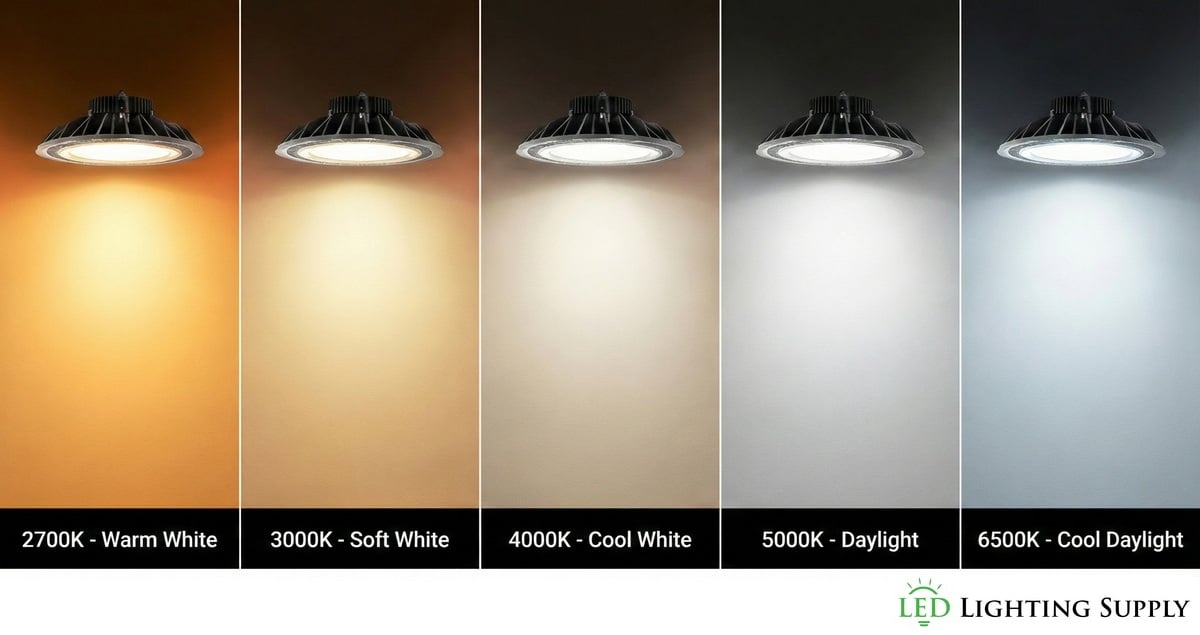
Color temperature uses the Kelvin scale, where lower numbers generally appear warmer and higher numbers generally appear cooler. CCT describes the apparent color of white light; it does not measure brightness, color rendering, efficacy, or productivity.
- 4000K is commonly used where a more neutral white appearance is preferred.
- 5000K is commonly used in industrial and warehouse applications where a cooler white appearance is preferred.
Both 4000K and 5000K can be suitable for warehouse lighting. Select CCT based on occupant preference, the visual environment, existing lighting, and the application rather than assuming one color temperature provides universally better performance.
Color Rendering Requirements for Warehouse Lighting
CRI represents the Color Rendering Index, a measure of how faithfully a light source renders colors compared with a reference source. CRI does not determine brightness or the foot-candle level required for a task.
Many general warehouse applications use fixtures rated at 70 CRI or higher. Higher CRI may be appropriate when workers must distinguish product colors, labels, wiring, safety markings, or material condition. Required illuminance should still be established independently through the task requirements and a photometric lighting plan.

Implementing Light Controls and Motion Sensor Technology
Light controls enable automated lighting management. Occupancy sensors, vacancy sensors, scheduling, and daylight-responsive controls can reduce energy use when properly selected, commissioned, and matched to warehouse operations.
Occupancy sensors may turn fixtures off or reduce them to a lower level after a programmed delay when an area is unoccupied. Sensor coverage, detection sensitivity, equipment movement, safety needs, and worker activity should be considered to avoid nuisance shutoffs or inadequate light during active work.
0-10V dimmable drivers are commonly used when a control system requires 0-10V dimming, but not every motion sensor or control strategy requires this interface. Confirm compatibility among the fixture driver, sensor, control wiring, and desired dimming behavior.
Minimum dimming levels vary by driver. Some drivers dim to 10% or another specified level rather than turning completely off. Specify dimming and controls based on the intended operating sequence and the exact fixture specifications.
Case Study: Installation of new LED Lighting for Stone Basyx in Charlotte, NC
|
After: 150 Watt High Output UFO High Bay | 24000 Lumens |
 |
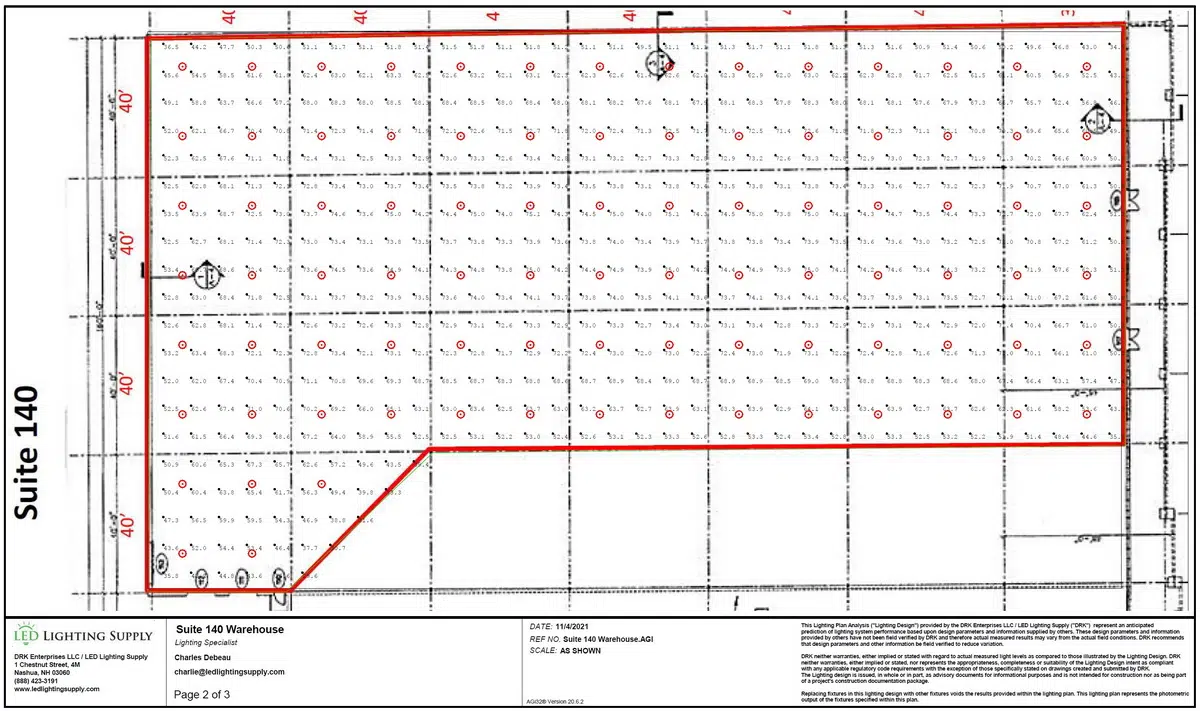
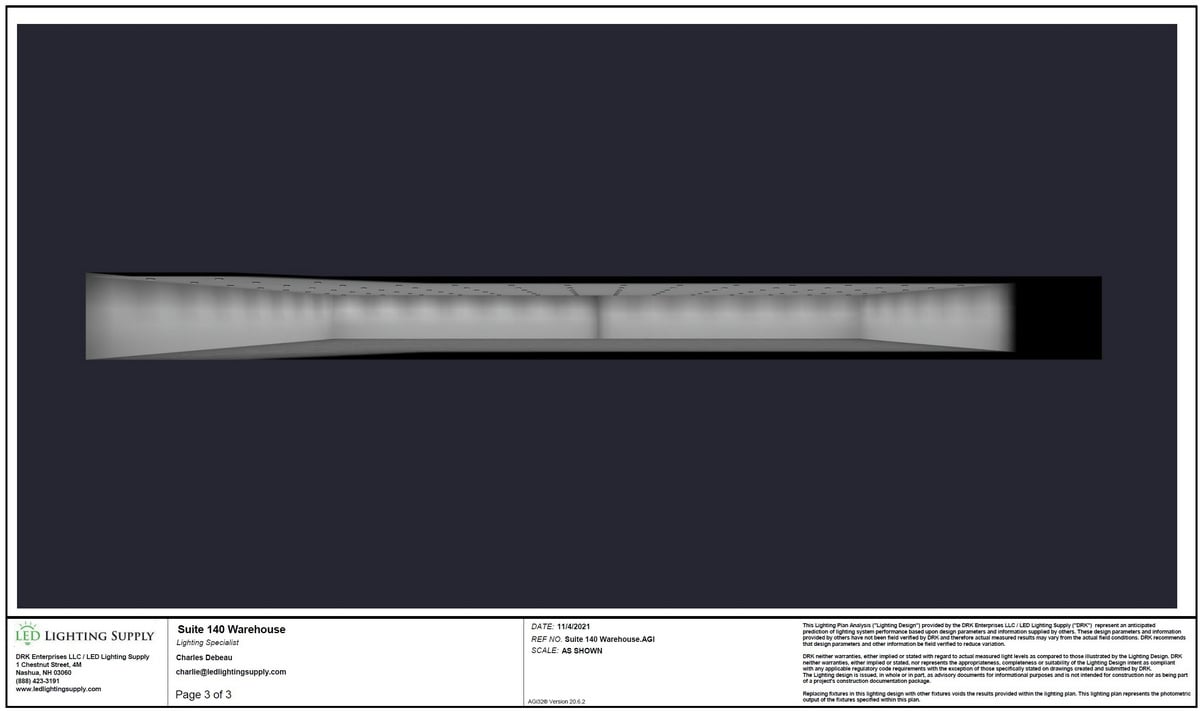
Lighting Plan We Created for the Customer
|
Lighting Plan |
Heat Map |
 |
 |
Warehouse / Retail Lighting Installation Plan Metrics
- Mounting height: 23 ft
- Fixture Used: MLLG-LED-HBHO-150-5-120: 80 / 100 / 120 / 150 Watt Adjustable UFO High Bay | 16000 to 30000 Lumens | 5000K | 100-277V | High Performance
- FC achieved: 65.36 FC average
- Uniformity (Avg/Min): 2.21
Impact Resistance for Warehouse Operations
Warehouse operations can expose fixtures to impacts from material-handling equipment or other activity. IK ratings from IK01 to IK10 classify resistance to specified mechanical impacts, with IK10 representing the highest level in the IK scale. Where impact resistance is needed, verify the fixture’s published IK rating, mounting method, location, and any protective-guard requirements. UFO fixtures may offer compact construction and impact-rated options, depending on model.
Wet Location Lighting Requirements
Fixtures installed in areas exposed to moisture should be selected for the actual environmental exposure and installed according to their listing and manufacturer instructions. An IP65 rating means the enclosure is dust-tight and protected against water jets; it does not by itself establish wet-location listing, chemical resistance, sanitation suitability, or hazardous-location approval. For more severe washdown exposure, IP66, IP69, or IP69K ratings may be relevant depending on the applicable standard and the specific washdown conditions.
Verify materials, coatings, seals, hardware, ambient-temperature limits, and manufacturer documentation separately where cleaning chemicals, corrosion, cold storage, or high-temperature washdown are present. UFO fixtures and LED NSF rated lights may offer ratings suitable for particular wet or food-processing applications, but suitability must be confirmed for the exact model and environment. Most linear fixtures are not automatically wet-location rated, although rated models are available.
Workplace lighting should provide adequate illumination for the tasks being performed and comply with applicable workplace and electrical requirements. OSHA requirements, local codes, the electrical professional, and the authority having jurisdiction may apply to a specific facility.
Why Warehouse Lighting Experts Trust LED Lighting Supply
As a company specializing in LED technology, we’ve completed over 20,000 commercial lighting projects across diverse warehouse applications. Our team can prepare energy-use comparisons based on the existing fixtures, proposed fixtures, operating schedules, and customer-supplied utility rates. Actual energy savings depend on project conditions, operating hours, controls, and installed equipment.
We offer commercial-grade fixtures for demanding warehouse environments. Our product specialists work with facility managers to review lighting requirements, fixture specifications, photometric files, dimensions, weights, available certifications, and product options. Final electrical installation, code compliance, and site-specific design decisions remain the responsibility of qualified professionals and the applicable project authority.