USCGC Vessel Projects Supplied:
3Average Foot Candles Achieved:
18 fcThe Backstory of the First USCGC Project
The first contact came from an Electrician's Mate aboard the USCGC Thetis seeking support in a marine-grade floodlight solution. Electrician’s Mates are the USCG sailors responsible for ship lighting, power distribution, and electrical machinery. The customer was sourcing a low-maintenance lighting solution the crew could install on the ship.
The Electrician's Mate on the ship performed the installation. LED Lighting Supply's role involved consultative guidance and access to specialty light fixture options. On a military vessel, working floodlights operate only during specific operations and remain off the rest of the time. Working deck operations like helicopter launches, boat launches, boardings, and underway replenishment all require high-intensity lighting to transfer cargo or fuel safely.
The USCGC Thetis crew required a heavy-duty marine-grade lighting solution for the working deck. It needed to deliver consistent light levels for on-demand military operations without interfering with the ship's main navigation lights at night.
The Challenge of Lighting a USCGC Deck
Two main constraints shaped the project. The first was the harsh exterior environment. Ship deck lighting on a Famous-class medium-endurance cutter is subject to continuous salt spray, vibrations, and wash-downs. The second was the existing lighting. The working deck area had inadequate light levels, creating unsafe conditions for the crew. USCGC Thetis needed a light fixture with a marine-grade finish to ensure it performed effectively in the harsh environment.
The ship must return to the port before a light fixture can be replaced. Because of this, cutter lighting installation work is performed during scheduled in-port maintenance periods. Missing the deadline means the project slips to the next maintenance window, which could be months out.
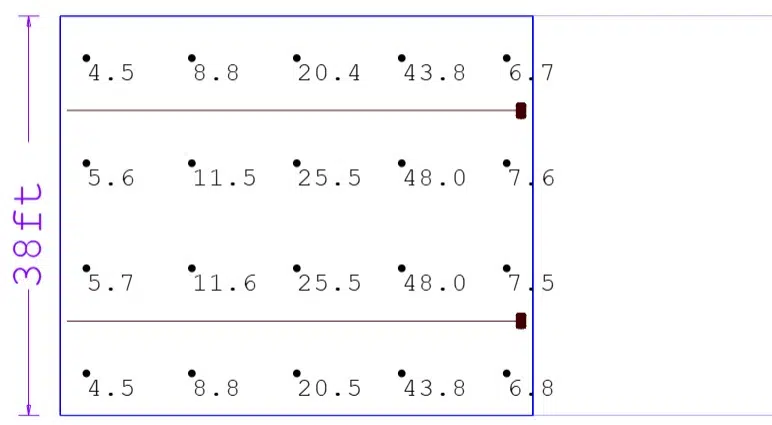
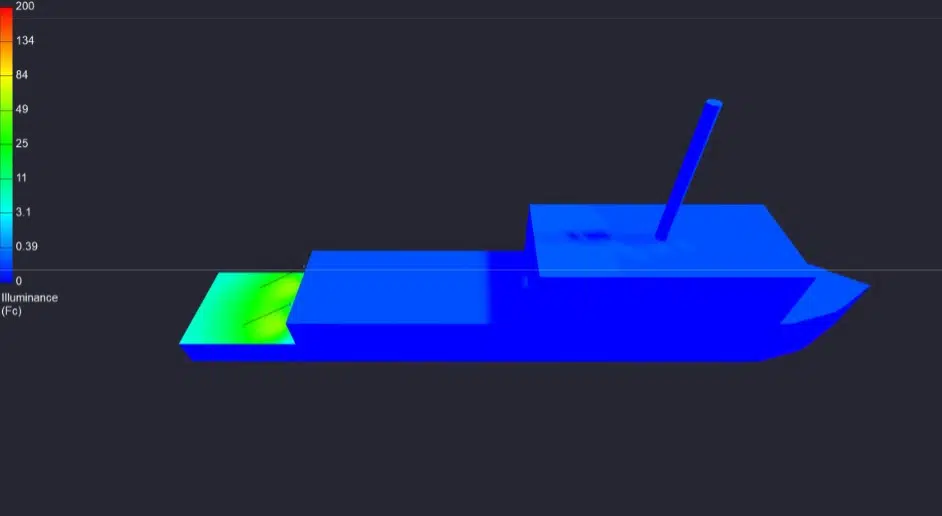
Sample Lighting Plan Created for USCGC Thetis
Lighting Plan Metrics:
- Mounting Height: 25 feet
- Foot Candles Achieved: 18 fc
- Uniformity (Min/Max fc): 10.67
- Photometric Lighting Plan Note: This sample plan was created to validate light levels with the lights installed.
- Product(s) Used: MLLG-AG-LED-IMF-200-5-[Optic]-TR-[V]
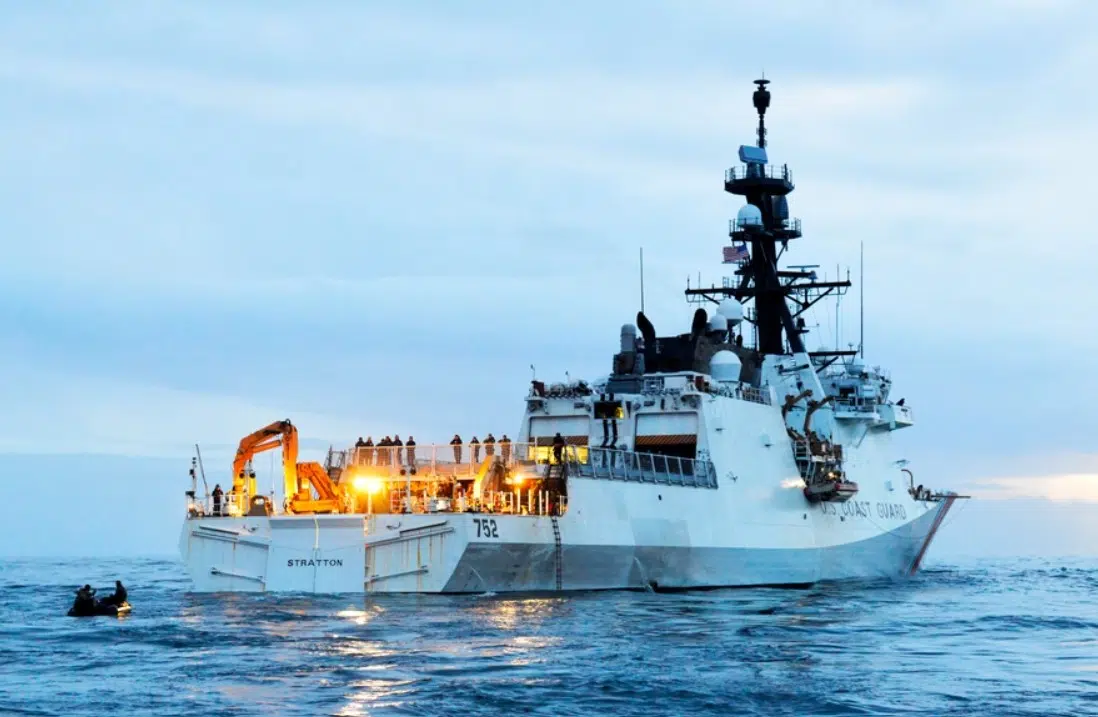
Before Our Solution: Image of USCGC Stratton (WMSL 752) With Metal Halide Lighting
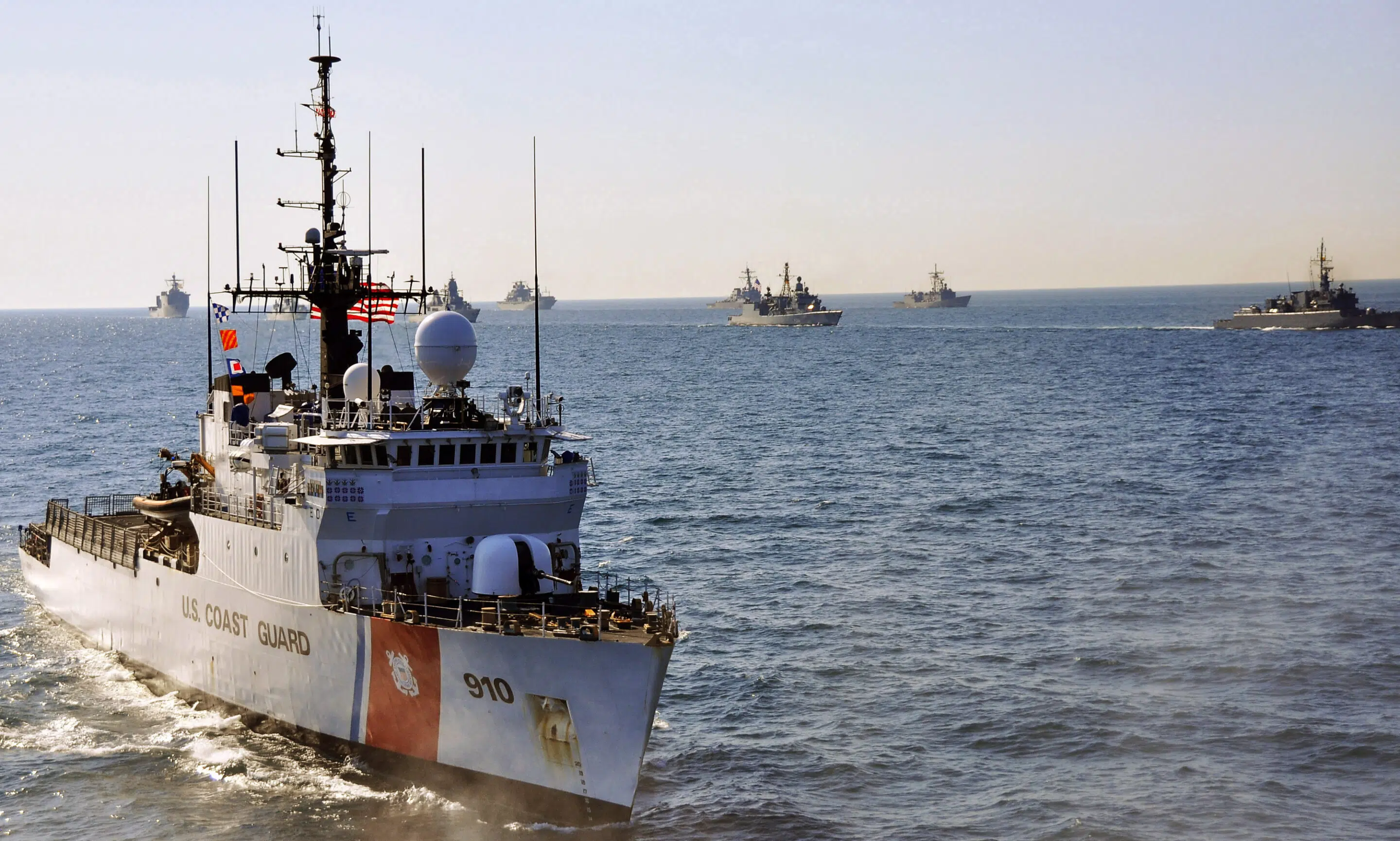
Image of USCGC Thetis (WMEC 910)
Risks of Inadequate Deck Lighting Aboard a USCGC
The following scenarios are general hazard considerations that inform deck lighting decisions on cutters.
- Night deck work happens on a wet, moving surface near open edges and deck fittings. Uneven or dim light coverage raises trip, fall, and man-overboard exposure for crew working boat launches, boardings, and line handling
- Helicopter operations put the crew near tie-down points and fast-moving equipment. Light aimed into the approach path degrades a pilot’s visibility at the point where visibility matters most
- Light spilling into the arcs of the navigation lights reduces watchstander night vision and can impair how those lights read to other vessels
- A single outage can degrade deck lighting for the remainder of a patrol or mission while waiting for the next scheduled in-port maintenance period
- In a wet, grounded steel environment, corroded housings, gaskets, and cable entries allow water ingress, which introduces fault and shock risk during any hands-on work
- Light fixture replacement means working at height, which adds fall exposure to what would otherwise be routine maintenance
For USCG cutters, exterior deck flood lighting and general illumination systems typically follow Navigation and Vessel Inspection Circulars standards along with Title 33 Code of Federal Regulations (CFR), Section 155.790 for hazardous material transfer areas. For marine transfer operations, this title requires a minimum light level of 1-5 foot candle (fc) in work areas. We use figures like this as a reference point for the vessel.
Recommended Foot Candle Range Note: USCG cutters don’t publish a public deck lighting spec, so we look to comparable commercial marine requirements as a reference point. Actual light levels vary with mounting height, operation scope, aiming, surface reflectance, and fixture condition.
Cutter navigation lights run from sunset to sunrise and are governed by the USCGC Navigation Rules. Under Navigation Rule 20, additional lights cannot be mistaken for prescribed navigation lights, impair their visibility or distinctive character, or interfere with proper lookout. Watchstanders rely on preserved night vision to maintain a proper lookout. This is why deck floodlighting must stay outside the navigation light view.
Marine Lighting Standards That Inform Deck Floodlight Selection
The following factors serve as guidelines for LED Lighting Supply when recommending a vessel lighting solution.
| Regulation / Rule | Notes / Description |
| Navigation Rule 20(b) Lights and Shapes | Additional lights such as floodlights must not be mistaken for prescribed navigation lights, impair their visibility/distinctive character, or interfere with proper lookout |
| Navigation Rule 5 Lookout | Requires vessels to maintain a proper lookout by sight, hearing, and other available means. Exterior lighting needs to illuminate working areas without producing excessive glare that harms night vision |
| Navigation Rule 36 Signals to Attract Attention | Specifically recognizes use of a searchlight directed toward a danger, while requiring that its use not confuse or adversely affect other vessels. Floodlight beam angles must be directed inward or downward onto the deck area |
| 33 CFR Part 89 Alternative Compliance | Establishes a process for vessels whose navigation-light arrangements are impracticable and unable to reach compliance, requiring the closest possible compliance |
| 46 CFR 111.75-15 General Lighting Requirements | Establishes the broader marine-safety principle that crew spaces need lighting providing a safe working environment and emergency illumination sufficient for damage control and safety |
Marine Lighting Standards Note: Regulatory and standards references in this case study are provided for general context only. They are not compliance guidance for any specific vessel. Lighting requirements vary by vessel class, operational area, mission profile, and compliance determinations rest with the vessel’s engineering authority.
The Strategy and Solution of the USCGC Thetis Project
The Electrician’s Mate leading the project was connected with Product Specialist Jeff Cesenaro for support with selecting the proper marine-grade floodlights for the vessel. Photometric lighting plans provide a visual representation of the lighting on the working deck area in relation to the cutter size. The Thetis order paired two 200-watt LED area floodlights with a marine-grade finish, both with 60-degree optics. The controlled optic is a meaningful part of the pairing. A 60-degree beam angle keeps the light on the deck where work happens rather than spilling into unwanted areas or a captain’s navigation view.
The marine-grade rating handles continuous exposure to saltwater, strong vibrations, and cleaning procedures. An IP rating of IP66 ensures the housing is dust-tight and protected against powerful water flow. These floodlights carry an L70 rating of 176,000 hours, which covers a long service interval between in-port maintenance windows. L70 is the point at which a fixture still delivers 70 percent of its original output.
Two floodlights provide evenly distributed illumination, minimizing shadows and blind areas created by vessel structures. Product Specialists offer consultative guidance on lighting optics, voltage, or mounting before and after the purchase. On a ship where the crew installs the lights and then maintains them for the rest of the job period, ongoing support is a top priority.
The Results of a Custom Marine-Grade LED Solution
The light level for the Thetis cutter reaches an average of 18 foot candles across the defined deck area. Upgrading the lighting gives crews consistent visibility across the work area after dark. This removes the uneven light coverage and unsafe conditions that had made night work on the cutter difficult.
Following this project, marine-grade floodlights were supplied across three cutters in three homeports between April 2023 and September 2024. Repeat purchasing decisions like these are a strong indicator of customer confidence. Across three vessels, three Electrician’s Mates chose our lighting evaluation. The cutter crews selected the same proven solution, demonstrating that LED Lighting Supply is a dependable supplier for the USCGC lighting projects.
While every USCGC has unique components, layouts, and mounting conditions to evaluate, the overall use case and recommendation remains consistent. Each project favors a controlled beam distribution matched to the mounting height. This approach keeps light focused on the working deck and away from the navigation technology. Every order works within a six-week window to align with the in-port maintenance schedule.
As a 24/7 federal maritime service, the USCG maintains roughly 200 cutters. The lighting on these ships supports round-the-clock search and rescue, law enforcement, and vessel operations in high-corrosion marine environments.
USCGC Vessel Lighting Projects Supported:
| Year | Cutter Name | Homeport | Fixtures Purchased | Cutter Length | Project Notes |
| 2023 | USCGC Thetis (WMEC 910) | Key West, FL | 200-watt LED area floodlight with a marine-grade finish | 270 feet | Famous-class medium endurance cutter. Two-fixture quantity for exterior deck area lighting |
| 2024 | USCGC Stratton (WMSL 752) | Alameda, CA | 200-watt LED area floodlight with a marine-grade finish | 418 feet | Legend-class national security cutter, the largest of the three vessels. Walkway and safety-zone lighting |
| 2024 | USCGC Forward (WMEC 911) | Portsmouth, VA | 100-watt LED area floodlight with a marine-grade finish | 270 feet | Famous-class medium endurance cutter, sister ship to Thetis. Working deck area lighting |
Electrician Note: All shipboard electrical work, fixture mounting, and work at height should be performed by the vessel’s qualified engineering personnel in accordance with applicable USCGC engineering standards and the cognizant technical authority. LED Lighting Supply supplies and specifies lighting products and does not perform installation or certify compliance.