The Complete Guide to How LED Lights are Made
LED lights are among the most energy-efficient lighting systems available. Many traditional lighting types are being replaced by LEDs because they can provide high efficacy, long service life, and flexible optical control. Depending on the product, operating conditions, driver quality, and thermal management, LED luminaires may have rated lives of 25,000 to 50,000 hours or more. LEDs emit light when electrical current passes through semiconductor materials, making them fundamentally different from traditional lighting technologies.
LEDs are manufactured into many products, including fixtures, bulbs, indicator lights, flashlights, and automotive lamps. At LED Lighting Supply, we have seen how this technology supports commercial, industrial, and residential lighting projects.
The Difference Between LED Lights and Traditional Lights
Traditional incandescent lighting creates light by heating a wire filament until it glows. Fluorescent lamps use an electrical discharge through gas to produce ultraviolet energy, which phosphors convert into visible light. Both technologies produce heat during operation.
LEDs create light through electroluminescence rather than by heating a filament. LEDs still generate heat that must be managed through the package, circuit board, heat sink, and fixture design, but they can convert a greater share of input power into useful visible light than many older lighting technologies.
LED Light Construction
An LED light source starts with one or more semiconductor chips, often called dies. The dies are mounted in packages that provide electrical connections, optical materials, and a thermal path for heat removal. White LEDs commonly use a blue-emitting LED chip combined with phosphor materials that convert part of the blue light into other wavelengths, producing white light.
In a complete LED fixture or lamp, LED packages are typically mounted to a circuit board and thermally connected to a heat sink or housing. Depending on the model, the finished product may also include a driver, optics, surge protection, sensors, dimming components, or other controls such as:
- Photocells or light-sensing capabilities
- Dimming functionality
- Preset timing controls
- Programmable or compatible control systems
Fixture construction, sealing, thermal design, optics, and driver quality all affect the performance and service life of the finished lighting product.
How an LED Light Works
LEDs use semiconductor materials engineered with controlled impurities, known as dopants, to create regions with different electrical properties. One region is N-type, with an excess of mobile electrons, and another is P-type, where electron vacancies known as holes act as positive charge carriers.
When the LED is forward biased, electrons and holes recombine in an active region near the P-N junction. That recombination releases energy as photons through electroluminescence. The semiconductor materials and device structure determine the wavelength, or color, of the emitted light. In most white LEDs, phosphor conversion changes part of the light from a blue LED chip into a broader spectrum that appears white.
How are LED Lights Made? – The Production Process of LED Lights
Understanding LED manufacturing helps explain why performance can vary between products. Modern LED manufacturing involves semiconductor fabrication, packaging, testing, and final fixture assembly. Exact materials and processes vary by LED type, manufacturer, and intended application.
Design Stage
Before manufacturing begins, engineers establish the intended performance and operating requirements for the LED and finished lighting product. These can include:
- Target lighting application and environment
- Color characteristics, including correlated color temperature (CCT) and color-rendering performance
- Light output, measured in lumens
- Target efficacy, measured in lumens per watt
- Electrical, thermal, optical, reliability, and control requirements
For a complete fixture, the final light distribution and illuminance depend on the LED source, optics, mounting arrangement, and fixture photometry – not lumens alone.
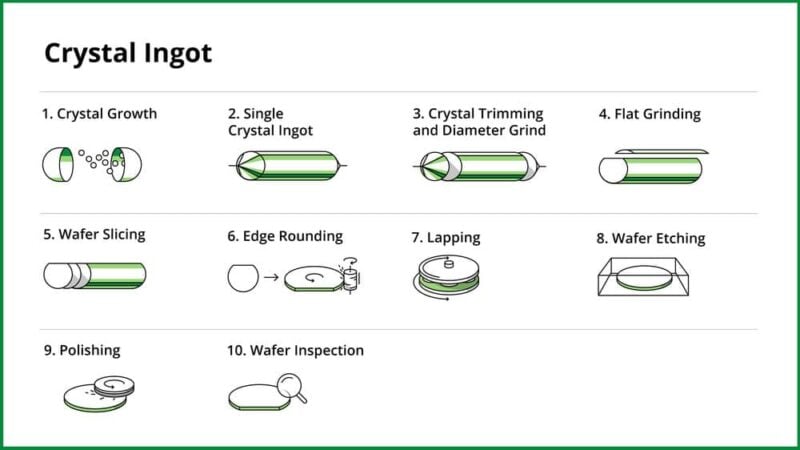
Step 1: Prepare the Substrate and Grow Semiconductor Layers
Modern high-brightness white LEDs commonly use gallium nitride (GaN)-based semiconductor structures. Manufacturers may begin with substrates such as sapphire, silicon carbide, or silicon. These substrates are manufactured and prepared separately before LED layers are added.
Thin semiconductor layers are then grown on the substrate, commonly using metal-organic chemical vapor deposition (MOCVD). For blue and many white LEDs, these layers often include GaN and indium gallium nitride (InGaN). The InGaN active region is engineered to emit blue light efficiently.
Step 2: Create N-Type and P-Type Semiconductor Regions
During epitaxial growth, manufacturers introduce carefully controlled dopants to create the electrical regions required for the LED. In GaN-based LEDs, silicon is commonly used as an N-type dopant and magnesium is commonly used as a P-type dopant. The specific materials, dopants, layer thicknesses, and manufacturing sequence vary by device design.
This process creates distinct semiconductor regions:
- N-type layer: A region designed to provide mobile electrons
- Active region: Often a multi-layer InGaN structure where electrons and holes recombine to produce light
- P-type layer: A region designed to provide holes for recombination
When the LED is operated at the correct forward voltage and current, electrons and holes recombine in the active region and release energy as light.

Step 3: Pattern, Etch, and Add Electrical Contacts
The semiconductor wafer is processed using photolithography and etching to define individual LED structures and expose the required layers. Metal contacts are then deposited and patterned to provide reliable electrical connections to the P-type and N-type regions.
Depending on the LED design, manufacturers may use wire-bond connections, flip-chip construction, reflective layers, textured surfaces, or other techniques to improve current distribution, light extraction, and thermal performance.
Step 4: Separate, Package, and Test the LED Dies
After wafer processing, the wafer is separated into individual LED dies. The dies are mounted to package assemblies or substrates that provide electrical connection and heat transfer. Electrical connections may be made with fine wire bonds or flip-chip methods.
For white LEDs, phosphor materials are commonly applied over or near the blue-emitting die. The package may also include encapsulant, lenses, reflectors, or other optical components. Manufacturers test and sort LEDs for characteristics such as light output, color, forward voltage, and performance consistency before they are incorporated into lamps and luminaires.
Why LED Manufacturing Quality Matters
LED performance depends on semiconductor quality, epitaxial growth, chip design, phosphor system, packaging, thermal design, driver performance, optics, and manufacturing quality control. Variations in these factors can affect efficacy, color consistency, lumen maintenance, electrical reliability, and service life.
For finished fixtures, the LED chip is only one part of the system. A well-designed luminaire also manages heat, regulates current appropriately, protects electrical components, and directs light where it is needed.
When selecting LEDs for professional applications, review the exact product specifications, photometric data, electrical ratings, environmental ratings, controls compatibility, and manufacturer documentation to identify products suited to the project requirements.