What is an LED? Complete Guide to LED Technology
LEDs, or Light-Emitting Diodes, are semiconductor electronic devices that produce visible light when an electrical current passes through them. Originally developed as simple indicator lights, LEDs have evolved into a widely used technology for indoor and outdoor commercial and industrial lighting applications.

Image credit: Wikimedia Commons
The electronic symbol below represents an LED, showing the cathode, anode, and direction of light emission:

Brief History of LED Development
LED technology dates back to the early 1900s, when British physicist Henry Round observed electroluminescence from silicon carbide crystals. In 1962, GE scientist Nick Holonyak developed an early practical visible-light LED that produced red light. George Craford later helped develop yellow LEDs.
Advances in semiconductor materials, manufacturing, optics, and thermal design have reduced LED costs while improving efficiency and light output.
How LEDs Work: The Science Behind the Light
LEDs operate using a P-N junction within semiconductor material. The LED contains an anode and cathode connected to semiconductor layers that form a P-N junction. Adding carefully controlled impurities to the semiconductor creates P-type and N-type regions within the LED chip. The assembly is commonly enclosed in a protective package that may also include an optical lens.

Schematic diagram of LED internal structure (Image credit: Wikimedia Commons)
When the LED is forward biased, conventional current flows from the anode (P side) to the cathode (N side). When an electron recombines with a hole at the P-N junction, it moves to a lower energy state. The energy difference between these states, called the “band gap,” influences the wavelength of light produced.

The excess energy is released as a photon. A larger band gap generally corresponds to higher-energy photons and shorter emitted wavelengths.

The visible spectrum extends approximately from 400 nm for violet light to 700 nm for red light. LEDs can produce light in relatively narrow wavelength bands. Many white LEDs use a blue or near-ultraviolet LED with phosphor materials that convert part of the light into a broader visible spectrum. Multiple LEDs and phosphor formulations can be used to create different colors and spectral distributions.
LED Device Components and Construction
Several factors contribute to LED lighting efficiency improvements:
- Advanced materials with optimized band gaps
- Improved fabrication techniques, reducing costs while increasing efficiency
- Enhanced heat dissipation methods
- Better light extraction from semiconductor materials
- Phosphor technology improvements for wavelength conversion
Individual LEDs are small components that produce specific amounts of light based on their design and operating conditions. LEDs are often described as low-power, mid-power, or high-power devices. Multiple LEDs may be combined to achieve the desired light output and distribution.

This compact size enables flexible LED combinations and versatile lighting designs. The effect of an individual LED or LED group failure depends on the circuit design, driver, and fixture construction.
Complete LED Light Assembly
Manufactured LED lighting products combine LEDs, drivers, optics, thermal components, housings, and controls designed to work together for the intended application.

LED lighting products commonly contain these essential components:
LED Cluster: Multiple LEDs arranged to produce the required light output and distribution.
LED Drivers: Drivers convert incoming AC power to regulated DC output for LEDs. Most commercial LED fixture drivers are constant-current devices with a model-specific output-current rating and output-voltage range. By comparison, 12V or 24V commonly describes a constant-voltage LED power supply used with compatible LED tape, modules, or other constant-voltage loads. Always match the driver type, output rating, dimming method, input voltage, and environmental rating to the LED load and the fixture manufacturer’s specifications. LED drivers may include:
- Power-conversion and current-regulation circuitry
- Control circuitry for dimming, monitoring, or protection, depending on model
Important: Resistors can limit current in some simple, appropriately designed LED circuits, but they dissipate power and are generally not a substitute for a properly matched regulated driver in commercial LED luminaires. Professional-grade LED drivers provide the current regulation required by the connected LED load.
Thermal Management: Critical for LED Performance
Heat Sinks: LEDs and driver electronics generate heat that must be managed to maintain performance and rated life. Poor thermal design, inadequate airflow, high ambient temperature, or excessive drive current can increase junction temperature, reduce light output over time, and shorten component life.
Three Essential Thermal Management Elements
Substrate Material: Metal-core PCBs and other thermally conductive substrates can provide mechanical mounting while spreading heat over larger areas for transfer to a heat sink or housing.
Interface Materials: Thermal films, pads, or compounds can improve heat transfer between components and heat sinks while providing electrical isolation where required.
Heat Sinks: Two common approaches are:
- Active heat sinks: Use fans or other forced-air methods
- Passive heat sinks: Use conductive materials, fins, and natural convection
Many LED luminaires use passive thermal designs. Active cooling may be used where heat load, enclosure size, ambient conditions, and fixture design require it.
LED Optics and Light Control
Optics: LEDs generally emit light into a forward hemisphere, but the actual distribution depends on the LED package, primary optic, and fixture design. Available beam patterns include narrow spot, flood, area-light, roadway, and other specialized distributions.
Lenses control light distribution through:
- Primary optics: Built into or directly associated with LED packages
- Secondary optics: Additional lenses, reflectors, or diffusers used for more precise beam control
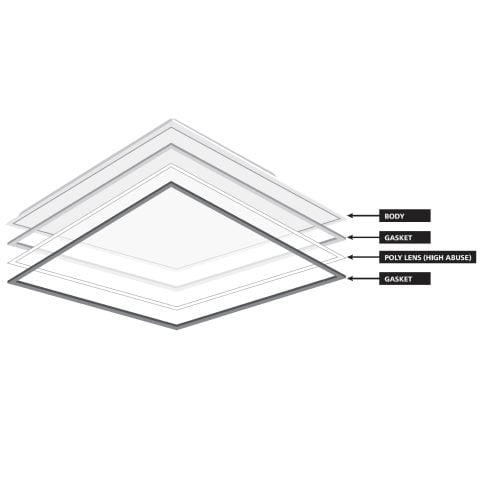
Polycarbonate lenses can provide good optical transmission and impact resistance, but suitability depends on the specific material, optical design, environment, and application. Optical surface quality and lens geometry affect light distribution, glare, and luminaire efficiency.
Key Advantages of LED Technology
- Energy Efficiency: LED luminaires can provide substantially more light per watt than many incandescent, halogen, and older fluorescent lighting systems. Actual luminaire efficacy varies by product, output, color quality, optics, driver, and operating conditions. Energy savings and payback depend on the existing system, operating hours, electricity cost, controls, installation cost, and maintenance requirements.
- Extended Lifespan: Many commercial LED products are rated at 50,000 hours or more based on a stated lumen-maintenance criterion, such as L70. Rated life is not necessarily the point of complete fixture failure, and actual service life depends on thermal conditions, driver performance, operating environment, and usage.
- Operating Characteristics: LEDs generally perform well in cold conditions and are not subject to filament wear from frequent switching. Performance still depends on the complete luminaire, driver, controls, and rated ambient-temperature range.
- Solid-State Construction: LEDs do not use the fragile glass envelope and suspended filament found in incandescent lamps. Product-level resistance to shock and vibration varies by luminaire construction, mounting, driver design, and manufacturer testing.
- Optical Control: LED arrays and fixture optics can direct light where it is needed, which can support efficient lighting designs when fixture selection and layout are based on appropriate photometric data.
Choosing the Right LED Solution
Understanding LED technology helps in selecting appropriate lighting solutions for specific applications. Consider required illuminance at the work surface, light distribution, glare, color quality, operating environment, controls, thermal conditions, mounting arrangement, and applicable electrical requirements when specifying an LED lighting system. Fixture quantity, mounting height, and spacing should be evaluated using fixture-specific photometric data rather than universal rules.
Professional Installation Note: LED driver installation and electrical connections should be performed by qualified electricians in accordance with applicable electrical codes, manufacturer instructions, and local safety requirements.