LED vs Fluorescent for Office Lighting
What’s the Best Lighting for an Office Environment?
Office lighting requires balancing multiple factors. You’ll need sufficient light on work surfaces for detailed tasks while controlling glare, reflections, and contrast that can contribute to visual discomfort.
The two most common options for commercial office lighting are fluorescent and LED fixtures. Fluorescent lighting has traditionally been popular due to lower initial costs, reasonable service life, and improved efficiency compared with incandescent lighting. LED technology can offer lower energy use and longer rated life in many applications, although initial fixture costs may be higher.
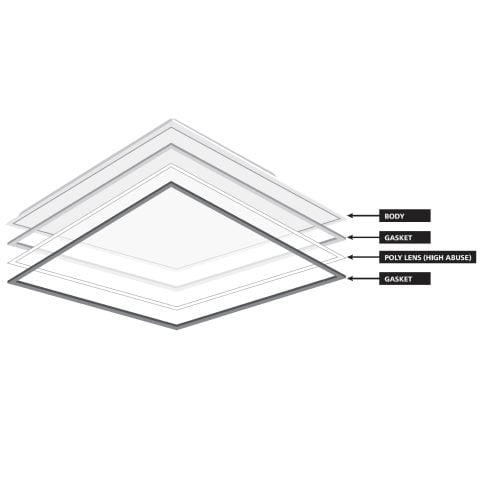
LED lighting is widely used in office renovations and new construction because fixtures are available in a range of output levels, color temperatures, optical distributions, and control-compatible configurations. LED flat panel lights and troffer lights are a common option for office ceilings. The right selection should be based on the office layout, ceiling height, visual tasks, existing lighting conditions, and the desired illuminance and glare-control results.
Important: All electrical work should be performed by qualified professionals in accordance with applicable local codes and regulations.

LED vs Fluorescent Office Lighting Comparison
Understanding how these technologies work helps explain their different performance characteristics.
How They Work
Fluorescent tubes operate by ionizing mercury vapor inside a glass tube. The process produces ultraviolet radiation, which phosphors on the tube’s inner walls convert to visible light. Depending on the lamp, ballast, installation, and condition of the system, fluorescent lighting may exhibit audible noise or visible flicker.
LEDs (Light-Emitting Diodes) are semiconductor devices that produce light through electron movement. Quality LED fixtures use thermal-management components, such as heat sinks, to manage heat at the LEDs and driver. LED fixtures use drivers to convert and regulate incoming electrical power for the LEDs.
Note: Fluorescent fixtures use ballasts to start the lamp and regulate lamp current. Ballast input losses should be included when evaluating fluorescent system energy use. For existing fluorescent fixtures, commercial LED replacements for fluorescent tubes may be an option where the fixture and retrofit requirements are compatible.
Energy Efficiency Comparison
Lighting efficacy is measured in lumens per watt (lm/W). For an accurate comparison, evaluate complete luminaires or systems using their rated input watts and delivered lumens rather than comparing an LED fixture with a fluorescent lamp alone.
- LED fixtures: Many commercial LED fixtures are rated around 130-160 lm/W, while selected high-efficiency models may be rated at 200 lm/W or higher.
- T8 fluorescent systems: A 32W T8 lamp may produce approximately 3,100 lumens, but the complete lamp-and-ballast system draws more than the lamp’s nominal 32W rating. Actual system efficacy varies with the lamp, ballast, fixture optics, number of lamps, and operating conditions.
Example calculation: A 150W LED fixture producing 24,000 lumens is rated at 160 lm/W. A fluorescent fixture with four 32W T8 lamps producing 3,100 lumens each provides 12,400 nominal lamp lumens; its system input wattage must include ballast power, and fixture optics further affect delivered light. Use published fixture photometric and electrical data for a meaningful replacement comparison.
Color Temperature and Quality
Correlated Color Temperature (CCT) describes the apparent warm or cool color of white light and is measured in Kelvin:
- Fluorescent: Available in a range of CCTs, commonly including 3000K, 3500K, 4000K, and 5000K, depending on the lamp.
- LED: Available in a broad range of CCTs; common commercial options include 3000K through 5000K.
- Office applications: 3500K or 4000K are common choices for general office lighting, but the appropriate CCT depends on the space, finishes, visual tasks, and user preference.
- Industrial spaces: 4000K and 5000K are commonly used in warehouses and factories, depending on the application and lighting design.
Color Rendering Index (CRI) measures how faithfully a light source renders colors compared with a reference illuminant on a 0-100 scale. Higher CRI values can improve color discrimination for tasks where color appearance matters. CRI is separate from light output, CCT, and efficacy.

Lifespan and Maintenance
Both technologies experience gradual light-output depreciation over time, but maintenance needs can differ:
- LED lights are commonly rated using lumen-maintenance values, such as L70, which indicates the estimated time until light output reaches 70% of initial output under specified test conditions.
- Fluorescent tubes can lose output over time, and lamp and ballast replacement may be required during the life of the fixture.
- Maintenance consideration: Frequent switching can shorten the life of some fluorescent lamps and ballasts. LED performance and service life also depend on fixture design, driver quality, ambient temperature, and operating conditions.
For facility managers, longer maintenance intervals and consistent system performance can reduce operating costs, but expected results should be evaluated using the selected fixture’s published specifications and operating conditions.
Lighting and Workplace Productivity
Appropriate lighting design can support visual comfort and task performance. Results depend on illuminance, glare control, uniformity, color quality, daylight availability, workstation layout, and individual needs.
Potential Benefits of Quality Lighting
- Improved visual comfort for detailed tasks
- Better color discrimination and visual accuracy where appropriate color rendering is selected
- Reduced visual discomfort when glare, reflections, and excessive contrast are controlled
- Support for alertness and occupant comfort through appropriate lighting design and scheduling
Considerations with Fluorescent Lighting
Some individuals may be sensitive to certain lighting characteristics:
- Light-sensitive individuals: Flicker, glare, or aging lamps and ballasts may be uncomfortable for some occupants.
- Circadian considerations: Like other artificial lighting, bright or blue-rich light exposure in the evening may affect sleep patterns for some people.
- Flicker sensitivity: Individuals with photosensitive conditions should consult healthcare providers about workplace lighting concerns.
Disclaimer: Individual responses to lighting vary. Consult healthcare professionals for specific medical concerns related to lighting sensitivity.
Why Choose LED for Commercial Office Lighting?
LED technology can offer several advantages for office environments:
- Higher luminaire efficacy can reduce lighting energy use
- Longer rated life can reduce lamp-replacement and maintenance needs
- Compatible dimming, occupancy sensing, daylight harvesting, and control options are available on selected fixtures and systems
- More color temperature, color-rendering, optical-distribution, and output options
- Lower electrical input can reduce heat added to the space compared with less-efficient lighting systems producing comparable light levels
Cost Considerations
While LED fixtures may have higher upfront costs, total cost of ownership can favor LED technology when energy use, maintenance, operating hours, utility rates, controls, and replacement costs are considered. A fixture-specific photometric plan can help determine the required quantity, mounting layout, illuminance, and glare performance for the office.
Many utility companies offer rebates for qualifying energy-efficient lighting upgrades, though available incentives, product requirements, and eligibility vary by location and utility provider.
Contact your local utility company to inquire about current rebate programs and eligibility requirements.
Technological advances continue to make LED lighting more cost-competitive for many commercial applications. Review the exact fixture specifications, photometric data, controls compatibility, and warranty before selecting a replacement system.