LED Lumens Explained: Understanding Brightness, Efficiency, and Light Quality
LED Lumens – There is No Comparison
LED lighting has become a widely used technology across residential, commercial, and industrial applications because it can offer high efficacy, controllability, long service life, and a broad range of optical and color-quality options. Compared with many legacy lighting technologies, properly selected LED systems can reduce energy use and maintenance requirements while providing light where it is needed.
LED upgrades can provide meaningful energy-cost savings when fixture performance, operating hours, controls, and utility rates support the change. LED lighting is commonly used in LED industrial lighting and LED commercial lighting applications.
Whether you’re illuminating a large warehouse with a complex LED system or shopping for a ceiling light to install in your office, it all comes down to lumens, fixture optics, and the light level required on the task area. Business owners and other professionals upgrading their lighting to LED fixtures frequently ask us about lumens. There isn’t really a single straightforward answer because delivered light depends on the fixture, layout, mounting height, and application. Read on for an overview of lumens and how to use them when evaluating an LED conversion.
Important note: Lighting performance, energy savings, and lumen equivalency vary based on fixture design, optics, mounting height, spacing, operating hours, controls, and application. The examples in this guide are provided for general education and comparison purposes only.
What are Watts?
Before diving into lumens, we need to quickly cover watts. A watt is a unit of power: the rate at which electrical energy is used or transferred. In electrical terms, watts equal volts multiplied by amps in a simple circuit. Watts remain useful for understanding a lighting system’s energy consumption, but they do not directly measure light output.
What are Lumens?
Now that we’ve covered watts, we can explore the ins and outs of lumens and LED lighting. But what are lumens, exactly?
A lumen is the SI unit of luminous flux: a measure of the total quantity of visible light emitted by a source, weighted for typical human visual sensitivity under photopic conditions. Simply put, lumens measure light output. Many people mistakenly use watts as a measure of brightness.
This confusion stems from decades of shopping for bulbs based on wattage for home lighting. Higher-wattage traditional lightbulbs often produced more light, but watts measure power consumption rather than brightness. That relationship is not consistent across lighting technologies.
LED fixtures can produce similar or greater light output than older technologies while using less power, depending on the products being compared. Lumens describe light output, while lumens per watt describe luminaire efficacy. For an installed lighting system, delivered foot-candles or lux on the work plane are often more useful measures than fixture lumens alone.

More Light, Less Energy (Watts) with LED
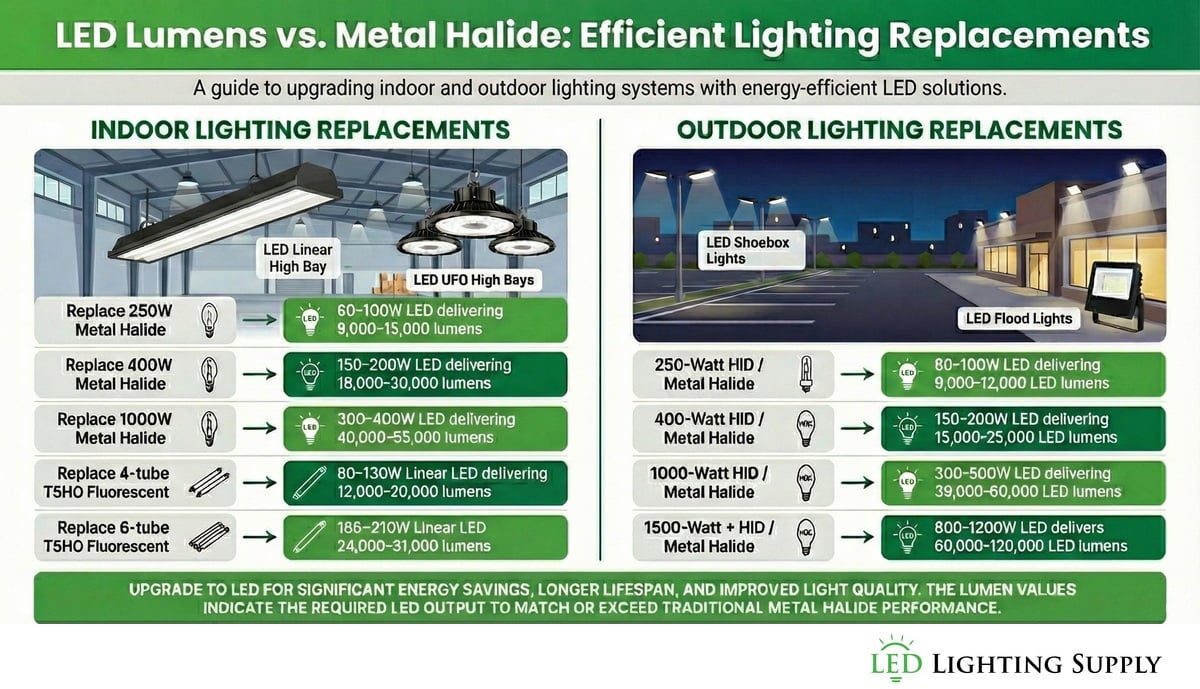
LED fixtures can provide required illumination with substantially lower power consumption than legacy systems when the fixtures, optics, and layout are selected for the application. In many commercial applications, a properly designed 150W LED fixture can provide illumination comparable to a 400W metal halide system when optics, mounting height, and distribution are matched appropriately. Actual equivalency and energy reduction depend on fixture design, ballast input wattage, controls, and application conditions.
LEDs generally convert a smaller portion of input power into heat than many traditional lamps, although LED fixtures still generate heat and require thermal management to maintain performance and service life. As LED technology improves, more light may be produced using less power. While watts remain important for estimating energy use, lumens, efficacy, optical distribution, and maintained illuminance are key considerations when evaluating modern LED systems.
Lumens and Useful Lumens
Total lumens describe the light emitted by a lamp or luminaire, but they do not show where the light is directed. Fixture optics, shielding, reflectors, room surfaces, and mounting conditions affect how much of that light reaches the intended task area.
In some markets, including under certain European lamp energy-labeling rules, directional lamps may be rated using “useful luminous flux” within a specified cone angle. That measurement is specific to the applicable test method and should not be treated as a universal prediction of in-field brightness. For commercial and industrial projects, fixture-specific photometric data is the better tool for evaluating delivered light.
Lumens & Directional Light Sources
With a directional light source, fixture lumens can often be used more effectively. LEDs are small-area light sources that can be paired with optics to direct light efficiently toward a target area. However, LED fixtures are not inherently directional in every application; omnidirectional LED lamps and wide-distribution LED luminaires are also available.
Conventional light sources, such as metal halide, high-pressure sodium, fluorescent lamps, and incandescent lamps, generally emit light in many directions. Their luminaires often use reflectors, refractors, lenses, or diffusers to distribute that light where it is needed.
Commercial and industrial environments such as warehouses, factories, and other facilities may need optics or reflectors to control light distribution, reduce spill light, and provide appropriate illuminance on the work plane. The amount of light that reaches the target area depends on luminaire efficiency, optical design, surface reflectance, room geometry, maintenance, and layout.
Consider metal halide fixtures as an example. A metal halide arc tube emits light in many directions, and the luminaire optical system redirects and controls that light. LED luminaires can often direct a larger share of their output toward the intended area without relying on the same reflector geometry, but performance must be evaluated using the specific fixture’s photometric data.
In reflector-based systems, each reflection can reduce light output because no reflector is perfectly efficient. The actual loss per reflection varies with reflector material, finish, cleanliness, angle, and fixture design; it is not a fixed one-lumen loss per bounce.

Lumen Quality over Quantity
Light quality and light quantity are separate but important considerations. The Color Rendering Index, or CRI, measures how faithfully a light source renders the colors of standardized test samples compared with a reference illuminant of similar color temperature. A reference source can have a CRI of 100.
CRI is commonly expressed on a scale up to 100, with higher values generally indicating better color fidelity for the samples included in the calculation. CRI does not measure brightness, lumen output, efficacy, glare, or the number of lumens required for a space. Higher-CRI products may be preferred where color discrimination or appearance matters, but lighting quantity should still be designed around target illuminance and visual-task needs.
For example, high-pressure sodium (HPS) lighting typically has poor color-rendering performance, while LED products are available in a wide range of CRI values, commonly including 70, 80, 90, and higher depending on the model. Two sources with different spectra can appear different in color and render objects differently even at similar measured illuminance. Compare fixture lumens, maintained foot-candles or lux, distribution, glare, CCT, and CRI when selecting lighting.

Photopic and Scotopic Lumens
Human vision responds differently at different light levels.
What are Photopic Lumens?
Photopic vision is the daylight and well-lit vision response dominated by the eye’s cones. Standard lumen ratings and conventional foot-candle or lux measurements use the photopic luminous-efficiency function. This is the standard basis for most general lighting calculations and light-meter measurements.
What are Scotopic Lumens?
Scotopic vision is low-light vision dominated by the eye’s rods. Rods are much less sensitive to color than cones and respond most strongly to different wavelengths than the photopic visual system. At intermediate light levels, known as the mesopic range, both rods and cones can contribute to vision.
Scotopic/photopic (S/P) ratio compares a source’s relative output when weighted by the scotopic and photopic visual-response functions. S/P ratio depends on the spectral power distribution of the specific light source, not simply whether it is LED, HPS, metal halide, or another technology. It can be useful in certain mesopic-vision research and applications, but it does not replace standard photometric design methods, required illuminance criteria, or fixture-specific photometric analysis.
LEDs are available with many different spectra and S/P ratios, while HPS and other sources also vary by lamp type. Do not assume every LED has an S/P ratio above a particular value or that an S/P ratio alone proves that fewer photopic lumens will meet an application’s lighting needs. To learn more about S/P ratios, review the source-specific data and use them in context with the project’s lighting criteria.
Lumen Degradation of Metal Halide Versus LED
Metal halide and other HID lamps can experience substantial lumen depreciation over their rated life, and depreciation varies by lamp type, ballast, operating position, switching frequency, and operating conditions. Relamping decisions should consider maintained light levels, lamp life, color shift, cycling behavior, access costs, and manufacturer data rather than relying on one universal percentage at a fixed number of hours.
Sports facilities and other high-demand applications may use group relamping schedules to help maintain consistent light levels and reduce outages. The appropriate replacement interval depends on the lamp, fixture, lighting criteria, usage, and maintenance program.
LED luminaires are commonly evaluated using lumen-maintenance projections such as L70, the estimated point at which light output reaches 70% of initial output under stated test and calculation conditions. Published LED lifetimes vary by product, drive current, ambient temperature, thermal design, and operating environment. Verify the manufacturer’s rated life, applicable TM-21 projection, warranty, and operating conditions for the exact fixture.
LED upgrades can improve initial and maintained illumination while reducing energy and maintenance costs when they are designed for the space and operating conditions. Results depend on the selected fixtures, existing system, controls, installation, and maintenance practices.
Important: LED lumen maintenance is commonly referenced using industry terms such as L70, which indicates the point at which a light source or luminaire is projected or rated to maintain 70% of its initial output under stated conditions. Many commercial LED fixtures are rated for 50,000 hours or more to L70, but the exact rating must be verified for the selected model.
LED Lumens – Seeing Things in a New Light
When we first entered the commercial and industrial lighting scene in 2008, there were many questions about LEDs, lumens, and fixtures in general. The most common question by far was “Why should I upgrade to LEDs?“
Today, LEDs are extremely common, and many business owners and facility managers understand their potential benefits. They often reach out to learn more about converting industrial and commercial lights to LED fixtures.
LED systems can be more energy-efficient and may require less maintenance than many legacy lighting systems. They are available for a wide variety of indoor, outdoor, wet-location, cold-storage, and other specialized applications, but suitability depends on the fixture’s specific listing, environmental rating, materials, ambient-temperature range, and manufacturer documentation.
People know that LEDs can offer advantages, but they want to know why. LED fixtures can provide high efficacy, controllable light distribution, appropriate color quality, and long projected lumen-maintenance life. These characteristics may reduce electrical and maintenance costs and improve the visual environment when the system is properly designed. LED lifetime claims, including 50,000-hour ratings, should be verified for the selected fixture and its rated operating conditions.
This can reduce maintenance costs because replacement intervals may be longer than with some conventional systems. LED products are available in a range of CRI ratings, allowing projects to select color-rendering performance appropriate for the task. Fixture lumens, optics, glare control, color quality, and maintained illuminance all contribute to successful lighting results.
How Many Lumens Do I Need?
- Step 1: Measure the square footage of the room you’ll be lighting. To do this, multiply the length of the room by the width of the room.
- Step 2: Determine an appropriate target illuminance for the space and visual tasks. Lighting needs vary greatly based on the room’s purpose, task detail, occupants, surface reflectance, and applicable recommendations.
- Step 3: Use square footage and target foot-candles as an initial estimate only. Multiplying area by target foot-candles estimates lumens needed at the work plane, not the fixture lumens required. Fixture quantity and output must account for optical distribution, mounting height, spacing, light loss factors, reflectances, obstructions, and maintenance.
Design reminder: Target foot-candle levels should be based on recognized recommendations, such as applicable IES guidance and project requirements, then verified through fixture-specific photometric analysis rather than estimated solely from square footage.
Professional Lighting Analysis and Custom Solutions
At LED Lighting Supply, our lighting specialists can provide custom lighting plans based on your facility’s application information and requirements. We can review your current lighting setup and prepare estimated energy-use, cost-savings, and payback comparisons using the information available for the project. Actual savings depend on operating hours, electricity rates, controls, installation, maintenance, and selected products.
We can provide photometric analysis to model fixture distribution and predicted foot-candle levels for your specific space using available project information and fixture photometric data. Final design, electrical installation, code compliance, and site-specific requirements remain the responsibility of the qualified design professional, electrical contractor, and authority having jurisdiction where applicable.
Our recommendations are based on over 15 years of commercial and industrial LED lighting experience, supported by photometric modeling and installation feedback across warehouses, factories, sports facilities, and outdoor environments.