Tunable LED Lighting Guide: Wattage, Color Temperature & Applications
LED lighting technology has evolved dramatically over the past decade, bringing improved efficiency and functionality to commercial and residential applications. Tunable lighting represents a practical advance, transforming static fixtures into more versatile solutions. Rather than purchasing multiple fixture configurations for different lighting needs, tunable technology can consolidate selectable output or color-temperature options into products that can be adjusted to suit project requirements.
The U.S. Department of Energy recognizes LED lighting as an important energy-efficiency technology, as detailed in its LED lighting guidance. LED upgrades can reduce lighting energy use compared with older fluorescent and high-intensity-discharge systems when properly designed and controlled. Actual savings vary based on operating hours, controls, fixture efficacy, light levels, and the existing lighting system.

What is Tunable Lighting?
Tunable lighting encompasses several technologies, including wattage- or lumen-selectable, color-selectable, dim-to-warm, tunable-white, and full-color systems. These solutions may provide control over wattage/output, color temperature, or both parameters through switches, drivers, or compatible controls. After 15+ years in commercial lighting, we have seen how this flexibility can simplify project planning and reduce inventory complexity.
Wattage Adjustable settings change fixture power draw and typically change light output. Because LED efficacy varies by product and setting, wattage alone is not a measure of brightness; lumens describe luminous flux, while delivered foot-candles or lux depend on fixture optics, mounting conditions, and layout. Typical selectable fixtures may offer settings such as 30W/40W/50W, depending on the model and application.
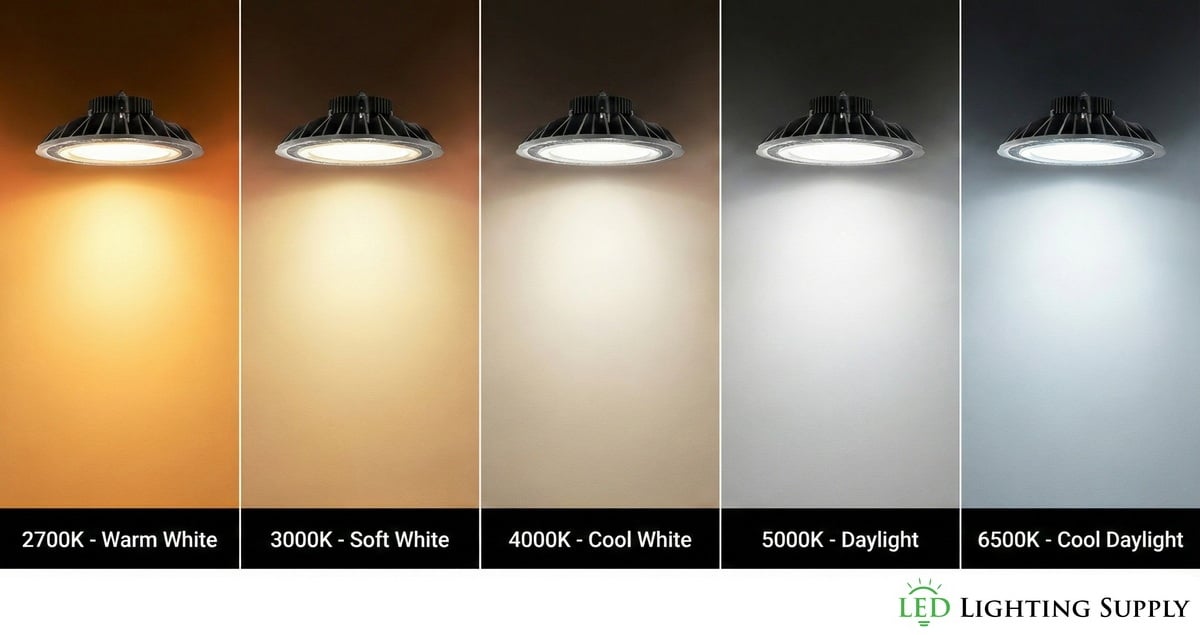
Color temperature (CCT) Adjustable options can range from warm 2700K yellowish-white tones to cool 5700K bluish-white light. CCT describes the apparent warm or cool appearance of white light; it does not indicate brightness, CRI, or efficacy. Warehouses, manufacturing facilities, hospitality spaces, and residences may use different CCTs based on visual tasks, finishes, occupant preferences, and project requirements.
The Illuminating Engineering Society provides lighting guidance and recommended practices for different applications through its lighting library. IES recommendations are design guidance and should be used alongside applicable codes, project requirements, and professional lighting design review. These resources can help designers evaluate appropriate CCT, illuminance, uniformity, glare, and color-rendering considerations.
How Does Tunable Lighting Work?
Many selectable fixtures use switches or dials located on the housing, within an accessible compartment, or on a compatible driver. External controls can simplify access during maintenance, while internal switches may be appropriate when settings are intended to remain fixed after installation. Advanced tunable-white and full-color systems can use dedicated control interfaces, such as compatible wall controls, building-control systems, or apps. Final control configuration should be verified against manufacturer instructions, the selected driver/control system, and applicable electrical-code requirements.
Categories of Tunable LED Products
Wattage Selectable
Wattage-selectable fixtures provide multiple output settings while generally maintaining a fixed nominal color temperature. Available settings vary by model and may include three output levels, such as lower, medium, and high settings. This approach can be useful for retrofits where light levels need adjustment without replacing the fixture. Lumen-selectable variants communicate output options in lumens rather than input power.
Color Selectable
Color-selectable technology focuses on CCT adjustment. Common configurations include 3000K/4000K/5000K options or 2700K/3000K/4000K/5000K/6500K options. Light output and efficacy can vary somewhat between CCT settings, so the published specifications for the selected setting should be reviewed. Five-CCT fixtures can be useful where final color-temperature preferences remain undetermined during installation.
Dim to Warm
Dim-to-warm fixtures are designed to shift toward warmer color temperatures as they dim, approximating the appearance of incandescent dimming. Depending on the model, full output may be approximately 2700K to 3000K, while low dimming levels may reach approximately 1800K. Restaurants, hotel lobbies, and residential applications may use this characteristic to create a warmer low-light atmosphere.
White Tunable
White-tunable systems, sometimes called Kelvin-adjustable lighting, provide adjustable intensity and color temperature. Control requirements vary by fixture and may use separate 0-10V channels, DALI, DMX, wireless controls, proprietary systems, or other compatible control methods. Some installations use separate controls for output and CCT, while others use a programmed scene controller or integrated interface. Not all dimming systems are compatible with all tunable drivers, and control compatibility should be confirmed before specification and installation.
Full Color Tunable
Full-color tunable fixtures incorporate multiple LED channels, often red, green, blue, and white (RGBW), to create a broad range of white-light and colored-light effects within the fixture’s color gamut. Beyond standard white-light settings, these systems can produce saturated colors for accent lighting, seasonal themes, or branding applications. Theme parks, entertainment venues, and hospitality projects may use these systems for dynamic lighting effects. Maximum lumen output can vary by mode; some fixtures deliver their highest output in dedicated white settings rather than saturated RGB mixes.
Benefits and Considerations
Tunable lighting can offer useful advantages for commercial projects. Design flexibility can reduce uncertainty during planning because final settings may be adjusted after installation within the fixture’s available range. Selectable fixtures can also reduce the number of product configurations a facility or contractor needs to stock.
Adjustable CCT can help improve visual consistency when compatible fixtures are set to similar target settings. However, it does not guarantee an exact color match across different fixture manufacturers, product families, optics, LED bins, CRI values, or ages. For visually critical installations, specify compatible fixtures with documented chromaticity, color-rendering, and binning information, and evaluate samples or mockups where appropriate.
For quality assurance and safety compliance, Underwriters Laboratories provides testing and certification information for lighting products, while the DesignLights Consortium maintains qualified product listings for eligible energy-efficient lighting products. DLC qualification is an efficiency and performance program, not an electrical safety certification. Not all tunable configurations qualify for DLC rebates at all settings; qualification is based on tested configurations listed on the DLC QPL and applicable utility-program requirements.
- Adaptability and flexibility – A single fixture model may support different output or CCT needs as spaces change throughout the day or between uses. For example, a conference room may use different lighting scenes for presentations and meetings when paired with compatible controls.
- Color consistency support – Selectable CCT can help installers align the nominal CCT of compatible fixtures, particularly within the same product family. Exact visual matching still depends on the fixtures’ spectral characteristics, chromaticity tolerances, CRI, optics, and operating history.
- Inventory flexibility – Volume production has made many selectable fixtures competitively priced with fixed-output alternatives. Whether a premium is justified depends on the selected product, project scope, control needs, and installation requirements.
However, certain limitations require consideration during project planning:
- Efficiency – Efficacy and lumen output can vary by CCT and output setting. Some tunable-white or color-mixing products may have different efficacy characteristics than fixed-CCT products, but the effect is model-specific. Review the manufacturer’s photometric and electrical data for the selected operating mode.
- Complexity – Installation and commissioning may require additional time when fixtures use advanced controls or multiple channels. Training maintenance staff on adjustment procedures can help prevent future confusion.
LED Tunable Fixtures Options
Tunable technology is available across many commercial and industrial product categories, allowing facilities to standardize fixture platforms while maintaining flexibility in performance. We offer LED high bay lights, wall pack lights, LED flood lights, and shoebox / area lights in selected wattage-selectable and color-temperature-selectable configurations. These fixtures can allow installers to adjust nominal output and CCT on-site within the product’s listed settings.
For projects requiring more precise control, select high bay and shoebox models may also offer optic-selectable distributions. Available optics can help address aisle layouts, perimeter lighting, or pole spacing, but fixture quantity, mounting height, spacing, and distribution should be evaluated using fixture-specific photometric data and an appropriate lighting layout.
Get Expert Tunable Lighting Guidance from LED Lighting Supply
Selecting the right tunable lighting solution requires understanding your performance requirements and application constraints. Our product specialists can help identify products that match established project requirements, compare published fixture specifications, and review available control options. We can also prepare custom lighting layouts showing proposed fixture placement, coverage patterns, and calculated light levels based on available photometric data and project information supplied by the customer. Energy-use and payback estimates can be prepared using stated utility rates, operating schedules, and proposed equipment assumptions. Final electrical, code-compliance, and professional engineering decisions remain the responsibility of the appropriate qualified professionals and authorities having jurisdiction.