Determining How Many HVLS Fans Replace Commercial Ceiling Fans
When upgrading airflow in a facility with existing ceiling fans, a common question arises: “How many commercial ceiling fans can be replaced by an HVLS (high volume, low speed) ceiling fan?” The answer is not a one-for-one calculation or a universal replacement ratio. An HVLS fan may provide circulation across a much larger open area than a conventional commercial ceiling fan, but the appropriate quantity and layout depend on the selected fan model, mounting height, building layout, obstructions, airflow goals, and the fan’s published performance data. A strategic fan layout plan helps determine where HVLS fans may supplement or replace existing commercial ceiling fans.
When HVLS Ceiling Fans May Replace Commercial Ceiling Fans
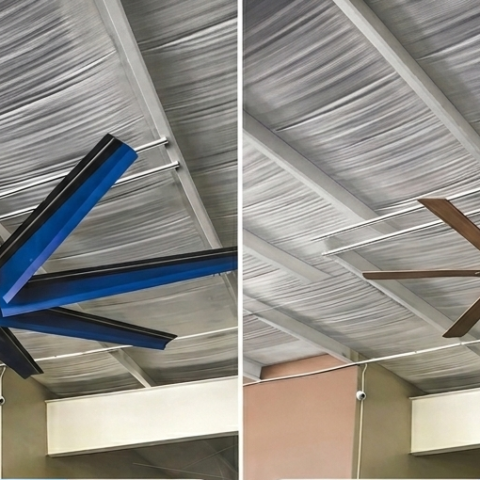
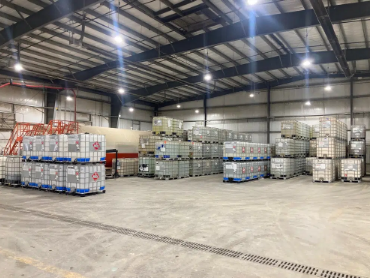
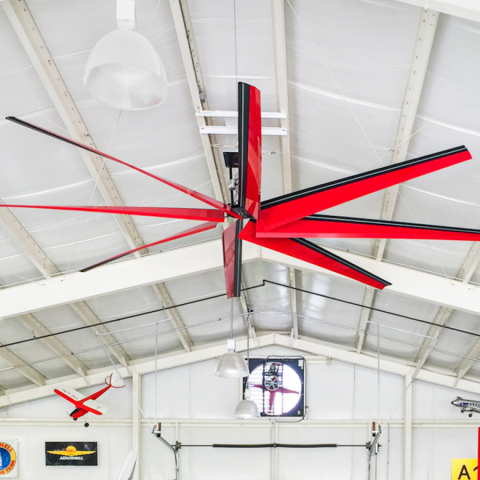
A traditional commercial ceiling fan may be replaced or supplemented with an HVLS fan in a large, open area where the selected fan can be safely mounted and its airflow pattern can reach the occupied area. Warehouses, gymnasiums, hangars, and open manufacturing spaces are common applications. Ceiling clearance, spacing, electrical supply, mounting structure, and manufacturer installation requirements must be reviewed for the specific fan model. Many HVLS fans are intended for higher-ceiling applications, but minimum mounting height and clearance requirements vary by manufacturer and fan diameter. For more information on HVLS fans, visit our comprehensive buyer’s guide.
When HVLS Ceiling Fans Are Not a Direct Commercial Ceiling Fan Replacement
HVLS fans are powerful circulation tools, but they are not always a direct replacement solution. Smaller rooms, low ceilings, substantial obstructions, irregular floor plans, and areas requiring localized airflow may be better served by commercial ceiling fans or a combination of fan types. HVAC equipment, racking, partitions, cranes, and other overhead or floor-level obstructions can change how air moves through the space. HVLS fans also circulate and mix air; they do not replace required exhaust ventilation, local source capture, makeup air, dust collection, or contaminant-control systems. To further understand commercial ceiling fans, see our buyer’s guide.
HVLS Ceiling Fan Count Replacement Calculation
To estimate how many HVLS fans may be appropriate for an existing commercial-fan installation, begin with the facility dimensions, ceiling height, obstruction layout, and desired air movement in occupied areas. You can use our free fan count calculator as a preliminary planning tool, but confirm the final quantity and layout with fan-specific performance information and a fan-layout review.
A useful preliminary calculation is:
Preliminary Fan Quantity = Total Area ÷ Model-Specific Recommended Coverage Area
The recommended coverage area must come from the selected fan manufacturer’s published application guidance or a layout based on the fan’s performance data. It is not a fixed value determined solely by fan diameter. Final layouts should account for mounting height, fan spacing, airflow overlap, obstructions, occupant locations, and the desired circulation or destratification objective.
HVLS Fan Airflow (CFM) for Evaluating Commercial Fan Replacement
Published airflow, often expressed in cubic feet per minute (CFM), can help compare fan models, but CFM alone does not determine how many fans a facility needs. Output can vary substantially by fan diameter, blade design, motor, speed setting, and the manufacturer’s test method.
- Compare published airflow data for the specific fan model and operating speed.
- Review the manufacturer’s recommended mounting height, spacing, and application guidance.
- Consider air speed and circulation at the occupied level, not only total CFM.
- Use a fan-specific layout when replacing multiple existing fans or planning a large open area.
CFM provides a starting point for product comparison, but it should be evaluated with the fan’s airflow distribution and the conditions of the actual space.
Difference Between Square Foot Coverage & CFM
Both square foot coverage and CFM can inform an HVLS fan layout, but they measure different things. CFM estimates the volume of air a fan moves while running. Recommended square-foot coverage is an application guideline for the floor area a particular fan may effectively serve under stated conditions. Neither metric should be used alone to specify a replacement. Ceiling height, fan speed, blade design, airflow pattern, obstructions, and required air movement affect real-world results.
Quick Reference: Project Types That May Benefit From an HVLS Fan Layout Review
| Space Type | Square Footage | Ceiling Height | Existing Commercial Ceiling Fan Count | HVLS Replacement Consideration |
| Medium-Sized Warehouse | 20,000 sq ft | 24-32 ft | 30 | Review an HVLS layout using the selected model’s published performance and spacing guidance. |
| Large-Sized Warehouse | 50,000 sq ft | 28-40 ft | 60-80 | Multiple HVLS fans may be appropriate; quantity depends on layout, racking, and airflow objectives. |
| Gymnasium | 12,000 sq ft | 22-30 ft | 8-12 | Review clearance from sports equipment, lighting, sprinklers, and occupied areas before selecting fan size and quantity. |
| Fitness Center | 15,000 sq ft | 20-22 ft | 18-25 | Evaluate mounting clearance, comfort expectations, and localized airflow needs; a mixed fan layout may be appropriate. |
| Indoor Sports Facility | 40,000 sq ft | 28-45 ft | 45-65 | Use a project-specific layout that considers court or field use, obstructions, and required clearances. |
| Commercial Garage | 20,000 sq ft | 20-28 ft | 20-30 | Review vehicle paths, lifts, exhaust requirements, and mounting locations; circulation fans do not replace required ventilation. |
| Retail Space | 5,000 sq ft | 13 ft | 2-4 | HVLS suitability depends on the specific fan’s clearance requirements, store layout, and comfort goals; commercial fans may be more suitable. |
| Airplane Hangar | 100,000 sq ft | 45-80 ft | 100-150 | Large open areas may suit multiple HVLS fans, subject to door operation, aircraft clearances, structural review, and fan-specific layout data. |
| Agricultural / Equestrian Facility | 25,000 sq ft | 20-28 ft | 25-40 | Review dust, moisture, corrosion exposure, animal areas, and the selected model’s environmental rating and installation guidance. |
| Schools & Universities | 10,000-100,000+ sq ft | Varies | Mixed systems | HVLS fans may suit large open spaces, while classrooms and smaller rooms often need localized commercial-fan solutions. |
This chart is intended as a quick reference guide only and should not be used as an exact calculation for fan replacement. A universal replacement ratio does not exist for replacing commercial ceiling fans with HVLS fans. The correct fan quantity depends on project-specific factors including floor area, ceiling height, selected fan diameter and performance data, building layout, obstructions, airflow goals, existing ventilation, heat load, and application type. Before investing in commercial & industrial fans, consult a Product Expert to review available fan specifications and layout options. A qualified installer, design professional, or project authority should verify electrical, mounting, structural, clearance, and code requirements.
Preventing Mistakes – Avoiding Size Issues with Replacements
One of the most common issues in fan replacement upgrades is incorrect sizing or layout. Installing a fan that is too large for the space or improperly locating it can create uncomfortable air movement, clearance conflicts, and unnecessary cost. Undersizing or excessive spacing can create stagnant zones and uneven circulation. The goal is to match the selected fan and layout to the space rather than install the largest fan possible or simply replicate the existing fan layout. Choosing the right fan is just as important as sizing it correctly. Replacing commercial ceiling fans with HVLS fans can simplify airflow management in suitable open spaces, but the right solution depends on your facility’s layout, ceiling height, structural support, and airflow goals.