Commercial vs Industrial Fans: How to Choose the Right Solution
Manufacturing facilities, warehouses, and commercial spaces rely on proper air circulation to maintain safe, productive, and comfortable environments. Poor airflow can lead to heat buildup, inconsistent temperatures, condensation issues, and reduced worker productivity.
Choosing between commercial and industrial fans comes down to understanding how each is built, where it performs best, and what your facility actually requires. In many cases, facilities achieve measurable efficiency gains and improved air quality simply by optimizing airflow, fan placement, and overall system design.
In this guide, we walk through how to evaluate commercial and industrial fans, when HVLS (high-volume, low-speed) fans are the right solution, and how to size them correctly using a practical, real-world approach.
Commercial or Industrial HVLS Fans?
When determining whether commercial or industrial fans are needed, start with how the space is used. Key factors include square footage, ceiling height, layout and obstructions, occupancy levels, and whether airflow is needed for comfort, process performance, or both. Commercial ceiling fans are designed for spaces that require consistent, localized airflow to improve occupant comfort. These are typically installed in areas with lower ceilings or segmented layouts where targeted airflow is more effective than full-space circulation.
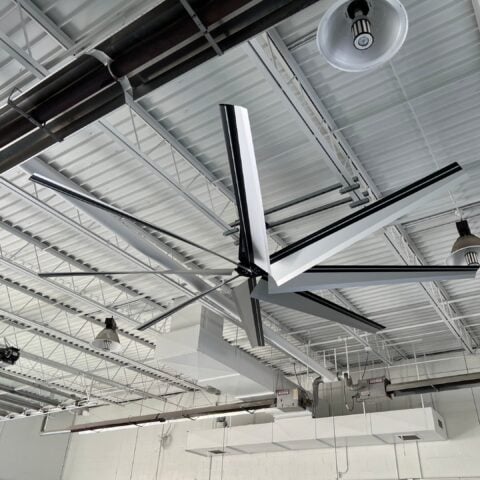
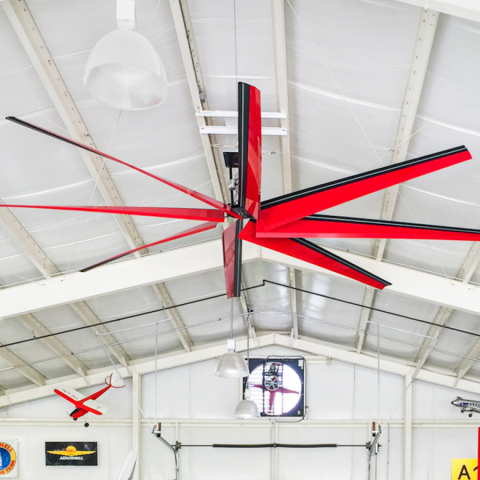
Industrial fans, particularly HVLS fans, are designed for large, open environments where moving air across the entire space is critical. These fans are commonly used in warehouses, manufacturing facilities, gymnasiums, aircraft hangars, and agricultural buildings. When used alongside HVAC systems, HVLS fans help destratify the air, reducing temperature differences between the floor and the ceiling. This allows heating and cooling systems to operate more efficiently, often resulting in energy savings in the range of 10-15% depending on building conditions and usage patterns.
Commercial and industrial fans both provide reliable air circulation, but selecting the right type directly impacts performance, energy usage, and long-term results. HVLS fans create consistent airflow by moving large volumes of air at low speeds, improving comfort without creating drafts. This process helps balance temperatures, reduce humidity buildup, and improve working conditions. Before selecting or replacing fans, evaluate the physical environment carefully. Ceiling height, structural obstructions, racking systems, and equipment placement all influence how air moves within the space and how effective a fan will be.
Common Applications and Recommended Fan Types
Understanding the application is one of the most important steps in selecting the right fan. Different environments have different airflow requirements, and choosing the wrong type can lead to poor performance or unnecessary costs.
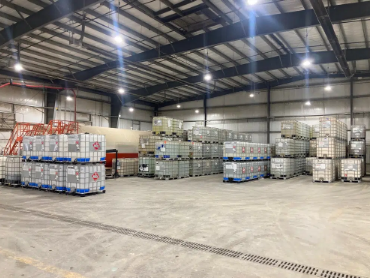
- Warehouses and Distribution Centers: HVLS fans are typically the best choice due to high ceilings and open floor plans. They provide full-space air circulation and help reduce heat buildup.
- Manufacturing Facilities: HVLS fans improve air movement across large production floors, helping with heat dissipation and worker comfort. In areas with specific processes, supplemental localized fans may also be used.
- Retail Stores and Offices: Commercial ceiling fans are often more appropriate due to lower ceilings and segmented layouts. They provide targeted airflow for occupant comfort.
- Restaurants and Hospitality Spaces: Commercial fans are used for comfort in dining areas, while larger open spaces may benefit from smaller HVLS units where ceiling height allows.
- Gyms and Sports Facilities: Both commercial and HVLS fans can be used, depending on ceiling height. Larger gymnasiums benefit from HVLS fans for full-court airflow.
- Agricultural Buildings and Barns: HVLS fans help regulate temperature and reduce moisture buildup, improving conditions for livestock and stored materials.
Fan Size Differences and Coverage
The key differences between traditional commercial fans and HVLS fans come down to blade diameter, airflow (CFM), coverage area, and overall efficiency. Square footage coverage indicates how much floor area a fan can effectively service, while CFM (cubic feet per minute) measures the volume of air it moves. Both metrics are critical when sizing a system correctly.
Commercial Ceiling Fans:
- Blade diameter typically ranges from 5 to 7 feet
- Lower CFM output, requiring multiple units for larger spaces
- Best suited for localized airflow and occupant comfort
- Ideal for ceilings under 15 to 20 feet
HVLS Ceiling Fans:
- Large blade diameters ranging from 10 to 24 feet
- High CFM output, allowing fewer fans to cover large areas
- Designed for full-space air circulation and destratification
- Most effective in spaces with ceilings above 20 feet
Because of these differences, a single HVLS fan can often replace multiple commercial ceiling fans, though not in a strict one-to-one ratio. The correct approach depends on ceiling height, total square footage, layout constraints, and airflow goals. Obstructions such as racking, machinery, or partitioned areas can impact airflow and may require adjustments to fan placement or quantity.
Key Considerations Before Selecting a Fan
- Ceiling Height: Determines whether HVLS fans are viable and how large they can be.
- Floor Layout: Open vs segmented spaces influence airflow patterns.
- Obstructions: Equipment, shelving, and structures can disrupt airflow.
- Airflow Goals: Comfort, temperature control, moisture reduction, or process support.
- HVAC Integration: Fans can improve efficiency when used alongside heating and cooling systems.
Taking the time to evaluate these factors ensures the selected fan system delivers consistent performance and long-term value. Proper sizing and placement are just as important as the type of fan chosen, and small adjustments in layout or selection can significantly impact results.