Explosion Proof Lights Supplied:
925-Year Maintenance Savings:
$13K+The Backstory of Toyota Indiana's Relationship With LED Lighting Supply
The project began when Toyota Motor Manufacturing Indiana's (TMMI) Environmental Engineer, Lisa Harmon, reached out to LED Lighting Supply. Lisa needed support in upgrading the company’s Princeton, Indiana auto assembly plant paint booth lights. A contractor working on a separate project at the plant had previously installed our explosion proof fixtures. Their team wanted to order additional replacement fixtures for an area outside of the paint booth. As the project progressed, the purchasing process was handled through Toyota’s distributor, C & E Advanced Technologies. The purchasing channel transferred from Toyota directly to the distributor, while we continued our role as the lighting supplier for the project.
The Challenge of the Hazardous Location Project
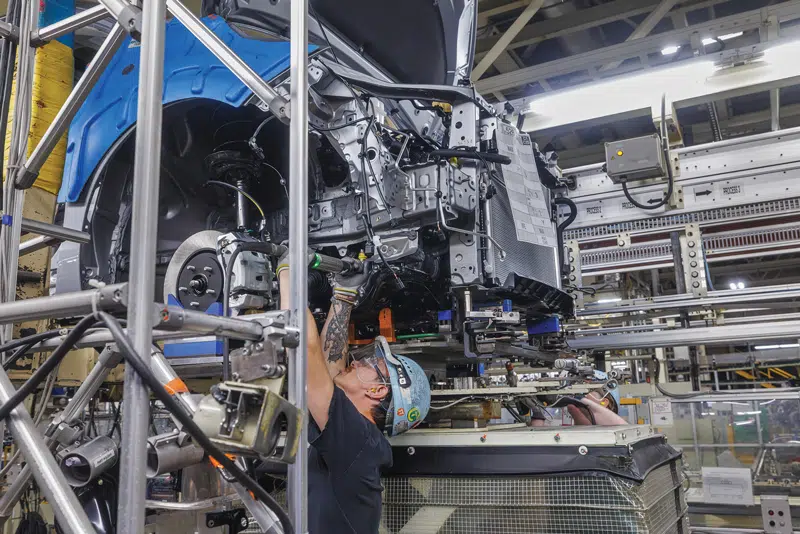
The TMMI plant paints vehicle materials, builds automotive bodies, welds panels, and assembles entire vehicles. Heavy-duty work like this creates an environment where flammable vapors may be present during normal operations. Every light fixture in a hazardous area is subject to classification. The legacy fluorescent lighting serving those spaces had reached the end of its useful life and was producing uneven light levels across the work area. The lighting solution needed to raise illumination levels while meeting the safety requirements for high-level assembly work.
The inconsistent light levels created by the traditional fluorescent T8 lighting in place raised potential risks:
- Safety risks to workers could arise if light fixtures, wiring, seals, or enclosures are not properly rated for C1D1 conditions. OSHA and NEC both treat these areas as spaces where a single ignition source can create a fire or explosion.
- Staff may experience reduced visibility. This can increase the chance of maintenance and production errors, hazards, and slower task completion.
- Inspection and quality-control errors can occur if lighting levels are too low or uneven for automotive manufacturing tasks.
- Operational disruption can occur if lighting failures happen in critical areas, forcing shutdowns, workarounds, or maintenance interventions.
- Exposure risk can occur if future replacements are not correctly matched with the original hazardous classification, temperature code, and installation method.
- The facility faces liability and compliance risks if equipment selection, documentation, or maintenance does not align with the location requirements.
* Hazardous location classification must be determined by a qualified engineer familiar with the specific facility and its processes. A licensed electrician should install to the classification that has already been established. LED Lighting Supply supplies fixtures to the classification our customers specify and does not perform area classification.
Hazardous location classification is site-specific. It depends on the materials in use, ventilation, enclosure design, and how far vapors travel during normal operations. Together, these factors determine whether a space is rated for Class I, Division 1 (C1D1) lighting, or Class I Division 2 lighting (C1D2). TMMI’s paint booth operation required a dependable, long-lasting lighting solution that could perform without fail while providing optimal visibility for workers.
LED Lighting Supply’s Custom Strategy and Solution
The customer initially requested linear light fixtures rated for C1D2. That was a reasonable starting point, given the shape of the lights already in place and the need to determine how the perimeter areas should be classified. After TMMI connected us to their distributor, our Product Specialist, Charlie DuBeau, guided the light fixture selection and placement for the hazardous area. The solution depended on LED Lighting Supply’s evaluation of the space.
Light level targets for automotive production environments range from about 50 foot candles (fc) for frame assembly, 100 fc for body/chassis or body parts assembly, and up to 200 fc for difficult assembly, finishing, and inspection. These values guided LED Lighting Supply when determining the correct light fixture options and layouts. The lighting upgrade needed to be rated with the correct class, group, and temperature rating for the environment. OSHA standard 29 CFR 1910.307 requires that hazardous areas be classified and equipment be approved for the specific location.
The existing T8 fluorescent lights were housed in explosion proof enclosures and placed outside the paint booth. This detail created uncertainty for the customer. They needed expert advice on whether they could relamp the existing light fixtures or if they needed to replace the fixture in its entirety. Explosion proof fixtures are certified as complete assemblies. The enclosure, seals, and light source are tested together. The UL listing applies to that specific combination. Changing the light source or disturbing the housing can impact the listing. LED Lighting Supply asked the necessary questions to determine whether simply swapping out the fluorescent tubes with LEDs would meet compliance requirements or if a one-for-one light fixture replacement was required.
As the conversation developed, the specification landed somewhere other than where it started. To ensure compliance and safety, TMMI opted for the one-for-one explosion proof lighting replacement. LED Lighting Supply recommended 150-watt round explosion proof LED light fixtures for the paint booth. Since these lights had previously been successfully implemented elsewhere in the facility, the customer was confident that they were the right solution for this project.
The Results of TMMI’s Explosion-Proof LED Upgrade
The explosion proof LED upgrade provides safe, uniform illumination in the hazardous paint booth area. The success of the first order drove Toyota to use the same light fixture model to fulfill the plant’s second and third orders. In total, 92 of the 150-watt explosion proof lights were placed across Toyota’s Indiana hazardous paint booth areas. The repeat purchase pattern shows the solution was able to support ongoing upgrades in the existing C1D1 workspace.
Toyota Motor Manufacturing Indiana Light Fixture Details
| Year | Light Fixture Type | Quantity | Project Type |
| 2021 | 150 Watt Round Explosion Proof LED Light (MLLG-E-LED-EXPLC-150-50-C1D1) | 32 | Initial paint booth order: Class I Division 1 area where atomized coatings and solvent vapors are present during normal operation. |
| 2022 | 150 Watt Round Explosion Proof LED Light (MLLG-E-LED-EXPLC-150-50-C1D1) | 12 | Expansion within existing classified area. Fill-in order extending coverage inside the same classified envelope. Order size points to targeted additions rather than a new zone. |
| 2023 | 150 Watt Round Explosion Proof LED Light (MLLG-E-LED-EXPLC-150-50-C1D1) | 48 | Additional classified paint areas. Largest order to date, applying the same fixture standard to additional classified paint operations beyond the original booth. |
Each LED fixture has a rated life of 50,000 hours at L70, meaning it still delivers at least 70 percent of its original light output at the 50,000-hour mark. Fluorescent T8 lamps generally fall between 20,000 and 30,000 hours depending on the lamp grade and ballast type. Fluorescent lamp life marks the point at which half the lamps in a test sample have burned out. The LED figure marks the point at which the light is still running, only dimmer than the day it was installed. This gap equates to roughly twice the service life per light fixture by transitioning to LEDs. Fluorescent lighting steadily loses light output while operating. Enclosed hazardous-location housings shorten the output even further. Doubling the light fixture life is projected to deliver meaningful maintenance savings over time.
Estimated Maintenance Savings From Choosing Our LED Lighting Solution
| Savings | Within 1 Year | Within 5 Years |
| Maintenance Savings | $6,440 | $13,953 |
* Maintenance savings are modeled at $70 per fixture in avoided service costs across 92 fixtures, calculated with LED Lighting Supply’s commercial LED savings calculator. Figures are projections based on fixture specifications and standard maintenance intervals. Actual results vary with operating hours, labor rates, and maintenance practices.
Implementing a custom hazardous-location LED solution allowed Toyota Motor Manufacturing Indiana to address both safety and performance in a single project. LED Lighting Supply’s expert support ensured the light fixture selection would be safe in the hazardous area while improving overall visibility.