Average Foot Candles Achieved:
91 fcTotal Number of Lights Supplied:
47The Backstory of Northern Illinois University’s Indoor Tennis Court Lighting Project
Northern Illinois University’s (NIU) Head Coach of the Division I Women's Tennis team, Eric Burns, contacted LED Lighting Supply for consultative guidance on an indoor tennis court lighting upgrade. NIU’s Nelson Tennis Center court layout consisted of 4 tennis courts in the Chick Evans Field House illuminated by a mixture of old and new LED fixtures. The lights produced harsh glare in players' eyes, while some of the older models started to fail.
Division I is the top competitive tier in the National Collegiate Athletic Association (NCAA). Athletes at this level train year-round and play a conference schedule that runs through the winter. This makes the facility the primary training and competition venue for months at a time.
Court lighting matters more at this level of competition. A Division I tennis serve travels fast enough that a player has a fraction of a second to pick up the ball, read its spin, and move. Glare during a serve toss or a dark ceiling behind an overhead shot costs the player that fraction of reaction time.
The Challenge of Illuminating Indoor Tennis Courts for Division I Athletes
NIU's tennis athletes were struggling with glare on the courts. They reported it was at its worst when they served the ball and when positioned along the edges of the courts. Coach Burns wanted to protect the investment they had recently made in the newer LED fixtures rather than replace the system outright.
Every light fixture in the sports complex was aimed straight down. The 48 newer linear LEDs were providing a bright, unshielded source directly in the players' line of sight. Above the courts is a domed concrete ceiling that receives almost no light.
That meant athletes were tracking a ball across a dark backdrop with bright hot spots in between. The lighting conditions on the courts raised several risks for players, coaches, and officials.
Lighting Plan Created for Northern Illinois University Indoor Tennis Facility
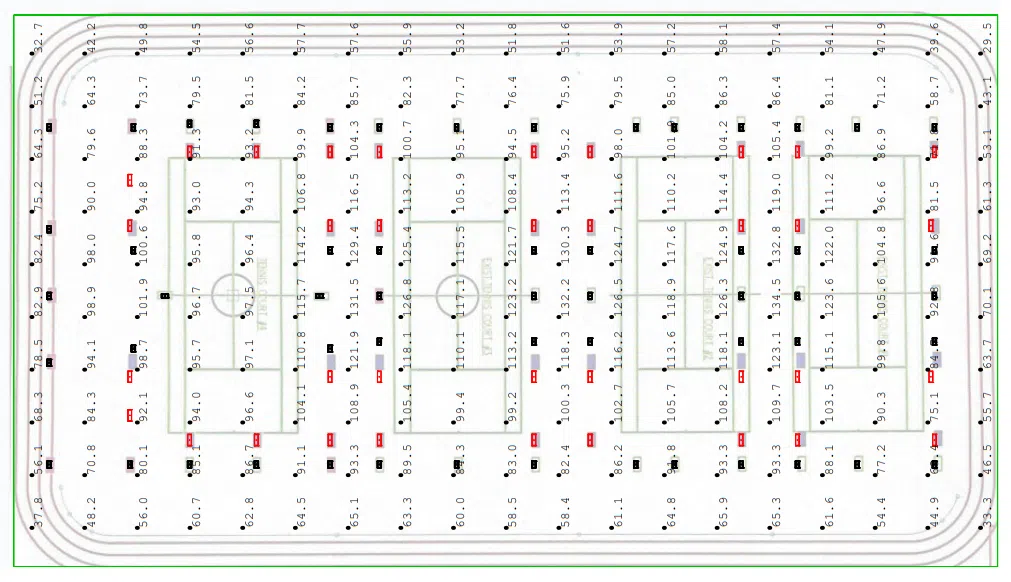
Lighting Plan Metrics:
- Mounting Height: 35 feet
- Average Foot Candles Achieved: 91 fc
- Uniformity (Min/Max fc): 4
- Product(s) Used: LLS-AG-HBLINR-300A-CC MLLG-X-LED-HBLIN6-(240/270/310)-CC-[V]
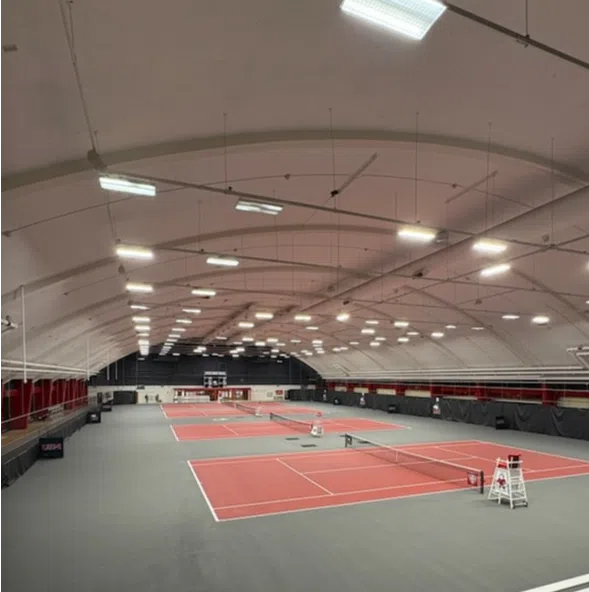
Before
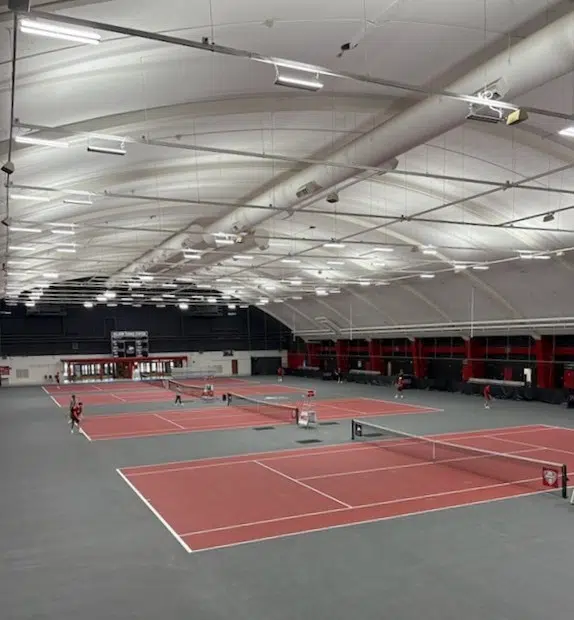
After
Potential Issues for Players
- Ball tracking suffers when a player looks up into an unshielded LED source during the serve toss, the one moment in a point when the eyes are fixed upward
- Contrast between bright lights and a dark ceiling forces constant pupil adjustment, which builds visual fatigue over a practice block or match
- Players positioned along the outside edges of the courts sit closest to the perimeter lights, putting them at the sharpest viewing angle to the glare source
- Mistimed contact from a lost ball raises the chance of wrist, shoulder, and elbow strain from off-center swings
- Failing older light fixtures create uneven light levels across the 4 courts, so conditions change depending on which court a player is assigned to
- Officials and coaches lose call accuracy when the ball crosses between a bright light and a dark ceiling
- Uneven output complicates video review and any broadcast or streaming coverage of home matches
College-level and televised indoor tennis calls for a light level of 90 to 120 foot candles (fc) on the playing surface. Before the upgrade, the facility averaged 58 to 70 fc across the 4 courts, leaving it below the benchmark for Division I competition. Uniformity and glare control matter more than lumen output. A player who cannot pick up the ball against the dark background is not helped when brightness is added in the same direction.
The recommended solution also had to work within the existing structural capacity. Mounting the lights at 35 feet in an older field house required verification that the existing tracks and structure could support the added light fixture weight.
The Strategy and Solution of Incorporating Indirect Lighting
Coach Burns connected with LED Lighting Supply Product Specialist, Mike Redmond, for one-on-one assistance. The Assistant Athletic Director, Matt Gonzales, also joined the project planning. The initial consultation gathered the details needed to determine a light fixture recommendation for an indoor athletic facility. That included the court count, layout, building dimensions of 260 x 164 x 36 feet, the ceiling material and finish, and the main areas on the courts where athletes reported the problem.
The tennis court lighting project started with a sample order so the team could evaluate the effect before committing to the full upgrade. The order included a 500-watt linear high bay and a rotatable 300-watt linear high bay so that the team could familiarize themselves with both recommendations.
After testing both light fixture options, Coach Burns told us what he thought,
“I love how it lights up the ceiling. That’s going to be very helpful.”
This feedback pointed directly at the rotatable 300-watt lighting unit. The rotatable feature allows you to aim the light up at the ceiling, where it reflects across the courts as a broad, soft source. The facility also has sufficient distance between the light fixtures and the ceiling for the light to spread before it reflects.
From there, our team created a photometric lighting plan to illustrate how the light levels would appear on the courts. The consensus was to supplement the existing LED lights with a series of indirect LED fixtures. This would reduce the glare issue without completely replacing all the existing lights.
The plan placed 36 rotatable 300-watt linear high bays throughout the middle of each court, with 11 wattage-adjustable linear high bays placed around the main perimeters. The layout kept direct light fixtures out of the areas where players look most often during play, delivering uniform light across all 4 courts.
The adjustable lights run at 240, 270, or 310 watts. More output is not automatically better in a space where glare is the main problem. Our team compared the options, and the layout confirmed the lower wattage was the right call. Running those lights at 240 watts alongside the uplighting system kept the target light levels on the courts without reintroducing the glare that had impacted player performance.
Consultative support extended beyond the purchase. When Coach Burns asked for guidance on the ideal way to mount the lights in an older building, we informed him the lights could be installed using the existing tracks and the included chains. This avoided drilling new attachment points into the dome structure.
NIU tennis standard facility requirements are governed by the Intercollegiate Tennis Association (ITA) and general NCAA conference guidelines.
Electrical Note: All the work should be performed by a licensed electrician in accordance with the National Electrical Code and local amendments.
The NIU tennis courts kept most of the existing linear LED lights. The gain in uniform light levels came from adding uplighting to the system rather than replacing it. This is what Coach Burns wanted from the first conversation.
The Results of an Indirect Tennis Court Lighting Upgrade
After the uplight fixtures were installed and a few existing linear light locations were adjusted, the light levels on the courts now reach 91 fc. That moves the 4 courts from below the benchmark for college tennis requirements into the 90 to 120 fc range recommended for college and televised indoor play. Upgrading from the first- or second-generation LEDs to modern high-efficiency LEDs also cuts energy use by 50%.
What the players noticed first was the ceiling. The coach reported that athletes pointed out how bright the large domed ceiling looks now, and the uplighting makes the facility feel taller. That reaction is the reflected light doing its job. The dome went from a dark backdrop that made a bright light painful to look at, into a lit surface that returns light evenly across the courts.
Lighting the dome removed the contrast that forced constant eye adjustment, easing the visual fatigue that built over a two-hour block. A player following a ball on the serve toss is now looking at an illuminated ceiling rather than into darkness.