


Industrial Drum Fans
- Reduce energy costs up to 15% with high-efficiency motors
- Temperature controld improves workplace safety ratings significantly
- Plug-and-play installation with mobile casters minimizes downtime costs



Our Industrial Drum Fans include portable high-velocity floor fans, barrel fans, and industrial air circulators for warehouses, factories, garages, and other large work areas. Available units feature cylindrical housings with high-performance blades that move large volumes of air horizontally. Product configurations include high-torque motors, Permanent Magnet Synchronous Motors (PMSM), aerodynamic blade wingtips, and variable-speed operation. Integrated caster wheels allow portable models to be repositioned throughout a facility, while plug-and-play designs provide straightforward setup.
Common applications for these fans include warehouses, manufacturing facilities, automotive shops, garages, machinery areas, production floors, and large storage spaces. Drum and floor fan configurations provide concentrated or widespread airflow across expansive areas, including workstations and locations with heat pockets or moisture accumulation. These industrial fans can also be integrated with existing air conditioning and ventilation systems for additional air movement. Heavy-duty drum fan models are available for industrial environments, while variable-speed configurations provide adjustable airflow intensity and operating noise levels.
-
 Starting At $2,415.28
-
Starting At $2,996.35
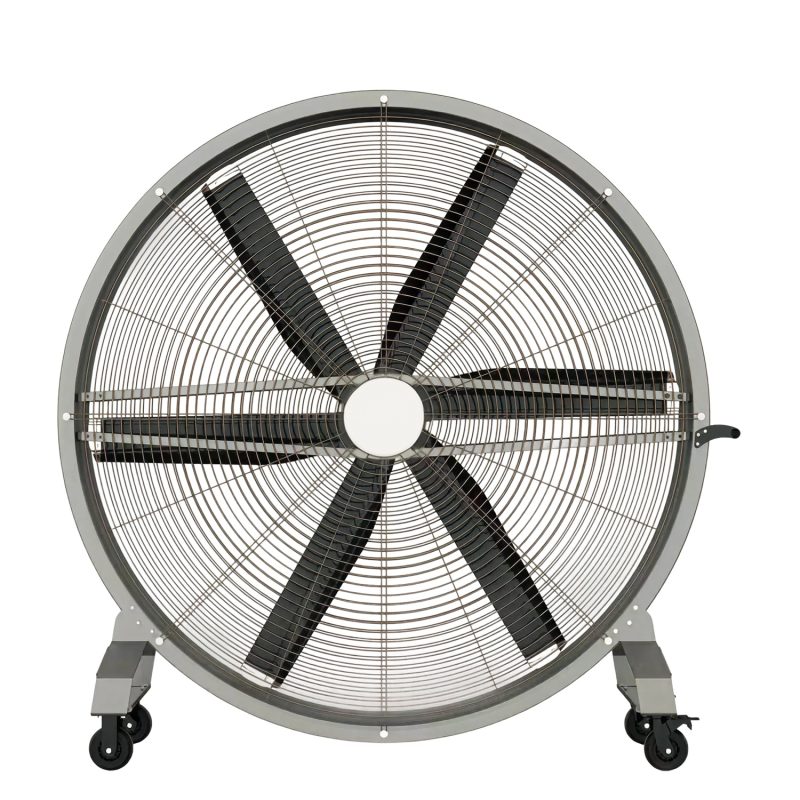
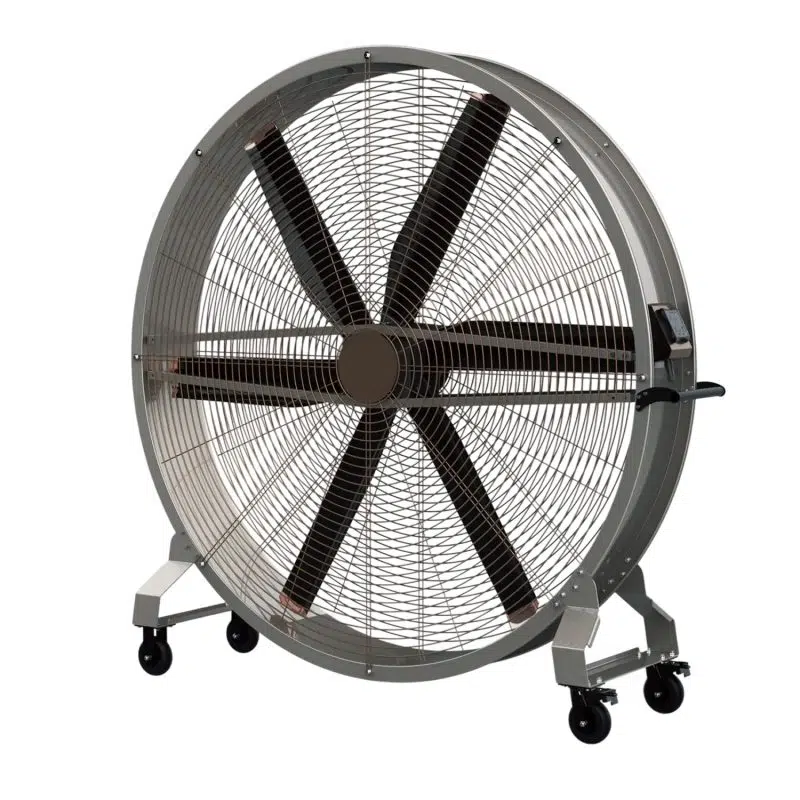
Industrial drum fans provide portable, directional air movement for warehouses, factories, garages, workshops, loading areas, gyms, event spaces, maintenance projects, and other locations where fixed fans are not practical. Also called barrel fans or high-velocity floor fans, these units can be moved as work areas, equipment, occupancy, and airflow needs change.
The correct drum fan depends on the required airflow, discharge distance, fan diameter, operating speed, electrical service, mobility, sound, floor conditions, environmental exposure, and the location of workers, equipment, vehicles, doors, and ventilation systems.
Selection Note: Industrial drum fans move indoor air but do not independently lower the actual room temperature, provide outdoor-air ventilation, remove airborne contaminants, control humidity, or replace HVAC, local exhaust, filtration, dehumidification, process cooling, or workplace heat-risk controls.
How to Select an Industrial Drum Fan
| Selection Factor | What to Confirm |
|---|---|
| Airflow objective | Determine whether the fan will provide general work-area circulation, directed airflow toward an occupied zone, temporary drying support, or air movement during maintenance and loading activity. |
| Fan diameter and airflow | Compare model-specific fan diameter, airflow, speed settings, discharge pattern, and published performance data rather than selecting by room square footage alone. |
| Air throw and distance | Estimate how far the fan must move useful air and identify racks, machinery, walls, vehicles, partitions, and stored materials that may block or redirect airflow. |
| Occupied work area | Identify whether employees will be standing, seated, performing detailed work, handling lightweight materials, or remaining in the airflow for extended periods. |
| Mobility | Review fan weight, wheel size, handles, frame design, locking features, and whether the unit can be repositioned safely across the facility’s floor surfaces. |
| Tilt and direction | Confirm whether the fan angle can be adjusted and whether the frame holds the selected direction securely during operation. |
| Speed control | Determine whether fixed-speed or variable-speed operation is needed to balance airflow, sound, energy use, and draft sensitivity. |
| Sound requirements | Use published model-specific sound information for workstations, offices, gyms, event areas, communication-sensitive zones, and other occupied spaces. |
| Electrical service | Confirm voltage, current draw, plug type, receptacle, circuit capacity, cord length, extension-cord restrictions, grounding, and any GFCI requirements. |
| Floor and traffic conditions | Review floor slope, vibration, debris, water, forklift routes, vehicle traffic, pedestrian paths, doors, and temporary work-zone boundaries. |
| Dust and process hazards | Determine whether airflow could spread dust, smoke, fumes, vapors, aerosols, sparks, loose packaging, or process contaminants into occupied areas. |
| Environmental exposure | Identify moisture, washdown, rain, corrosion, chemicals, high or low ambient temperatures, and hazardous-location requirements. |
| Guarding and access | Verify intake and discharge guards, blade access protection, clearance from clothing and materials, and suitability for public or supervised areas. |
| Maintenance | Plan how blades, guards, housings, wheels, handles, cords, plugs, switches, and motors will be inspected and cleaned. |
| Product documentation | Verify airflow, electrical specifications, controls, approved environment, duty rating, installation or assembly instructions, maintenance schedule, safety listing, and warranty. |
Drum Fans Compared With Other Industrial Fan Types
| Fan Type | Typical Use |
|---|---|
| Industrial Drum Fans | Portable, high-volume directional airflow across open work areas, loading zones, garages, workshops, gyms, event spaces, and temporary project locations. |
| Pedestal Fans | Elevated, adjustable airflow toward workstations, assembly areas, service counters, or smaller occupied zones. |
| Wall-Mounted Fans | Fixed directional airflow where floor space is limited or a permanently mounted fan is preferred. |
| Commercial Ceiling Fans | General circulation across standard commercial rooms and smaller industrial support spaces with suitable ceilings and mounting structure. |
| HVLS Fans | Broad, low-speed air movement across large open areas with high ceilings and adequate overhead clearances. |
| Exhaust and Ventilation Equipment | Outdoor-air exchange, contaminant removal, source capture, filtration, and pressure control when properly designed for the process or building. |
Drum fans are often selected when portability and concentrated horizontal airflow are more important than permanent installation. They may also supplement ceiling or wall-mounted fans in facilities with changing work zones, but they should not be treated as substitutes for required ventilation, exhaust, or cooling systems.
Warehouses, Loading Areas, and Distribution Facilities
Drum fans can be repositioned near packing stations, staging areas, dock work zones, maintenance locations, and other occupied areas as warehouse needs change. Fan placement should account for rack rows, forklifts, pallet movement, loading doors, conveyors, storage changes, and pedestrian traffic.
Airflow should not disturb loose labels, stretch wrap, cartons, paper, lightweight packaging, powders, or small components. A fan positioned for maximum distance may not be appropriate near a detailed packing or inspection task.
Loading doors and dock activity create changing air patterns. Drum fans may support local air movement, but they do not prevent outdoor-air infiltration or replace dock heaters, air curtains, ventilation, cooling, or building-pressure controls.
Factories, Workshops, and Equipment Areas
In manufacturing and workshop settings, drum fans may direct airflow toward assembly stations, maintenance areas, service bays, or other occupied zones. Placement should be reviewed around machinery, cutting or grinding operations, welding, painting, chemicals, process heat, and local exhaust systems.
Do not direct airflow in a way that spreads sparks, metal particles, dust, smoke, fumes, vapors, or aerosols. Fan airflow may also interfere with welding shielding gas, paint application, laboratory processes, fume extraction, or dust collection.
A drum fan should not be relied upon to keep machinery, electrical equipment, batteries, or process components within their approved operating temperatures. Equipment-cooling requirements should follow the equipment manufacturer’s instructions.
Garages, Automotive Shops, and Service Bays
Portable drum fans can support air movement in service bays, detailing areas, tire shops, maintenance garages, and other automotive workspaces. Fan placement should remain clear of lifts, vehicles, exhaust hoses, tools, cords, fluids, and active traffic routes.
Standard drum fans should not be assumed suitable around fuel vapors, solvent use, spray finishing, battery charging, flammable liquids, or other potentially hazardous atmospheres. Review the area classification and approved equipment requirements before operating electrical fans in these locations.
Vehicle exhaust must be handled through suitable source-capture and ventilation systems. A drum fan may move exhaust gases farther through the building rather than remove them.
Gyms, Events, and Public-Facing Spaces
Drum fans may provide temporary or adjustable airflow in weight rooms, training areas, indoor events, assembly spaces, and other occupied facilities. Their portability can be useful when layouts change, but stronger airflow and fan sound may not be appropriate near every occupant or activity.
In public or supervised spaces, verify guarding, cord routing, fan stability, control access, and separation from children, spectators, athletes, equipment, decorations, and temporary seating.
Airflow should not interfere with sports equipment, lightweight signs, curtains, audio systems, event materials, or emergency access routes.
Temporary Drying and Restoration Applications
Air movement may help moisture evaporate from exposed surfaces when temperature, humidity, and ventilation conditions support drying. Drum fans may be used during maintenance, cleaning, water-damage response, floor finishing, or renovation when the selected product and environment are suitable.
A fan does not independently remove moisture from the building. Effective drying may also require dehumidification, outdoor-air exchange, heating, extraction, moisture monitoring, and correction of the underlying water source.
Do not use a standard fan where standing water, electrical hazards, contaminated water, mold remediation, hazardous dust, or flammable vapors require specialized procedures and approved equipment.
Airflow Direction, Placement, and Obstructions
Drum fans produce concentrated airflow from a floor-level position. Their effectiveness depends on where the fan is placed, the direction of discharge, the operating speed, and the objects between the fan and the target zone.
Position the fan on a stable surface where the intake and discharge remain clear. Avoid placing it where clothing, plastic sheeting, paper, dust, tools, or other materials may be drawn into the guard or blown across the work area.
Do not assume that pointing multiple fans in the same direction will improve performance. Poorly coordinated fans may create turbulence, recirculation, or conflicting air patterns. Where multiple units are used, observe the actual airflow and adjust placement and speed for the occupied area and task.
Dust, Fumes, Vapors, and Hazardous Locations
Air movement can redistribute contaminants. Before using a drum fan, identify whether the area contains combustible dust, flammable gases, vapors, smoke, welding fumes, paint mist, chemical aerosols, biological contaminants, or other materials that should be captured or contained.
Standard industrial drum fans should not be assumed suitable for classified hazardous locations. Equipment used in these areas must carry the appropriate approval for the specific class, division, zone, group, temperature code, and environmental conditions.
Fan placement should support rather than interfere with local exhaust, dust collection, spray booths, fume extraction, isolation zones, and other process controls. An industrial hygienist, ventilation professional, fire-protection professional, or other qualified specialist may be needed for hazardous or contaminant-producing processes.
Electrical Service, Cords, and Safe Floor Placement
Electrical requirements vary by drum fan. Before use, confirm the selected model’s voltage, current draw, plug configuration, grounding, circuit capacity, cord length, and approved operating environment.
Use receptacles, extension cords, adapters, and GFCI protection only as permitted by the manufacturer and applicable electrical requirements. Undersized or damaged cords may overheat, create voltage drop, or present shock and fire hazards.
Route cords away from forklifts, vehicles, doorways, sharp edges, liquids, heated surfaces, and pedestrian traffic. Where a cord crosses a work area, protect it using an appropriate routing or guarding method.
Place the fan on a stable, level surface. Lock wheels or use provided stabilizing features when available. Do not position portable fans where they could roll, tip, vibrate into equipment, or block aisles and emergency routes.
Motors, Controls, Mobility, and Sound
Drum fan construction varies by model. Products may use direct-drive, belt-drive, AC, permanent-magnet, or other motor and drive configurations. Fan diameter, airflow, speed range, power use, sound, weight, wheel design, tilt adjustment, guards, and controls should be reviewed using the selected product’s documentation.
| Product Feature | What to Review |
|---|---|
| Motor and drive | Confirm motor type, drive configuration, voltage, current draw, duty rating, service requirements, and approved environment. |
| Speed settings | Determine whether fixed speeds or variable-speed control are needed for the required airflow, sound, and task. |
| Tilt adjustment | Verify the available discharge angles and how securely the fan holds its selected position. |
| Wheels and handles | Review wheel diameter, floor compatibility, locking features, handle location, total weight, and movement through doors or between work zones. |
| Guards | Confirm intake and discharge guarding, spacing, attachment, and suitability for the intended work or public environment. |
| Sound | Use published sound data at relevant speeds and consider communication, concentration, alarms, and nearby occupied areas. |
Cleaning, Inspection, and Maintenance
Dust, fibers, grease, and debris can collect on fan blades, guards, housings, motors, wheels, and controls. Cleaning frequency should reflect the environment, operating hours, and manufacturer’s instructions.
Before cleaning or inspection, disconnect the fan from power and follow the manufacturer’s lockout, servicing, and reassembly instructions. Do not operate the fan with missing guards, damaged blades, loose fasteners, worn cords, defective switches, unstable wheels, or unusual vibration or sound.
Use only cleaning products and methods approved for the fan’s materials, finish, motor, controls, and electrical components. Inspection and maintenance intervals should follow the selected manufacturer’s instructions rather than a universal schedule.
Common Industrial Drum Fan Selection Mistakes
- Selecting by diameter alone: Airflow, discharge pattern, speed, air throw, obstructions, sound, and electrical requirements also affect performance.
- Treating air movement as cooling: Drum fans may improve perceived comfort but do not lower the actual room temperature by themselves.
- Using a fan as ventilation: Portable fans do not independently provide outdoor air, filtration, source capture, or contaminant removal.
- Ignoring dust, fumes, or vapors: Strong airflow may spread contaminants or interfere with local exhaust and process controls.
- Using a standard fan in a hazardous area: Classified locations require equipment approved for the specific hazard and environment.
- Creating cord and traffic hazards: Poor cord routing or unstable placement may interfere with pedestrians, forklifts, vehicles, doors, or emergency paths.
- Assuming every fan is quiet: Sound varies by model, speed, motor, blade design, guard, and surrounding environment.
- Overlooking lightweight materials: Airflow may disturb packaging, dust, labels, paper, plastic sheeting, curtains, and small components.
- Assuming all fans are suitable outdoors: Rain, moisture, washdown, corrosion, and temperature exposure require model-specific approvals.
- Using fixed energy-savings estimates: Operating costs and potential HVAC effects depend on fan power, hours, controls, climate, building systems, and actual use.
Industrial Drum Fan Selection Support
LED Lighting Supply can help compare drum fan options using the application, required airflow, target distance, work-zone dimensions, obstructions, electrical service, environmental conditions, mobility needs, sound requirements, and operating schedule.
You can use our Fan Electricity Consumption Calculator to estimate fan operating cost using the selected model’s power input, expected operating hours, and local electricity rate. Calculator results do not account for demand charges, HVAC interaction, changes in operating practices, or other facility energy use.
Portable drum-fan placement is usually adjusted in the field as work areas and tasks change. Any preliminary placement guidance should be verified under actual operating conditions and revised when racks, equipment, vehicles, occupancy, ventilation, or processes change.
Certifications, Environmental Ratings, and Warranty
Safety listings, voltage options, controls, environmental ratings, duty ratings, maintenance requirements, and warranties vary by drum fan model. Depending on the selected product, electrical safety documentation may include a UL, ETL, MET, CSA, or other recognized listing.
Electrical safety listings, outdoor approval, damp- or wet-location ratings, ingress ratings, corrosion resistance, hazardous-location approvals, ambient-temperature limits, and warranty coverage address different product characteristics and should be reviewed separately.
Before ordering, confirm the selected fan’s airflow, speed settings, electrical specifications, plug and cord, sound data, dimensions, weight, mobility features, guards, approved operating environment, maintenance requirements, and warranty terms.
Need Help Selecting an Industrial Drum Fan?
Contact LED Lighting Supply and provide the application, work-zone dimensions, required airflow distance, photographs, obstructions, occupied areas, electrical service, environmental conditions, mobility needs, sound requirements, and operating schedule when available.
Our Product Specialists can help compare available fan diameters, airflow levels, speed controls, motors, frames, wheels, guards, electrical configurations, and environmental ratings. Final electrical requirements, workplace placement, ventilation and exhaust needs, hazardous-location suitability, process safety, industrial hygiene, and code compliance should be confirmed by the appropriate electrical, mechanical, industrial hygiene, fire-protection, safety, or code professionals when required.
Industrial Drum Fans FAQs
How Do I Choose The Right Industrial Drum Fan?
Choose a drum fan by matching model-specific airflow, discharge distance, diameter, speed control, electrical service, mobility, sound, and environmental approval to the work area. Also account for obstructions, occupied zones, lightweight materials, traffic routes, and whether the fan can be positioned safely on the available floor surface.
Are Industrial Drum Fans A Substitute For Ventilation Or Cooling Systems?
No. Industrial drum fans move indoor air but do not independently lower room temperature, provide outdoor-air ventilation, remove contaminants, control humidity, or replace HVAC, exhaust, filtration, dehumidification, or process cooling systems.
When Should I Choose A Drum Fan Instead Of A Wall, Pedestal, Or HVLS Fan?
Choose a drum fan when portable, concentrated horizontal airflow is more important than permanent installation. Pedestal fans suit elevated airflow toward smaller zones, wall fans preserve floor space, and HVLS fans provide broad low-speed air movement across large open areas with adequate ceiling clearance.
Can Industrial Drum Fans Be Used Around Dust, Fumes, Or Hazardous Locations?
Standard industrial drum fans should not be assumed suitable where combustible dust, flammable gases, vapors, smoke, fumes, paint mist, or other contaminants are present. Airflow can redistribute contaminants, and classified locations require equipment approved for the specific hazard, environment, and applicable classification.
What Should I Check Before Using A Drum Fan In A Warehouse Or Loading Area?
Check rack rows, forklifts, pallets, conveyors, loading doors, pedestrian routes, cords, and materials that could block or be disturbed by airflow. Fan placement should support the occupied work zone without blowing loose packaging, labels, paper, stretch wrap, powders, or small components across the area.
Can An Industrial Drum Fan Help With Temporary Drying?
Yes, air movement may help exposed surfaces dry when temperature, humidity, and ventilation conditions support evaporation. A drum fan does not remove moisture from the building, and drying may also require dehumidification, outdoor-air exchange, heating, extraction, moisture monitoring, and correction of the water source.