Lighting Audit Checklist
If you’re a facilities manager, you likely perform periodic checkups of the heavy machinery and other equipment that you use daily. But there might be a large aspect of your daily operating equipment that you’ve unintentionally forgotten. In both commercial and industrial facilities, the lighting used can be a significant energy draw. These are often vast spaces that need to be illuminated for long periods of time.
Sometimes, even for the entire 24-hour day. If you’re currently using LED lights (or in the process of switching to LEDs), you’ve already taken a significant step toward reducing your energy costs when the system is properly selected, installed, and controlled. However, lighting that is damaged, poorly maintained, incorrectly controlled, or no longer suited to the space can waste energy or provide inadequate light. For owners of commercial spaces like warehouses, a lighting audit may be important before converting to LED warehouse lighting.
Thankfully, there’s an effective way to evaluate whether your commercial LED lighting or industrial LED lighting is functioning as intended: a lighting audit.
What is a Lighting Audit?
A lighting audit is an in-person analysis of a building or site that documents the existing lighting system and identifies opportunities to improve energy use, maintenance, controls, light levels, and lighting quality. The audit can be conducted in indoor and outdoor spaces.
General Information Needed
Basic info includes:
- Floor and ceiling plans showing current fixture locations
- Space dimensions (Length x Width x Ceiling Height)
- Future renovation plans if they exist
Financial Information Needed
The last type of information needed is financial. Utility bills, electricity rates, energy consumption in kWh, and demand charges in kW where applicable can help estimate existing operating costs at the facility. From there, you can estimate potential energy and maintenance savings from an upgrade project. Actual savings depend on operating hours, utility rates, controls, the selected equipment, and installation conditions.
There are many reasons why you might want to change the lights in your business or building.
Perhaps you are looking for ways to lower your electric bill. Maybe you want to improve your customer experience through fine details, or maybe you have realized that your current lighting fixtures are not the right fit for your workers and business in general.
Whatever your reasons may be, this may be the right time to evaluate ineffective or costly lighting and find an appropriate solution for your business’s needs. However, to make the most out of this project, you will need to perform a lighting audit.
Lighting Information Needed
You will need to collect the lighting specifications for each area. This information can include:
- # of fixtures
- Type of fixtures
- How many lamps and/or ballasts are there in each fixture?
- Type of lamps or ballasts used
- Wattage of each model of fixture used
- What is the space used for?
- How many hours per day is the space used for?
- At what height are tasks performed?
- How much natural daylight is there?
Occupant Information
It is useful to know how the existing lighting system is perceived. This type of insight can be pivotal to understanding the pain points for your customer. This step can involve surveying employees or management. Great questions to ask include:
- Do occupants experience glare on their screens?
- Is the lighting too dim to work effectively?
- Do occupants report excessive heat, glare, or discomfort near fixtures or daylight openings?
How to Perform a Lighting Audit
If your business facility has lots of lights, you need a detailed plan. Just visiting the local home improvement store won’t cut it.
Shopping without a plan may result in you ending up with lights that may not be as cost-efficient as you need them to be, will look out of place at your site, and may not save you as much energy as expected. For this very reason, it’s important to perform a lighting audit. This process will help you estimate your lighting retrofit scope and evaluate your project’s potential ROI (return on investment).

Determine Your Objective
Before you start calculating how many bulbs you would need to buy, you need to consider your goals and objectives and be clear about what you’re looking to achieve with this lighting outfitting. Lighting retrofits can achieve a diverse array of goals; however, the best upgrades have highly specific objectives.
The savviest business owners have already determined what they want to achieve with this upgrade before starting the project.
- Are you looking for ways to reduce your energy bill and save energy?
- Are you hoping to reduce your maintenance costs?
- Is the lighting too strong or too soft?
- Do you want to improve your lighting quality? Do you want lighting in another color?
All these concerns should be tackled in any project of this kind. The first step of your audit should be determining which one of these goals you want to achieve:
- Save Energy
- Reduce Maintenance Costs
- Improve Light Levels
- Boost Light Quality
- Change Light Color
When deciding which objective to tackle, spend some time analyzing its importance for your business and ranking it. The next step is to determine the level of change you’re looking to achieve. For instance, do you want to dramatically increase the quality of your lights or slightly improve their effectiveness?
Mapping out your needs this way can help you determine the crucial parts of your project and focus more on them. This is also a highly recommended exercise to do if you’re collaborating with a lighting contractor with extensive experience in the field.
By categorizing your needs by their importance and determining the degree of change you would want to see in your facility, you’ll significantly help your contractor to get an idea of what exactly you need so they can create a detailed course of action. If you plan on undertaking this project yourself, this step will help you start on the right foot and create momentum to get most of the work done.
Gather Your Tools
Once you have determined your main goal for this project, you should start gathering some valid data. However, you first need to be equipped with the proper tools for the job. If you’re dealing with a medium-sized facility, counting all the fixtures with your fingers is simply not going to cut it. Similarly, you can’t just hope you’ll remember all the kinds of lights you have, their exact location, and their output. At this point in your project, you will have to start using some basic tools. Luckily, this ensemble is very small. Here are your essential tools:
- High Resolution Digital Camera
- Tape Measure
- Digital Laser Measure
- Light Meter
- Lighting Audit Form
You can start with your phone’s camera. Take a photo of each type of light you have installed. Take shots from various angles in the areas where your employees work. Capture every model of fixture up close so that you will know the exact types you have. You should also take some point-of-view shots of all your rooms or floors so that you can compare how they looked before the remodeling and how they look after. Buy a digital laser and a tape measure to get the exact dimensions. This is particularly important if you can’t access any drawings or floor plans of your facility.
For best results, it is important that you know the length and width of every area as well as the distance between the floors and lights. You can use a light meter to accurately measure illuminance levels in your facility. This will help you determine whether you will want to decrease, increase, or maintain those levels with your new lighting fixtures. A light meter may read in foot-candles or lux, which measure illuminance at the meter’s location, typically on the task plane.
Finally, the most important part of this project is the audit form. With this piece of paper, you should note every piece of information about your lighting system you deem important. You should write down the number of fixtures, how many of each type you have, the current and desired light quality and level, and the preferred color characteristics.
As mentioned before, if you’re collaborating with an experienced contractor, this piece of paper will be a great starting point for them as well. However, if you don’t have this form, a lighting contractor may do their own audit and handle these details. Take a look at the lighting worksheets below that you can use if you want to change the lighting in your facility. Regardless of whether you plan on working with your employees or want to employ a commercial lighting contractor, these forms can help kickstart your project and help you manage it more efficiently.

If your facility doesn’t have a great variety of fixtures, you will need only this worksheet. Just write down the information for each lamp together with the rough hours it is used every month. This will help you evaluate how much energy your current lighting fixtures consume and estimate how much energy an LED lighting upgrade may save over time.
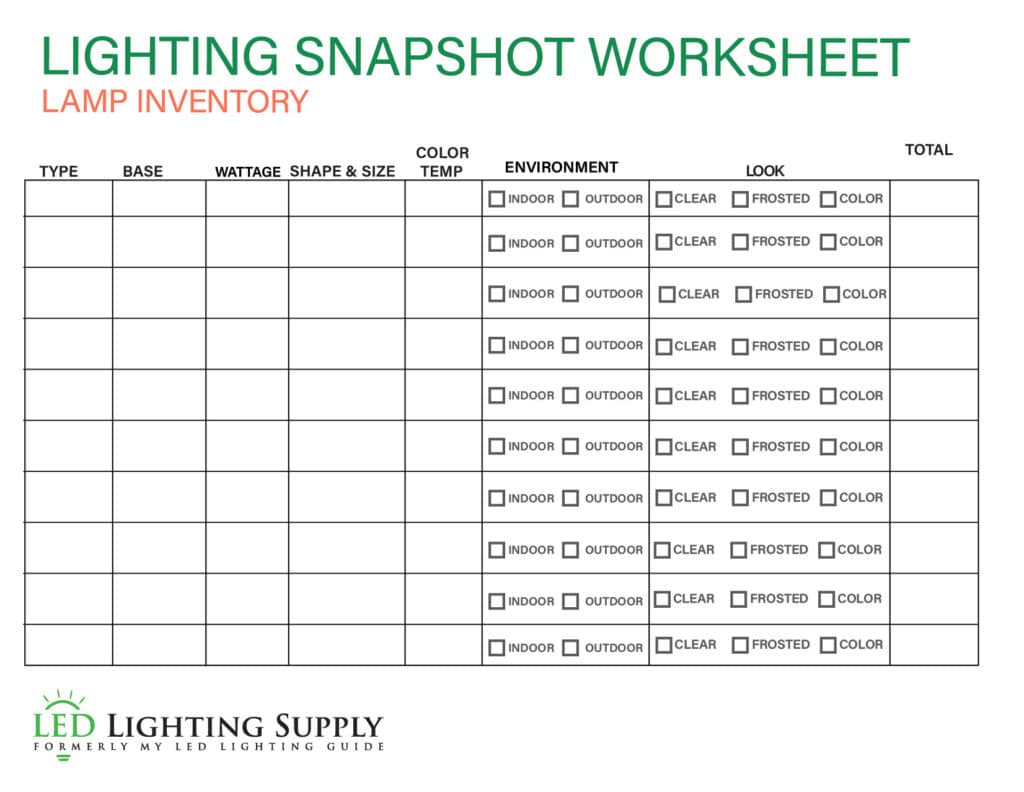
If your business has a diverse range of lamps, using this worksheet together with the Room Count worksheet will help you inventory your facility. Make sure to note each lamp type you have and give it a reference number, which you will use in the Room Count. This will help you to keep track of the kinds of lights you have in each area.
Get Exact Numbers
“The most important part of conducting a lighting audit is writing down the exact number of fixtures, the right lamp and wattage types in every fixture, as well as the ‘burn hours’ for each light, and not just the business’s hours of operation” – The FSG Albuquerque Branch Manager, Billy Ramirez. The truth of the matter is, in most facilities, lights are kept on much longer than during normal business hours.
Many employees come to work earlier and leave later than others. Plus, in some companies, the cleaning and maintenance teams work during the night. Also, some facilities work throughout the weekend, although they are officially closed. And during all those extra hours, the lights are on.
So, when you are trying to figure out how many hours exactly you and your employees use the lights, consider their actual pattern of use. Accurate operating hours are important for estimating energy use, maintenance intervals, and the expected service life of a proposed system. You would be wrong if you simply multiply nine hours a day by five days a week. There are also a couple of other figures and information that you should keep in mind when doing your calculations:
- Financial Information (your electricity bills)
- Facility Information (drawings, floor plans, exact locations of HVAC, exit points, controls, and equipment rooms)
- Occupant Information (burn hours, problem areas, etc.)
The more usable information you have after the audit, the better the beginning of your project will be. This way, you will gather the information needed to improve the lighting in your business yourself or give this information to an experienced contractor to help scope the project.
Here’s an extensive list of the important considerations you’ll want to include in your lighting audit:
- Hours of Operation
- Burn Hours
- # of Fixtures
- Lighting Controls for Each Area
- Input Voltage
- # of Lamps per Fixture
- # of Lamps per Ballast
- Type of Lamps and Ballast
- Are there reflectors, lenses, wire guards, or emergency ballasts?
- What is the condition of the fixtures, failed lamps, or systems?
- Are the fixtures air handlers?
- How much daylight is there?
- What tasks are performed in the space, and what light levels are appropriate for those tasks?
- Are partitions used? Do they block any light?
- Are there unique fixtures or physical features, such as areas with an established hazardous-location classification?
- What is the ceiling type?
- What are the space dimensions?
- At what height are tasks completed?
- Are there any obstructions besides partitions?
- What is the fixture mounting height?
- How are the fixtures mounted?
- Are the walls or floors reflective? If so, what color are they and how reflective?
Making Changes After a Lighting Audit
A lighting audit should identify weaknesses or improvement opportunities in your facility’s lighting. In some cases, the audit may show that existing fluorescent, metal halide, or other HID lighting has excessive energy use, poor maintenance history, inadequate light levels, poor uniformity, or unsuitable color quality. In other cases, existing lighting may still be appropriate for the space and only require maintenance, controls, or targeted changes.
LED lighting can offer higher luminaire efficacy, longer rated life, controllability, and reduced maintenance compared with many older lighting systems. Actual results depend on the existing installation and the selected LED fixture, including its photometric distribution, lumen output, color quality, controls compatibility, ambient-temperature rating, and installation conditions. A photometric lighting plan using fixture-specific IES data can help confirm light levels, uniformity, and fixture placement before an upgrade.
Even facilities using LED lighting benefit from periodic audits. Drivers, controls, sensors, lenses, mounting conditions, and changing space layouts can affect system performance over time. Review the manufacturer’s published rated life, warranty, lumen-maintenance data, and application limits for the exact fixture being considered.