Trust Pilot Reviews
Menu
Search Icon
LED Lighting Supply / Blog / High Bays vs Low Bays: How to Choose the Best Option

High Bays vs Low Bays: How to Choose the Best Option


Before we discuss the differences between LED high bays and low bays, it is essential to understand bay lighting. Bay lights are light fixtures used to illuminate relatively large areas. They are most often mounted on ceilings 12+ feet high and produce over 8,000 lumens. Bay lighting is available in two distinct styles, each with a drastically different application. You’ll most often hear these commercial lights and industrial lights referred to by two different styles, otherwise known as high bay lighting and low bay lighting. These two have many differences, which we’ll go over in detail later.

But for now, just know that High Bays are typically found on ceilings over twenty feet, and Low Bays are most commonly used for ceilings between 12 to 20 feet. Within these two categories, you’ll find several different variations of both styles, each suited to a different purpose. These high-powered lights are widely used in commercial and industrial facilities across the country. But choosing which one is right for your facility can be tricky, especially when they appear so similar on the surface. Here, we’ll break down the key differences between the two, their numerous variations, and provide suggestions for various applications.

Bay lights come in many shapes and sizes, but the most popular versions are circular UFO lights and rectangular (or square) shaped linear high bays. Both low bays and high bay light fixtures are energy-efficient. Their energy consumption, compared to traditional lighting solutions like fluorescent lights and metal halide lights, is significantly lower. Their energy efficiency will dramatically lower your energy bills by 50% or more.

High Bay Lights Basics

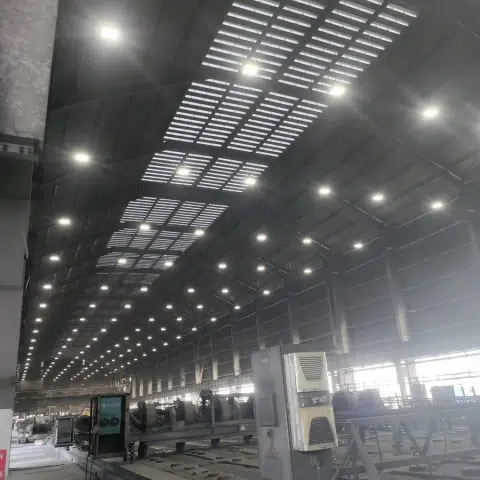
Because these lights are so similar, in this case, it’s more helpful to discuss them in terms of where they can commonly be found. A High Bay is a tall vertical ceiling space with a vast open area beneath it. Any light designed to be installed and illuminate this area is a “High Bay Fixture”. These are powerful lights, and wide beam angles make them perfect for illuminating high bay areas and providing uniform light distribution.

As far as the actual installation goes, the spacing of high bays must be equal to their mounting height. What this means is that at a 25-foot height, the light fixtures should be spaced 25 feet apart. Even so, a photometric study is an ideal way to determine the best layout for your space.

Low Bay Lights Basics

Now that you’re familiar with what high bays are, it’s time to look at their counterparts, low bay lighting. A low bay is a space where the ceiling is between 12 and 20 feet high. Typically, LED low bay lights used for short ceiling areas are between 10,000 and 20,000 lumens. Since they are mounted so much closer to the ground than high bays, they do not require a powerful LED light to properly illuminate the space. A low bay light fixture is designed to provide proper lighting in these spaces.

  • If you were to use a light with higher lumens, you’d likely find that the light would be much too bright in that space.
  • High bay and low bay lights look virtually identical when you look at them side by side. However, their applications are quite different. Height of installation, mounting, and beam angle are some of the key differences between high bay and low bay lighting.

UFO vs Linear Infographics

High Bay vs Low Bay Selector

Choose feet or meters: Leave blank if you just want bay type.
Note: Calculator results are estimates. Final fixture selection, spacing, and electrical work should be verified by a qualified professional and must comply with local codes and local government requirements. LED Lighting Supply provides free lighting plans to confirm fixture selection within your facility.

1. Height of Installation

Although we’ve already mentioned this a couple of times, it’s worth going over in detail because it is the most noticeable difference. For your lighting to correctly suit your space and do its job, noting the ceiling height is extremely important. Choosing the wrong type, whether it’s too powerful for a low ceiling or vice versa, will result in poor light distribution and an unworkable environment.

High Bays

LED High bays are specifically designed for spaces with ceilings anywhere from 20 to 40 feet high. To function properly, they are the more powerful versions of the bay fixtures we offer. On average, they produce between 15,000 and 60,000 lumens. High Bays can also be outfitted with optics if needed to ensure the light is directed to the floor, and not on the walls. These extra steps ensure that the fixture can evenly illuminate the space without wasting any shine.

Case Study: Replacement of 1500 Watt Metal Halide Lighting with 480 Watt LED UFO High Bays in Lagos, Nigeria

After: 480 Watt LED UFO High Bay Light | 76800 Lumens
After Picture

Lighting Plan We Created for the Customer

Lighting Plan

Heat Map

Lighting Plan Heat Map

Aircraft Hangar Lighting Installation Plan Metrics

Low Bays

Low bay lights are used when the ceiling is anywhere from 10 to 20 feet high. Because of this, low bay lights produce fewer lumens than high bays. Fewer lumens may seem like a bad thing, but if you installed a high bay light on a 15-foot ceiling, you would quickly discover that the light is way too bright and distributed extremely unevenly. Low bay lights are typically used in smaller commercial and industrial environments for both public and private use.

Case Study:Garage Shop Lighting with LED Lighting Supply 30 / 40 / 50 Watt Adjustable 4 Foot Shop Strip Light in Clarksville, TN

After: 30 / 40 / 50 Watt Adjustable 4 Foot Shop Strip Light | 4200 to 6500 Lumens After: 30 / 40 / 50 Watt Adjustable 4 Foot Shop Strip Light | 4200 to 6500 Lumens
After Picture After Picture

Lighting Plan We Created for the Customer

Lighting Plan
Lighting Plan

Garage Shop Lighting Installation Plan Metrics

2. Application

These lights are widely used in industrial and commercial spaces. These lights are hardy and virtually maintenance-free, making them a no-brainer for facility managers. But high bays and low bay lights have very different applications. To give you a general idea of what each light does best, we’ve listed some options.

High Bay Applications

Low Bay Applications

  • Warehouses
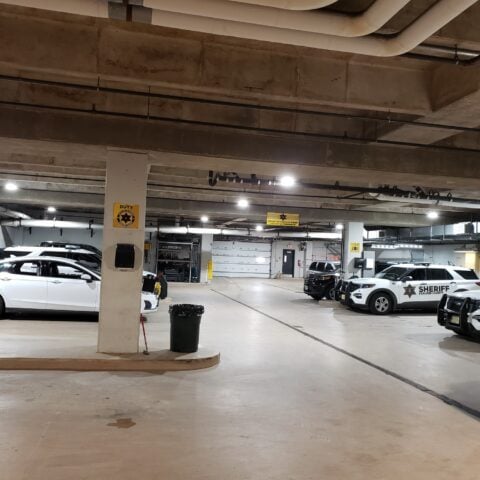
  • Parking Garages
  • Pole Barns
  • Loading Docks
  • Workshops: Use LED shop lights
  • Retail stores

Mllg Led Hbc 150 50 Fc Shop Lighting

3. Wattage and Power, and Lumen Output

The amount of power you use will vary greatly between high bay and low bay applications. Using a powerful fixture in a low-bay / low-ceiling application will make the lighting too bright. Not using a powerful bay fixture in a high bay application will have the reverse effect. The lighting will appear dim and underlit.

  • High bay wattages range from 150 to 200 Watts to replace 400-Watt Metal Halides, and 240 to 400 Watts to replace 1000-Watt Metal Halides.
  • Low bay wattages range from 80 to 150 watts. It’s almost harder to light up a lower ceiling application because light balance and shadow reduction are harder to solve.

High ceilings have the advantage of allowing light to be balanced more easily across a space. Many of the low bay and high bay lights we offer now have wattage-adjustable toggle switches that allow you to change the lumen output post installation.

Important: From our experience designing lighting layouts for warehouses, hangars, and manufacturing facilities, incorrect high bay and low bay selection is one of the most common causes of uneven illumination and excessive glare.

Mllg Led Hb3 200 50 Batting Cage

4. Beam Angles and Optic Options

Although it is often overlooked, choosing the ideal beam angle for your LED fixture is very important. This can be defined as the “width” of the light that is produced by the lamp and is measured in degrees. Note: LED Lights use optics to control beam angles, whereas old technology, like Metal Halide, uses reflectors to control beam angles. It is not common to find reflectors on an LED Indoor Fixture.

LED High Bay Lights’ beam angles are usually either 60, 90, or 120 degrees. This relatively narrow beam produces a highly concentrated shine. This is extremely important in high bay lighting because it ensures that the light doesn’t dissipate before it reaches the ground. Low bay LED Lights usually use a beam angle of 120 degrees. Facilities with lower roof heights benefit from wider beam angles since there is less space for the light to spread out and provide illumination.

Mllg Led Hbc 200 5 120 Joe Gibbs Racing Nascar

5. Mounting Options

Mounting methods apply more to the application of the light than the fixture, but there are still noteworthy distinctions between mounting high bay and low bay fixtures. Both fixtures can be suspended from chains or hooks, or they can be mounted directly to the ceiling. But their opposing settings play a huge role in determining how they are installed.

  • High bay fixtures can be hung from the ceiling using chains, pendants, hooks, or mounted directly. In addition to traditional mountings, high bay lights can also be used to provide lighting to vertical surfaces.
  • Low bays are a little less flexible. Since they are designed for spaces with lower ceilings, there is much less room for them to hang. Because of this, low bays are mounted as close to the ceiling as possible.

6. Input Voltage

In commercial and industrial spaces, the input voltage is typically much higher than what you see in a home residence. It is very common to see voltages up to 277 Volts in a commercial space and voltages up to 480 Volts in an industrial space. Standard voltage drivers on low bays and high bays are 100-277V. This means that any voltage between 100 and 277V will automatically be detected by the driver and adjusted without the need for conversion or set by the installer.

High-voltage drivers, available on some high and low bays, are offered in the range of 277-480V. They are also self-adjusting like the standard voltage drivers.

Lls X Hblin8 4 300 260 230 Cc

7. Color Temperature

Color Temperatures can vary significantly. The most common range of temperatures is between 2700K and 6500K. The lower the number, the more yellow the light (also described as warm lighting). The higher the number, the bluer the light is (also described as cool lighting). The most common low bay and high bay lighting temperatures are 4000K and 5000K.

Of those two, 5000K is the most commonly requested and purchased for commercial and industrial applications. Many of the fixtures we now offer are color-adjustable. This allows you to select the color temperature you want post-installation. If you are unsure of what color temperature to use, you may want to select a color-adjustable fixture that allows you to change the color temperature of the fixture post-install.

2700k 6500k Color Temperatures