


Flood Light Poles for Security and Area Lighting
- Poles engineered to withstand 130 mph winds with 50+ year lifespans
- Fiberglass and steel options resist corrosion, rot, and structural decay
- Calculate precise energy savings based on your current utility costs


Flood light poles are vertical mounting structures commonly installed in outdoor areas such as parking lots, sports courts, and industrial site perimeters. These poles are available in round or square profiles and are typically constructed from steel or fiberglass to match the demands of different environments. Anchor-based and direct burial options accommodate a range of soil conditions and installation preferences, supporting layouts that require elevated lighting fixtures across open lots, along drive lanes, or around facility boundaries.
This category features Commercial & Industrial Lighting Solutions for projects that call for durable pole-mounted lighting infrastructure. Flood light poles are frequently positioned throughout large exterior spaces, including service yards, recreational complexes, and building approaches, where consistent fixture placement and structural reliability are essential for site layouts.
Showing 1–12 of 25 results
 SKU:MLLG-WL-POLE-20-4RD-DB-BZ-TN | Web ID:2116Minimum Order: 2Minimum Order Total: $1,967.34Availability: 44 In Stock Ships 7-14 Days
- Height Above Grade (ft): 20
- Buried Depth Below Grade (ft): 5
- Pole Weight (lbs): 132
- Pole Color: Bronze
- Pole Gauge: 11
- Warranty: 1 year
Starting At$983.67

- SKU:LLS-LN-POLE-20FT-4.5-RD-BK | Web ID:2700Minimum Order: 2Minimum Order Total: $1,974.46Availability: 85 In Stock Ships 7-14 Days
- Pole Weight (lbs): 124
- Pole Color: Black
- Pole Gauge: 11
- Warranty: 1 year
Starting At$987.23 - SKU:MLLG-WL-POLE-20FT-4-SQ-[COLOR]-TN | Web ID:1912White:13 In StockShips 7-14 DaysBronze:341 In StockShips 7-14 Days
- Pole Weight (lbs): 169
- Pole Width (in): 4
- Pole Color: Bronze | White
- Pole Gauge: 11
- Warranty: 1 year
Starting At$773.47 - SKU:MLLG-WL-POLE-20FT-4-RD-BZ-TN | Web ID:1917Minimum Order: 2Minimum Order Total: $1,644.90Availability: 186 In Stock Ships 7-14 Days
- Pole Weight (lbs): 143
- Pole Color: Bronze
- Pole Gauge: 11
- Warranty: 1 year
Starting At$822.45 - SKU:MLLG-WG-POLE-CP-20-4SQ-DB | Web ID:2172Minimum Order: 4Minimum Order Total: $3,303.64Availability: 54 In Stock Ships 3-4 weeks
- Height Above Grade (ft): 20
- Buried Depth Below Grade (ft): 5
- Pole Weight (lbs): 68
- Pole Width (in): 4
- Pole Color: Bronze | Black | White | Gray | Custom
- Pole Gauge: .205 in
- Warranty: 7 years
Starting At$825.91
- SKU:MLLG-WG-POLE-CP-20-4SQ-AB | Web ID:2562Minimum Order: 4Minimum Order Total: $3,820.00Built to Order 5 Weeks
- Pole Weight (lbs): 52
- Pole Width (in): 4
- Pole Color: Bronze | Black | White | Gray | Custom
- Pole Gauge: .205 in
- Warranty: 7 years
Starting At$955.00 25 Foot Round Tapered Steel Light Pole | 6.5 Inch Base Diameter | Anchor Base | High Wind Zone Rated
SKU:MLLG-WL-POLE-25FT-65-TRD-BZ-T | Web ID:2170Minimum Order: 2Minimum Order Total: $2,016.00Availability: 19 In Stock Ships 7-14 Days- Pole Weight (lbs): 163
- Pole Color: Bronze
- Pole Gauge: 11
- Warranty: 1 year
Starting At$1,008.00- SKU:MLLG-WL-POLE-25FT-4-RD-BZ-TN | Web ID:1918Minimum Order: 2Minimum Order Total: $1,987.76Availability: 270 In Stock Ships 7-14 Days
- Pole Weight (lbs): 176
- Pole Color: Bronze
- Pole Gauge: 11
- Warranty: 1 year
Starting At$993.88 - SKU:MLLG-WL-POLE-25FT-4-SQ-[COLOR]-TN | Web ID:1916Bronze:247 In StockShips 7-14 DaysWhite:7 In StockShips 7-14 Days
- Pole Weight (lbs): 190
- Pole Width (in): 4
- Pole Color: Bronze | White
- Pole Gauge: 11
- Warranty: 1 year
Starting At$926.00 - SKU:MLLG-WG-POLE-CP-25-4SQ-DB | Web ID:2333Minimum Order: 4Minimum Order Total: $3,776.36Availability: 33 In Stock Ships 3-4 weeks
- Height Above Grade (ft): 25
- Buried Depth Below Grade (ft): 4.5
- Pole Weight (lbs): 80
- Pole Width (in): 4
- Pole Color: Bronze | Black | White | Gray | Custom
- Warranty: 7 years
Starting At$944.09 - SKU:MLLG-WG-POLE-CP-25-5SQ-AB | Web ID:2561Minimum Order: 4Minimum Order Total: $5,107.28Built to Order 5 Weeks
- Pole Weight (lbs): 103
- Pole Width (in): 5
- Pole Color: Bronze | Black | White | Gray | Custom
- Warranty: 7 years
Starting At$1,276.82 - SKU:LLS-WL-POLE-AM-25FT-5-RD-BZ-TN | Web ID:2673Minimum Order: 2Minimum Order Total: $3,105.46Availability: 23 In Stock Ships 7-14 Days
- Pole Weight (lbs): 136
- Pole Color: Bronze
- Pole Gauge: 0.255 in.
- Warranty: 1 year
Starting At$1,552.73



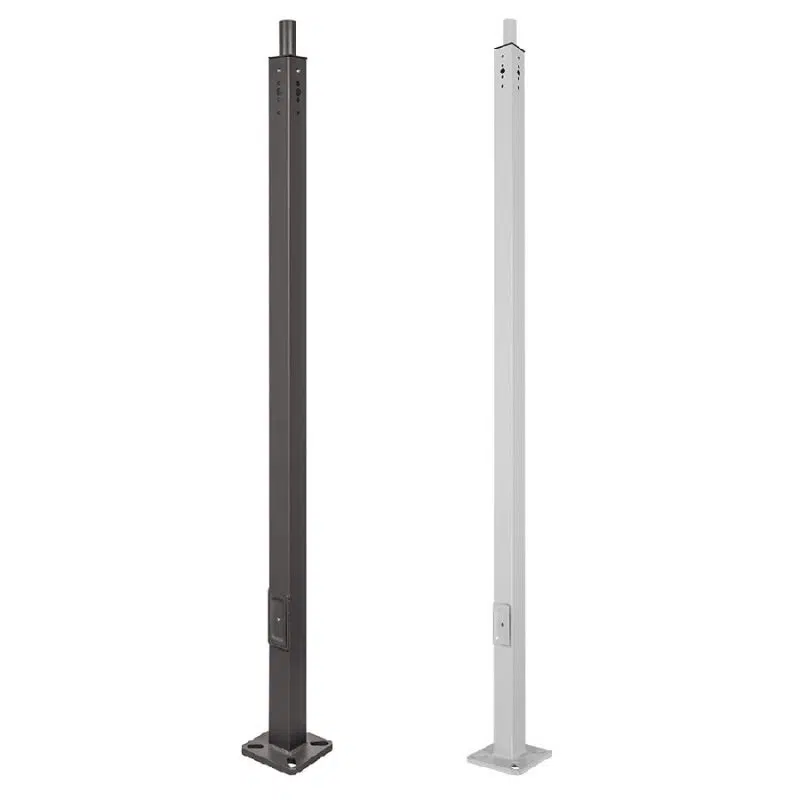




What Are LED Flood Light Poles?
LED flood light poles are vertical support structures designed to elevate area lighting fixtures for optimal coverage. With 15+ years in commercial lighting, we have seen these flood light pole solutions improve project outcomes through strong structural integrity and weather resistance. Commercial-grade flood light poles can withstand wind speeds up to 130 mph when properly specified, while maintaining fixture positioning for consistent illumination across large areas.
What Are the Different Types of Light Poles?
We offer commercial flood light poles in two main mounting configurations, each suited for specific soil conditions and installation needs.
What Are the Different Flood Light Pole Mounting Types?
- Anchor-based installations - These use concrete footings with embedded anchor bolts to secure the pole at ground level. This method provides strong stability in shifting soil and allows for future pole removal or replacement. Installation requires concrete curing time but offers enhanced performance in high-wind areas. Anchor-base mounting is typically recommended for permanent installations in unstable soil or extreme weather.
- Direct burial poles - These poles are embedded directly into excavated holes without concrete foundations or extra hardware. This cost-effective method reduces labor and material costs while providing adequate stability for most uses. Direct burial works best in stable soil and temporary projects where quick deployment is needed.
What Are the Different Flood Light Pole Material Types?
Material choice affects pole performance, lifespan, and maintenance. Customers select between two proven materials based on environment and project needs.
- Fiberglass light poles - Fiberglass poles offer resilience through hollow composite construction. They resist rot, rust, corrosion, and fire, and are lighter than steel. Fiberglass flexes under wind loads, making it ideal for hurricane-prone areas. Most installations see 50+ year lifespans subject to environmental conditions with minimal maintenance.
- Steel light poles - Steel poles provide robust support for parking lots, sports courts, and high-fixture-count projects. Available in heights from 10 feet to 30 feet, steel resists fire, pests, and decay. Use protective top caps to shield wiring and prevent moisture. Galvanized coating supports 25-year performance subject to environmental conditions in standard environments.
What Are the Different Flood Light Pole Shapes?
Pole shape affects wind resistance and aesthetics. Choose shape based on environment and architectural needs. There are several flood light pole types available to suit different project requirements.
What Are Round Flood Light Poles?
Cylindrical poles channel wind around their surface, reducing drag and stress in high-wind locations. The smooth profile integrates with commercial landscapes and provides good load distribution for multiple fixtures. Round poles are well-suited for coastal areas with consistent wind exposure.
What Are Square Flood Light Poles?
Square poles maximize rigidity and provide stable mounting for directional fixtures. Flat sides secure bracket hardware better than round poles, ensuring fixtures maintain aiming angles. Square geometry is best for multiple fixtures or heavy loads where stability is critical.
Proper Flood Light Pole Height Ranges & Suitable Projects
Height selection affects coverage, spacing, and light uniformity. Optimal spacing is typically 3-4 times the pole height, model dependent, for even illumination. Beam angle and fixture wattage should match flood light pole height for effective distribution.
Short Flood Light Poles
Poles between 10 to 20 feet are ideal for security lighting and small commercial parking areas. Lower heights work best with wide beam angle fixtures (120 to 140 degrees) to maximize coverage. Security camera integration often requires lower mounting for facial and vehicle identification.
Medium Flood Light Poles
Heights from 20 to 30 feet suit parking lots, recreational courts, and construction sites. This range balances coverage and installation complexity while keeping fixture costs reasonable. Adjustable brackets are important at these heights to fine-tune illumination and eliminate shadows.
Tall Flood Light Poles
Poles 30+ feet are used for stadiums, highways, and athletic fields. Narrow beam fixtures (60 to 90 degrees) project light over greater distances. Higher wattage fixtures, typically 400 watts to 1000 watts, are needed to maintain adequate light at ground level from these heights.
How Long Do Flood Light Poles Last?
Pole lifespan depends on material, environment, and maintenance. Fiberglass poles outperform steel in corrosive environments, delivering 50+ year lifespans subject to environmental conditions with minimal upkeep. Steel poles reach 25-year performance when properly maintained, though coastal areas may see shorter life due to salt. Regular inspection and coating maintenance extend pole life for any material.
Why Choose LED Lighting Supply for Your Flood Light Pole Project
Our certified lighting specialists offer complimentary custom lighting plans tailored to your facility's dimensions and needs. We calculate energy savings based on your current lighting costs and local utility rates, helping you understand the financial impact before purchase. Our team can also advise on flood light pole installation best practices to ensure long-term performance.
With over 15+ years of commercial lighting experience, our product specialists have specified flood light poles for thousands of parking lots, sports facilities, and industrial sites in diverse environments. You get direct access to technical support from experts who understand pole specifications, soil requirements, flood light pole base options, and local building codes (verify with local government authority), not generic customer service scripts.
Flood Light Poles for Security and Area Lighting Frequently Asked Questions
What Are LED Flood Light Poles?
LED flood light poles are vertical support structures that elevate area lighting fixtures for maximum coverage. Commercial-grade poles withstand wind speeds up to 130 mph when properly specified while maintaining precise fixture positioning across large areas.
What Are the Different Types of Light Poles?
Flood light poles are available in two mounting configurations: anchor-based installations using concrete footings with embedded anchor bolts, and direct burial poles that embed directly into excavated holes without concrete foundations.
What Are the Different Flood Light Pole Mounting Types?
Anchor-based installations provide superior stability in shifting soil conditions and high-wind environments. Direct burial poles reduce labor time and material costs, working best in stable soil conditions and temporary lighting projects.
What Are the Different Flood Light Pole Material Types?
Fiberglass poles resist rot, rust, corrosion, and fire with 50+ year lifespans subject to environmental conditions. Steel poles are available in heights from 10 feet to 30 feet with 25-year performance subject to environmental conditions when galvanized.
What Are the Different Flood Light Pole Shapes?
Round poles reduce drag and structural stress in high-wind locations by channeling wind flow around their surface. Square poles maximize structural rigidity and provide stable mounting surfaces for multiple fixtures or heavy fixture loads.
What Are Round Flood Light Poles?
Cylindrical poles channel wind flow around their surface, reducing drag in high-wind locations. Round poles work particularly well in coastal installations where consistent wind exposure demands aerodynamic design.
What Are Square Flood Light Poles?
Square profiles maximize structural rigidity and accommodate bracket hardware more securely than round poles. The flat sides ensure fixtures maintain precise aiming angles in applications requiring multiple fixtures or heavy fixture loads.
Proper Flood Light Pole Height Ranges & Suitable Projects
Optimal spacing ranges 3-4 times the pole height, model dependent, for uniform illumination. Beam angle and fixture wattage must complement pole height for effective light distribution.
Short Flood Light Poles
Poles between 10-20 feet excel in security lighting and smaller commercial parking areas. Lower mounting heights work best with wide beam angle fixtures (120-140 degrees) to maximize ground coverage.
Medium Flood Light Poles
Heights from 20 to 30 feet serve parking lots, recreational courts, and construction sites. Adjustable mounting brackets become critical at medium heights to fine-tune illumination patterns and eliminate shadows between poles.
Tall Flood Light Poles
Installations from 30+ feet address large-area lighting in stadiums, highways, and athletic fields. Higher wattage fixtures (400-1000 watts) with narrow beam angles (60-90 degrees) compensate for increased mounting height.
How Long Do Flood Light Poles Last?
Fiberglass poles deliver 50+ year lifespans subject to environmental conditions with minimal upkeep. Steel poles reach 25-year performance when properly maintained, though coastal installations may see reduced lifespans due to salt exposure.
Why Choose LED Lighting Supply for Your Flood Light Pole Project
Certified lighting specialists provide complimentary custom lighting plans designed for your facility's dimensions and usage requirements. Product specialists have 15+ years of commercial lighting experience specifying poles for parking lots, sports facilities, and industrial sites.