Understanding BAA and TAA Compliance for LED Lighting Projects
Disclaimer: This guide is for informational purposes only and does not constitute legal or procurement advice. Always consult your contracting officer or legal advisor for project-specific requirements.
When supplying LED lighting to federal, state, or municipal projects, compliance with domestic sourcing regulations is often mandatory. Two of the most commonly referenced regulations are the Buy American Act (BAA) and the Trade Agreements Act (TAA). While they are related, they are not the same, and misunderstanding the difference can delay approvals, disqualify bids, or expose the audit to risk.
At LED Lighting Supply, we work with contractors, procurement officers, and federal buyers to ensure lighting systems meet the appropriate compliance requirements. This guide explains what BAA and TAA are, how LED lighting products and poles qualify, and how government agencies determine which standard applies.
What Is the Buy American Act (BAA)?
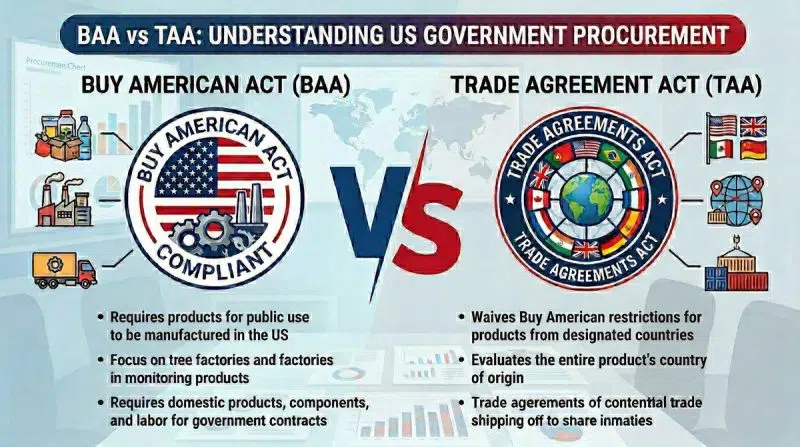
The Buy American Act (41 U.S.C. Chapter 83), enacted in 1933, requires that the U.S. federal government prefer domestically produced goods when purchasing supplies for public use, unless a specific exception applies.
BAA Core Requirements
For a manufactured product (such as an LED light fixture) to qualify as BAA compliant:
- The product must be manufactured in the United States
- A required percentage of the cost of components must be sourced from the United States
The required domestic content percentage has increased in recent years under updated federal acquisition rules. Because thresholds can change, projects should always reference the applicable Federal Acquisition Regulation (FAR) clause in the contract and verify the current requirements before procurement.
How an LED Light Can Qualify as BAA Compliant
An LED fixture may qualify as BAA compliant if:
- Final assembly occurs in the United States
- The required percentage of component cost is U.S.-sourced
- Documentation supports domestic manufacturing and component origin
For lighting products, components typically evaluated include housings, drivers, LED boards, wiring assemblies, optics, and mounting hardware. Proper documentation and supplier certifications are essential. Important: Simply being “assembled in the USA” does not automatically make a product BAA compliant. The domestic component cost threshold must also be satisfied.
Tip: Always request and review compliance documentation from your supplier before specifying or purchasing products.
What Is the Trade Agreements Act (TAA)?
The Trade Agreements Act of 1979 (19 U.S.C. §§ 2501-2581) governs federal purchases above certain dollar thresholds, particularly those made under GSA Schedules and large federal contracts. Unlike BAA, TAA does not require U.S. manufacturing. Instead, it requires that products be manufactured or “substantially transformed” in either:
- The United States, or
- A TAA-designated country
What Does “Substantial Transformation” Mean?
A product is considered compliant if it undergoes a substantial transformation in a TAA-designated country, meaning it becomes a new and different article of commerce with a new name, character, or use. For LED lighting, this may involve significant manufacturing processes such as LED board population, driver integration, thermal assembly, and final product configuration performed in a designated country.
Which Countries Qualify as TAA-Designated Countries?
TAA-designated countries generally fall into the following categories:
- World Trade Organization Government Procurement Agreement (WTO GPA) countries
- Free Trade Agreement (FTA) partner countries
- Least Developed Countries
- Caribbean Basin countries
Examples of TAA-designated countries include (but are not limited to):
- United States
- Canada
- Mexico
- United Kingdom
- Germany
- France
- Italy
- Japan
- South Korea
- Australia
- Spain
- Sweden
- Netherlands
China is not a TAA-designated country. Products manufactured or substantially transformed in China generally do not qualify as TAA-compliant. Because the designated country list and requirements can change based on trade agreements and policy updates, procurement teams should confirm current eligibility at the time of purchase.
Key Differences Between BAA and TAA
| Category | BAA | TAA |
|---|---|---|
| Primary Focus | Preference for U.S.-made goods | Allows products from designated trade partner countries |
| Manufacturing Location | Must be manufactured in the U.S. | U.S. or TAA-designated country |
| Component Cost Requirement | Yes (domestic content threshold applies) | No domestic content percentage requirement |
| Common Application | Federal agency purchases under certain thresholds | GSA Schedule contracts and larger federal procurements |
| China Eligibility | Generally not compliant | Not compliant |
Similarities Between BAA and TAA
- Both apply to U.S. federal government procurement.
- Both are enforced through Federal Acquisition Regulation (FAR) clauses.
- Both require accurate country-of-origin documentation.
- Both can impact project eligibility, audits, and contract compliance.
Can a Government Agency Accept TAA Products Instead of BAA?
The answer depends on the contract structure and the applicable FAR clauses.
- If a contract specifically requires BAA compliance, a product must meet BAA requirements. TAA compliance alone is not automatically sufficient.
- If the procurement falls under a TAA-covered acquisition (such as many GSA Schedule contracts above threshold values), then TAA compliance applies instead of BAA.
In other words, TAA does not automatically replace BAA. The governing contract language determines which rule applies. Because requirements vary by agency, contract vehicle, and dollar threshold, procurement officers should confirm compliance requirements before specifying products.
Note: Non-compliance can result in bid disqualification, funding delays, or contract penalties.
How We Support BAA and TAA Projects
To simplify procurement for federal, state, and municipal buyers, we clearly label qualifying products on our website as BAA-compliant or TAA-compliant where applicable. This allows contractors, purchasing agents, and government agencies to quickly identify products that align with contract requirements before entering the submittal and approval process.
For projects requiring compliance verification, we:
- Coordinate directly with our OEM manufacturing partners to obtain the required BAA or TAA documentation
- Provide formal compliance statements and supporting certifications
- Supply country-of-origin information for technical submittals
- Assist contractors and procurement teams during compliance reviews
- Review project specifications and applicable FAR clauses before bid submission when requested
Because BAA and TAA requirements are driven by specific contract language, confirming compliance before procurement helps reduce approval delays, audit exposure, and funding risk.
BAA and TAA compliance are not marketing designations. They are contractual obligations tied to federal acquisition regulations. Accurate documentation must originate from the manufacturer and align with the governing contract language.
If you are specifying lighting for a federally funded project and require BAA or TAA documentation, our team can help coordinate the necessary information to support your procurement process.
BAA and TAA compliance are contractual obligations tied to federal acquisition regulations. If you are specifying lighting or poles for a federal, state, or municipal project and need assistance confirming requirements or documentation, our team can help ensure the selected product aligns with the applicable standards.
Compliance is not just a checkbox. It is a contractual obligation that can affect funding eligibility and payment approvals. Our team helps customers reduce risk by ensuring the selected lighting solution aligns with the project’s regulatory requirements.
Contact us if you need assistance reviewing compliance documentation or selecting BAA/TAA-compliant lighting for your project.
Safety and Performance Certifications
For government and commercial projects alike, compliance with sourcing regulations is only part of the evaluation process. LED lighting products should also meet applicable safety and performance standards such as UL, ETL, DLC, or other recognized certifications, depending on the application. These certifications help verify electrical safety, photometric performance, and operational reliability. When specifying lighting for hazardous locations, industrial facilities, or public infrastructure, confirming both regulatory compliance (BAA/TAA) and third-party safety certifications is essential for risk mitigation and long-term performance.
Warranty and Warranty Support
Warranty protection is especially important in government-funded projects where long service life and maintenance cost control are critical. Many professional-grade LED fixtures include multi-year manufacturer warranties covering defects in materials and workmanship. Beyond the written warranty, responsive technical support and replacement logistics are equally important. Working with a knowledgeable lighting partner helps ensure that warranty claims, documentation requests (including compliance records), and replacement coordination are handled efficiently throughout the project lifecycle.
Final Considerations
BAA and TAA compliance requirements continue to evolve as federal sourcing policies change. Because lighting systems represent a permanent infrastructure investment, verifying compliance before procurement is essential. If you are specifying lighting for a federal or publicly funded project and need clarification on BAA or TAA requirements, our team can help you review available options and supporting documentation to reduce compliance risk.